Sovereignty Module: Bank the Fire
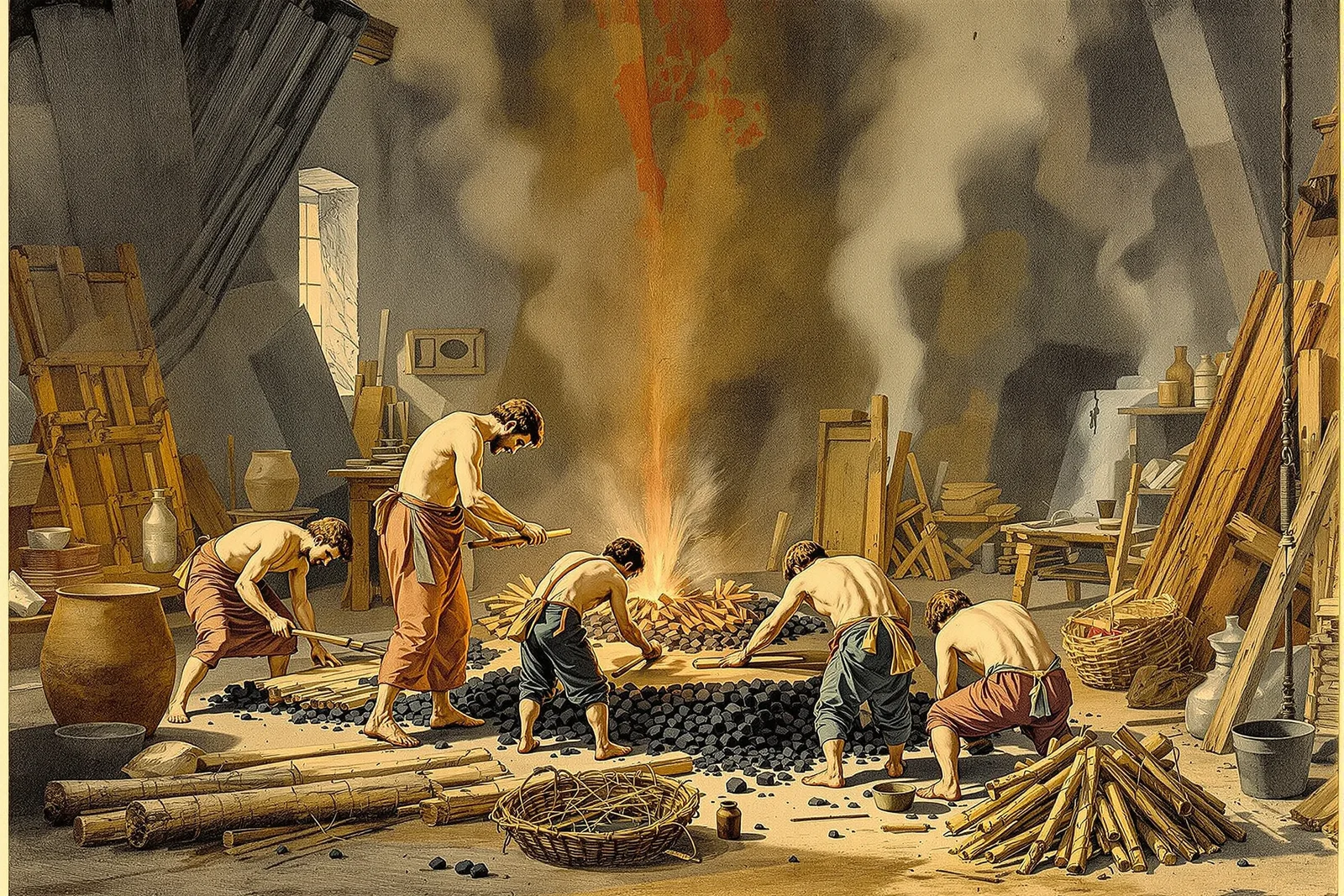
Complete Charcoal and Fuel Production: From Wood to Carbon
Charcoal burns hotter and cleaner than wood, enabling metalworking, water filtration, medicine, and efficient cooking. This campaign covers charcoal making, fuel types, kiln construction, and activated charcoal.
Chapter 1: Fuel Comparison
| Fuel | Heat (BTU/lb) | Burn Temp | Smoke | Availability | Renewability | Best Use |
|---|---|---|---|---|---|---|
| Green wood | 4,000-5,000 | 1,100°F | Heavy | Abundant | Renewable | Emergency only |
| Seasoned wood | 6,000-8,000 | 1,200°F | Moderate | Abundant | Renewable | Cooking, heating |
| Charcoal (wood) | 12,000-13,000 | 2,000°F+ | Very low | Made from wood | Renewable | Metalworking, cooking |
| Coal (mineral) | 10,000-14,000 | 2,500°F+ | Heavy (sulfur) | Mined | Non-renewable | Industry, heating |
| Coke (processed coal) | 12,000-14,000 | 2,800°F+ | Low | Processed from coal | Non-renewable | Steelmaking |
| Peat | 3,000-5,000 | 900°F | Moderate | Bogs/wetlands | Slowly renewable | Heating |
| Dried dung | 2,500-3,500 | 800°F | Moderate-heavy | Animal waste | Renewable | Cooking (arid regions) |
| Biogas (methane) | ~1,000 BTU/cu ft | 3,600°F | None | Anaerobic digestion | Renewable | Cooking, lighting |
Chapter 2: Charcoal Making Methods
| Method | Yield | Quality | Time | Scale | Difficulty |
|---|---|---|---|---|---|
| Pit method | 15-25% | Moderate | 24-72 hours | Small-medium | Low |
| Mound/clamp | 20-30% | Good | 3-7 days | Medium-large | Moderate |
| Retort (drum) | 30-40% | Very good | 4-8 hours | Small | Moderate |
| Brick kiln | 25-35% | Good | 2-5 days | Medium-large | Moderate (build once) |
| TLUD (top-lit updraft) | 25-35% | Good | 1-3 hours | Very small | Low |
Retort method (most efficient small-scale): 1) Get two steel drums (55-gallon). 2) Inner drum: fill with wood pieces (2-4 inch diameter, cut to fit). 3) Seal inner drum (leave small vent hole). 4) Place inner drum inside outer drum. 5) Build fire in space between drums (or under outer drum). 6) Heat drives gases out of wood through vent hole. 7) These gases ignite and help heat the process (self-fueling). 8) When no more gas comes from vent: charcoal is done. 9) Seal vent hole. 10) Let cool completely before opening (24 hours — oxygen = fire). 11) Yield: 30-40% by weight (best of any simple method).
Pit method (simplest): 1) Dig pit (3-4 ft deep, 4-6 ft diameter). 2) Fill with dry hardwood (split to 3-4 inch diameter). 3) Light fire on top. 4) When burning well, cover with green branches. 5) Cover with soil (6-8 inches — seal from air). 6) Leave small vent holes (control burn rate). 7) Monitor: smoke should be thin and blue (thick white = too much air). 8) Adjust vents to control. 9) When smoke stops: seal all vents completely. 10) Wait 24-48 hours (must cool completely). 11) Dig out charcoal carefully. 12) Yield: 15-25% (lower than retort but no equipment needed).
Chapter 3: Wood Selection
| Wood Type | Charcoal Quality | Burn Time | Heat Output | Density | Best For |
|---|---|---|---|---|---|
| Oak (white/red) | Excellent | Long | Very high | Very dense | Blacksmithing, long cooking |
| Maple (hard) | Excellent | Long | Very high | Very dense | Blacksmithing |
| Hickory | Excellent | Very long | Very high | Very dense | Blacksmithing, grilling |
| Beech | Very good | Long | High | Dense | General use |
| Birch | Good | Moderate | Moderate | Medium | Quick-start charcoal |
| Pine/softwood | Poor | Short | Low | Light | Firestarters only |
| Willow | Moderate | Short | Moderate | Light | Gunpowder charcoal |
| Alder | Good | Moderate | Moderate | Medium | Smoking food |
Chapter 4: Activated Charcoal
| Property | Regular Charcoal | Activated Charcoal | Difference |
|---|---|---|---|
| Surface area | 10-50 m²/g | 500-2,000 m²/g | 10-100x more |
| Adsorption | Low | Very high | Activated traps chemicals |
| Porosity | Low-moderate | Very high | Microscopic pores |
| Production | Simple heating | Chemical or steam activation | Additional processing step |
| Uses | Fuel, filtration (basic) | Water purification, poison treatment, air filtration | Medical and industrial |
Steam activation method: 1) Make regular charcoal first (any method). 2) Crush to small pieces (pea-sized or smaller). 3) Place in metal container with perforated bottom. 4) Heat to 1,100-1,650°F (cherry red to bright orange). 5) Inject steam through charcoal (steam from boiling water piped in). 6) Steam reacts with carbon, creating microscopic pores. 7) Continue for 1-3 hours. 8) Cool without air exposure. 9) Result: activated charcoal with vastly increased surface area. 10) Test: activated charcoal removes color from water (regular charcoal does not, or poorly).
Chemical activation (simpler): 1) Soak raw wood in calcium chloride or zinc chloride solution (24 hours). 2) Dry partially. 3) Carbonize at 900-1,100°F in sealed container. 4) Wash thoroughly with water (remove chemicals). 5) Dry completely. 6) Result: activated charcoal (lower quality than steam method but easier).
Chapter 5: Applications
| Application | Charcoal Type | Amount | Method | Effectiveness |
|---|---|---|---|---|
| Water filtration | Activated (best) or regular | 1-5 lbs per filter | Layer in filter column | Removes chemicals, taste, odor |
| Poison treatment | Activated only | 1-2 g/kg body weight | Mix with water, drink | Adsorbs many poisons |
| Soil amendment (biochar) | Regular (crushed) | 5-10% by volume | Mix into soil | Improves water retention, biology |
| Air filtration | Activated | Variable | Pack in filter housing | Removes odors, chemicals |
| Blacksmithing fuel | Regular (hardwood) | Continuous supply | Burn in forge | Reaches welding temperature |
| Gunpowder ingredient | Willow charcoal | 15% of mixture | Grind very fine, mix | Fuel component |
| Drawing/art | Vine or willow | Sticks | Burn in sealed tube | Drawing medium |
| Tooth cleaning | Activated (fine powder) | Pinch | Brush on teeth | Whitens, cleans |
Reference Card
- Seal from air or it's ash (charcoal making = heating wood without oxygen; air turns it to ash). 2. Hardwood makes best charcoal (oak, maple, hickory — dense wood = dense, long-burning charcoal). 3. Retort is most efficient (30-40% yield vs 15-25% for pit — worth building the equipment). 4. Cool completely before opening (opening hot charcoal to air = instant fire — wait 24 hours minimum). 5. Activated charcoal saves lives (adsorbs poisons in stomach — every household should have some). 6. Biochar improves soil permanently (charcoal in soil lasts centuries, improves water retention and biology). 7. Blue smoke means good burn (thin blue smoke = proper carbonization; white smoke = too much air). 8. Charcoal enables metalworking (wood fire maxes at 1,200°F; charcoal reaches 2,000°F+ — necessary for forging).