Sovereignty Module: Keep the Hive
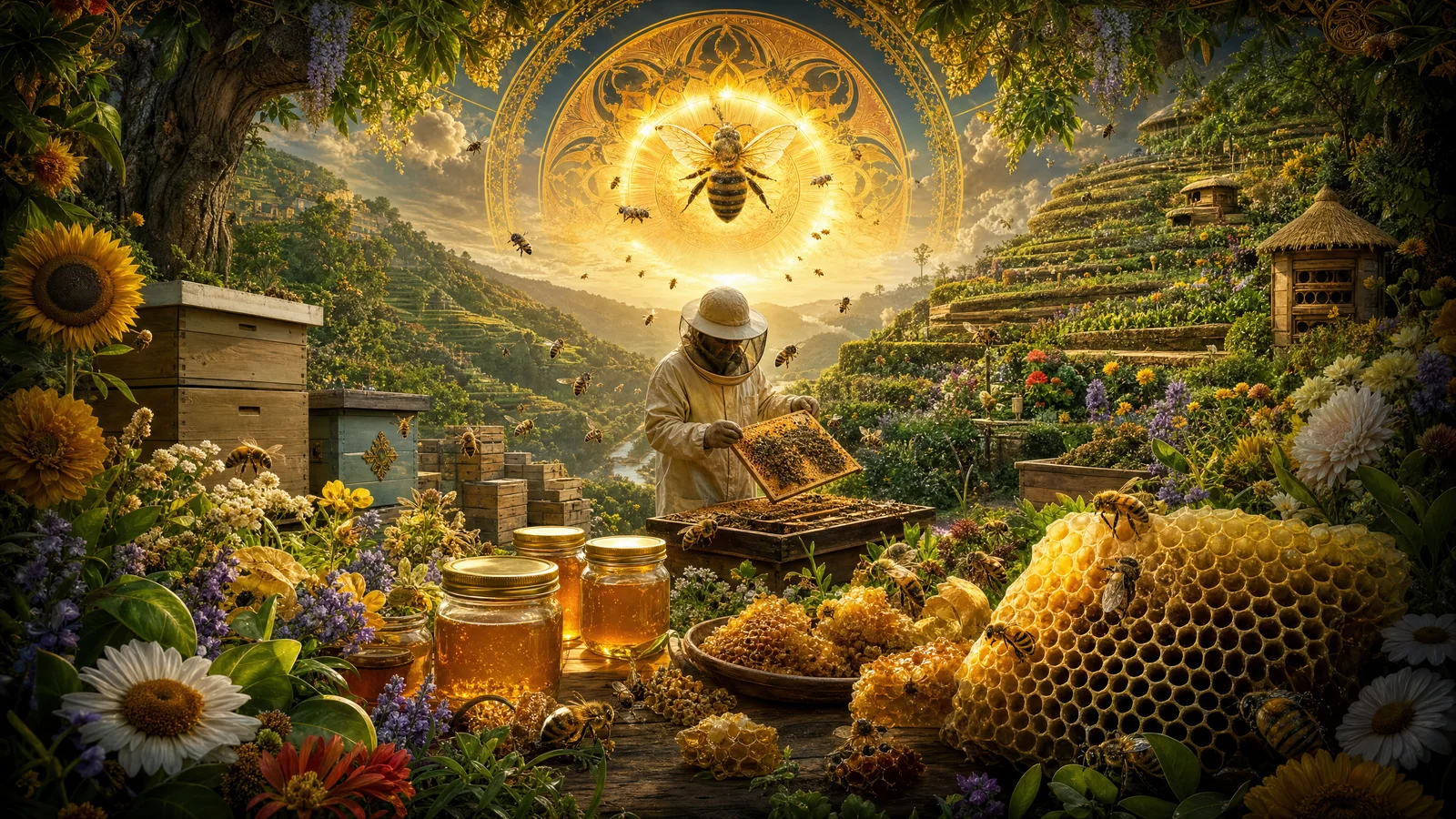
Complete Beekeeping, Honey Production, and Pollination Management Guide
The Philosophy of the Hive
Bees are the keystone of agriculture. One third of all food crops depend on insect pollination, and honeybees are the primary pollinator for most of them. A single hive pollinates millions of flowers per season, dramatically increasing yields of fruits, vegetables, and seeds within a two-mile radius. Beyond pollination, bees produce honey (a perfect food that never spoils), beeswax (for candles, waterproofing, and medicine), propolis (a powerful antimicrobial), and royal jelly. This campaign provides the complete knowledge to establish, manage, and multiply bee colonies for perpetual food security.
Chapter 1: Bee Biology
The Colony as Superorganism:
A honeybee colony is not a collection of individuals but a single superorganism with approximately 60,000 members functioning as one entity. Understanding colony biology is essential for successful management.
| Caste | Number | Lifespan | Role |
|---|---|---|---|
| Queen | 1 per colony | 2-5 years | Lays all eggs (up to 2,000/day at peak). Produces pheromones that unify the colony. |
| Workers (female) | 20,000-60,000 | 6 weeks (summer), 4-6 months (winter) | All labor: nursing, building, foraging, guarding, temperature control |
| Drones (male) | 0-2,000 (seasonal) | 3-4 months | Mate with queens from other colonies. Expelled before winter. |
Worker Bee Age-Based Tasks:
| Age (days) | Task | Details |
|---|---|---|
| 1-3 | Cell cleaning | Prepares cells for new eggs |
| 3-6 | Nurse bee | Feeds larvae royal jelly, then pollen/honey mixture |
| 6-12 | Wax production | Secretes wax scales, builds comb |
| 12-18 | Honey processing | Receives nectar from foragers, ripens into honey |
| 18-21 | Guard duty | Inspects returning bees, repels intruders |
| 21+ | Forager | Collects nectar, pollen, water, and propolis |
The Annual Cycle:
| Season | Colony Activity | Beekeeper Action |
|---|---|---|
| Late winter | Queen begins laying, cluster expands | Check food stores, feed if light |
| Spring | Rapid buildup, swarming impulse | Add supers, manage swarm prevention |
| Early summer | Peak population, maximum foraging | Harvest surplus honey, split strong hives |
| Late summer | Population declines, drones expelled | Assess winter stores, treat for mites |
| Fall | Colony contracts, winter bees raised | Feed if needed, reduce entrances, insulate |
| Winter | Cluster forms, minimal activity | Leave alone, check weight occasionally |
Chapter 2: Hive Types and Construction
The Langstroth Hive (standard movable-frame):
The most common hive worldwide. Rectangular boxes with removable frames that allow inspection, management, and honey harvest without destroying comb.
| Component | Dimensions (inches) | Purpose |
|---|---|---|
| Bottom board | 16.25 x 22 | Floor of hive, includes entrance |
| Deep box (brood) | 16.25 x 19.875 x 9.625 | Houses brood nest (eggs, larvae, pollen) |
| Medium super (honey) | 16.25 x 19.875 x 6.625 | Honey storage (lighter to lift when full) |
| Frames (10 per box) | 19 x 9.125 (deep) or 19 x 6.25 (medium) | Hold wax comb |
| Inner cover | 16.25 x 20 | Insulation, ventilation |
| Outer cover (telescoping) | 16.75 x 22.25 | Weather protection |
| Queen excluder | 16.25 x 20 (wire grid) | Keeps queen in brood box, workers pass through |
The Top-Bar Hive (simplest to build):
A horizontal trough with bars across the top from which bees build natural comb downward. No frames, no foundation, no expensive equipment. Ideal for communities without access to manufactured beekeeping supplies.
Construction: A trapezoidal trough (wider at top, narrower at bottom, approximately 36-48 inches long, 12-14 inches deep). Top bars are 1.25 inches wide (matching natural bee space). Bees build comb hanging from each bar.
Advantages: Cheap to build from any lumber, no foundation needed, natural comb, easy inspection (lift one bar at a time), no heavy lifting.
Disadvantages: Cannot stack for expansion, honey harvest destroys comb (bees must rebuild), less honey production than Langstroth.
The Warre Hive (vertical top-bar):
Square boxes stacked vertically, with top bars instead of frames. New boxes are added to the BOTTOM (not top), mimicking the natural downward building pattern of wild colonies. Minimal intervention philosophy.
Chapter 3: Obtaining Bees
Methods of Acquiring Colonies:
| Method | Cost | Difficulty | Best For |
|---|---|---|---|
| Package bees (3 lbs + queen) | Moderate | Easy | Beginners, starting from scratch |
| Nucleus colony (nuc, 5 frames) | Moderate-high | Easy | Fastest start, already established |
| Catching a swarm | Free | Moderate | Experienced beekeepers, free bees |
| Bait hive/trap | Free (materials only) | Moderate | Passive acquisition, locally adapted bees |
| Colony split | Free (from existing hive) | Moderate | Expanding an existing apiary |
| Cutout (removing wild colony) | Free or paid | Difficult | Rescuing bees from structures |
Swarm Catching:
Swarms are clusters of bees (with a queen) that have left their parent colony to establish a new home. They are generally docile (gorged with honey, no home to defend) and easy to capture.
Equipment needed: A box or bucket, a white sheet, a bee brush or large feather, and a ladder (if swarm is elevated).
Method: Place the box beneath the swarm. Give the branch a sharp shake (bees fall into box). If the queen is in the box, remaining bees will march in. Set box near the swarm location with entrance open until evening, then move to permanent hive location after dark.
Bait Hive Construction:
A bait hive attracts passing swarms to move in voluntarily. Place at 8-15 feet elevation, facing south, with a 1.5 square inch entrance. Interior volume: approximately 40 liters (one deep Langstroth box). Bait with old dark comb (if available) and lemongrass oil (mimics queen pheromone). Success rate: 50-80% during swarm season if placed in a good location.
Chapter 4: Hive Management
Inspections:
Inspect every 7-14 days during active season (spring through fall). Each inspection should answer:
- Is the queen present and laying? (Look for eggs: tiny white grains standing upright in cells)
- Is the brood pattern healthy? (Solid pattern of capped brood = healthy queen)
- Is there enough room? (If 80%+ of frames are full, add a box)
- Are there signs of disease or pests? (Unusual brood patterns, dead larvae, mites)
- Is the temperament acceptable? (Excessive aggression may indicate queenlessness)
Swarm Prevention:
Swarming is the colony's natural reproduction method, but it costs the beekeeper half their bees and most of the season's honey crop. Prevention methods:
| Method | How | Effectiveness |
|---|---|---|
| Add space early | Add supers before the colony fills existing boxes | High (addresses congestion) |
| Checkerboard | Alternate empty and full frames in honey supers | Moderate |
| Split the colony | Remove frames of brood + bees to start new colony | Very high (removes swarming impulse) |
| Remove queen cells | Destroy swarm cells (peanut-shaped cells on frame bottoms) | Temporary (they rebuild in days) |
| Young queen | Requeen annually (young queens swarm less) | Moderate |
Feeding:
Feed when natural forage is insufficient (early spring before flowers bloom, or fall if stores are light).
| Feed Type | Recipe | When to Use |
|---|---|---|
| Sugar syrup (1:1) | 1 lb sugar : 1 lb water | Spring stimulation (mimics nectar flow) |
| Sugar syrup (2:1) | 2 lbs sugar : 1 lb water | Fall feeding (thicker, stored as winter food) |
| Pollen substitute | Commercial patty or soy flour/brewer's yeast mix | Early spring when no natural pollen available |
| Fondant/candy board | Cooked sugar (candy consistency) | Emergency winter feeding |
| Dry sugar | Granulated sugar on paper above frames | Emergency winter feeding (simplest) |
Chapter 5: Honey Harvest
When to Harvest:
Harvest only SURPLUS honey (what the colony does not need for winter). A colony needs 60-90 pounds of honey to survive winter (varies by climate). Harvest only what exceeds this amount.
Honey is ready when cells are capped with white wax (indicating moisture content below 18.6%, the threshold for preservation). Never harvest uncapped honey (it will ferment).
Harvest Methods:
| Method | Equipment | Best For |
|---|---|---|
| Crush and strain | Bucket, strainer, potato masher | Top-bar hives, small scale, no equipment |
| Cut comb | Knife, containers | Selling comb honey, minimal processing |
| Extractor (centrifugal) | Extractor, uncapping knife/fork | Langstroth hives, large scale, preserves comb |
| Escape board | One-way bee escape | Clearing bees from supers without brushing |
Crush and Strain Method (simplest):
- Remove frames/bars of capped honey from hive
- Cut comb from frames into a bucket
- Crush comb thoroughly with hands or potato masher
- Pour crushed comb into a strainer (paint strainer bag works well) over a clean bucket
- Let gravity drain honey through strainer (12-24 hours)
- Bottle honey from the collection bucket
- Render the leftover wax (melt in water, strain, cool; wax floats to top)
Yield Expectations:
| Hive Type | First Year | Established Colony (good year) | Notes |
|---|---|---|---|
| Langstroth | 0-30 lbs | 30-100+ lbs surplus | First year: colony building, little surplus |
| Top-bar | 0-20 lbs | 20-50 lbs surplus | Lower yields but simpler management |
| Warre | 0-20 lbs | 20-60 lbs surplus | Minimal intervention approach |
Chapter 6: Bee Health and Disease Management
Varroa Mites (the primary threat):
Varroa destructor is a parasitic mite that feeds on bee fat bodies and transmits viruses. Without management, varroa kills most colonies within 1-3 years.
| Treatment | Type | When to Apply | Effectiveness |
|---|---|---|---|
| Oxalic acid (vaporization) | Organic acid | Broodless period (late fall/winter) | 90-95% kill of phoretic mites |
| Oxalic acid (dribble) | Organic acid | Broodless period | 80-90% |
| Formic acid (MAQS) | Organic acid | Summer (kills mites in brood) | 85-95% |
| Thymol (Apiguard) | Essential oil | Late summer, above 60F | 75-85% |
| Drone comb trapping | Mechanical | Spring/summer | 30-50% (supplemental) |
| Powdered sugar dusting | Mechanical | Any time | 10-30% (supplemental only) |
| Brood break (caging queen) | Mechanical | Summer | 80-90% (combined with oxalic acid) |
Monitoring Mite Levels:
Alcohol wash or sugar shake: Collect 300 bees (half cup) from a brood frame. Wash in alcohol or shake in powdered sugar. Count dislodged mites. Treatment threshold: 3+ mites per 100 bees (summer) or 2+ mites per 100 bees (fall).
Common Diseases:
| Disease | Cause | Symptoms | Treatment |
|---|---|---|---|
| American Foulbrood (AFB) | Bacteria (Paenibacillus larvae) | Sunken, perforated cappings; ropy dead larvae; foul smell | BURN THE HIVE (no cure; highly contagious) |
| European Foulbrood (EFB) | Bacteria (Melissococcus plutonius) | Twisted, discolored larvae; sour smell | Requeen (hygienic stock); may resolve naturally |
| Nosema | Fungus (Nosema ceranae) | Dysentery, reduced lifespan, poor buildup | Good ventilation, strong colonies, fumagillin |
| Chalkbrood | Fungus (Ascosphaera apis) | White/grey mummified larvae | Requeen, improve ventilation, usually self-resolving |
| Small hive beetle | Beetle (Aethina tumida) | Larvae tunnel through comb, slime | Traps, strong colonies, reduce excess space |
Chapter 7: Hive Products Beyond Honey
Beeswax:
Produced by worker bees from glands on their abdomen. Used for: candles (brightest, cleanest burning), waterproofing (leather, canvas, wood), cosmetics (lip balm, lotion), food preservation (wax wraps), grafting compound, and furniture polish.
Rendering: Melt cappings/old comb in water (double boiler or solar wax melter). Strain through cloth. Wax solidifies on top of water when cooled. Remelt and pour into molds.
Yield: Approximately 1-2 pounds of wax per 100 pounds of honey harvested.
Propolis:
A resinous substance collected from tree buds, used by bees to seal cracks and sanitize the hive. Powerful antimicrobial, antiviral, and antifungal properties.
Collection: Scrape from hive bodies and frames, or use propolis traps (flexible plastic grids that bees fill with propolis).
Uses: Tincture (dissolve in alcohol) for sore throats, wound healing, and immune support. Salve for skin conditions. Varnish for wood instruments.
Pollen:
Collected by foraging bees and packed into cells as protein food for larvae. Can be harvested using pollen traps (grids at hive entrance that scrape pollen from returning bees' legs).
Nutritional value: 20-35% protein, rich in vitamins, minerals, and enzymes. Used as human food supplement.
Caution: Harvest pollen only from strong colonies with abundant forage. Never take more than 10-20% of incoming pollen (the colony needs the rest).
Chapter 8: Colony Multiplication
Making Splits (artificial swarming):
The primary method of increasing colony numbers without purchasing new bees.
Simple split method:
- Find a strong colony with 8+ frames of brood
- Move 3-4 frames of brood (with adhering bees) into a new hive box
- Ensure the new box has frames with eggs (so bees can raise a new queen)
- Add frames of honey/pollen for food
- Move the new box to a different location (2+ miles away, or foragers return to parent)
- The queenless half raises a new queen from young larvae (takes 16 days to emerge, plus 2-3 weeks to mate and begin laying)
Queen Rearing (advanced):
For communities needing many queens (to requeen colonies or make many splits):
Grafting method: Transfer 12-24 hour old larvae from your best colony into artificial queen cups. Place in a strong, queenless colony (the "cell builder"). Bees raise these larvae as queens. After 10 days, place sealed queen cells into mating nucs (small colonies). Queens emerge, mate, and begin laying within 2-3 weeks.
Chapter 9: Apiary Layout and Management
Site Selection:
| Factor | Ideal | Why |
|---|---|---|
| Sun exposure | Morning sun, afternoon shade | Early warmth encourages foraging; shade prevents overheating |
| Wind protection | Windbreak on north/west sides | Reduces winter heat loss |
| Water source | Within 1/4 mile | Bees need water daily; provide if none nearby |
| Forage | Diverse flowers within 2 miles | More forage = more honey |
| Access | Vehicle access for heavy supers | Honey supers weigh 30-60 lbs each |
| Flooding | Above flood level | Hives must stay dry |
| Human activity | Away from paths, livestock, neighbors | Reduces stinging incidents |
Hive Spacing: Minimum 3 feet between hives, entrances facing different directions or staggered to reduce drifting (bees entering wrong hive).
Number of Hives: Start with 2 (minimum). If one colony fails, the other provides resources for recovery. For a family's pollination and honey needs: 2-4 hives. For community supply: 10-20+ hives.
Chapter 10: Seasonal Calendar
| Month | Northern Hemisphere Action |
|---|---|
| January | Monitor weight (heft test). Emergency feed if light. Order equipment. |
| February | Check for early buildup. Feed pollen substitute if needed. |
| March | First inspection when temps reach 55F+. Assess queen, food, population. |
| April | Add supers as needed. Swarm management begins. Make splits. |
| May | Peak swarm season. Weekly inspections. Add supers generously. |
| June | Main honey flow (varies by region). Monitor space. |
| July | Harvest spring honey (if surplus). Continue monitoring. |
| August | Assess winter stores. Begin mite treatments. |
| September | Complete mite treatment. Feed 2:1 syrup if stores are light. |
| October | Reduce entrances (mouse guards). Final inspection. |
| November | Insulate if in cold climate. Leave bees alone. |
| December | Monitor weight. Do not open hives. Plan for next year. |
Reference Card
THE BEEKEEPER'S GOLDEN RULES:
- Never harvest more honey than the colony can spare (60-90 lbs needed for winter)
- Monitor and manage varroa mites (the number one killer of colonies)
- Provide space before the colony needs it (prevents swarming)
- Requeen aggressive colonies (genetics determine temperament)
- Keep strong colonies strong (combine weak colonies rather than nursing them)
- Two hives minimum (one can rescue the other)
- Local bees are best (adapted to your climate and flora)
- Observe more than you intervene (bees have managed themselves for millions of years)
This campaign provides the complete knowledge to establish and maintain honeybee colonies for pollination, honey, wax, and colony multiplication. A community with healthy hives has dramatically increased crop yields, a perpetual source of sweetener and preservative, and the raw materials for candles, medicine, and waterproofing.