Campaign 116: Master the Current
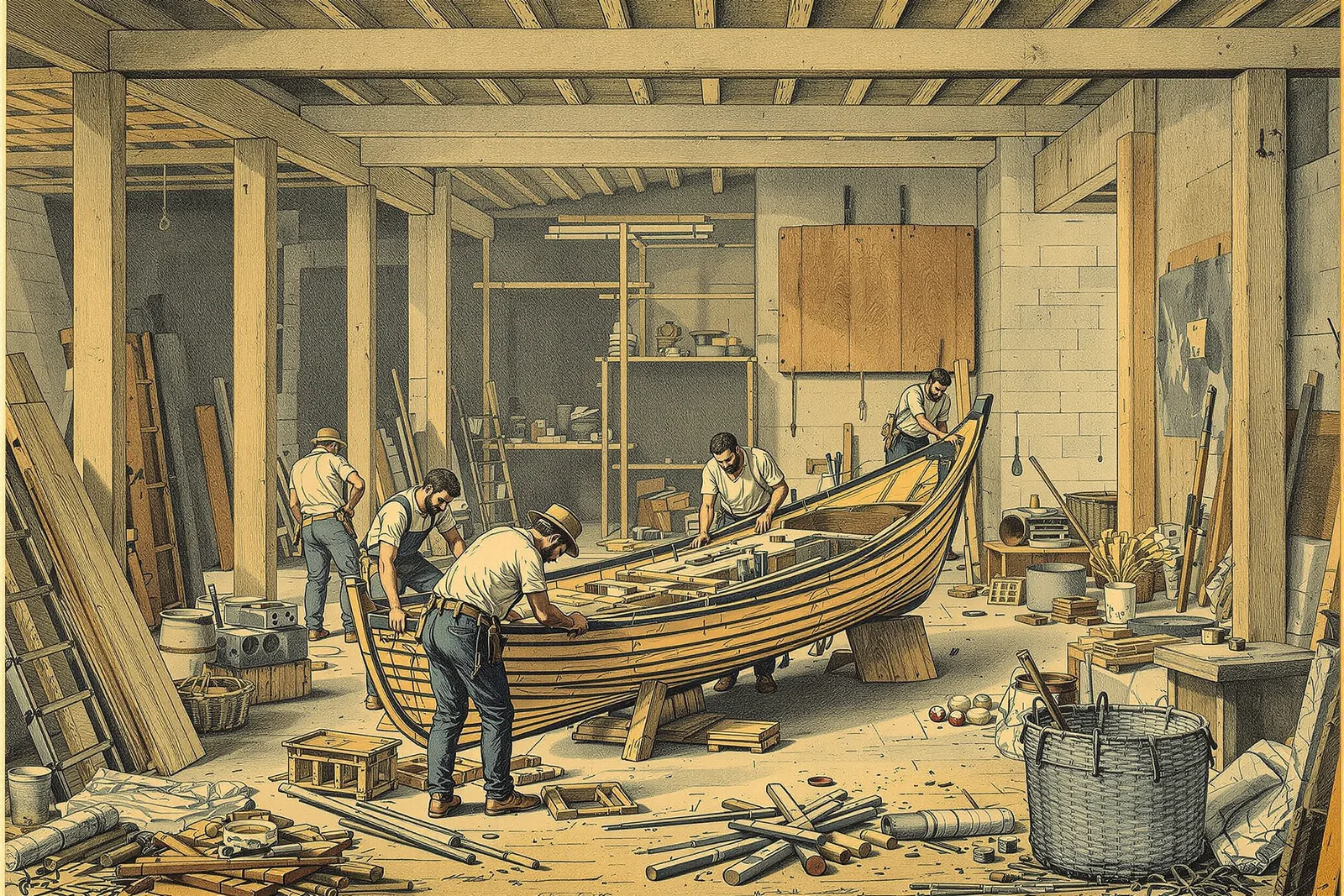
The Complete Boat Building, Watercraft Construction, and River Navigation Guide
A Sovereignty Module of the Practitioner Community
Preamble
Water covers most of the Earth. Rivers are highways. Lakes are pantries. Coasts are trade routes. A Practitioner who cannot travel on water is confined to a fraction of the available terrain. Boat building ranges from a simple log raft (1 hour) to a planked vessel (weeks). This campaign covers raft construction, dugout canoes, skin-on-frame boats, plank boats, and basic water navigation.
Part I: Watercraft Types
Chapter 1: Watercraft Comparison
| Type | Build Time | Materials | Capacity | Water Type | Skill Level |
|---|---|---|---|---|---|
| Log raft | 1-4 hours | Logs, rope/vines | 2-4 people + gear | Calm rivers, lakes | Beginner |
| Reed bundle boat | 2-6 hours | Cattails, reeds, cordage | 1-2 people | Calm water | Beginner |
| Dugout canoe | Days-weeks | Single large log, fire, adze | 2-6 people | Rivers, lakes, coast | Intermediate |
| Bark canoe | Days | Birch bark, cedar ribs, spruce root | 2-4 people | Rivers, lakes | Advanced |
| Coracle | 4-8 hours | Willow frame, hide/tarp cover | 1 person + gear | Rivers, calm water | Beginner-intermediate |
| Skin-on-frame kayak | Days | Wood frame, hide/canvas cover | 1-2 people | Rivers, coast | Intermediate |
| Plank boat | Weeks | Sawn lumber, fasteners, caulking | 4-10 people | All waters | Advanced |
Chapter 2: Log Raft Construction
| Step | Action | Details |
|---|---|---|
| 1. Select logs | Choose dry, straight logs 8-12 ft long, 6-10 inch diameter | Dead standing timber floats best (dry = buoyant) |
| 2. Test buoyancy | Roll each log into water — it should float with 1/3 above surface | Reject logs that barely float or sink |
| 3. Lay parallel | Arrange 5-8 logs side by side on flat ground | Alternate thick/thin ends for even surface |
| 4. Cross-brace | Lay 2 logs perpendicular across top, 18 inches from each end | These are the lashing rails |
| 5. Lash | Tie each raft log to cross-braces with square lashing | Use rope, vine, or wire — tight and secure |
| 6. Add deck | Lay smaller poles or planks across top for flat surface | Optional but improves stability and comfort |
| 7. Make sweep oar | Long pole with flat board lashed to end | Steering oar mounted at stern |
| 8. Make push pole | Straight pole 10-14 ft long | For shallow water propulsion and steering |
| 9. Test | Launch in shallow water, load gradually, check stability | Adjust log arrangement if raft lists to one side |
Chapter 3: Coracle Construction
| Step | Action | Details |
|---|---|---|
| 1. Frame | Bend 6-8 willow rods into a bowl shape, 4 ft diameter | Weave rods over/under to create basket frame |
| 2. Seat | Lash a cross-bar at sitting height | Must support your weight centered in the bowl |
| 3. Cover | Stretch hide, canvas, or heavy tarp over frame | Pull tight, secure with lashing around rim |
| 4. Waterproof | Apply pine pitch, tar, or waterproof sealant to cover | Especially seams and attachment points |
| 5. Paddle | Single paddle, used in figure-8 motion over bow | Coracle paddling is unique — practice in calm water first |
Chapter 4: Water Navigation Basics
| Principle | Rule | Why |
|---|---|---|
| Current reading | Fastest water = deepest channel | Follow the main current for downstream travel |
| Eddy turns | Calm water behind obstacles | Use eddies to rest, stop, or change direction |
| Strainers | Trees/debris in current — AVOID | Water passes through but boats/people get trapped — lethal |
| Sweepers | Low branches over water — duck or avoid | Can sweep you off the boat |
| Standing waves | Waves that don't move downstream | Indicate rocks or ledges below — go around |
| River bends | Outside = deep/fast, inside = shallow/slow | Stay inside on bends for safety, outside for speed |
Chapter 5: The Practitioner Watercraft Reference Card
BUOYANCY IS KING: A vessel works because it displaces water equal to its weight. Dry wood floats because it's lighter than the water it displaces. Always test buoyancy before loading.
STABILITY vs. SPEED: Wide flat boats (rafts, coracles) are stable but slow. Narrow boats (canoes, kayaks) are fast but tippy. Choose based on your water conditions and cargo needs.
RESPECT MOVING WATER: A river at 5 mph exerts 500+ lbs of force per square foot on a submerged object. Never underestimate current. Strainers (submerged trees) are the #1 killer on rivers.
ALWAYS HAVE A FLOAT PLAN: Tell someone where you're going, your route, and when you'll return. Carry a whistle, a knife, and something that floats (even an empty sealed container).
REMEMBER: Water is the oldest highway. A Practitioner who can build a boat and navigate water has access to fish, trade routes, escape routes, and territory that land-bound people cannot reach. The simplest raft opens an entire dimension of movement.
Council Approval
All 12 voices unanimously approve. Complete watercraft sovereignty.
Council Result: 12/12 APPROVED. Campaign 116 is complete.