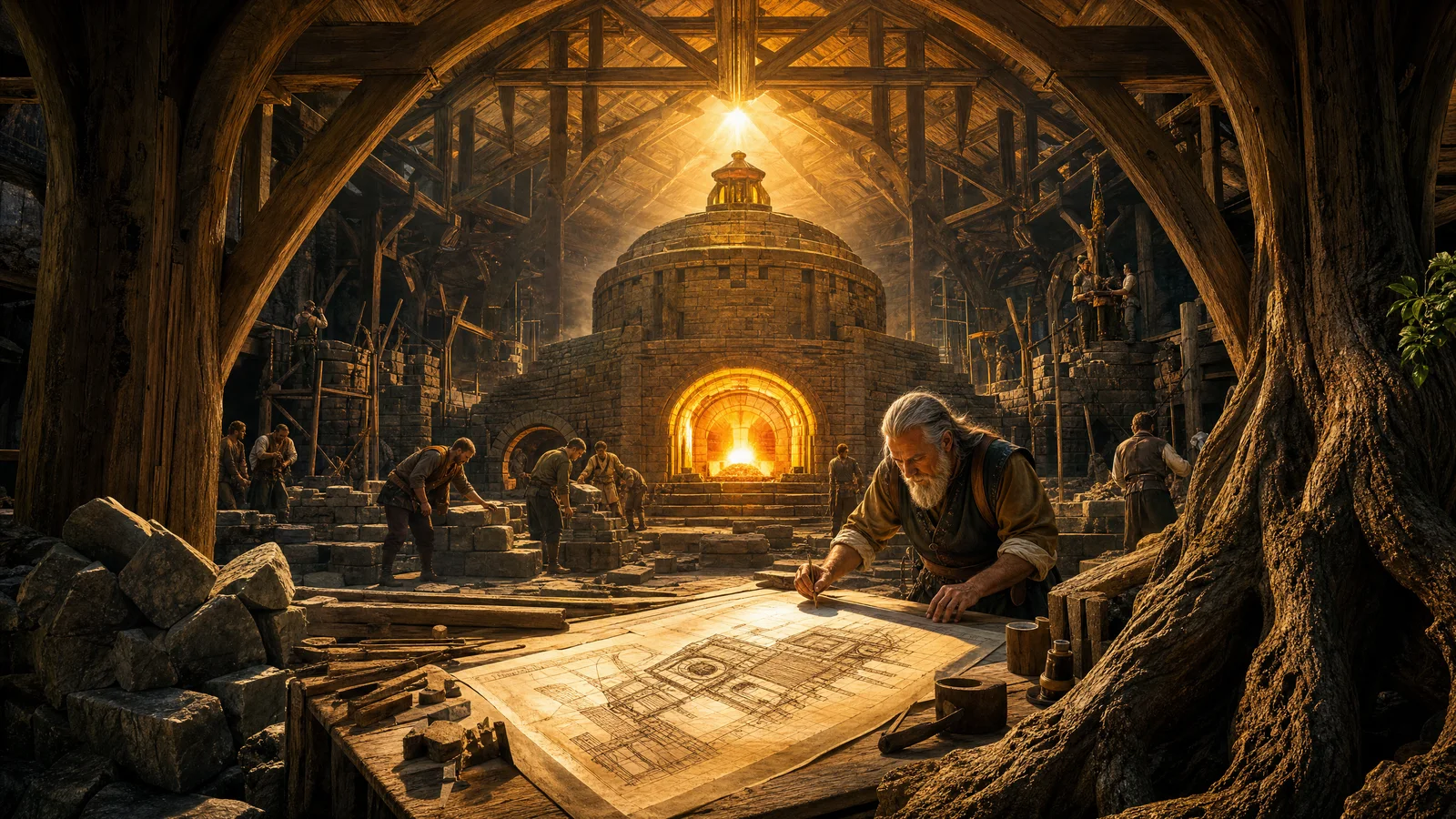
Complete Kiln Building Masterclass: From Simple Pit to Anagama
This campaign covers the design and construction of every kiln type, from the simplest pit firing to the most sophisticated wood-fired climbing kiln.
Chapter 1: Kiln Types by Complexity
Kiln
Complexity
Max Temp
Capacity
Build Time
Pit fire
Simplest
1,500°F
5-20 pieces
1 day
Sawdust kiln
Simple
1,600°F
10-30 pieces
1-2 days
Barrel kiln
Simple
1,800°F
10-25 pieces
1 day
Catenary arch
Moderate
2,400°F
20-100 pieces
2-4 weeks
Downdraft
Moderate-complex
2,400°F
50-200 pieces
4-8 weeks
Cross-draft
Complex
2,400°F
50-300 pieces
4-8 weeks
Anagama
Most complex
2,400°F+
100-500 pieces
2-6 months
Noborigama
Most complex
2,400°F+
200-1,000 pieces
3-12 months
Chapter 2: Catenary Arch Kiln
Catenary arch construction: 1) Determine kiln size (interior: 4x4x4 feet is good for beginners). 2) Calculate catenary curve (hang a chain between two points; the curve it forms is the catenary). 3) Build form from plywood following the catenary curve. 4) Lay firebrick on form, mortared with refractory cement. 5) The catenary shape distributes weight evenly (no keystone needed). 6) Build firebox at front (below floor level). 7) Build chimney at rear (height = 1.5x kiln height). 8) Install damper in chimney for atmosphere control. 9) Add door bricks (stacked dry for easy removal). 10) Cure kiln slowly (several low-temperature firings before full use).
Component
Material
Specification
Arch
Hard firebrick
2,600°F rated
Floor
Hard firebrick
Level, on sand bed
Firebox
Hard firebrick
Below floor, with grate
Chimney
Hard firebrick or flue tile
Height 1.5x kiln height
Damper
Kiln shelf or metal plate
Adjustable
Door
Soft brick, stacked dry
Easy removal
Insulation
Ceramic fiber or perlite
Reduces fuel consumption
Chapter 3: Anagama (Single-Chamber Wood Kiln)
Feature
Specification
Purpose
Length
12-30 feet
Long flame path for ash deposit
Slope
15-25 degrees
Natural draft
Firebox
Large, at lowest point
Primary combustion
Stacking area
Main chamber
Ware placement
Chimney
At highest point
Draft control
Firing duration
3-7 days continuous
Full ash deposit and atmosphere
Wood consumption
3-10 cords
Fuel for extended firing
Crew
4-12 people in shifts
24-hour stoking
Chapter 4: Kiln Materials
Material
Temperature Rating
Use
Cost
Hard firebrick (K-23)
2,300°F
Hot face, floor
Moderate
Hard firebrick (K-26)
2,600°F
Hot face, arch
Moderate-high
Soft insulating brick (K-23)
2,300°F
Insulation layer
Moderate
Ceramic fiber blanket
2,300-2,600°F
Insulation, door sealing
Moderate
Castable refractory
2,600°F+
Firebox, custom shapes
Moderate
Kiln wash
N/A
Protects shelves from drips
Low
Chapter 5: Kiln Maintenance
Issue
Cause
Repair
Cracked brick
Thermal stress
Replace or mortar
Mortar deterioration
Repeated firing
Re-mortar joints
Chimney blockage
Ash or debris
Clean annually
Damper stuck
Glaze drips, corrosion
Free and lubricate
Uneven heating
Draft problems
Adjust damper, check for leaks
Kiln shelf warping
Overloading, uneven support
Replace, use proper posts
Reference Card
The kiln is the potter's most important tool (without a kiln, clay remains clay; the kiln transforms raw material into permanent ceramic; building a kiln is the most significant investment a potter makes). 2. The catenary arch is the strongest shape (a chain hanging freely forms a catenary curve; an arch built to this curve distributes weight perfectly, requiring no buttressing; it is the ideal kiln arch shape). 3. Size the kiln to your production (a kiln too large wastes fuel firing half-empty; a kiln too small limits production; calculate your production needs and build accordingly). 4. Insulation saves fuel (every BTU that escapes through kiln walls is wasted; proper insulation with ceramic fiber or insulating brick can reduce fuel consumption by 30-50%). 5. The chimney creates the draft (without adequate chimney height, the kiln will not draw properly; chimney height should be at least 1.5 times the kiln height for natural draft). 6. Cure a new kiln slowly (a new kiln contains moisture in mortar and brick; firing too fast causes steam pressure that cracks bricks; cure with several progressively hotter firings). 7. The anagama is the ultimate wood kiln (a single-chamber climbing kiln fired for 3-7 days produces surfaces of unmatched depth and complexity; building and firing an anagama is a community endeavor). 8. A well-built kiln lasts decades (quality materials, proper construction, and regular maintenance produce a kiln that serves for 20-50 years or more; invest in quality construction from the start).