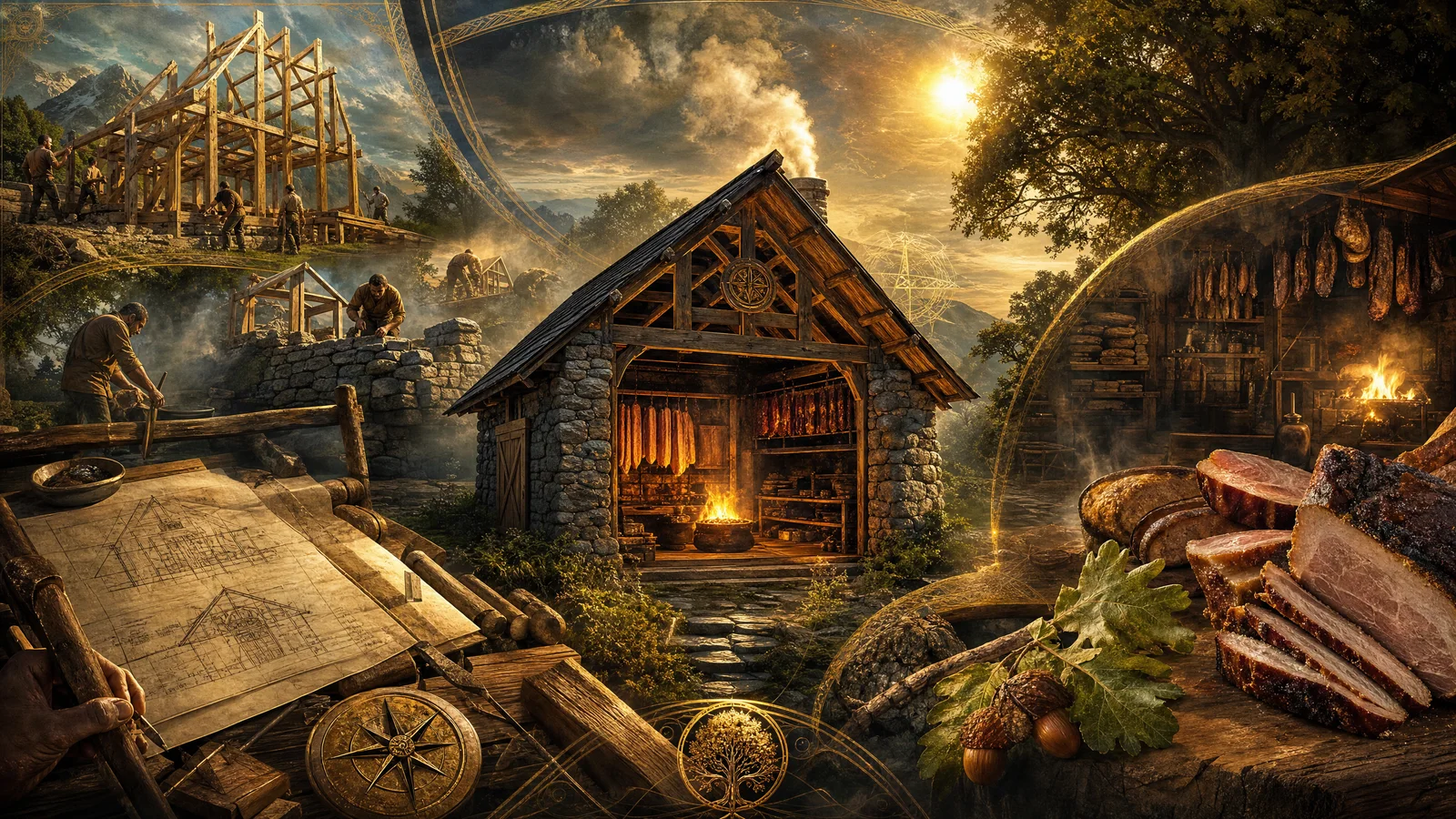
Complete Smokehouse Construction and Operation: From Frame to Flavor
A smokehouse preserves meat, fish, and cheese for months without refrigeration. This campaign covers smokehouse design, construction, wood selection, and smoking techniques.
Chapter 1: Smokehouse Types
Type
Size
Capacity
Difficulty
Temperature Control
Best For
Barrel smoker
55-gallon drum
20-40 lbs
Very low
Moderate
Small batches
Box smoker (plywood)
3x3x6 feet
50-100 lbs
Low
Good
Family use
Masonry smokehouse
4x4x7 feet
100-200 lbs
Moderate
Very good
Permanent, heavy use
Log smokehouse
4x6x7 feet
100-200 lbs
Moderate
Good
Traditional, durable
Underground smoke pit
Variable
20-50 lbs
Low
Moderate
Primitive, field use
Chapter 2: Construction
Masonry smokehouse: 1) Foundation: concrete pad, 4x4 feet minimum. 2) Walls: concrete block, brick, or stone (8 inches thick). 3) Height: 7 feet interior minimum. 4) Door: solid wood or metal, tight-fitting. 5) Ventilation: adjustable vent at top (controls smoke density and temperature). 6) Smoke source: external firebox connected by underground pipe (6-8 feet long). 7) External firebox keeps heat separate from smoking chamber. 8) Hanging rods: metal or hardwood rods across interior (support meat). 9) Drip pan: below hanging meat (catches fat). 10) Thermometer: at meat level (monitors temperature).
Component
Material
Purpose
Specification
Firebox
Brick, stone, or metal
Generate smoke
External, 6-8 feet from chamber
Smoke tunnel
Clay pipe, metal pipe
Transport smoke
6-8 feet, slight upward slope
Smoking chamber
Masonry, wood
Hold meat in smoke
4x4x7 feet minimum
Hanging rods
Steel rod, hardwood
Support meat
Spaced 12 inches apart
Vent (top)
Adjustable damper
Control smoke flow
4-6 inch opening
Door
Wood, metal
Access, seal
Tight-fitting
Thermometer
Dial or digital
Monitor temperature
At meat level
Chapter 3: Smoking Wood
Wood
Flavor
Intensity
Best For
Availability
Hickory
Strong, bacon-like
Heavy
Pork, beef, game
Eastern N. America
Mesquite
Very strong, earthy
Very heavy
Beef, game (use sparingly)
Southwest
Apple
Sweet, mild, fruity
Light
Poultry, pork, cheese
Widespread
Cherry
Sweet, mild
Light-medium
Poultry, pork, game
Widespread
Oak
Medium, balanced
Medium
Beef, pork, sausage
Widespread
Maple
Sweet, mild
Light
Poultry, pork, cheese
Northern regions
Alder
Delicate, slightly sweet
Light
Fish (traditional)
Pacific NW
Pecan
Rich, nutty
Medium
Pork, poultry
Southern US
Woods to avoid: 1) Pine, spruce, fir (resinous, produces toxic creosote). 2) Cedar (too strong, resinous). 3) Treated or painted wood (toxic chemicals). 4) Plywood or particle board (glue fumes). 5) Any unknown wood (may be toxic).
Chapter 4: Smoking Methods
Method
Temperature
Duration
Result
Shelf Life
Cold smoking
68-86°F
1-14 days
Flavored, requires curing first
Weeks-months (if cured)
Warm smoking
86-140°F
4-12 hours
Partially cooked, flavored
Days-weeks
Hot smoking
140-275°F
2-8 hours
Fully cooked, flavored
Days (refrigerated)
Cold smoking process: 1) Meat must be cured first (salt cure or brine cure). 2) Curing kills bacteria and draws out moisture. 3) After curing, rinse and dry meat surface (form pellicle). 4) Pellicle: tacky surface that absorbs smoke. 5) Place in smokehouse at 68-86°F. 6) Maintain thin, steady smoke. 7) Smoke for 1-14 days depending on product. 8) External firebox essential (keeps heat low). 9) Smoke only in cool weather (below 70°F ambient). 10) Result: preserved meat that stores for months without refrigeration.
Chapter 5: Curing Before Smoking
Cure Type
Salt Ratio
Cure Time
Products
Difficulty
Dry cure (salt only)
3-5% of meat weight
1-2 days per pound
Bacon, ham, jerky
Low
Brine cure (wet)
1 cup salt per gallon water
1-2 days per pound
Ham, fish, poultry
Low
Equilibrium cure
2-3% of meat weight
5-7 days
Bacon, charcuterie
Low
Reference Card
External firebox is the key (separating the fire from the smoking chamber allows temperature control; a pipe or tunnel carries smoke without excessive heat). 2. Cure before cold smoking (cold smoking does not cook meat; meat must be salt-cured first to prevent bacterial growth during the long smoking process). 3. Form the pellicle (after curing, dry the meat surface until tacky; this pellicle absorbs smoke evenly and creates the characteristic smoked color). 4. Fruit woods for mild flavor (apple, cherry, and maple produce sweet, mild smoke; use them for poultry, fish, and cheese). 5. Hickory for strong flavor (hickory produces the classic bacon/ham smoke flavor; it is the traditional American smoking wood). 6. Never use resinous wood (pine, spruce, fir, and cedar produce toxic creosote and bitter flavors; use only hardwoods and fruit woods). 7. Temperature determines the product (cold smoking preserves without cooking; hot smoking cooks and flavors; warm smoking is a compromise). 8. A smokehouse extends the harvest (meat that would spoil in days can be preserved for months through proper curing and smoking).