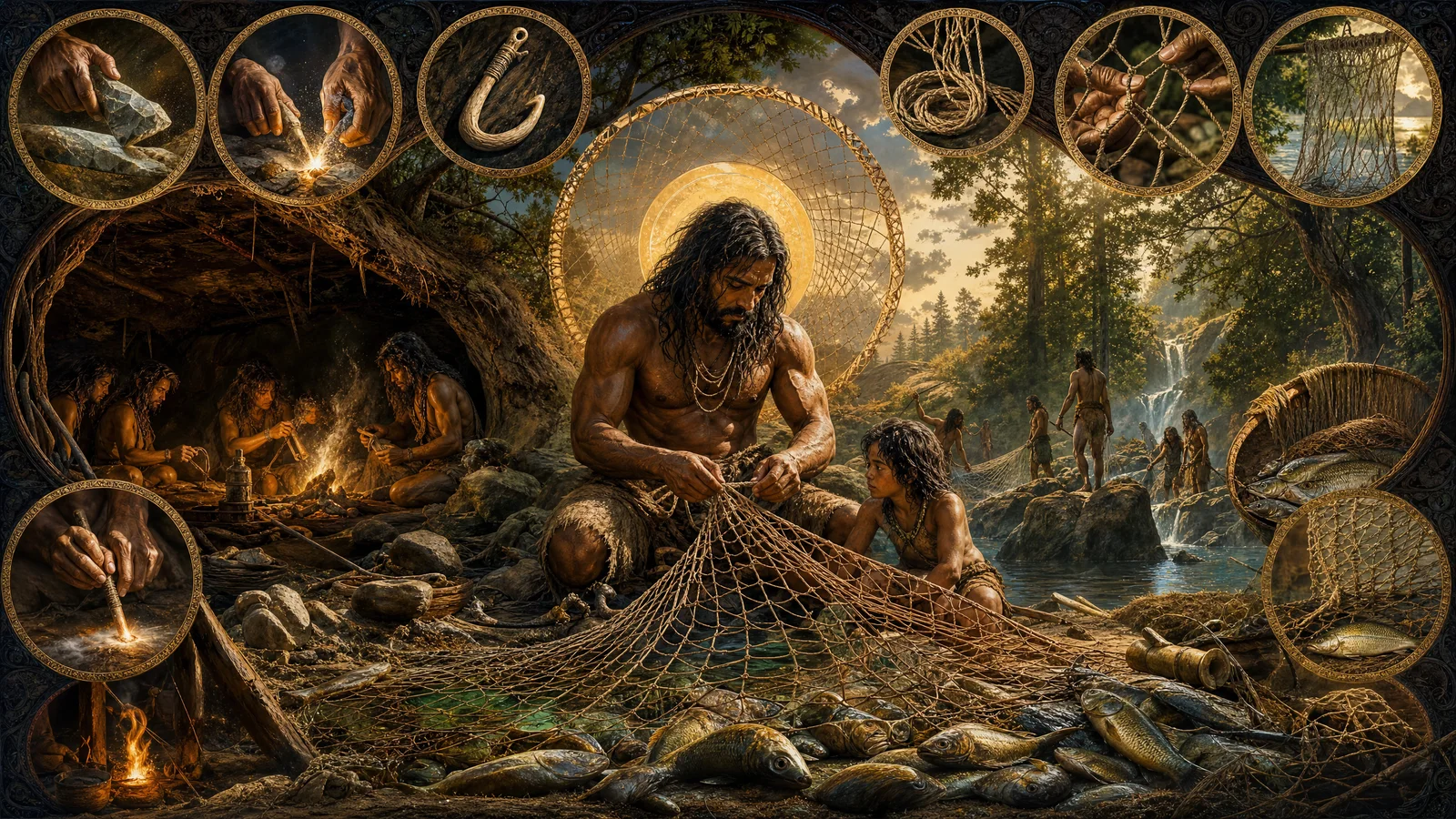
Complete Primitive Fishing and Net Making: From Hook to Harvest
Fish are among the most accessible protein sources in a survival situation. This campaign covers hook making, line construction, net tying, trap building, and fish preservation.
Chapter 1: Primitive Hooks and Lines
Hook Type
Material
Difficulty
Effectiveness
Best For
Gorge hook
Bone, wood, thorn
Very low
Good
All fish (swallowed whole)
J-hook (bone)
Bone
Moderate
Very good
Medium to large fish
J-hook (thorn)
Hawthorn, honey locust
Low
Good
Small to medium fish
J-hook (wire/nail)
Metal
Low
Excellent
All fish
Circle hook (bone)
Bone
High
Very good
Self-setting, less gut-hooking
Compound hook
Wood + thorn
Moderate
Good
Medium fish
Gorge hook construction: 1) Cut bone or hardwood sliver 1-2 inches long. 2) Sharpen both ends to points. 3) Carve groove around center for line attachment. 4) Tie line to center groove. 5) Bait covers entire gorge (fish swallows it). 6) When fish swallows and you pull, gorge turns sideways. 7) Points dig into stomach or throat. 8) Most reliable primitive hook design. 9) Works for any size fish (scale gorge to target species).
Chapter 2: Net Making
Net Type
Mesh Size
Use
Material
Difficulty
Gill net
1-4 inches
Passive fishing (fish swim into net)
Cordage, monofilament
Moderate
Cast net
1/2-1 inch
Active throwing over fish
Cordage, weights
High
Dip net
1/4-1 inch
Scooping fish
Cordage, frame
Low
Seine net
1/4-1 inch
Dragging through water
Cordage, floats, weights
Moderate
Landing net
1/2-1 inch
Landing hooked fish
Cordage, frame
Low
Net tying (sheet bend knot method): 1) Cut mesh gauge (flat stick, width = desired mesh size). 2) Cut shuttle (flat stick with notches to hold twine). 3) Load shuttle with cordage. 4) Tie starting loop to fixed point. 5) Loop cordage around mesh gauge. 6) Pass shuttle through previous mesh opening. 7) Tie sheet bend knot (the universal net knot). 8) Slide gauge down, repeat across row. 9) Turn work, start next row. 10) Each row adds one mesh width of depth. 11) Continue until net is desired size. 12) Add float line (top) and lead line (bottom) for gill or seine nets.
Chapter 3: Fish Traps
Trap Type
Construction
Effort
Effectiveness
Best Location
Funnel trap (basket)
Woven basket with inward-pointing funnel
High
Very good
Streams, rivers
Weir (stone/stick)
V-shaped wall directing fish to trap
High
Excellent
Shallow streams
Tidal trap
Stone walls exposed at low tide
Very high
Excellent
Coastal areas
Bottle trap (improvised)
Plastic bottle with inverted neck
Very low
Moderate
Streams (small fish)
Crayfish trap
Woven basket or wire mesh
Moderate
Good
Streams, lakes
Funnel trap construction: 1) Weave cylindrical basket (2-3 ft long, 1 ft diameter). 2) Close one end (back of trap). 3) Create funnel: weave cone shape that points inward. 4) Funnel opening: 2-3 inches (fish enter but cannot find exit). 5) Attach funnel to open end of basket. 6) Bait inside with fish guts, bread, or crushed shellfish. 7) Place in stream facing upstream (fish swim into funnel). 8) Weight with rocks to prevent washing away. 9) Check daily (fish will die if left too long). 10) One trap can catch multiple fish per day.
Chapter 4: Fish Preservation
Method
Shelf Life
Difficulty
Equipment
Flavor Change
Smoking (hot)
1-2 weeks
Low
Smokehouse, fire
Smoky, cooked
Smoking (cold)
1-3 months
Moderate
Cold smokehouse
Smoky, raw texture
Salt curing
6-12 months
Low
Salt (lots)
Very salty
Sun drying
1-6 months
Very low
Sun, dry climate
Concentrated
Pickling
3-6 months
Low
Vinegar, salt, jar
Tangy, firm
Fermentation
6-12 months
Low
Salt, container
Strong, umami
Chapter 5: Fishing Strategy
Water Type
Best Method
Best Time
Target Species
Bait
Small stream
Hand line, gorge hook
Dawn, dusk
Trout, panfish
Insects, worms
Large river
Trotline, gill net
Night
Catfish, carp
Cut bait, dough
Lake (shore)
Set lines, dip net
Dawn, dusk
Bass, panfish
Worms, minnows
Lake (deep)
Drop line, jug fishing
Varies
Catfish, walleye
Cut bait
Tidal (shore)
Cast net, seine
Incoming tide
Mullet, shrimp
None (net)
Pond
Funnel trap, hand line
Morning
Panfish, catfish
Bread, insects
Reference Card
The gorge hook is the most reliable primitive hook (it requires no special materials and works for any size fish; master this design first). 2. Gill nets fish while you sleep (set a gill net at dusk and check at dawn; passive fishing multiplies your effort). 3. Weirs are permanent fish factories (a well-built stone weir in a stream can provide fish indefinitely with minimal maintenance). 4. The sheet bend is the net knot (every net in the world is tied with the sheet bend; learn this one knot and you can make any net). 5. Bait the trap, not the hook (traps catch fish 24 hours a day; a baited funnel trap is more efficient than a hand line). 6. Preserve the surplus immediately (fish spoil within hours in warm weather; smoke, salt, or dry any fish you cannot eat today). 7. Fish move at dawn and dusk (most fish feed actively at low light; concentrate your fishing effort at these times). 8. Read the water (fish hold in specific locations: behind rocks, in eddies, under overhanging banks; learn to read water and you'll find fish).