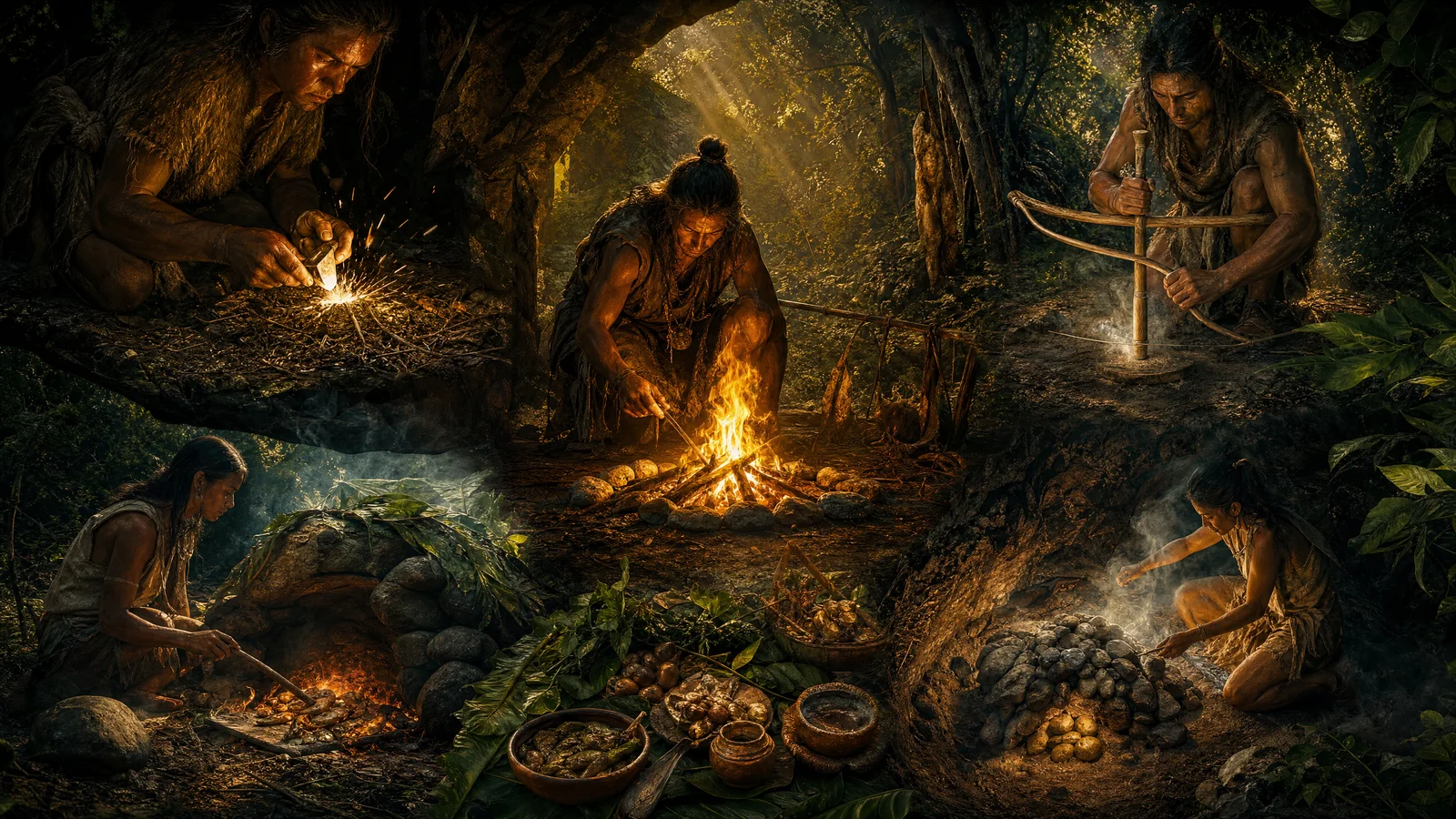
Complete Primitive Cooking Methods: From Open Fire to Earth Oven
Cooking without modern equipment requires understanding heat transfer, fire management, and improvised cooking vessels. This campaign covers open fire cooking, earth ovens, hot rock cooking, and food preparation.
Chapter 1: Fire Cooking Methods
Method
Heat Type
Temperature Control
Best For
Difficulty
Direct flame
Radiant + convection
Low
Searing, quick cooking
Very low
Coal bed
Radiant + conduction
Good
Grilling, roasting
Low
Spit roasting
Radiant (all sides)
Moderate
Whole animals, large cuts
Low
Plank cooking
Conduction + smoke
Good
Fish, thin cuts
Low
Ash roasting
Conduction
Moderate
Root vegetables, tubers
Very low
Reflector oven
Radiant (reflected)
Good
Baking, bread
Moderate
Hanging pot
Convection (liquid)
Good
Soups, stews, boiling
Low
Coal bed cooking: 1) Build large fire and let burn to coals (30-60 minutes). 2) Spread coals into even bed (2-3 inches deep). 3) Place grill (green wood rack) 4-6 inches above coals. 4) Cook food on grill (similar to modern grilling). 5) Control heat: raise/lower grill, spread/concentrate coals. 6) Add fresh coals from fire as needed. 7) For ash roasting: bury food directly in hot ash and coals. 8) Wrap food in leaves (banana, grape, corn husk) to protect from ash. 9) Root vegetables: 30-60 minutes buried in coals. 10) Meat: wrap in clay for clay-baked cooking (seals in moisture).
Chapter 2: Earth Oven (Underground Oven)
Earth oven construction: 1) Dig pit 2-3 ft deep, 3-4 ft diameter. 2) Line bottom with rocks (river rocks, NOT wet rocks from streams, they can explode). 3) Build large fire in pit on top of rocks. 4) Burn for 2-3 hours (rocks must be extremely hot). 5) Remove fire and excess ash (leave hot rocks). 6) Place layer of green vegetation (grass, leaves) on hot rocks. 7) Place food on vegetation layer. 8) Cover food with more green vegetation. 9) Optional: add water to create steam (speeds cooking). 10) Cover with earth (seal completely, no steam escaping). 11) Cook for 4-12 hours depending on food quantity. 12) Uncover carefully, remove food. 13) Result: slow-cooked, tender, smoky food.
Food
Cooking Time
Preparation
Result
Root vegetables (whole)
2-4 hours
Wash, leave whole
Tender, sweet
Whole chicken/rabbit
3-5 hours
Clean, season
Fall-off-bone tender
Pork shoulder
8-12 hours
Season, wrap in leaves
Pulled pork texture
Corn on cob
1-2 hours
Leave in husk
Steamed, sweet
Fish (whole)
1-2 hours
Clean, wrap in leaves
Flaky, moist
Bread dough
2-3 hours
Shape, wrap in leaves
Crusty, dense
Chapter 3: Hot Rock Cooking
Method
Application
Vessel
Difficulty
Stone boiling
Boiling water without fireproof vessel
Bark container, skin bag, wooden bowl
Low
Rock frying
Cooking on flat hot rock
Large flat stone
Very low
Rock baking
Baking on heated stone
Flat stone near fire
Very low
Sweat lodge cooking
Steaming food
Enclosed structure
Moderate
Stone boiling: 1) Heat rocks in fire until glowing (30-60 minutes). 2) Fill container with water and food (bark basket, animal stomach, wooden bowl). 3) Use wooden tongs or split stick to transfer hot rocks to water. 4) Rocks instantly heat water (one fist-sized rock raises 1 quart significantly). 5) Add rocks until water boils. 6) Remove cooled rocks, add fresh hot ones to maintain boil. 7) Continue until food is cooked. 8) This method allows boiling in ANY container that holds water. 9) Even a hole in the ground lined with animal skin works. 10) Used for thousands of years before pottery.
Chapter 4: Improvised Cooking Vessels
Vessel
Material
Heat Resistance
Capacity
Difficulty
Lifespan
Bark container
Birch bark
Moderate (with water inside)
1-5 quarts
Low
Days to weeks
Wooden bowl
Carved hardwood
Low (stone boiling only)
1-3 quarts
Moderate
Months
Clay pot
Fired clay
Good
1-10+ quarts
Moderate
Months to years
Animal stomach
Stomach lining
Moderate (with water)
1-3 quarts
Low
Days
Bamboo tube
Bamboo section
Moderate
1-2 quarts
Very low
Single use to days
Gourd
Dried gourd
Low (stone boiling only)
1-5 quarts
Very low
Weeks to months
Tin can (salvaged)
Steel/tin
Excellent
Varies
Very low
Months
Chapter 5: Food Preparation Without Tools
Task
Primitive Method
Modern Equivalent
Difficulty
Cutting
Sharp stone flake, obsidian
Knife
Low
Grinding
Mano and metate (stone on stone)
Food processor
Moderate (labor)
Peeling
Sharp stone scraper
Peeler
Low
Mixing
Wooden paddle in vessel
Spoon/whisk
Very low
Straining
Woven grass basket
Colander
Moderate
Measuring
Consistent vessel (shell, gourd)
Measuring cup
Low
Reference Card
Coal beds are better than flames (flames are uneven and hard to control; a bed of glowing coals provides steady, even heat for cooking). 2. Earth ovens are slow cookers (bury food with hot rocks and come back hours later; the earth oven is the original slow cooker). 3. Never use wet river rocks (rocks from streams can contain trapped moisture that turns to steam and causes the rock to explode violently). 4. Stone boiling works in anything (you can boil water in a bark basket, a skin bag, or a hole in the ground; hot rocks transfer heat to water instantly). 5. Wrap food in leaves (green leaves protect food from ash and add moisture; banana leaves, corn husks, and grape leaves all work). 6. Green wood does not burn quickly (use green (living) wood for grills, spits, and cooking racks; it chars slowly instead of catching fire). 7. Clay-baked food is self-basting (coating meat in clay and baking in coals seals in all moisture; the clay peels away with skin and feathers). 8. Fire management is cooking skill (controlling your fire, building proper coal beds, and managing heat is more important than any recipe).