Sovereignty Module: Kindle the Flame
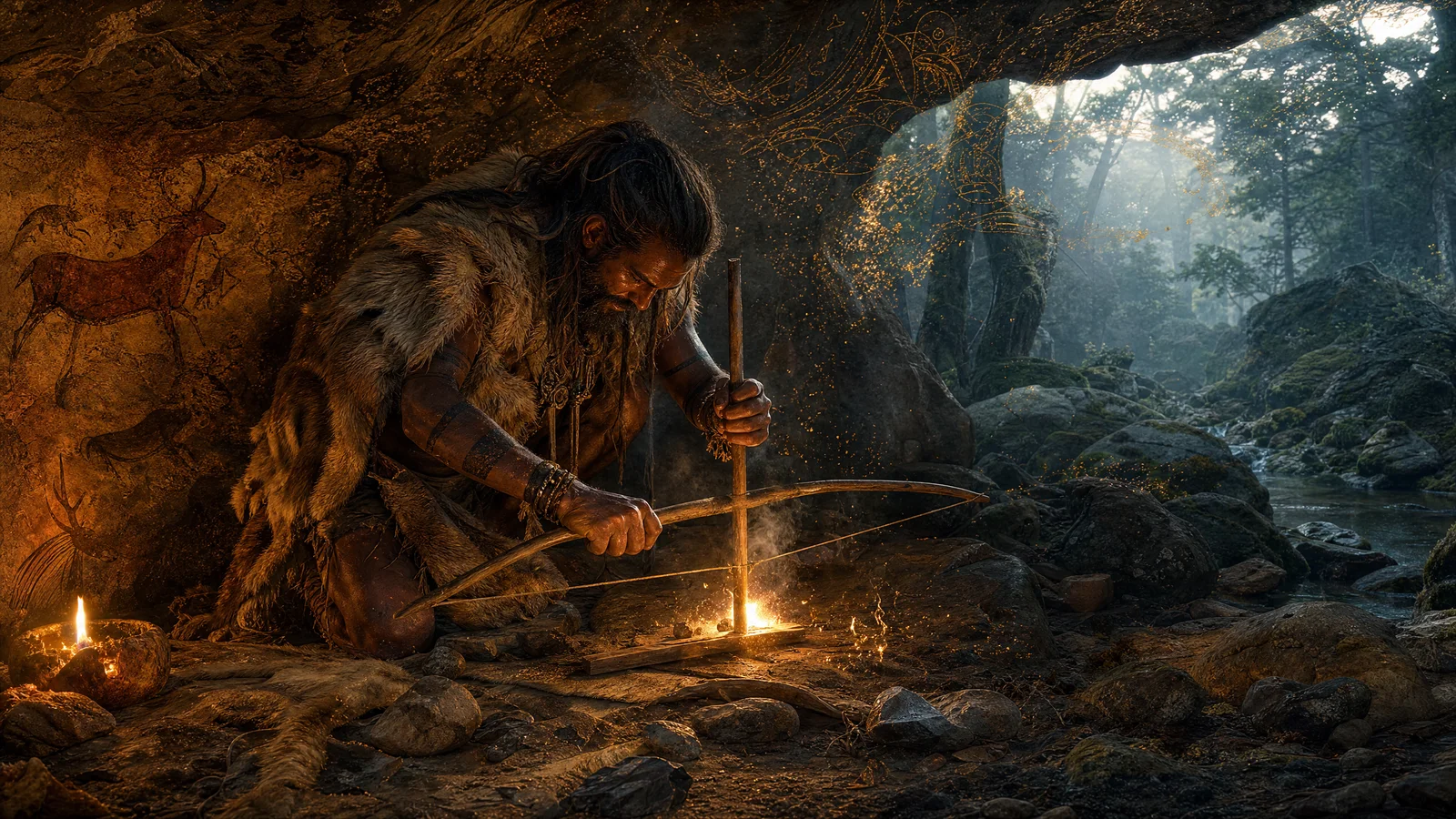
Complete Primitive Fire Starting, Tinder Preparation, and Fire Management Guide
Fire is the foundation of civilization. This campaign covers every method of starting fire without modern tools, preparing tinder, and managing fires for cooking, heating, and industry.
Chapter 1: Fire Starting Methods
| Method | Difficulty | Reliability | Speed | Conditions | Materials Needed |
|---|---|---|---|---|---|
| Ferro rod (modern) | Very low | Excellent (all weather) | 5-30 seconds | Any | Ferro rod + striker + tinder |
| Flint and steel | Low | Very good | 30-120 seconds | Any (dry tinder required) | Flint + carbon steel + char cloth |
| Bow drill | Moderate-high | Good (practice required) | 1-5 minutes | Dry conditions | Specific woods + cordage |
| Hand drill | High | Fair (very difficult) | 2-10 minutes | Dry, warm conditions | Specific woods (no cordage needed) |
| Fire plow | High | Fair | 2-10 minutes | Dry conditions | Softwood board + hardwood stick |
| Fire saw (bamboo) | Moderate | Good (in tropics) | 1-3 minutes | Dry conditions | Bamboo |
| Pump drill | Moderate | Good | 1-3 minutes | Dry conditions | Constructed tool + board |
| Magnifying lens | Very low | Excellent (sunny only) | 10-60 seconds | Direct sunlight required | Any convex lens |
| Compression (fire piston) | Low (with tool) | Very good | 1-5 seconds | Any | Fire piston + tinder |
| Chemical (potassium permanganate + glycerin) | Low | Excellent | 30-60 seconds | Any | Chemicals |
Chapter 2: Bow Drill (Most Reliable Primitive Method)
| Component | Material | Specification | Critical Details |
|---|---|---|---|
| Fireboard (hearth) | Soft, dry wood (cedar, willow, cottonwood, basswood) | Flat board, 3/4 inch thick, 2+ inches wide | Must be DRY. Fingernail should dent it easily. |
| Spindle (drill) | Same wood as fireboard (or slightly harder) | 8-12 inches long, 3/4 inch diameter, straight | Rounded top, pointed bottom. Same wood = best friction. |
| Bow | Slightly curved stick (any wood) | 24-30 inches, slight curve | Sturdy enough not to flex under tension |
| Cordage | Paracord, rawhide, plant fiber rope | Length of bow + 6 inches | Must grip spindle without slipping. Slight slack. |
| Handhold (socket) | Hardwood, stone, bone, or shell | Fits in palm, has depression | Lubricate with oil, wax, or green leaves (reduce friction at top) |
| Notch | Cut in fireboard | V-shaped, 1/8 of circle, reaches center of burn hole | This is where the coal forms. Cut AFTER burning in. |
| Coal catcher | Bark, leaf, thin wood chip | Placed under notch | Catches the ember as it forms |
Technique: Burn in first (create depression in fireboard). Cut notch to center of depression. Place coal catcher under notch. Bow drill with long, full strokes. Increase speed and pressure when smoke thickens. Stop when coal forms in notch. Transfer coal to tinder bundle. Blow gently to flame.
Chapter 3: Tinder Materials (Best to Worst)
| Material | Reliability | Availability | Preparation | Ignition Method |
|---|---|---|---|---|
| Char cloth (cotton charred in tin) | Excellent | Made from cotton scraps | Char in sealed tin over fire | Spark (flint/steel, ferro rod) |
| Birch bark (thin, papery) | Excellent | Birch trees | Peel thin layers, shred fine | Spark or friction |
| Cedar bark (inner, shredded) | Excellent | Cedar trees | Shred very fine, fluff into ball | Spark or friction |
| Cattail fluff (seed heads) | Excellent | Wetlands (fall/winter) | Collect dry seed heads | Spark (burns fast — add to bundle) |
| Fatwood (resinous pine) | Excellent | Dead pine stumps | Shave into fine curls | Spark or flame |
| Dried grass (fine, dead) | Good | Fields, meadows | Bundle loosely, bird-nest shape | Friction coal or spark |
| Thistle/milkweed down | Good | Fields (fall) | Collect dry seed fluff | Spark |
| Punk wood (rotted, dry) | Good | Dead standing trees | Find dry, crumbly wood | Friction coal (catches, holds ember) |
| Dryer lint | Excellent | Laundry | Collect and store dry | Any spark |
| Pine needles (dead, dry) | Fair | Pine forests | Bundle loosely | Flame (not spark alone) |
| Paper/cardboard | Excellent | Salvage | Shred or crumple | Any method |
Chapter 4: Fire Lay Types
| Fire Lay | Purpose | Structure | Best For |
|---|---|---|---|
| Teepee | Quick start, boiling water | Tinder in center, kindling leaned around in cone | Starting fires, quick heat, signaling |
| Log cabin | Long-burning, cooking platform | Alternating layers of sticks in square, tinder inside | Cooking (flat top), coal production |
| Lean-to | Windy conditions | Large log as windbreak, kindling leaned against it | Wind protection, one-sided heat |
| Star/Indian fire | Long-burning, fuel-efficient | 4-6 long logs radiating from center, pushed in as they burn | Overnight fires, fuel conservation |
| Dakota hole | Concealed, wind-resistant, efficient | Two holes connected underground: fire hole + air tunnel | Stealth, windy conditions, cooking |
| Reflector fire | Maximum heat toward shelter | Fire backed by log wall or rock face | Heating shelter, cold weather |
| Platform fire | Wet/snowy ground | Fire built on platform of green logs | Wet conditions, snow |
| Keyhole fire | Cooking + warmth simultaneously | Keyhole shape: round fire area + narrow cooking channel | Camp cooking (coals raked into channel) |
Chapter 5: Flint and Steel
| Component | Material | Source | Preparation |
|---|---|---|---|
| Striker (steel) | High-carbon steel (old file, knife spine, custom forged) | Blacksmith, hardware store, salvage | Must be hardened steel (sparks when struck against flint) |
| Flint (or equivalent) | Flint, chert, jasper, quartz, agate | Riverbeds, limestone areas, gravel pits | Sharp edge required. Knap to create fresh edge. |
| Char cloth | 100% cotton fabric, charred | Old t-shirts, jeans, cotton balls | Char in sealed tin (small hole in lid) over fire until smoking stops |
| Tinder bundle | Shredded cedar bark, dried grass, or similar | Forest, fields | Bird-nest shape: char cloth in center, fine tinder around it |
Technique: Hold flint in non-dominant hand with char cloth on top edge. Strike steel downward against flint edge (sharp, glancing blow). Sparks land on char cloth. When char cloth catches (glowing spot), transfer to tinder bundle. Blow gently, progressively harder until flame erupts.
Chapter 6: Fire Safety and Management
| Principle | Rule | Reason |
|---|---|---|
| Clear area | 10-foot radius cleared to bare ground | Prevents ground fire spread |
| Wind awareness | Build fire on downwind side of camp | Sparks blow away from shelter |
| Water nearby | Always have water or dirt available to extinguish | Emergency suppression |
| Never leave unattended | Extinguish completely or have someone watch | Wind can spread embers |
| Extinguishing | Drown with water, stir ashes, drown again, feel with hand | "If it's too hot to touch, it's too hot to leave" |
| Overhead clearance | No branches within 15 feet above fire | Prevents crown fire |
| Firewood storage | Store upwind and away from fire | Prevents accidental ignition of fuel supply |
Reference Card
- Bow drill: soft, dry wood (cedar, willow, cottonwood). Same wood for fireboard AND spindle. Must be bone dry.
- Char cloth: 100% cotton charred in sealed tin. Best spark-catcher. Make in advance, keep dry.
- Tinder bundle: bird-nest shape. Fine material in center, progressively coarser outward. Blow from below.
- Flint and steel: high-carbon steel only (old files work). Strike steel against flint, not flint against steel.
- Fatwood: resinous heartwood from dead pine stumps. Nature's fire starter. Shave fine curls.
- Dakota hole: dig fire pit + angled air tunnel. Wind-resistant, fuel-efficient, low-visibility, great for cooking.
- Fire progression: tinder → kindling (pencil-thin) → small sticks → wrist-thick → fuel logs. Never skip sizes.
- Wet conditions: look for standing dead wood (dry inside), birch bark (waterproof), fatwood (resin repels water).