Sovereignty Module: Fire the Stone
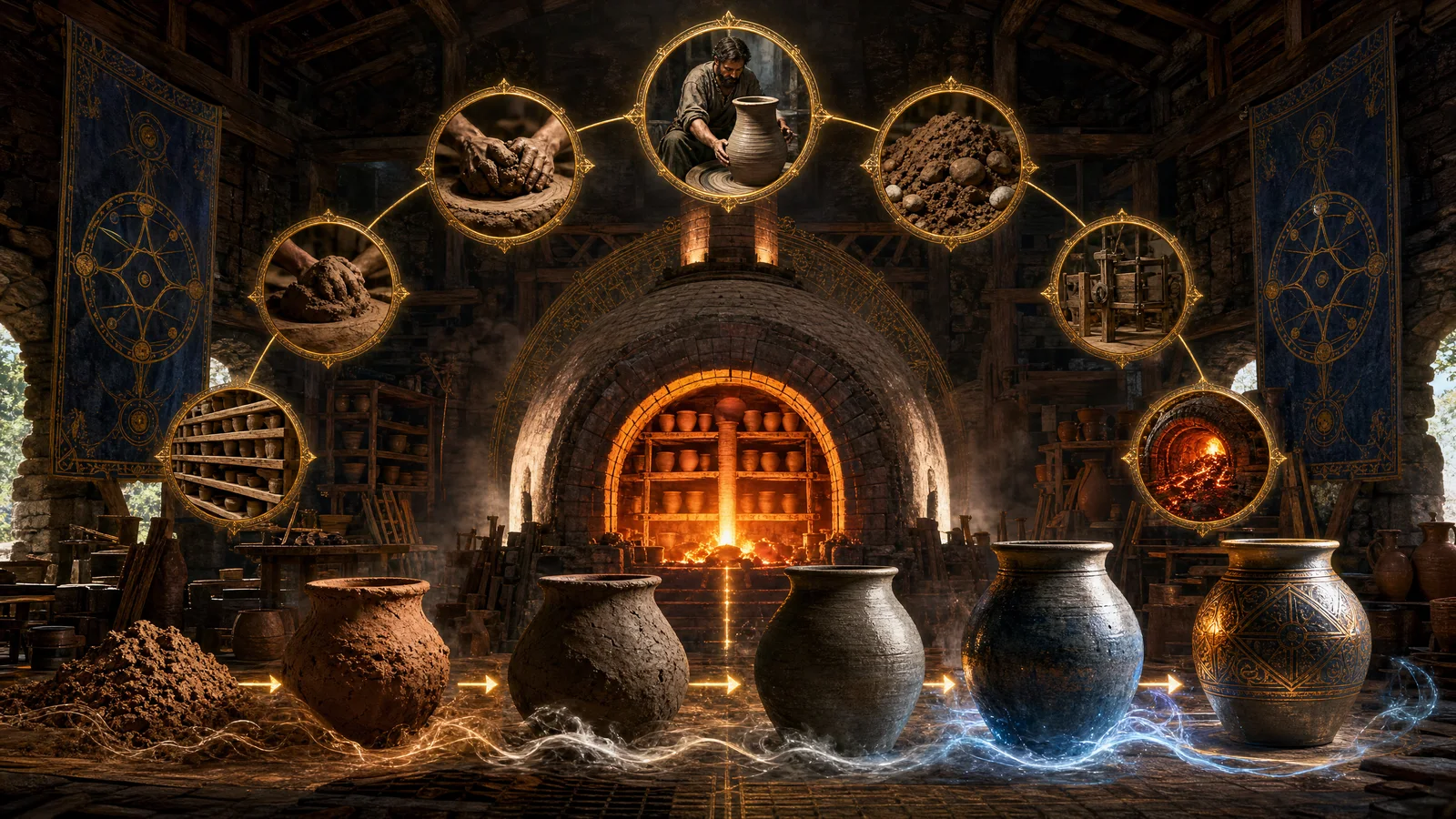
Fire the Stone
Complete Stoneware Production: From Earthenware to Vitrified Ceramic
Complete Stoneware Production: From Earthenware to Vitrified Ceramic
Stoneware is the workhorse of functional pottery. This campaign covers stoneware clay bodies, high-fire glazes, kiln requirements, and the production of durable, waterproof ceramic ware.
Chapter 1: Stoneware vs Earthenware
| Property | Earthenware | Stoneware |
|---|---|---|
| Firing temperature | Cone 06-1 (1,828-2,109°F) | Cone 6-10 (2,232-2,381°F) |
| Porosity | 5-15% (porous) | 0-3% (vitrified) |
| Strength | Moderate | High |
| Waterproof | No (needs glaze) | Yes (even unglazed) |
| Durability | Good | Excellent |
| Thermal shock | Moderate | Good |
| Color | Red, buff, white | Gray, brown, buff |
Chapter 2: Stoneware Clay Bodies
| Clay Body | Cone | Color (Oxidation) | Color (Reduction) | Character |
|---|---|---|---|---|
| Standard stoneware | 6-10 | Buff to tan | Gray to brown | Versatile, reliable |
| Dark stoneware | 6-10 | Brown | Dark brown to black | Rich, earthy |
| Porcelaneous stoneware | 6-10 | White to cream | White to gray | Refined, translucent |
| Iron-bearing stoneware | 6-10 | Brown to rust | Dark gray to black | Rustic, textured |
| Flameware | 6-10 | Varies | Varies | Thermal shock resistant |
Chapter 3: High-Fire Glazes
| Glaze Type | Cone | Surface | Character |
|---|---|---|---|
| Ash glaze | 9-12 | Varied, natural | Wood ash + clay + feldspar |
| Celadon | 9-10 | Smooth, jade-like | Iron in reduction |
| Tenmoku | 9-10 | Rich brown-black | High iron, reduction |
| Shino | 9-10 | Orange-peel texture | Carbon trapping |
| Salt glaze | 9-10 | Orange-peel, glossy | Salt vapor in kiln |
| Nuka (rice husk ash) | 9-10 | Milky, opalescent | Rice husk ash based |
Chapter 4: Production Standards
| Test | Method | Standard |
|---|---|---|
| Absorption | Weigh dry, boil 5 hours, weigh wet | Less than 3% for stoneware |
| Thermal shock | Boiling water into frozen pot | No cracking |
| Glaze fit | Visual inspection after firing | No crazing or shivering |
| Food safety | Lemon juice test (24 hours) | No glaze deterioration |
| Strength | Drop test from 12 inches | No breakage |
Chapter 5: Kiln Requirements
| Kiln Type | Max Temperature | Fuel | Atmosphere Control | Cost |
|---|---|---|---|---|
| Electric | Cone 10 (2,381°F) | Electricity | Oxidation only | Moderate |
| Gas (natural/propane) | Cone 12+ | Gas | Full control | Moderate-high |
| Wood | Cone 12+ | Wood | Natural variation | Low fuel, high labor |
| Oil/waste oil | Cone 10+ | Oil | Good control | Low fuel cost |
| Coal | Cone 10+ | Coal | Moderate control | Low fuel cost |
Reference Card
- Stoneware is vitrified (at cone 6-10, the clay body fuses into a dense, waterproof material; this vitrification makes stoneware ideal for functional ware that holds liquids without glazing). 2. High-fire glazes have depth and complexity (the extreme temperatures of stoneware firing create glaze surfaces with depth, movement, and variation that low-fire glazes cannot match). 3. Reduction firing transforms stoneware (the gray body and rich glaze colors of reduction-fired stoneware are among the most prized ceramic surfaces; celadon, tenmoku, and shino all require reduction). 4. Stoneware is the potter's bread and butter (for production potters, stoneware provides the durability, food safety, and beauty that customers demand; it is the standard for functional pottery). 5. Test every clay body and glaze (absorption tests confirm vitrification; thermal shock tests confirm durability; food safety tests confirm that glazes are safe for food contact; testing is not optional). 6. The kiln must reach temperature reliably (stoneware requires sustained high temperatures; a kiln that cannot reliably reach cone 6-10 cannot produce stoneware; invest in a kiln adequate for the task). 7. Wood-fired stoneware is the pinnacle (the combination of high temperature, natural atmosphere variation, and ash deposits creates surfaces of unmatched complexity and beauty; wood firing is the ultimate ceramic experience). 8. Stoneware connects us to ancient traditions (stoneware has been produced in China for over 3,000 years; every stoneware potter joins a tradition of excellence that spans millennia and cultures).
TransmissionCOMPLETE — unaltered & unabridged
Words735 — every one of them
SHA-256 of source text0eb81562aa6c2eacbc8cfa8e32359d7f7431f2cd7b764f9be64bf5c249379ccd
Canonical textdownload campaign-fire-stone.md — byte-identical to what this page renders