Sovereignty Module: Master the Forge
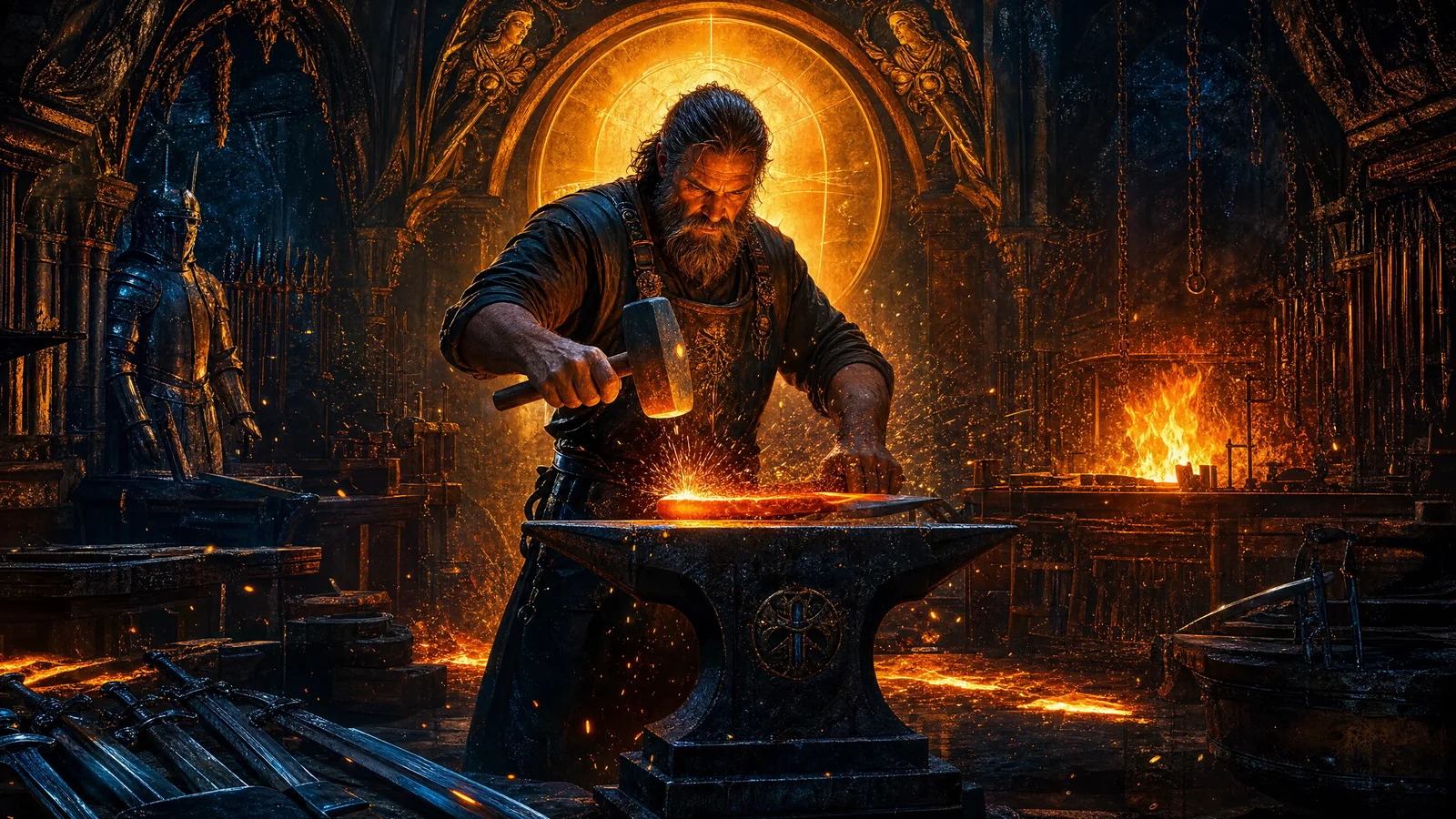
Complete Metalworking: From Ore to Finished Product
Metal transforms civilization. This campaign covers prospecting, smelting, forging, casting, hardening, and finishing metals from raw ore to completed tools and weapons.
Chapter 1: Metal Identification and Prospecting
| Metal | Where Found | Ore Appearance | Melting Point | Difficulty | Primary Uses |
|---|---|---|---|---|---|
| Copper | Green/blue rock near streams | Malachite (green), azurite (blue) | 1,984°F (1,085°C) | Low-moderate | Tools, wire, vessels, alloys |
| Tin | Alluvial deposits, veins | Cassiterite (black/brown, heavy) | 449°F (232°C) | Low | Bronze alloy (with copper) |
| Iron | Red/brown soil, bog deposits | Hematite (red), magnetite (black) | 2,800°F (1,538°C) | High | Tools, weapons, structural |
| Lead | Heavy grey veins | Galena (silver-grey, cubic) | 621°F (327°C) | Very low | Solder, weights, plumbing |
| Silver | Veins in quartz, with lead ore | Native (shiny), argentite (dark) | 1,764°F (962°C) | Moderate | Currency, jewelry, medicine |
| Gold | Alluvial (streams), quartz veins | Native (yellow, heavy, malleable) | 1,948°F (1,064°C) | Low (if found) | Currency, jewelry, electronics |
| Zinc | With copper and lead ores | Sphalerite (yellow-brown) | 787°F (420°C) | Moderate | Brass alloy, galvanizing |
Prospecting indicators: 1) Color changes in rock/soil (red = iron, green/blue = copper). 2) Heavy black sand in streams (magnetite, often with gold). 3) Quartz veins (often carry gold, silver, copper). 4) Bog iron (orange-brown deposits in swampy areas — easiest iron source). 5) Stream panning (heavy metals settle in bends and behind rocks).
Chapter 2: Smelting
| Metal | Ore | Furnace Type | Temperature | Flux | Yield | Time |
|---|---|---|---|---|---|---|
| Copper | Malachite/azurite | Simple pit or shaft | 2,000°F+ | None needed | 30-60% | 4-8 hours |
| Bronze | Copper + tin (90:10) | Crucible in furnace | 1,800°F+ | Borax | 80%+ | 2-4 hours |
| Iron (bloom) | Hematite/bog iron | Bloomery (shaft) | 2,300°F+ | Limestone | 10-30% | 6-12 hours |
| Iron (cast) | Hematite | Blast furnace | 2,800°F+ | Limestone | 40-60% | Continuous |
| Lead | Galena | Simple fire | 1,100°F+ | None | 60-80% | 2-4 hours |
| Brass | Copper + zinc | Crucible | 1,700°F+ | Borax | 80%+ | 2-4 hours |
Bloomery furnace (simplest iron smelting): 1) Build chimney of clay/stone (3-5 ft tall, 12-18 inch interior). 2) Tuyere (air pipe) enters at bottom (bellows attached). 3) Fill with alternating layers of charcoal and crushed ore. 4) Light from bottom, pump bellows continuously. 5) Temperature must exceed 2,300°F (charcoal + forced air achieves this). 6) After 6-12 hours, break open furnace. 7) Extract bloom (spongy iron mass). 8) Hammer bloom while hot to consolidate and remove slag.
Chapter 3: Forging Techniques
| Technique | Purpose | Temperature | Tools | Difficulty |
|---|---|---|---|---|
| Drawing out | Lengthen/thin metal | Yellow-white heat | Hammer, anvil | Low |
| Upsetting | Thicken/shorten metal | Yellow heat | Hammer, anvil | Low |
| Bending | Change direction | Orange-yellow heat | Hammer, anvil, vise | Low |
| Punching | Make holes | Orange heat | Punch, anvil (over hole) | Low-moderate |
| Splitting | Divide metal | Orange heat | Chisel, anvil | Low |
| Welding (forge) | Join two pieces | White heat (sparking) | Hammer, flux (borax) | High |
| Scrolling | Decorative curves | Orange heat | Hammer, scroll jig | Moderate |
| Fullering | Create grooves/necks | Orange heat | Fuller tool, anvil | Moderate |
| Swaging | Shape round/square | Orange heat | Swage block | Moderate |
| Riveting | Permanent fastening | Cold or warm | Hammer, rivet set | Low |
Forge welding (joining iron to iron): 1) Heat both pieces to white heat (sparking, almost melting). 2) Sprinkle borax flux on joint surfaces (prevents oxidation). 3) Return to fire briefly (flux melts, cleans surfaces). 4) Remove quickly, place together on anvil. 5) Strike firmly — first blow seats the joint, subsequent blows consolidate. 6) Work from center outward (pushes slag out). 7) If weld fails, reflux and retry. Temperature is critical — too cold won't bond, too hot burns the iron.
Chapter 4: Heat Treatment
| Process | Purpose | Method | Result |
|---|---|---|---|
| Hardening | Maximum hardness | Heat to critical (cherry red), quench in water/oil | Hard but brittle |
| Tempering | Reduce brittleness | After hardening, reheat to specific color, air cool | Tough and springy |
| Annealing | Maximum softness | Heat to cherry red, cool very slowly (in ash) | Soft, workable |
| Normalizing | Uniform grain | Heat to cherry red, cool in still air | Consistent properties |
| Case hardening | Hard surface, soft core | Pack in carbon (charcoal), heat for hours | Wear-resistant surface |
Temper colors (steel heated after hardening — color indicates temperature):
- Pale straw (220°C/430°F): Razors, scrapers, engraving tools
- Dark straw (240°C/460°F): Knives, chisels, plane blades
- Brown (260°C/500°F): Axes, punches, drill bits
- Purple (280°C/540°F): Swords, springs, saw blades
- Blue (300°C/570°F): Springs, screwdrivers
- Grey-blue (320°C/610°F): Too soft for cutting tools
Chapter 5: Projects (Essential Tools)
| Project | Metal | Weight | Time | Difficulty | Priority |
|---|---|---|---|---|---|
| Knife (general purpose) | High-carbon steel | 4-8 oz | 2-4 hours | Moderate | Critical |
| Axe head | Medium-carbon steel | 2-4 lbs | 4-8 hours | High | Critical |
| Nails (various) | Mild steel or iron | 1-4 oz each | 5-15 min each | Low | Critical |
| Chisel (wood) | High-carbon steel | 8-16 oz | 2-3 hours | Moderate | High |
| Hammer head | Medium-carbon steel | 1-3 lbs | 3-5 hours | Moderate | High |
| Hinge | Mild steel | 4-12 oz | 1-2 hours | Low | Moderate |
| Chain links | Mild steel | Varies | 10-20 min/link | Low-moderate | Moderate |
| Sword/machete | High-carbon steel | 2-4 lbs | 8-20 hours | Very high | Moderate |
| Plow point | Medium-carbon steel | 5-15 lbs | 4-8 hours | High | Critical (farming) |
| Tongs (blacksmith) | Mild steel | 2-4 lbs | 2-4 hours | Moderate | Critical (first tool) |
Reference Card
- Charcoal is king (only fuel hot enough for iron smelting without modern equipment). 2. Bellows multiply heat (forced air is the difference between campfire and forge). 3. Color tells temperature (black → red → orange → yellow → white = cold → hot). 4. Hammer at heat (metal moves easily when hot, cracks when cold). 5. Quench for hardness (water = maximum hard; oil = moderate; air = soft). 6. Temper after hardening (hard but brittle is useless — temper to the right color). 7. Flux before welding (borax prevents oxidation at the joint). 8. Make tongs first (you need tongs to hold hot metal to make everything else).