Sovereignty Module: Order the Community
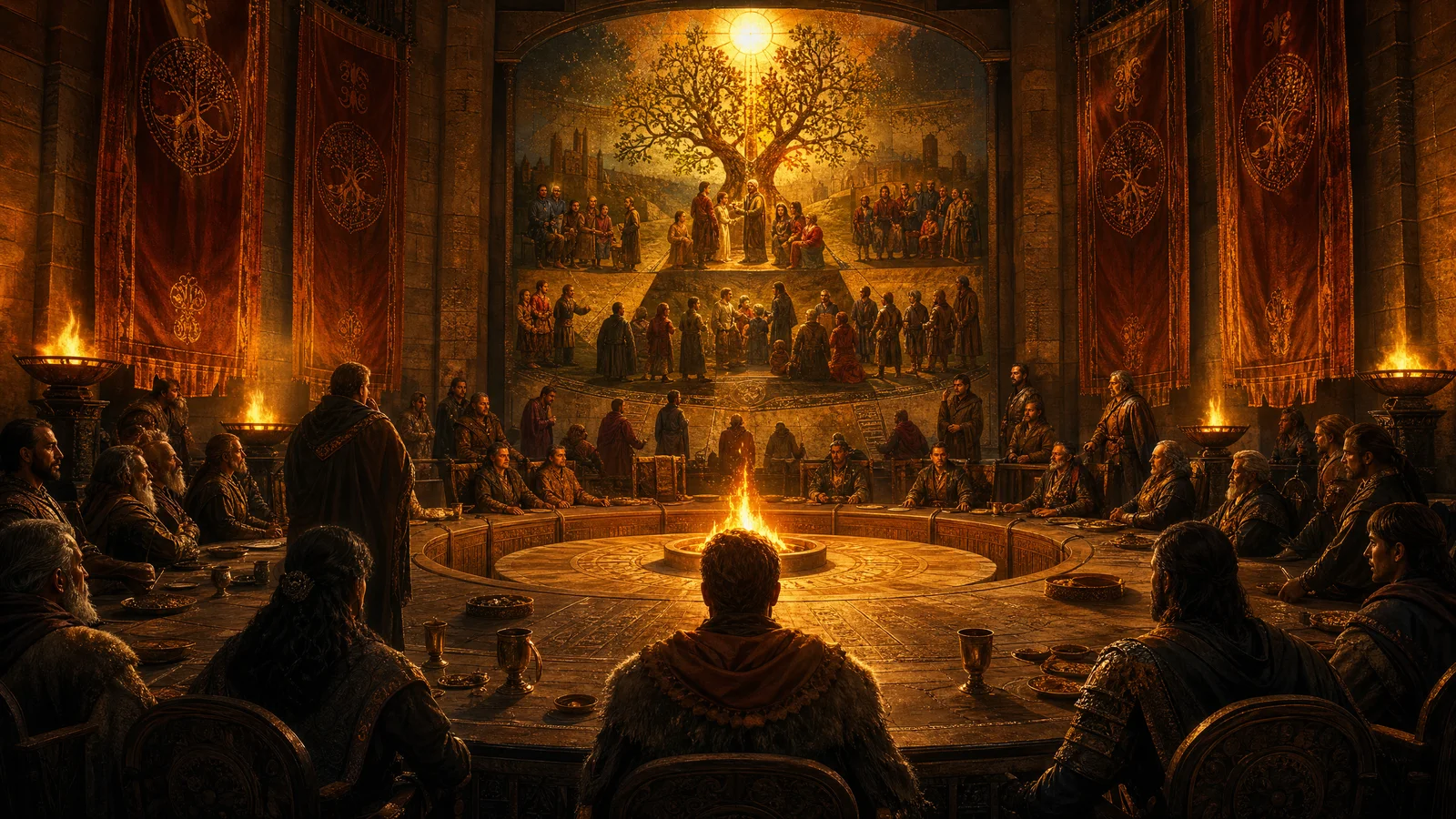
Complete Governance and Law: From Family to Nation
Without governance, communities fragment. This campaign covers leadership structures, dispute resolution, law, defense organization, and community building.
Chapter 1: Governance Structures
| Structure | Size | Decision Speed | Representation | Stability | Best For |
|---|---|---|---|---|---|
| Family/clan patriarch | 5-30 | Very fast | Low (one decides) | Moderate | Small family groups |
| Council of elders | 20-200 | Moderate | Moderate (experienced voices) | High | Villages, tribes |
| Direct democracy (assembly) | 50-500 | Slow | Very high (all vote) | Moderate | Small communities |
| Representative democracy | 100-unlimited | Moderate | High (elected delegates) | High | Towns, regions |
| Constitutional republic | 100-unlimited | Moderate | High (with protections) | Very high | Long-term governance |
| Military hierarchy | Any | Very fast | Low (chain of command) | High (short-term) | Crisis/defense only |
Chapter 2: Essential Laws (Minimum Viable Legal Code)
| Category | Core Principle | Enforcement | Penalty Range |
|---|---|---|---|
| Life (murder, assault) | No person may take or harm another's life without just cause | Community tribunal | Banishment to death (extreme) |
| Property (theft, destruction) | What a person creates or trades for is theirs | Community tribunal | Restitution + labor |
| Contract (promises, trade) | Agreements freely made must be honored | Arbitration | Specific performance or compensation |
| Family (marriage, children) | Children must be protected; unions are sacred | Elder council | Varies by offense |
| Community (duties, defense) | All able members contribute to common defense and infrastructure | Council | Loss of privileges, extra labor |
| Land (use, boundaries) | Land belongs to those who work it productively | Survey + council | Boundary adjustment |
| Dispute resolution | All conflicts resolved by process, not violence | Mandatory arbitration | Process-dependent |
Chapter 3: Dispute Resolution Process
| Step | Action | Who | Timeline | Binding? |
|---|---|---|---|---|
| 1 | Direct negotiation between parties | Disputants only | 1-7 days | No (voluntary) |
| 2 | Mediation (neutral third party facilitates) | Chosen mediator | 1-14 days | No (voluntary) |
| 3 | Arbitration (neutral party decides) | Appointed arbiter | 7-30 days | Yes (binding) |
| 4 | Tribunal (community panel of 5-7) | Elected/appointed judges | 14-60 days | Yes (binding, appealable) |
| 5 | Appeal (larger panel reviews) | Regional council | 30-90 days | Yes (final) |
Key principle: exhaust lower steps before escalating. Most disputes resolve at step 1-2 if both parties act in good faith. Tribunal reserved for serious matters (violence, major theft, banishment).
Chapter 4: Defense Organization
| Unit | Size | Leader | Function | Equipment |
|---|---|---|---|---|
| Fire team | 4 | Team leader | Basic tactical unit | Individual weapons |
| Squad | 8-12 | Squad leader | Patrol, guard duty | Individual weapons + 1 heavy |
| Platoon | 30-50 | Platoon leader | Area defense, operations | Mixed weapons |
| Company | 100-200 | Captain | Major operations | Full equipment |
| Militia (community) | All able adults | Elected commander | Total defense | Whatever available |
Militia organization: All able-bodied adults (16-60) train monthly. Rotating guard duty (2-4 hours/week per person). Alert system (bell, horn, radio). Rally points designated. Chain of command clear. Weapons maintained and accessible. Ammunition stored centrally.
Chapter 5: Community Infrastructure
| System | Priority | Responsibility | Maintenance | Governance Role |
|---|---|---|---|---|
| Water supply | Critical | Water committee | Daily monitoring | Ensure access for all |
| Food production | Critical | Individual + collective | Seasonal | Coordinate planting, resolve land disputes |
| Defense/security | Critical | Militia + council | Continuous | Organize, train, equip |
| Roads/bridges | High | Work crews (rotational) | Seasonal | Assign labor, prioritize projects |
| Education | High | Teachers (community-supported) | Continuous | Fund, oversee curriculum |
| Health/medical | High | Healers (community-supported) | Continuous | Fund, ensure access |
| Communication | Moderate | Comm team | Continuous | Maintain systems, relay information |
| Trade/market | Moderate | Market committee | Weekly | Set rules, resolve disputes, maintain standards |
| Justice | Moderate | Tribunal/council | As needed | Hear cases, enforce decisions |
| Records/archives | Moderate | Clerk/scribe | Continuous | Maintain births, deaths, property, laws |
Chapter 6: Economic Organization
| System | Complexity | Fairness | Efficiency | Best For |
|---|---|---|---|---|
| Barter (direct trade) | Very low | Variable | Low (double coincidence problem) | Very small groups, initial stage |
| Labor credits (time-based) | Low | High | Moderate | Small communities (50-200) |
| Commodity money (grain, salt, metal) | Moderate | Moderate | Moderate-high | Medium communities |
| Coined money (standardized metal) | Moderate-high | High | High | Larger communities, inter-community trade |
| Mixed (money + communal labor) | Moderate | High | High | Most communities |
Labor credit system: 1 hour of labor = 1 credit (regardless of task type). Credits tracked by community clerk. Spend credits for goods/services from others. Prevents hoarding, ensures all labor valued equally. Works well for communities of 50-200 people.
Reference Card
- Governance: start with council of elders (experienced, trusted). Transition to representative system as community grows.
- Laws: keep simple. Protect life, property, contracts. Resolve disputes through process, not violence.
- Defense: all able adults train. Rotating guard duty. Clear chain of command. Rally points. Alert system.
- Disputes: negotiate → mediate → arbitrate → tribunal. Most resolve at step 1-2 if good faith exists.
- Infrastructure: water and food first. Then defense. Then roads, education, health. Assign rotating labor crews.
- Economy: labor credits work for small communities. Transition to commodity/coined money as trade expands.
- Records: write everything down. Births, deaths, property, agreements, laws, decisions. Memory fails; records endure.
- Leadership: rotate positions. Term limits. No one holds power permanently. Accountability to community assembly.