Sovereignty Module: Fire the Earth
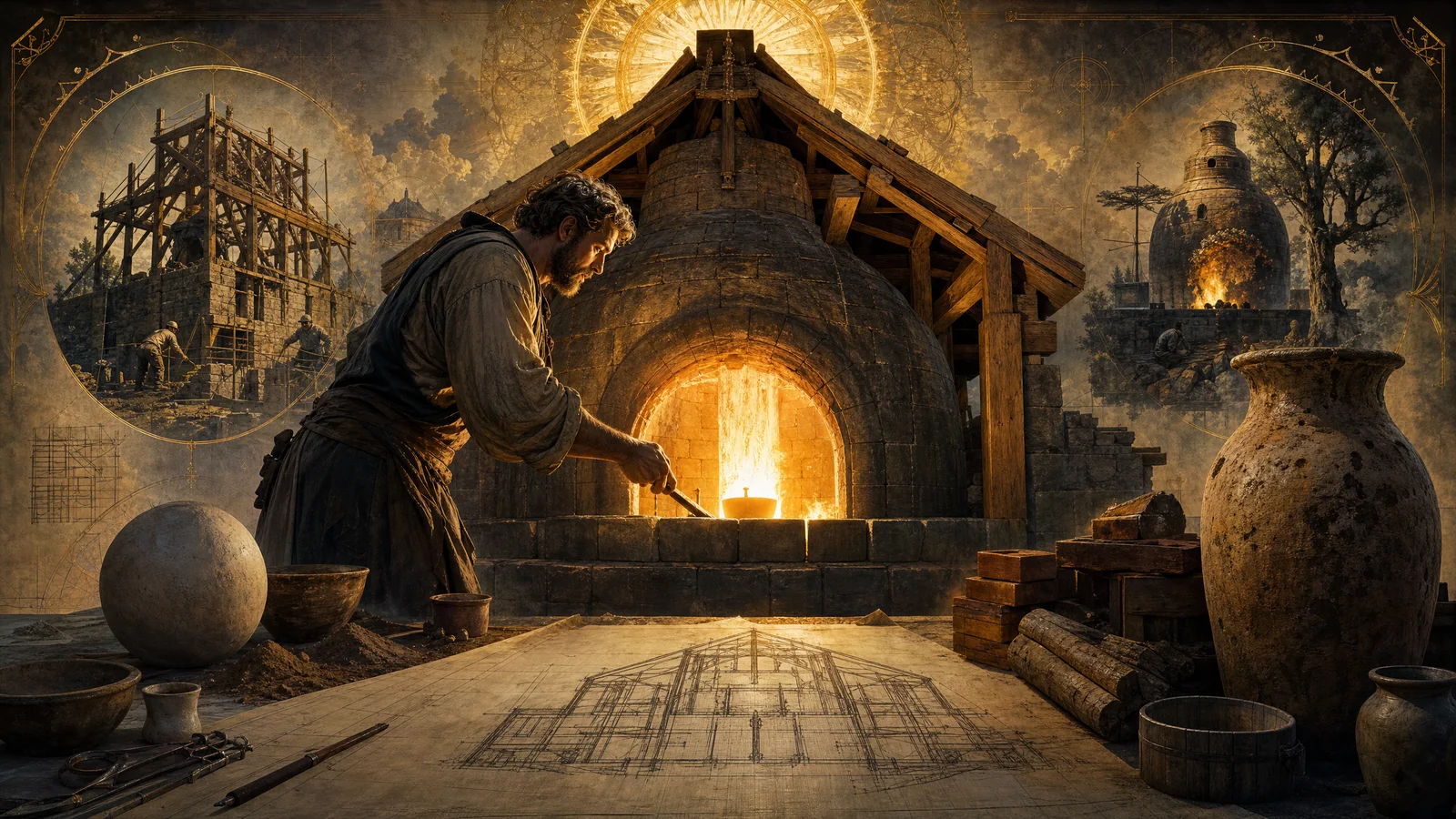
Fire the Earth
Complete Kiln Construction, Firing Techniques, and Advanced Ceramics Guide
Complete Kiln Construction, Firing Techniques, and Advanced Ceramics Guide
Kilns transform soft clay into permanent, waterproof vessels. From simple pit fires to advanced updraft kilns capable of stoneware temperatures, this campaign covers every method of controlled high-temperature firing and the ceramics they produce.
Chapter 1: Kiln Types
| Kiln Type | Max Temperature | Fuel | Complexity | Products |
|---|---|---|---|---|
| Open pit fire | 1200-1500F (650-800C) | Wood, dung | Very low | Earthenware, basic pots |
| Sawdust kiln | 1200-1600F (650-870C) | Sawdust | Low | Decorative, blackware |
| Updraft kiln (single chamber) | 1800-2300F (980-1260C) | Wood | Moderate | Earthenware to stoneware |
| Downdraft kiln | 2000-2400F (1090-1315C) | Wood, coal | High | Stoneware, porcelain |
| Anagama (tunnel kiln) | 2300-2500F (1260-1370C) | Wood (continuous) | High | Ash-glazed stoneware |
| Bottle kiln | 2000-2400F (1090-1315C) | Coal | High | Industrial pottery |
| Raku kiln | 1600-1900F (870-1040C) | Gas, wood | Moderate | Decorative raku ware |
Chapter 2: Building a Simple Updraft Kiln
| Step | Action | Materials |
|---|---|---|
| 1 | Select site (level, well-drained, away from structures) | Clear area 10x10 feet |
| 2 | Dig firebox trench (2 feet deep, 2 feet wide, 3 feet long) | Shovel |
| 3 | Build firebox walls with firebrick or dense clay brick | Firebrick or hand-formed clay bricks (fired first) |
| 4 | Install grate bars over firebox (iron bars or clay bars) | Supports ware above fire |
| 5 | Build kiln chamber walls (circular, 3-4 feet diameter, 3-4 feet tall) | Firebrick, clay mortar |
| 6 | Leave spy holes (2-3 small holes at different heights) | For observing pyrometric cones |
| 7 | Build dome or arch roof (leave flue hole at top) | Brick arch or removable clay dome |
| 8 | Install damper at flue | Controls draft and temperature |
| 9 | Dry kiln thoroughly (1-2 weeks) then fire slowly to cure | Prevents cracking |
Chapter 3: Firing Schedule
| Phase | Temperature Range | Rate | Duration | Purpose |
|---|---|---|---|---|
| Water smoking | Room temp to 400F (200C) | Very slow (50F/hour) | 4-8 hours | Drives off remaining moisture |
| Organic burnout | 400-1000F (200-540C) | Moderate (100F/hour) | 4-6 hours | Burns out organic matter |
| Quartz inversion | 1060F (573C) | SLOW through this point | Hold 30 min | Quartz crystal structure changes (critical) |
| Sintering | 1000-target temp | Moderate-fast | 4-8 hours | Clay particles fuse |
| Soaking | Target temperature | Hold steady | 30-60 min | Ensures even heat throughout |
| Cooling | Target to room temp | Natural (kiln sealed) | 12-48 hours | Too fast = cracking |
Chapter 4: Clay Bodies
| Type | Firing Temp | Properties | Color (fired) | Use |
|---|---|---|---|---|
| Earthenware | 1800-2100F (980-1150C) | Porous unless glazed, easy to work | Red, brown, buff | Flower pots, tiles, basic vessels |
| Stoneware | 2200-2400F (1200-1315C) | Vitrified (waterproof without glaze), strong | Gray, brown, tan | Storage vessels, cookware, pipes |
| Porcelain | 2300-2600F (1260-1430C) | Translucent, very strong, non-porous | White | Fine tableware, insulators |
| Terracotta | 1800-2000F (980-1090C) | Porous, warm color | Orange-red | Sculpture, architectural |
| Ball clay | 2200-2400F (1200-1315C) | Very plastic, fine-grained | Light buff to white | Added to other clays for plasticity |
Chapter 5: Glazes
| Glaze Type | Flux | Firing Temp | Result |
|---|---|---|---|
| Wood ash glaze | Wood ash (calcium, potassium) | 2200-2400F | Natural greens, browns, tans |
| Salt glaze | Sodium (table salt thrown in kiln) | 2300F+ | Orange-peel texture, clear to brown |
| Lead glaze (historical) | Lead oxide | 1800-2000F | Clear, glossy (TOXIC, historical only) |
| Feldspar glaze | Feldspar mineral | 2200-2400F | Smooth, varied colors |
| Slip glaze (Albany-type) | High-iron clay | 2200-2400F | Dark brown to black |
| Lime glaze | Limestone powder | 2200F+ | Matte white to cream |
Simple wood ash glaze recipe: 40% wood ash (washed) + 40% feldspar + 20% clay. Sieve through 80 mesh. Apply to bisque-fired ware. Fire to cone 6-10.
Chapter 6: Temperature Measurement
| Method | Accuracy | Range | Cost |
|---|---|---|---|
| Pyrometric cones (Orton cones) | Very high | Specific temps (each cone = one temp) | Moderate |
| Color of kiln interior | Low-moderate | 1000F+ | Free |
| Thermocouple + pyrometer | Very high | Full range | High |
| Draw trials (pull test pieces) | High | Full range | Low |
Color temperature guide: Dull red (1000F), Cherry red (1300F), Bright cherry (1500F), Orange (1800F), Yellow-orange (2000F), Yellow (2200F), Light yellow/white (2400F+).
Reference Card
- Quartz inversion at 1060F (573C) is critical: go slow or pots crack
- Updraft kiln: firebox below, ware above, flue at top
- Earthenware fires at 1800-2100F; stoneware at 2200-2400F
- Wood ash makes a free, natural glaze: wash ash, mix with feldspar and clay
- Cool kilns slowly (12-48 hours): fast cooling cracks everything
- Dry all ware completely before firing: moisture = explosion in kiln
- Pyrometric cones are the most reliable temperature indicator
- Salt glazing: throw salt into kiln at peak temperature for orange-peel surface
TransmissionCOMPLETE — unaltered & unabridged
Words931 — every one of them
SHA-256 of source texta3ac51818d9d4daa356f1d6162ded9c6e56e5968d9b82b0b228004863600da14
Canonical textdownload campaign-kilns.md — byte-identical to what this page renders