EDUCATIONAL & HISTORICAL CONTENT — This material documents historical firearms technology for academic study. Always comply with all applicable firearms laws in your jurisdiction. The publisher assumes no liability for any use or misuse of this information.
Sovereignty Module: Lock and Load
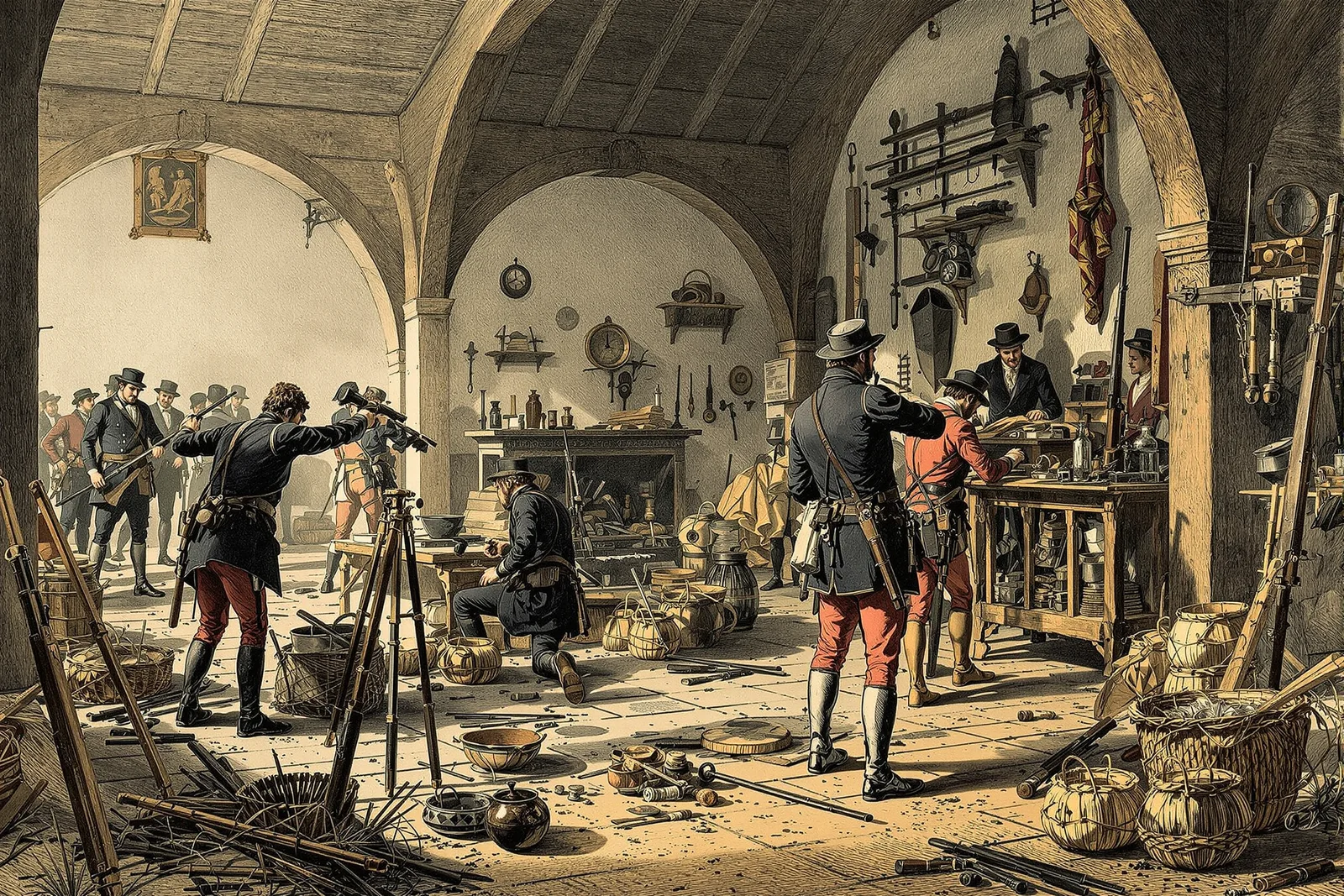
Complete Flintlock Mechanics and Black Powder Firearms: From Spark to Shot
Black powder firearms represent a critical technology transition. This campaign covers flintlock mechanisms, loading procedures, maintenance, and the principles of early firearms.
Chapter 1: Flintlock Mechanism
| Component | Material | Function | Maintenance |
|---|---|---|---|
| Lock plate | Steel | Mounts all mechanism components | Keep clean and oiled |
| Cock (hammer) | Steel | Holds flint, strikes frizzen | Check flint regularly |
| Flint | Knapped flint or agate | Creates sparks when striking frizzen | Replace when dull (every 20-30 shots) |
| Frizzen (steel) | Hardened steel | Struck by flint, produces sparks | Must be hard (re-harden if soft) |
| Frizzen spring | Spring steel | Holds frizzen closed over pan | Must be strong enough to resist opening |
| Pan | Steel (part of lock plate) | Holds priming powder | Keep clean, dry |
| Mainspring | Spring steel | Powers cock forward | Must be strong (reliable ignition) |
| Sear | Steel | Holds cock at half and full cock | Must engage reliably |
| Tumbler | Steel | Connects cock to sear | Notches must be clean |
| Bridle | Steel | Supports tumbler and frizzen pivot | Keep screws tight |
Firing sequence: 1) Cock pulled to full cock (sear engages full-cock notch). 2) Trigger pulled (sear releases tumbler). 3) Mainspring drives cock forward. 4) Flint strikes frizzen (scraping action). 5) Sparks shower into pan (frizzen pushed open by flint). 6) Priming powder in pan ignites. 7) Flash travels through touch hole into barrel. 8) Main charge ignites. 9) Expanding gas propels projectile. 10) Total lock time: approximately 30-50 milliseconds.
Chapter 2: Loading Procedure
| Step | Action | Safety | Time |
|---|---|---|---|
| 1. Half cock | Place lock at half cock (safety) | Prevents accidental firing | 2 sec |
| 2. Charge | Pour measured powder charge down barrel | Use powder measure, not horn | 5 sec |
| 3. Patch and ball | Place lubricated patch over muzzle, center ball, push with short starter | Patch must be centered | 5 sec |
| 4. Ram | Push ball to bottom with ramrod | Seat firmly on powder (no air gap) | 5 sec |
| 5. Prime | Open frizzen, pour small amount of fine powder in pan | Don't overfill pan | 3 sec |
| 6. Close frizzen | Snap frizzen closed over pan | Keeps priming in place | 1 sec |
| 7. Full cock | Pull cock to full cock | Ready to fire | 1 sec |
| 8. Aim and fire | Aim, squeeze trigger | Keep muzzle pointed safely | Variable |
Powder charges: 1) Measure powder by volume (not weight in the field). 2) General rule: equal volume of powder to ball diameter (e.g., .50 caliber = 50 grains). 3) Adjust for purpose: less for target, more for hunting. 4) Never exceed manufacturer's recommendation (if known). 5) Use FFg (double-F) for rifles and large pistols. 6) Use FFFg (triple-F) for priming pan and small pistols. 7) Never use FFFFg (quad-F) as main charge (too fast, dangerous). 8) Consistent charges = consistent accuracy.
Chapter 3: Maintenance
| Task | Frequency | Method | Why |
|---|---|---|---|
| Clean barrel | After every shooting session | Hot soapy water, patches, oil | Black powder residue is corrosive |
| Clean lock | After every session | Disassemble, wipe, oil | Residue causes misfires |
| Oil all metal | After cleaning and before storage | Light oil on all surfaces | Prevents rust |
| Check flint | Every 20-30 shots | Replace when dull or chipped | Dull flint = poor sparks = misfire |
| Check touch hole | Before each session | Clear with pick | Blocked = no ignition |
| Inspect wood | Monthly | Oil with linseed oil | Prevents cracking |
| Check screws | Monthly | Tighten all | Vibration loosens screws |
Barrel cleaning: 1) Remove barrel from stock (if possible). 2) Plug touch hole or nipple. 3) Fill barrel with hot soapy water. 4) Run wet patch through barrel (tight-fitting). 5) Repeat with clean patches until patches come out clean. 6) Run dry patches until dry. 7) Run oiled patch through barrel. 8) Clean touch hole with wire pick. 9) Oil all external metal. 10) Black powder residue absorbs moisture and causes rust; clean the same day you shoot.
Chapter 4: Black Powder
| Grade | Granulation | Use | Burn Rate |
|---|---|---|---|
| Fg (single) | Coarse | Cannons, large bore muskets | Slow |
| FFg (double) | Medium | Rifles, shotguns, large pistols | Moderate |
| FFFg (triple) | Fine | Small rifles, pistols, priming | Fast |
| FFFFg (quad) | Very fine | Priming pans only | Very fast |
Black powder composition: 1) Potassium nitrate (saltpeter): 75%. 2) Charcoal: 15%. 3) Sulfur: 10%. 4) All ingredients must be finely ground separately. 5) Mixed carefully (never grind mixed powder). 6) Corned (moistened, pressed, dried, broken into granules). 7) Granule size determines grade (Fg through FFFFg). 8) Store in cool, dry location away from heat and spark. 9) Black powder is classified as an explosive; handle with extreme care.
Chapter 5: Accuracy and Marksmanship
| Factor | Effect | Optimization |
|---|---|---|
| Powder charge | Velocity, recoil | Consistent measurement |
| Ball fit (patch thickness) | Gas seal, friction | Match patch + ball to bore |
| Patch lubrication | Reduces friction, seals gas | Consistent lube (spit, oil, beeswax) |
| Seating depth | Pressure consistency | Ram ball firmly to powder every time |
| Lock time | Time from trigger to ignition | Good flint, strong spring, clean touch hole |
| Trigger pull | Affects aim during release | Smooth, consistent pull |
| Sight alignment | Where ball goes | Front sight centered in rear notch |
| Follow-through | Maintaining aim through ignition | Don't flinch (hardest skill) |
Reference Card
- Seat the ball on the powder (an air gap between ball and powder can cause barrel failure; always ram firmly to the charge). 2. Measure powder, never pour from the horn (pouring from a powder horn near an ember in the barrel can ignite the horn; use a measure). 3. Clean the same day (black powder residue is hygroscopic and corrosive; a barrel left dirty overnight will pit). 4. Half cock is the safety (half cock prevents the cock from falling; always half cock when loading and moving). 5. Keep your flint sharp (a dull flint produces weak sparks; replace or re-knap every 20-30 shots). 6. Consistent loading equals accuracy (same powder charge, same patch, same ball, same seating depth, every time). 7. Never smoke near powder (black powder ignites from any spark or flame; no smoking, no open flames near powder). 8. Respect the weapon (black powder firearms are real weapons; all firearm safety rules apply with equal force).