Sovereignty Module: Measure the Land
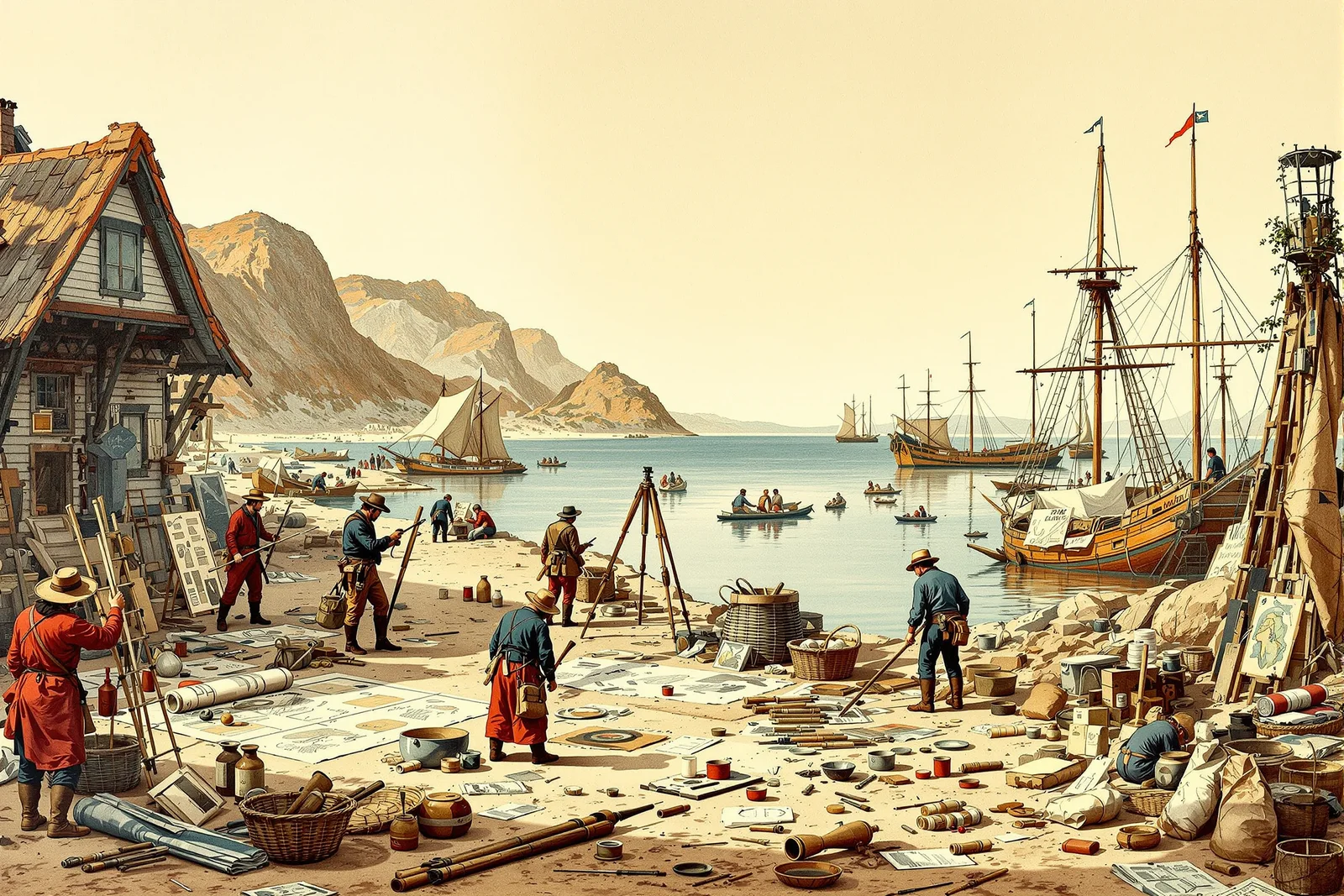
Complete Surveying and Mapping: From Compass to Cadastre
Accurate land measurement enables property rights, construction, road building, irrigation, and defense planning. This campaign covers instruments, measurement techniques, map creation, and property boundary establishment.
Chapter 1: Basic Instruments
| Instrument | Measures | Accuracy | Build Difficulty | Materials | Cost |
|---|---|---|---|---|---|
| Compass | Direction (bearing) | +/- 1-2 degrees | Low (if magnet available) | Magnetized needle, housing | Low |
| Level (water) | Horizontal plane | +/- 1/8 inch per 100 ft | Very low | Clear tube + water | Very low |
| Plumb bob | Vertical (true plumb) | Very high | Very low | Weight + string | Very low |
| Chain/tape | Distance | +/- 1 inch per 100 ft | Low | Chain links or rope | Low |
| Clinometer | Slope angle | +/- 1 degree | Low | Protractor + plumb bob | Very low |
| Transit/theodolite | Angles (horizontal + vertical) | +/- 1 minute of arc | Very high | Precision metalwork + optics | Very high |
| Ranging poles | Alignment | Visual | Very low | Straight poles, painted | Very low |
| Stadia rod | Distance (with transit) | +/- 1 ft per 100 ft | Low | Graduated pole | Low |
Water level (most useful DIY instrument): 1) Get clear flexible tubing (20-50 ft). 2) Fill with water (no air bubbles). 3) Water level at both ends is ALWAYS the same height (physics). 4) One person holds one end at reference point. 5) Other person moves their end until water matches a mark. 6) That point is exactly level with the reference. 7) Works around corners, over obstacles, any distance the tube reaches. 8) Accuracy: within 1/8 inch over 100 feet — better than most spirit levels.
Chapter 2: Distance Measurement
| Method | Range | Accuracy | Equipment | Speed | Best For |
|---|---|---|---|---|---|
| Pacing | Any | +/- 3-5% | None (calibrated stride) | Fast | Rough estimates |
| Chain/tape | 0-300 ft | +/- 0.1% | Chain or tape | Moderate | Property surveys |
| Stadia (optical) | 100-1000 ft | +/- 0.5% | Transit + stadia rod | Fast | Topographic mapping |
| Triangulation | Miles | +/- 0.01% | Transit + baseline | Slow (setup) | Large area surveys |
| Odometer (wheel) | Any | +/- 1-2% | Measuring wheel | Fast | Road measurement |
Pace calibration: 1) Measure exact 100-foot course (tape measure). 2) Walk it naturally 5 times, counting paces. 3) Average the count. 4) Your pace length = 100 / average count. 5) Typical: 2.5 ft per pace (40 paces per 100 ft). 6) Practice on different terrain (uphill paces shorter, downhill longer). 7) For rough work: 1,000 paces approximately = 1/2 mile.
Chapter 3: Angle Measurement and Bearings
| System | Format | Example | Use | Precision |
|---|---|---|---|---|
| Compass bearing | N/S + angle + E/W | N 45° E (= northeast) | Property descriptions | Degrees |
| Azimuth | 0-360° from north | 045° (= northeast) | Military, navigation | Degrees |
| Interior angles | Angle at each corner | 90° (right angle) | Closed traverses | Degrees + minutes |
| Deflection angles | Turn from straight ahead | R 30° (right turn 30°) | Road surveys | Degrees |
Compass survey (property boundary): 1) Start at known corner (monument, stake). 2) Set up compass, sight to next corner. 3) Read bearing (e.g., N 45° E). 4) Measure distance to next corner (chain/tape). 5) Move to next corner, repeat. 6) Continue around entire property. 7) Return to starting point (closure). 8) If you don't return exactly: error exists — distribute proportionally. 9) Record all bearings and distances (the "metes and bounds" description).
Chapter 4: Elevation and Topography
| Method | Accuracy | Range | Equipment | Speed | Application |
|---|---|---|---|---|---|
| Water level | +/- 1/8" | Tube length (50-100 ft) | Tube + water | Slow | Construction, foundations |
| Hand level + rod | +/- 0.1 ft | 100-200 ft | Hand level, rod | Moderate | Rough profiles |
| Dumpy level + rod | +/- 0.01 ft | 300+ ft | Level instrument, rod | Moderate | Precise elevation |
| Clinometer + distance | +/- 1 ft | Any | Clinometer, tape | Fast | Slope profiles |
| Barometric | +/- 10-50 ft | Any elevation | Barometer | Fast | Mountain heights |
Profile leveling (for irrigation/road grade): 1) Set up level instrument at midpoint. 2) Read rod at starting point (backsight). 3) Read rod at next point along route (foresight). 4) Difference = elevation change between points. 5) Move instrument forward, repeat. 6) Chain readings together for continuous profile. 7) Plot on graph paper (distance horizontal, elevation vertical). 8) Design grade line on profile (desired slope for water flow or road).
Chapter 5: Map Making
| Map Type | Scale | Content | Use | Skill Level |
|---|---|---|---|---|
| Sketch map | Approximate | Major features, routes | Quick reference, planning | Low |
| Property plat | 1:500 to 1:2000 | Boundaries, corners, area | Legal ownership | Moderate |
| Topographic | 1:5000 to 1:50000 | Contours, features, roads | Planning, navigation | High |
| Road/route | Variable | Alignment, grade, features | Construction | Moderate-high |
| Military/tactical | 1:25000 to 1:50000 | Terrain, cover, obstacles | Defense planning | High |
Map drawing procedure: 1) Choose scale (fit area on available paper). 2) Establish north arrow and scale bar. 3) Plot control points first (surveyed corners, known locations). 4) Draw boundaries and major features. 5) Add topographic detail (contour lines from elevation data). 6) Label all features (names, elevations, distances). 7) Add legend (symbols used). 8) Title block (area name, date, surveyor, scale).
Chapter 6: Property Establishment
| Element | Purpose | Method | Permanence | Legal Weight |
|---|---|---|---|---|
| Corner monuments | Mark boundary corners | Stone, iron pipe, concrete | Permanent | Highest |
| Boundary description | Legal text defining property | Metes and bounds or lot/block | Written record | Highest |
| Area calculation | Determine property size | Coordinate geometry or planimeter | Calculated | Supporting |
| Witness trees/marks | Help relocate corners | Blaze trees, note distance/bearing | Semi-permanent | Supporting |
| Plat map | Visual representation | Drawn to scale from survey | Recorded document | High |
| Registration | Public record | Filed with community recorder | Permanent record | Highest |
Reference Card
- Water level never lies (water always finds its own level — most reliable instrument you can build). 2. Close your traverse (survey must return to start — if it doesn't close, there's an error). 3. Measure twice (one wrong measurement ruins entire survey — verify everything). 4. Permanent monuments (property corners must survive generations — use stone, iron, or concrete). 5. Written records outlast memory (bearings, distances, and descriptions on paper prevent disputes). 6. North is reference (all bearings reference magnetic or true north — state which you're using). 7. Triangulation extends range (one measured baseline + angles = distances to remote points). 8. Contour lines show shape (connect points of equal elevation — spacing shows steepness).