Sovereignty Module: Master the Anvil
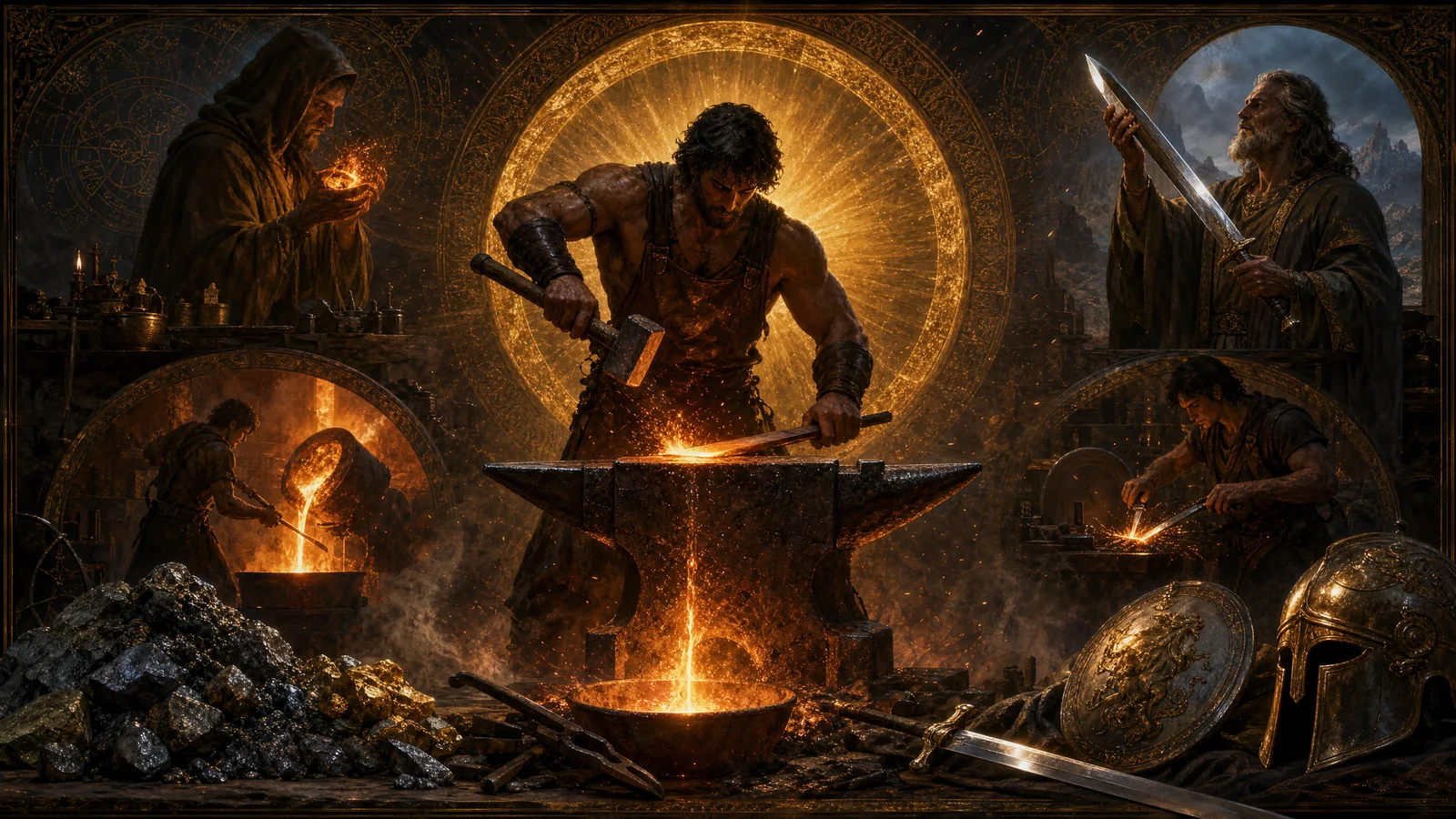
Complete Metalworking: From Ore to Finished Product
Metal tools and weapons define civilization's capability. This campaign covers prospecting, smelting, forging, casting, and finishing metals.
Chapter 1: Metal Properties
| Metal | Melting Point | Hardness | Workability | Corrosion | Sources | Primary Uses |
|---|---|---|---|---|---|---|
| Copper | 1,984°F | Soft | Excellent (cold/hot work) | Moderate (patina) | Malachite, azurite, native copper | Wire, pipe, alloys, cookware |
| Tin | 450°F | Very soft | Excellent | Very low | Cassiterite ore | Alloy with copper (bronze), plating |
| Bronze (Cu+Sn) | 1,750°F | Moderate-hard | Good | Low | Copper + tin (90/10) | Tools, bells, bearings, weapons |
| Iron (wrought) | 2,800°F | Moderate | Good (hot work) | High (rusts) | Hematite, magnetite, bog iron | Tools, hardware, structural |
| Steel (carbon) | 2,500°F | Hard-very hard | Moderate (hot work) | High (rusts) | Iron + carbon (0.2-1.5%) | Cutting tools, springs, weapons |
| Cast iron | 2,100°F | Very hard (brittle) | Cast only (not forged) | Moderate | Blast furnace (iron + excess carbon) | Cookware, stoves, machine parts |
| Lead | 621°F | Very soft | Excellent | Very low | Galena ore | Bullets, solder, weights, roofing |
| Zinc | 787°F | Moderate | Good | Low | Smithsonite, sphalerite | Galvanizing, alloy (brass) |
| Brass (Cu+Zn) | 1,700°F | Moderate | Excellent | Low | Copper + zinc (60-70/30-40) | Hardware, instruments, decoration |
| Aluminum | 1,221°F | Soft-moderate | Excellent | Very low | Bauxite (requires electricity) | Lightweight structures, cookware |
| Silver | 1,764°F | Soft | Excellent | Low (tarnish) | Native, argentite ore | Jewelry, currency, antibacterial |
| Gold | 1,948°F | Very soft | Excellent | None | Native (placer, lode) | Currency, jewelry, electronics |
Chapter 2: Forge Construction
| Component | Material | Size | Purpose | Notes |
|---|---|---|---|---|
| Firepot | Cast iron or steel plate | 8-12 inch diameter, 4-6 inch deep | Contain fire, direct air | Heart of the forge |
| Tuyere (air inlet) | Steel pipe | 1-2 inch diameter | Deliver air to fire | Angled up into firepot |
| Bellows/blower | Leather + wood or electric blower | Sufficient for 200+ CFM | Force air into fire | Bellows: traditional. Blower: easier |
| Forge table | Steel plate or brick | 30x30 inch minimum | Support fire, hold work | Waist height (comfortable) |
| Chimney/hood | Sheet metal | 18-24 inch opening | Remove smoke | Essential for indoor forge |
| Anvil | Cast/forged steel | 100-300 lbs | Shape metal | Flat face, horn, hardy hole |
| Slack tub | Metal or stone container | 5-20 gallons | Quench hot metal | Water or oil (for hardening) |
| Tool rack | Wood or metal | Wall-mounted | Organize tools | Within arm's reach of anvil |
Charcoal forge (simplest): Dig pit 12 inches deep, 18 inches wide. Line with firebrick or stone. Install tuyere (pipe) from side, angled up. Connect to bellows or blower. Fill with charcoal. Light. Pump air. Achieves welding heat (2,300°F+) in minutes. Cost: nearly free if you make charcoal.
Chapter 3: Essential Forging Operations
| Operation | Temperature | Tools | Technique | Result |
|---|---|---|---|---|
| Drawing out | Yellow-white heat | Hammer, anvil | Strike at angle, rotate 90°, repeat | Lengthens and thins metal |
| Upsetting | Yellow heat | Hammer, anvil face | Strike end-on (compress) | Thickens metal (for heads, etc.) |
| Bending | Orange-yellow heat | Hammer, anvil horn/edge | Strike over edge or horn | Creates angles and curves |
| Punching | Yellow heat | Punch, hammer, anvil | Drive punch through | Creates holes (no metal lost) |
| Drifting | Orange heat | Drift (tapered tool) | Drive through punched hole | Enlarges/shapes holes |
| Splitting | Yellow heat | Hot chisel, hammer | Cut partway through | Divides metal (for forks, etc.) |
| Welding (forge) | White/sparking heat | Hammer, flux (borax) | Clean, flux, heat to welding, strike | Joins two pieces permanently |
| Twisting | Orange-red heat | Vise, wrench | Grip ends, twist | Decorative, strengthens |
| Scrolling | Orange heat | Hammer, anvil horn, scroll jig | Bend progressively tighter | Decorative ends, hooks |
| Fullering | Yellow heat | Fuller tool, hammer | Strike with rounded tool | Creates grooves, necks down |
Chapter 4: Heat Treatment
| Process | Temperature | Cooling | Result | Used For |
|---|---|---|---|---|
| Hardening | Critical temp (1,475°F for medium carbon) | Quench in oil or water (fast) | Maximum hardness (brittle) | Cutting edges, springs |
| Tempering | 350-600°F (after hardening) | Air cool | Reduces brittleness, retains hardness | All hardened tools (essential) |
| Annealing | Critical temp | Furnace cool (very slow) | Maximum softness | Before machining, after cold work |
| Normalizing | Above critical temp | Air cool | Refines grain, moderate hardness | After forging, before hardening |
| Case hardening | 1,500-1,700°F + carbon source | Quench | Hard surface, soft core | Wear surfaces, gears |
Tempering colors (steel): Straw yellow (400°F) = files, razors. Gold (430°F) = drills, taps. Brown (460°F) = scissors, axes. Purple (500°F) = knives, chisels. Blue (560°F) = springs, saws. Grey (600°F) = screwdrivers. Heat slowly, watch color, quench when correct color reaches cutting edge.
Chapter 5: Casting
| Method | Metals | Detail | Volume | Equipment | Best For |
|---|---|---|---|---|---|
| Sand casting | All (especially iron, bronze, aluminum) | Moderate | Any | Flask, sand, pattern | General parts, large items |
| Lost wax (investment) | Bronze, gold, silver | Very high | Small-medium | Wax, plaster, kiln | Jewelry, complex shapes |
| Permanent mold | Lead, zinc, aluminum | Moderate | Production runs | Metal mold (machined) | Repeated identical parts |
| Centrifugal | All | Good | Rings, pipes | Spinning mold | Hollow cylinders, rings |
Sand casting procedure: 1) Make pattern (wood, exact shape of desired part + shrinkage allowance). 2) Pack sand around pattern in flask (two halves). 3) Remove pattern (leaves cavity). 4) Cut gates and risers (channels for metal flow). 5) Close flask. 6) Pour molten metal. 7) Cool. 8) Break out, clean, finish. Sand: fine silica sand + clay binder (bentonite) + water. Reusable.
Chapter 6: Projects
| Project | Steel Needed | Difficulty | Time | Tools | Skills Practiced |
|---|---|---|---|---|---|
| S-hook | 1/4" round, 8" | Beginner | 15 min | Hammer, anvil, tongs | Scrolling, tapering |
| Nail | 1/4" square, 4" | Beginner | 5 min | Hammer, anvil, header | Drawing, heading |
| Knife (simple) | 1/4" x 1" flat, 8" | Moderate | 2-4 hours | Hammer, anvil, grinder, quench | Tapering, heat treat, grinding |
| Tongs | 3/8" round, 18" each | Moderate | 2-3 hours | Hammer, anvil, punch | Drawing, bending, riveting |
| Axe head | 1" x 2" flat, 6" | Advanced | 4-8 hours | Hammer, anvil, drift, welder | Punching, drifting, welding, heat treat |
| Chain link | 3/8" round, 6" each | Moderate | 30 min/link | Hammer, anvil, mandrel | Bending, forge welding |
| Hinge | 1/4" x 1" flat, 8" | Moderate | 1-2 hours | Hammer, anvil, mandrel | Scrolling, punching, riveting |
| Chisel | 3/4" octagon, 8" | Moderate | 1-2 hours | Hammer, anvil, grinder | Tapering, heat treat |
Reference Card
- Steel selection: mild steel (1018/A36) for structural, medium carbon (1045/1075) for tools, high carbon (1084/1095) for cutting edges. Higher carbon = harder but more brittle.
- Heat colors: black = too cold. Dark red (1,100°F) = minimum forging. Cherry red (1,400°F) = good forging. Orange (1,700°F) = easy forging. Yellow (2,000°F) = welding range. White/sparking = too hot (burning steel).
- Quench: oil for most tool steels (slower, less shock). Water for mild steel and some specific steels. Never quench in water if unsure — oil is safer.
- Temper ALWAYS: hardened steel without tempering WILL break. Heat to 400-500°F after hardening. Watch colors. This is not optional.
- Charcoal fuel: makes excellent forge fuel. Burns hotter than coal with less sulfur (which damages steel). Make your own from hardwood.
- Anvil: heavier is better. 150 lbs minimum for serious work. Mount at knuckle height. Secure firmly. The anvil IS the blacksmith's most important tool.
- Safety: leather apron, safety glasses, ear protection. Hot metal looks the same as cold metal. Never reach across the anvil. Keep floor clear.
- Practice: start with S-hooks and nails. Graduate to tongs and knives. Every project teaches new skills. 100 hours = basic competence. 1,000 hours = journeyman.