Sovereignty Module: Master the Forge
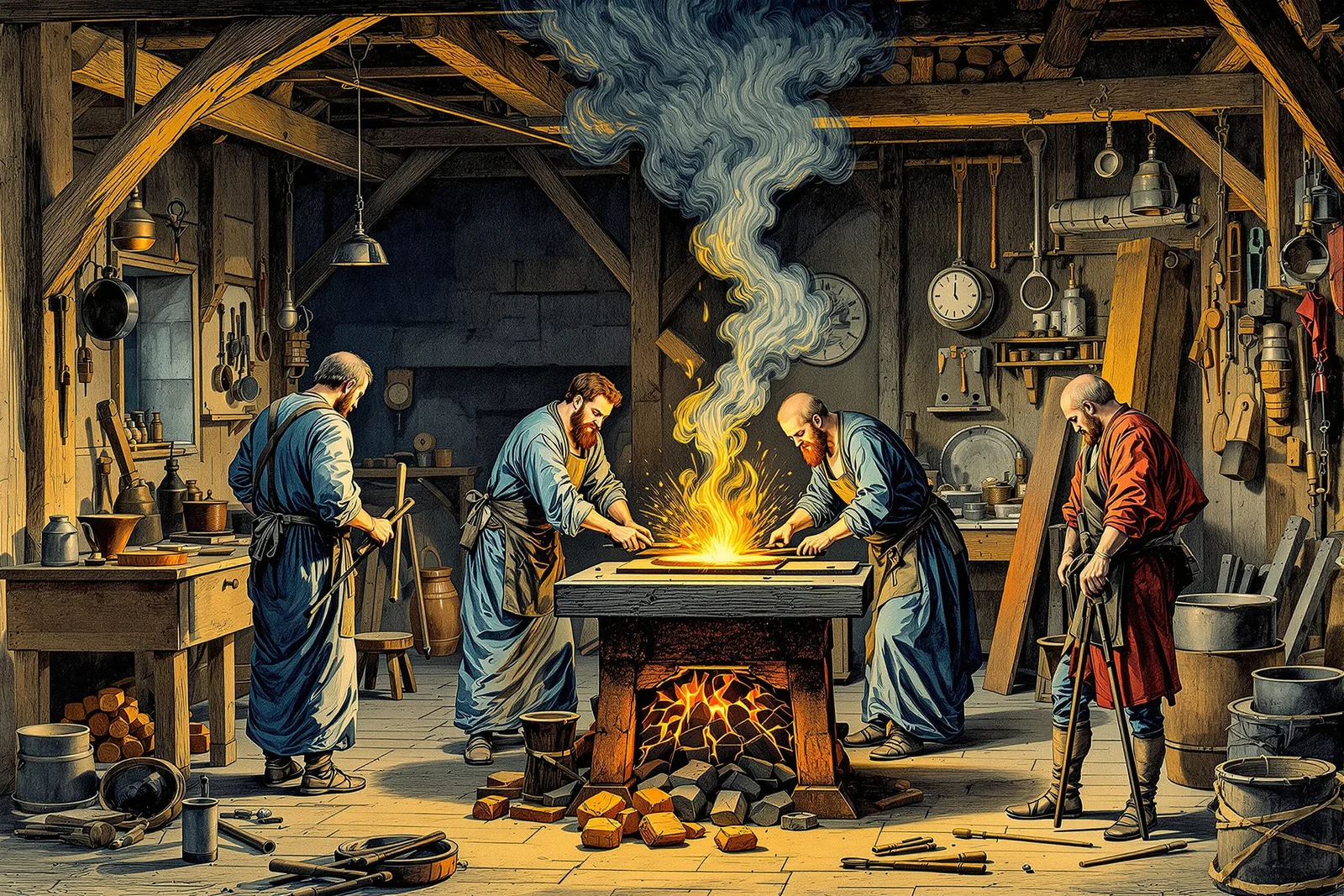
Complete Metalworking: From Ore to Finished Product
Metal transforms civilization. This campaign covers prospecting, smelting, forging, casting, and finishing of iron, steel, copper, bronze, and precious metals.
Chapter 1: Prospecting and Ore Identification
| Metal | Ore Appearance | Found In | Indicator Plants/Signs | Processing Difficulty |
|---|---|---|---|---|
| Iron | Red/brown/black heavy rocks | Everywhere (most common) | Red soil, rust-colored streams | Moderate |
| Copper | Green/blue staining on rocks | Volcanic areas, old mountains | Malachite green staining | Moderate |
| Tin | Black heavy grains in streams | Granite areas, alluvial deposits | Heavy black sand in panning | Moderate |
| Gold | Yellow flakes/nuggets | Quartz veins, stream beds | Heavy yellow in pan, quartz veins | Low (smelting), high (finding) |
| Silver | Grey/black tarnished, with lead | Volcanic areas, with galena | Lead ore often contains silver | High |
| Lead | Heavy grey cubic crystals (galena) | Limestone areas | Very heavy grey rocks | Low |
| Zinc | Grey/brown with copper ores | With copper deposits | Associated with copper | Moderate |
Bog iron: Easiest iron source for beginners. Found in swamps, bogs, and stream beds as orange-brown nodules. Bacteria concentrate iron from groundwater. Harvest nodules, dry, roast, then smelt. Renewable — reforms in 20-30 years.
Chapter 2: Smelting
| Metal | Melting Point | Fuel Required | Furnace Type | Flux | Output |
|---|---|---|---|---|---|
| Copper | 1984°F | Charcoal | Pit or shaft furnace | None or limestone | Copper ingot |
| Bronze (Cu+Sn) | 1750°F | Charcoal | Crucible in furnace | Borax | Bronze ingot |
| Iron (bloomery) | 2800°F (doesn't fully melt) | Charcoal (lots) | Bloomery furnace | Limestone | Iron bloom (spongy) |
| Steel (from iron) | 2500°F | Charcoal | Forge or cementation | None | Steel billet |
| Lead | 621°F | Wood fire | Open pot | None | Lead ingot |
| Gold | 1948°F | Charcoal | Crucible | Borax | Gold button |
Bloomery iron smelting: 1) Build furnace (clay cylinder, 3-4 ft tall, 12 inch interior diameter). 2) Tuyere (clay pipe for bellows air, angled down). 3) Preheat furnace (burn wood 1 hour). 4) Charge: alternate layers of charcoal and crushed ore (1:1 ratio by volume). 5) Maintain air blast (bellows continuously, 4-8 hours). 6) Temperature: 2200-2800°F (iron doesn't melt, forms spongy bloom). 7) Break open furnace bottom. 8) Remove bloom (white hot). 9) Hammer immediately to consolidate and expel slag. 10) Result: wrought iron (workable, weldable).
Chapter 3: Forging Techniques
| Technique | Purpose | Temperature | Tools | Difficulty |
|---|---|---|---|---|
| Drawing out | Lengthen/thin metal | Yellow-white heat | Hammer, anvil | Low |
| Upsetting | Thicken/shorten metal | Yellow heat | Hammer, anvil | Moderate |
| Bending | Create angles/curves | Orange-yellow heat | Hammer, anvil, bending fork | Low |
| Punching | Create holes | Orange heat | Punch, anvil (over hardy hole) | Low |
| Splitting | Divide metal | Orange heat | Hot chisel, anvil | Low |
| Forge welding | Join two pieces | White heat (sparking) | Hammer, flux (borax) | High |
| Twisting | Decorative/strengthen | Orange heat | Tongs, vise, wrench | Low |
| Scrolling | Decorative curves | Orange heat | Scroll jig, hammer | Moderate |
| Hardening | Make steel hard | Cherry red → quench | Quench tank (oil or water) | Moderate |
| Tempering | Reduce brittleness | Straw-blue colors (350-600°F) | Torch or oven | Moderate |
Heat colors (critical for forging): Black heat (below working) → Dark red (1000°F, barely visible) → Cherry red (1400°F, good for bending) → Orange (1700°F, general forging) → Yellow (1900°F, heavy work) → Light yellow (2100°F, forge welding) → White/sparking (2300°F+, burning — too hot).
Chapter 4: Casting
| Method | Metals | Detail Level | Complexity | Best For |
|---|---|---|---|---|
| Sand casting | All | Moderate | Moderate | Large parts, simple shapes |
| Lost wax (investment) | All | Very high | High | Jewelry, complex shapes |
| Permanent mold | Low-melting (lead, zinc, aluminum) | Good | Moderate | Repeated identical parts |
| Open mold | All | Low | Very low | Ingots, simple shapes |
Sand casting process: 1) Make pattern (wood or wax model of desired object). 2) Pack green sand (sand + clay + water) around pattern in flask (two-part box). 3) Remove pattern (leaves cavity). 4) Cut sprue (pour hole) and vents. 5) Close flask halves. 6) Pour molten metal. 7) Cool completely. 8) Break out casting. 9) Clean, file, finish.
Chapter 5: Projects and Applications
| Project | Metal | Skill Level | Time | Essential For |
|---|---|---|---|---|
| Nails | Iron/steel | Beginner | 5-10 min each | Construction |
| Knife | Steel | Intermediate | 2-4 hours | Daily use, survival |
| Axe head | Steel | Intermediate-advanced | 4-8 hours | Forestry, construction |
| Hinge | Iron | Beginner | 30-60 min | Doors, gates |
| Chain links | Iron | Beginner-intermediate | 15-30 min each | Lifting, securing |
| Plow point | Steel | Advanced | 4-8 hours | Agriculture |
| Horseshoe | Iron | Intermediate | 30-60 min | Draft animals |
| Sword/spear | Steel | Advanced | 8-20 hours | Defense |
Reference Card
- Charcoal is essential (wood doesn't get hot enough for iron). 2. Air supply is everything (bigger bellows = hotter fire). 3. Work at correct heat color (too cold = cracks, too hot = burns). 4. Quench steel in oil (water can crack it). 5. Temper after hardening (always — brittle steel breaks). 6. Flux for forge welding (borax prevents oxidation). 7. Let the hammer do the work (heavy hammer, controlled swing). 8. Safety: leather apron, eye protection, tongs for everything hot.