Sovereignty Module: Mix the Ink
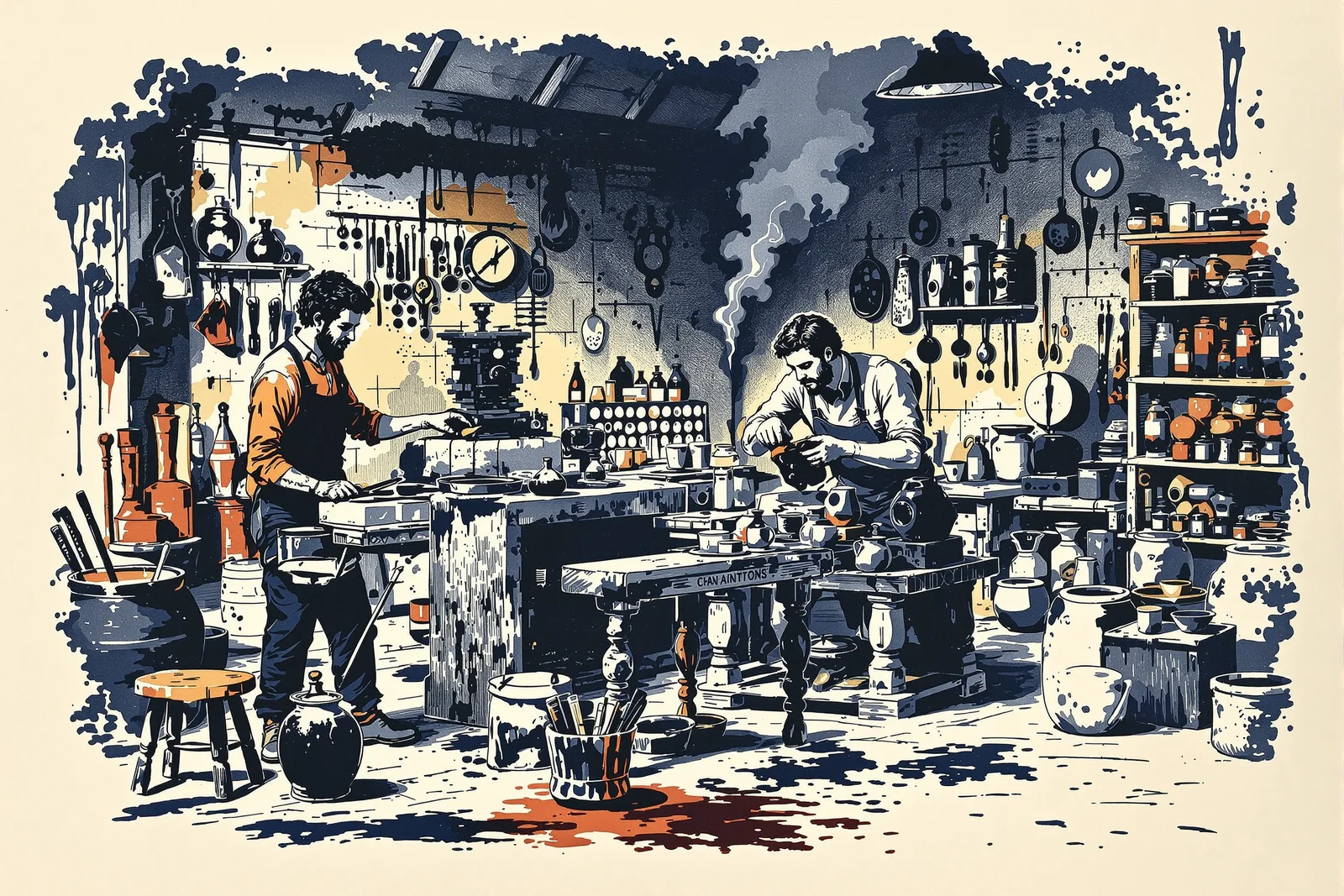
Complete Ink and Writing Materials: From Soot to Script
The ability to record information is the foundation of civilization. This campaign covers ink making, pen construction, paper alternatives, and bookbinding.
Chapter 1: Ink Types
| Ink Type | Color | Permanence | Difficulty | Ingredients |
|---|---|---|---|---|
| Carbon ink (lamp black) | Deep black | Excellent (lightfast) | Low | Soot, water, binder (gum arabic) |
| Iron gall ink | Blue-black (darkens) | Very good | Moderate | Oak galls, iron sulfate, gum arabic |
| Walnut ink | Warm brown | Good | Very low | Walnut hulls, water |
| Berry ink | Red/purple | Poor (fades) | Very low | Berries, vinegar, salt |
| Pokeberry ink | Deep red-purple | Moderate | Very low | Pokeberries, vinegar |
| Charcoal ink | Gray-black | Good | Very low | Charcoal powder, water, binder |
Chapter 2: Carbon Ink Production
Carbon ink recipe: 1) Collect soot (lamp black): hold metal plate over candle or oil lamp flame. 2) Scrape accumulated soot into container. 3) Alternative: burn pine resin in enclosed space, collect soot. 4) Grind soot as fine as possible (mortar and pestle). 5) Mix soot with water (start with thick paste). 6) Add binder: gum arabic (tree sap from acacia) dissolved in water. 7) Ratio: 1 part soot, 2 parts water, 1/2 part gum arabic solution. 8) Mix thoroughly until smooth. 9) Strain through fine cloth to remove lumps. 10) Adjust consistency: add water for thinner ink, more soot for darker. 11) Store in sealed container (lasts months to years). 12) Carbon ink is lightfast and waterproof when dry.
| Component | Function | Source | Proportion |
|---|---|---|---|
| Carbon (soot) | Pigment (color) | Candle soot, lamp black, charcoal | 1 part |
| Water | Carrier (vehicle) | Clean water | 2 parts |
| Gum arabic | Binder (adhesion) | Acacia tree sap | 1/2 part dissolved |
| Honey (optional) | Humectant (prevents drying) | Beekeeping | Few drops |
| Clove oil (optional) | Preservative | Clove buds | Few drops |
Chapter 3: Iron Gall Ink
Iron gall ink recipe: 1) Collect oak galls (round growths on oak trees caused by wasps). 2) Crush galls into small pieces. 3) Soak crushed galls in water for 2-3 days (or boil for 1 hour). 4) Strain liquid (contains tannic acid). 5) Add iron sulfate (copperas/green vitriol): 1 part iron sulfate to 3 parts gall extract. 6) Iron reacts with tannin to form blue-black pigment. 7) Add gum arabic as binder (1/2 part dissolved in water). 8) Stir thoroughly. 9) Ink starts pale but darkens as it oxidizes on paper. 10) Iron gall ink bites into paper (very permanent). 11) Warning: excess iron sulfate can corrode paper over centuries.
Chapter 4: Writing Instruments
| Instrument | Material | Difficulty | Line Quality | Durability |
|---|---|---|---|---|
| Quill pen | Goose/turkey feather | Low | Excellent (flexible) | Moderate (re-cut often) |
| Reed pen | Phragmites reed, bamboo | Very low | Good (bold) | Low (re-cut often) |
| Brush | Animal hair, bamboo handle | Moderate | Excellent (varied) | Good |
| Metal nib (dip pen) | Steel, copper | High (smithing) | Excellent | Very good |
| Stylus (wax tablet) | Wood, bone, metal | Very low | Moderate | Excellent |
| Charcoal stick | Charcoal | Very low | Moderate (broad) | Low (breaks) |
Quill pen preparation: 1) Select large flight feather (goose, turkey, swan). 2) Strip barbs from lower 2-3 inches of shaft. 3) Cure quill: soak in water overnight, then heat in hot sand (300°F for 10 minutes). 4) Curing hardens the shaft and makes it more durable. 5) Cut nib: slice shaft at 45-degree angle. 6) Cut slit: thin cut from center of nib tip, 1/4 inch long. 7) Shape nib: trim sides for desired width. 8) Slit holds ink by capillary action. 9) Re-cut nib as it wears (every few pages).
Chapter 5: Paper Alternatives
| Writing Surface | Difficulty | Durability | Availability | Reusable |
|---|---|---|---|---|
| Birch bark | Very low | Good | Northern forests | No |
| Papyrus | Moderate | Good | Wetlands (Cyperus) | No |
| Parchment (animal skin) | High | Excellent | Animal husbandry | Can scrape and reuse |
| Wax tablet | Low | N/A (temporary) | Beeswax, wood | Yes (smooth and rewrite) |
| Clay tablet | Very low | Excellent (if fired) | Clay deposits | No (once dried/fired) |
| Slate | Very low | Excellent | Quarried | Yes (wipe clean) |
| Homemade paper | Moderate | Good | Plant fiber, screen | No |
Reference Card
- Carbon ink is the simplest and most permanent (soot plus water plus a binder; carbon ink has survived thousands of years on ancient manuscripts). 2. Iron gall ink bites into paper (the chemical reaction between iron and tannin creates a permanent bond with paper fibers; this is why historical documents survive). 3. A quill pen is free and excellent (a goose or turkey feather, properly cured and cut, produces writing quality equal to the finest steel nibs). 4. Cure the quill before cutting (soaking and heating the quill shaft hardens it and prevents splitting; an uncured quill is soft and wears quickly). 5. The slit holds the ink (the thin slit in the nib tip holds ink by capillary action and releases it as you write; without the slit, the pen cannot write). 6. Gum arabic is the universal binder (dissolved acacia sap binds pigment to paper; without a binder, ink smears and flakes off). 7. Walnut ink requires no chemistry (boil walnut hulls in water for a beautiful, permanent brown ink; it is the easiest ink to make from foraged materials). 8. Record everything (the ability to write and preserve knowledge is the foundation of civilization; make ink, make pens, and write down everything you learn).