Campaign 112: Know the Fungus
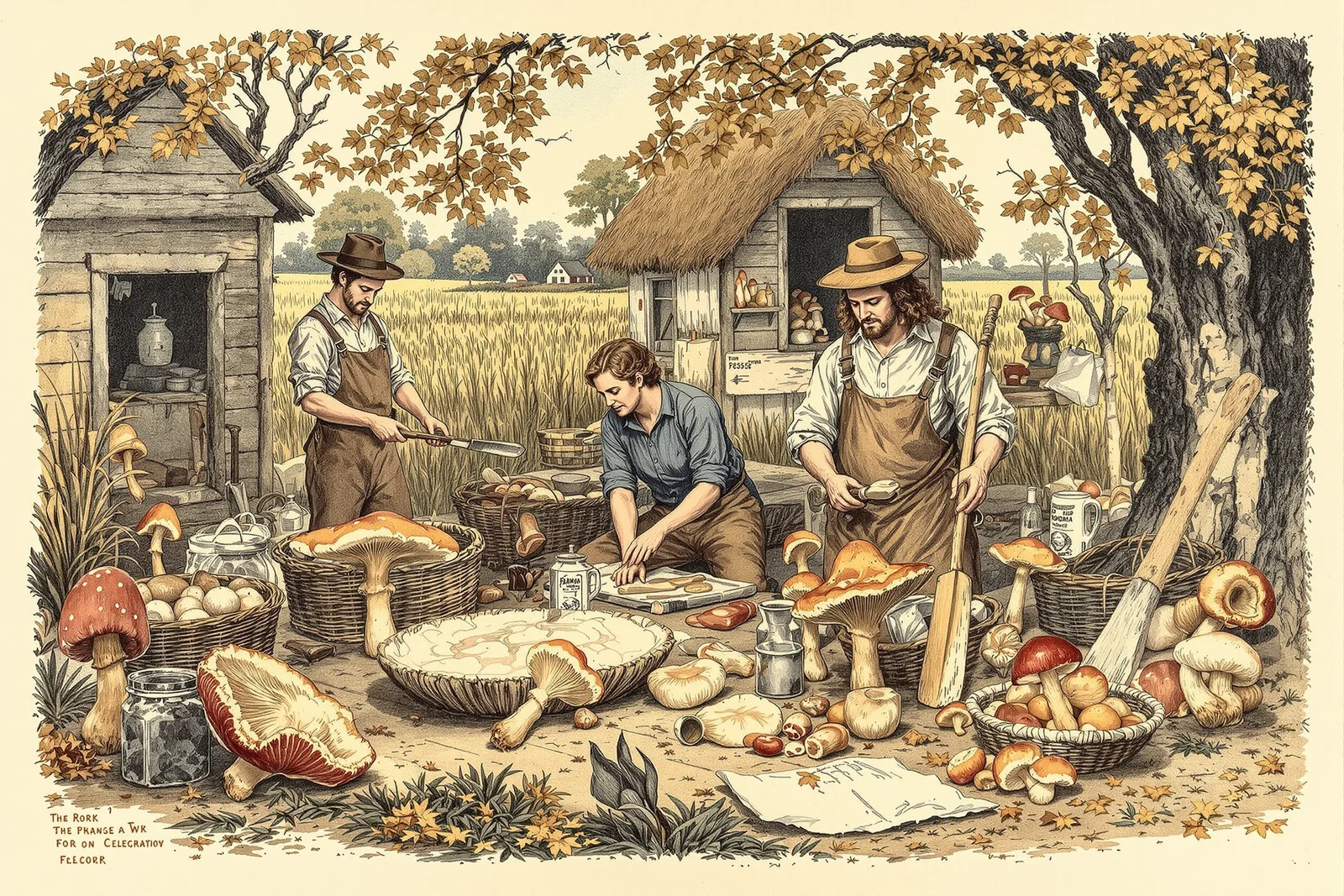
The Complete Mushroom Identification, Mycology, and Fungal Literacy Guide
A Sovereignty Module of the Practitioner Community
Preamble
Mushrooms are the most misunderstood kingdom of life. They are not plants. They are closer to animals genetically. Fungi decompose dead matter, form symbiotic networks with trees (mycorrhizae), produce powerful medicines, and provide high-quality protein. They are also the source of some of the deadliest poisons on Earth. The difference between a meal and a fatality is identification skill. This campaign covers mushroom anatomy, identification methodology, safe foraging rules, edible species, poisonous species, and medicinal fungi.
Part I: Mushroom Anatomy and Identification
Chapter 1: Mushroom Anatomy
| Part | Description | Identification Value |
|---|---|---|
| Cap (pileus) | Top surface — shape, color, texture, size | High — first feature observed |
| Gills (lamellae) | Blade-like structures under cap | Very high — attachment, spacing, color |
| Pores | Sponge-like surface under cap (boletes) | High — replaces gills in some groups |
| Teeth/spines | Hanging tooth-like structures under cap | High — distinctive group identifier |
| Stem (stipe) | Vertical support structure | High — presence of ring, volva, color, texture |
| Ring (annulus) | Skirt-like membrane on stem | Very high — indicates certain genera (Amanita, Agaricus) |
| Volva (cup) | Cup or sack at base of stem | CRITICAL — indicates Amanita (many deadly species) |
| Spore print | Color of spores deposited on paper | Very high — definitive for many species |
| Flesh | Interior when cut — color, color change, texture | High — some species bruise blue, yellow, red |
| Odor | Smell of fresh specimen | Moderate-high — some species have distinctive odors |
Chapter 2: The 5-Point Identification Protocol
| Step | Action | Why |
|---|---|---|
| 1. Habitat | Note: tree species nearby, soil type, season, dead wood vs. ground | Many mushrooms are host-specific |
| 2. Macro features | Cap shape/color/texture, gill attachment, stem features, ring, volva | Narrows to genus level |
| 3. Spore print | Place cap gill-down on white AND black paper for 4-12 hours | Spore color is definitive for many species |
| 4. Chemical tests | KOH, iron salts, Melzer's reagent on cap/flesh | Some species require chemical confirmation |
| 5. Cross-reference | Use 2+ field guides, confirm ALL features match | Never identify from a single feature |
Chapter 3: Beginner-Safe Edible Species (The "Foolproof Four")
| Species | Key Features | Lookalikes | Habitat | Season |
|---|---|---|---|---|
| Chicken of the Woods (Laetiporus) | Bright orange/yellow shelf fungus, no gills | None dangerous (if on correct trees) | Hardwood trees (avoid on eucalyptus/conifers) | Summer-fall |
| Giant Puffball (Calvatia gigantea) | White, round, 8-20 inches, solid white interior | Small puffballs (cut open — must be pure white inside, no outline of mushroom shape) | Fields, meadows | Late summer-fall |
| Morel (Morchella) | Honeycomb-patterned cap, hollow from top to bottom | False morel (Gyromitra) — cap attached at top only, not hollow, brain-like | Hardwood forests, burn sites | Spring |
| Chanterelle (Cantharellus) | Egg-yolk yellow, false gills (ridges, not blades), fruity smell | Jack-o-lantern (Omphalotus) — true gills, grows in clusters on wood, glows in dark | Hardwood/conifer forests | Summer-fall |
Chapter 4: Deadly Species to Know
| Species | Common Name | Lethal Dose | Symptoms | Onset |
|---|---|---|---|---|
| Amanita phalloides | Death Cap | 1/2 cap (30g) | Liver/kidney failure | 6-24 hours (delayed!) |
| Amanita ocreata | Destroying Angel | 1/2 cap | Liver/kidney failure | 6-24 hours (delayed!) |
| Amanita bisporigera | Eastern Destroying Angel | 1/2 cap | Liver/kidney failure | 6-24 hours (delayed!) |
| Galerina marginata | Funeral Bell | Several caps | Liver failure (same toxin as Death Cap) | 6-24 hours |
| Gyromitra esculenta | False Morel | Variable | Liver/kidney damage, hemolysis | 2-6 hours |
| Conocybe filaris | Fool's Conecap | Several caps | Liver failure | 6-24 hours |
THE AMANITA WARNING: Amanita phalloides (Death Cap) is responsible for 90% of mushroom fatalities worldwide. It has a pleasant taste, causes no immediate symptoms, and by the time symptoms appear (6-24 hours), liver damage is often irreversible. It has a white spore print, white gills, a ring on the stem, and a volva (cup) at the base. ALWAYS check for a volva.
Chapter 5: The Practitioner Mycology Reference Card
RULE 1: WHEN IN DOUBT, THROW IT OUT. No meal is worth a fatality. If you cannot positively identify a mushroom with 100% certainty using multiple features, do not eat it.
RULE 2: ALWAYS CHECK THE BASE. Dig up the entire mushroom — don't cut at ground level. The volva (death cup) at the base is the single most important feature for avoiding deadly Amanitas, and it's underground.
RULE 3: SPORE PRINT EVERY TIME. Place the cap on paper for 4-12 hours. Spore color eliminates entire groups of species and is one of the most reliable identification features.
RULE 4: NO SINGLE FEATURE IS SUFFICIENT. Identification requires ALL features matching: habitat, season, cap, gills/pores, stem, ring, volva, spore print, smell, taste (spit, don't swallow), and chemical tests.
REMEMBER: Fungi are the hidden kingdom that connects all life. A Practitioner who understands mycology has food, medicine, soil improvement, and decomposition services — but only if they can tell friend from foe with absolute certainty. Identification skill is life or death. There are no second chances with Amanita.
Council Approval
All 12 voices unanimously approve. Complete mycological literacy sovereignty.
Council Result: 12/12 APPROVED. Campaign 112 is complete.