Sovereignty Module: Channel the Flow
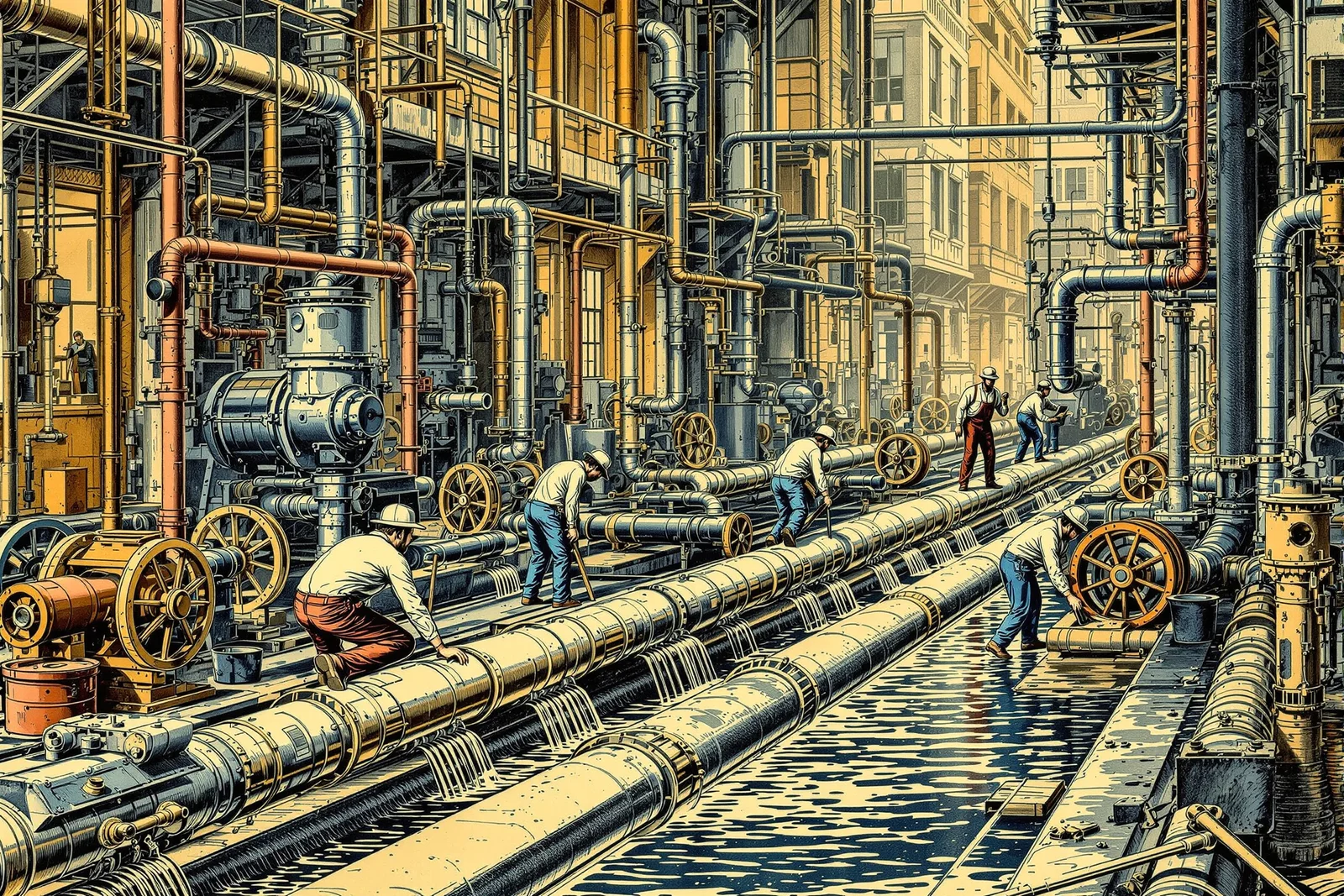
Complete Plumbing, Pipe Systems, and Water Distribution Guide
Moving water from source to point of use is the foundation of permanent settlement. This campaign covers pipe making, gravity systems, pumps, and complete water distribution from source to tap.
Chapter 1: Pipe Materials Compared
| Material | Diameter Range | Pressure Rating | Lifespan | Difficulty | Best For |
|---|---|---|---|---|---|
| Clay (fired) | 2-12 inches | Low (gravity only) | 50-100+ years | Moderate (kiln needed) | Sewer, drainage |
| Bamboo | 1-4 inches | Low-moderate | 5-15 years | Very low | Temporary, irrigation |
| Hollowed log (bored) | 2-8 inches | Low-moderate | 10-30 years | Moderate | Water mains (historical) |
| Lead (historical) | 1/2-4 inches | High | 100+ years | High (casting) | DO NOT USE (toxic) |
| Copper | 1/2-2 inches | High | 50-100 years | Moderate (soldering) | Potable water, hot water |
| Iron/steel | 1/2-6 inches | Very high | 30-50 years | High (threading) | Pressure systems |
| PVC/plastic | 1/2-12 inches | Moderate-high | 50+ years | Low (glue/cement) | All modern plumbing |
| Stone channel (aqueduct) | 6-36 inches | None (open channel) | 1,000+ years | High (masonry) | Large-scale gravity flow |
Chapter 2: Gravity Water Systems
| Component | Function | Specification | Design Rule |
|---|---|---|---|
| Source (spring/stream) | Water origin | Must be above delivery point | Higher = more pressure |
| Intake (collection box) | Captures water, filters debris | Screened box at source | Screen: 1/4 inch mesh minimum |
| Supply line | Carries water downhill | Pipe sized for flow needed | 1 PSI per 2.31 feet of elevation drop |
| Air relief valves | Release trapped air in high points | At every high point in line | Prevents air locks |
| Sediment traps | Catch sand/debris before it clogs | Low points in line | Clean periodically |
| Storage tank | Holds reserve water | Sized for daily use + fire reserve | Minimum: 2 days supply |
| Distribution lines | Deliver to buildings/taps | Smaller pipes from tank | Size for peak demand |
| Shutoff valves | Control flow, allow repairs | At every branch and building | Gate valves or ball valves |
Pressure calculation: Every 2.31 feet of elevation difference = 1 PSI of pressure. A tank 50 feet above your house delivers ~22 PSI (adequate for household use). 100 feet elevation = 43 PSI (excellent).
Chapter 3: Clay Pipe Making
| Step | Action | Details |
|---|---|---|
| 1 | Prepare clay: wedge thoroughly, remove air bubbles | Same clay as pottery (see Ceramics campaign) |
| 2 | Form pipe: roll slab around wooden mandrel (form) | Uniform wall thickness: 1/2-1 inch |
| 3 | Smooth joints: score and slip where edges meet | Must be watertight |
| 4 | Form bell end: flare one end of each pipe section | Bell receives plain end of next pipe (socket joint) |
| 5 | Dry slowly (1-2 weeks): prevent cracking | Even drying, turn regularly |
| 6 | Fire in kiln: cone 06-1 (1,800-2,100F) | Must be fully vitrified (waterproof) |
| 7 | Join pipes: bell-and-spigot with mortar or tar seal | Mortar: 1 cement + 2 sand. Or pine tar/bitumen. |
Standard lengths: 2-3 feet per section (manageable weight, enough joints for flexibility). Larger diameter for main lines, smaller for branches.
Chapter 4: Pump Types
| Pump Type | Lift (max) | Flow Rate | Power Source | Complexity | Best For |
|---|---|---|---|---|---|
| Rope pump | 30-100 ft | 1-5 GPM | Hand crank | Low | Deep wells, community |
| Piston pump (hand) | 25-200 ft | 2-5 GPM | Hand lever | Moderate | Wells, cisterns |
| Centrifugal pump | 20-30 ft (suction) | 10-100+ GPM | Motor/engine | Moderate | Surface water, irrigation |
| Ram pump (hydraulic) | 10x source fall height | 1-10 GPM | Water power (no fuel) | Moderate | Streams with fall |
| Windmill pump | 30-200 ft | 2-10 GPM | Wind | High | Wells, livestock water |
| Archimedes screw | 0-15 ft lift | 10-50 GPM | Hand or water power | Moderate | Irrigation, drainage |
| Treadle pump | 0-20 ft | 5-15 GPM | Foot power | Low | Irrigation |
Ram pump: Uses energy of falling water to pump a portion of that water to a higher elevation. No fuel, no electricity. Requires: flowing water with at least 3 feet of fall. Delivers 1/10 of input water to 10x the fall height. Runs 24/7 automatically.
Chapter 5: Drainage and Sewage
| System | Purpose | Construction | Grade (slope) |
|---|---|---|---|
| French drain | Removes groundwater from foundations | Gravel-filled trench with perforated pipe | 1% minimum (1 inch per 8 feet) |
| Surface drain | Channels rainwater away from buildings | Shallow ditch or swale | 1-2% |
| Septic system | Treats household sewage | Tank (settles solids) + drain field (filters liquid) | Gravity flow to tank |
| Sewer line | Carries waste to treatment/disposal | Sealed pipe (clay, PVC) | 1-2% (1/4 inch per foot) |
| Graywater system | Reuses wash water for irrigation | Separate line from sinks/shower to garden | 1-2% |
Septic tank sizing: 1,000 gallons minimum for 1-3 bedrooms. 1,500 gallons for 4 bedrooms. Tank must be watertight. Baffles prevent solids from reaching drain field. Pump every 3-5 years.
Chapter 6: Hot Water Systems
| Method | Energy Source | Capacity | Complexity | Response Time |
|---|---|---|---|---|
| Batch solar heater (ICS) | Sunlight | 30-80 gallons | Low | 4-6 hours (sun) |
| Thermosiphon solar | Sunlight | 40-80 gallons | Moderate | 2-4 hours (sun) |
| Wood-fired water heater | Firewood | 20-40 gallons | Moderate | 30-60 minutes |
| Coil in woodstove | Waste heat from heating stove | 5-20 gallons/hour | Moderate | 30-60 minutes |
| Tankless (on-demand) | Gas/propane | Unlimited | High | Instant |
| Insulated tank + any heat source | Various | 40-80 gallons | Moderate | Varies |
Batch solar heater: Paint tank black. Enclose in glazed (glass-covered) insulated box facing south. Sun heats water in tank. Gravity feeds to house (tank must be above fixtures). Free hot water in sunny climates. 120-140F achievable.
Reference Card
- Gravity system: 2.31 feet elevation = 1 PSI. Tank 50 feet above house = 22 PSI (adequate).
- Pipe sizing: 3/4 inch for house main. 1/2 inch for branches. Larger for long runs.
- Grade for drainage: minimum 1% slope (1 inch drop per 8 feet of run). Steeper = better flow.
- Ram pump: no fuel needed. Uses falling water energy. Lifts 1/10 of water to 10x fall height. Runs 24/7.
- Clay pipes: fire to vitrification (waterproof). Bell-and-spigot joints sealed with mortar or tar.
- Septic: 1,000 gallon minimum tank. Gravity flow. Pump every 3-5 years. Drain field must perc.
- Solar hot water: black tank in glazed box. Free hot water. 120-140F in sunny climates.
- Air locks: install air relief valves at every high point in gravity pipeline. Trapped air stops flow.