Sovereignty Module: Channel the Flow
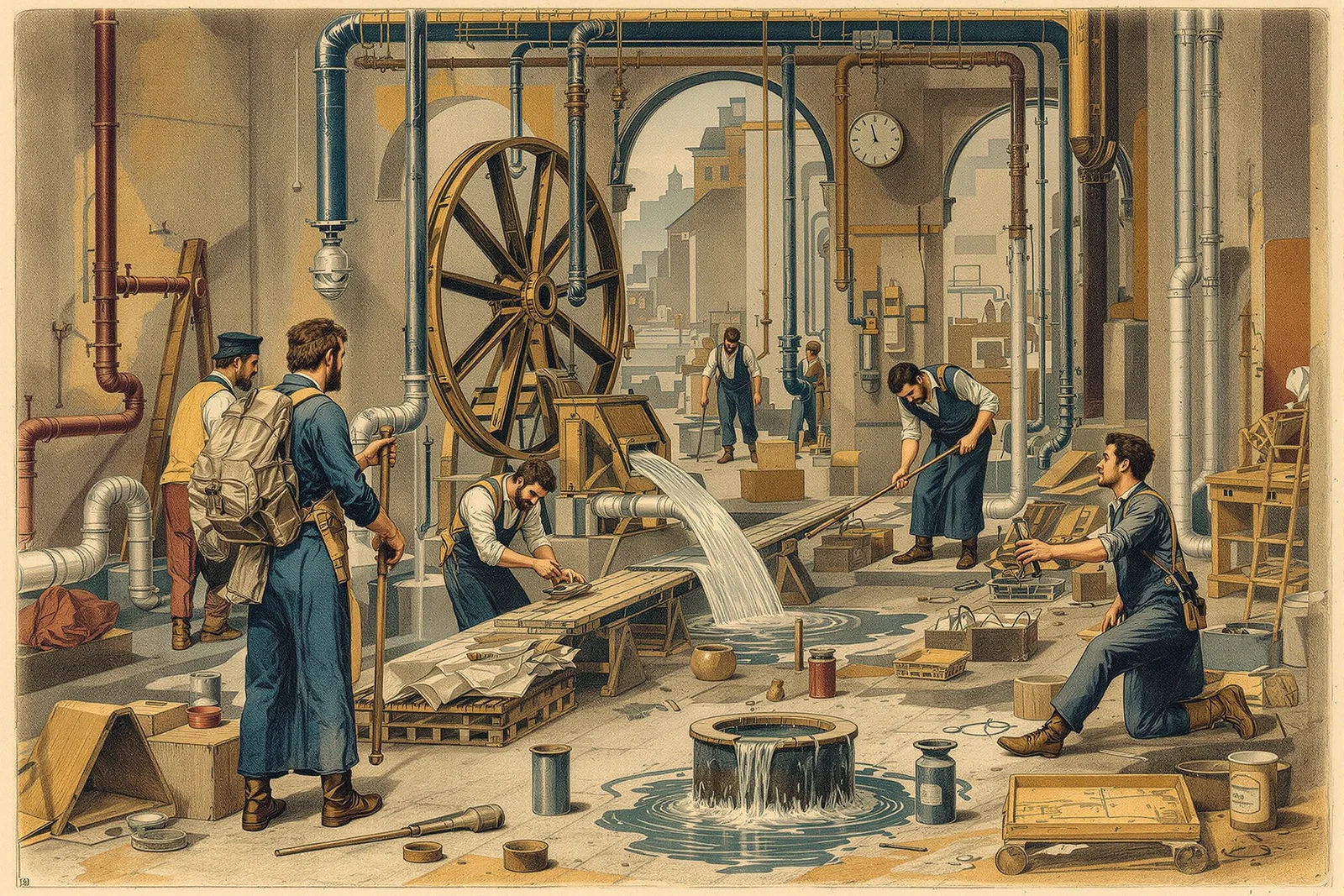
Complete Plumbing, Pipe Fabrication, and Water Distribution Guide
A community needs water delivered reliably to homes, workshops, and fields, and wastewater removed safely. This campaign covers pipe materials, joining methods, gravity-fed and pressurized systems, valves, fixtures, and drainage design from raw materials to functioning infrastructure.
Chapter 1: Pipe Materials
| Material | Pressure Rating | Durability | Fabrication Difficulty | Best Use |
|---|---|---|---|---|
| Clay (fired) | Low (gravity only) | Excellent (millennia) | Moderate (kiln required) | Sewer, drainage |
| Bamboo (sealed) | Low-moderate | 5-15 years | Low | Temporary water supply |
| Hollowed log (bored) | Low | 10-30 years (buried, wet) | Moderate | Rural water mains |
| Lead (historical) | High | Centuries | Moderate (casting/rolling) | Avoid for drinking water (toxic) |
| Copper | High | 50-100 years | High (smelting, drawing) | Drinking water, hot water |
| Cast iron | Very high | 50-100+ years | High (foundry) | Mains, high-pressure |
| Wrought iron/steel | Very high | 30-50 years (corrosion) | High | Pressure systems |
| Concrete (reinforced) | Moderate-high | 50-100 years | Moderate | Large mains, culverts |
| PVC/plastic (salvaged) | High | 50+ years | N/A (salvage only) | All water and sewer |
| Stone (carved channel) | None (gravity) | Millennia | High (labor intensive) | Aqueducts, irrigation |
Chapter 2: Pipe Joining Methods
| Method | Materials | Strength | Watertight | Skill Level |
|---|---|---|---|---|
| Bell and spigot (clay) | Clay pipes, mortar or tar seal | Good | Good | Moderate |
| Soldered (copper) | Copper pipe, tin-lead or tin-silver solder, flux | Excellent | Excellent | High |
| Threaded (iron/steel) | Threaded pipe, pipe dope or tape | Excellent | Excellent | Moderate |
| Flanged (bolted) | Flanges, gaskets, bolts | Excellent | Excellent | Moderate |
| Compression (bamboo/wood) | Wrapping with cord + tar/pitch | Moderate | Good | Low |
| Cemented (concrete) | Concrete pipe, mortar joint | Good | Good | Low-moderate |
| Fused (plastic) | PVC pipe, solvent cement | Excellent | Excellent | Low |
Chapter 3: Gravity-Fed Water Systems
Design a system that delivers water from a spring or reservoir at elevation to a community below using only gravity.
| Component | Function | Design Rule |
|---|---|---|
| Source (spring/reservoir) | Water supply | Must be above all delivery points |
| Intake | Collects water, screens debris | Screen mesh, overflow, sediment trap |
| Main line | Carries water downhill | Size for peak demand, 1-2% minimum slope |
| Break-pressure tanks | Prevents excessive pressure in steep terrain | Every 60-80m of vertical drop |
| Distribution tank | Stores water near community | Size for 1-2 days demand |
| Branch lines | Delivers to individual taps | Smaller diameter, valves at each branch |
| Taps/faucets | User access points | Self-closing to prevent waste |
Pressure: Every 10 feet (3m) of elevation difference = approximately 4.3 PSI. A source 100 feet above the tap delivers 43 PSI (excellent household pressure).
Chapter 4: Pumped Systems
| Pump Type | Power Source | Head (max lift) | Flow Rate | Best For |
|---|---|---|---|---|
| Hand pump (lever) | Human | 30-200 feet | 5-15 gal/min | Wells, small supply |
| Rope pump | Human | 30-100 feet | 3-10 gal/min | Deep wells, low cost |
| Ram pump (hydraulic) | Water flow (no fuel) | 10x source fall height | 1/10 of drive flow | Streams with elevation |
| Windmill pump | Wind | 30-300 feet | 5-50 gal/min | Continuous, windy areas |
| Steam/engine pump | Fuel | Unlimited (staged) | 50-5,000+ gal/min | Large systems |
| Solar pump | Sunlight | 30-600 feet | 5-100 gal/min | If panels available |
Chapter 5: Hot Water Systems
| System | Heat Source | Complexity | Capacity |
|---|---|---|---|
| Pot on fire | Wood/gas | Minimal | Batch (gallons) |
| Coil in firebox | Wood stove/fireplace | Low | Continuous (slow) |
| Thermosiphon (tank above firebox) | Wood | Moderate | 20-80 gallons |
| Solar collector (black pipe/panel) | Sun | Moderate | 20-80 gallons |
| Heat exchanger (coil in boiler) | Any boiler fuel | High | Unlimited |
Thermosiphon principle: Hot water rises, cold water sinks. A tank above a heat source with pipes connecting top and bottom creates natural circulation without a pump.
Chapter 6: Drainage and Sewer
| Pipe Size | Use | Minimum Slope |
|---|---|---|
| 1.5 inch | Sink, lavatory | 1/4 inch per foot |
| 2 inch | Shower, bathtub, laundry | 1/4 inch per foot |
| 3 inch | Toilet (single) | 1/4 inch per foot |
| 4 inch | Main building drain, multiple toilets | 1/8 inch per foot |
| 6+ inch | Community sewer main | 1/8 inch per foot |
Every drain needs a trap (U-shaped pipe section that holds water, blocking sewer gas from entering the building) and a vent (pipe to roof that allows air in so water flows freely).
Chapter 7: Valve Types
| Valve | Function | Use |
|---|---|---|
| Gate valve | Full open/close (not for throttling) | Main shutoffs |
| Globe valve | Flow regulation (throttling) | Faucets, flow control |
| Ball valve | Quick open/close (quarter turn) | Shutoffs, isolation |
| Check valve | Allows flow one direction only | Pump outlets, backflow prevention |
| Float valve | Automatically closes when tank is full | Tank fill control |
| Pressure relief | Opens at set pressure to prevent burst | Boilers, pressurized tanks |
Reference Card
- Gravity systems need minimum 1-2% slope for flow; every 10 feet elevation = 4.3 PSI
- Every drain needs a trap (blocks sewer gas) and a vent (allows air flow)
- Size pipes for peak demand, not average (everyone uses water at the same times)
- Break-pressure tanks every 60-80m vertical drop prevent pipe bursts in steep terrain
- Ram pumps lift water using only the energy of flowing water (no fuel, no electricity)
- Hot water rises naturally (thermosiphon), eliminating need for circulation pumps
- Copper is ideal for drinking water; avoid lead; clay/concrete for drainage
- Always install shutoff valves at every branch so repairs don't shut down the whole system