Sovereignty Module: Shape the Earth
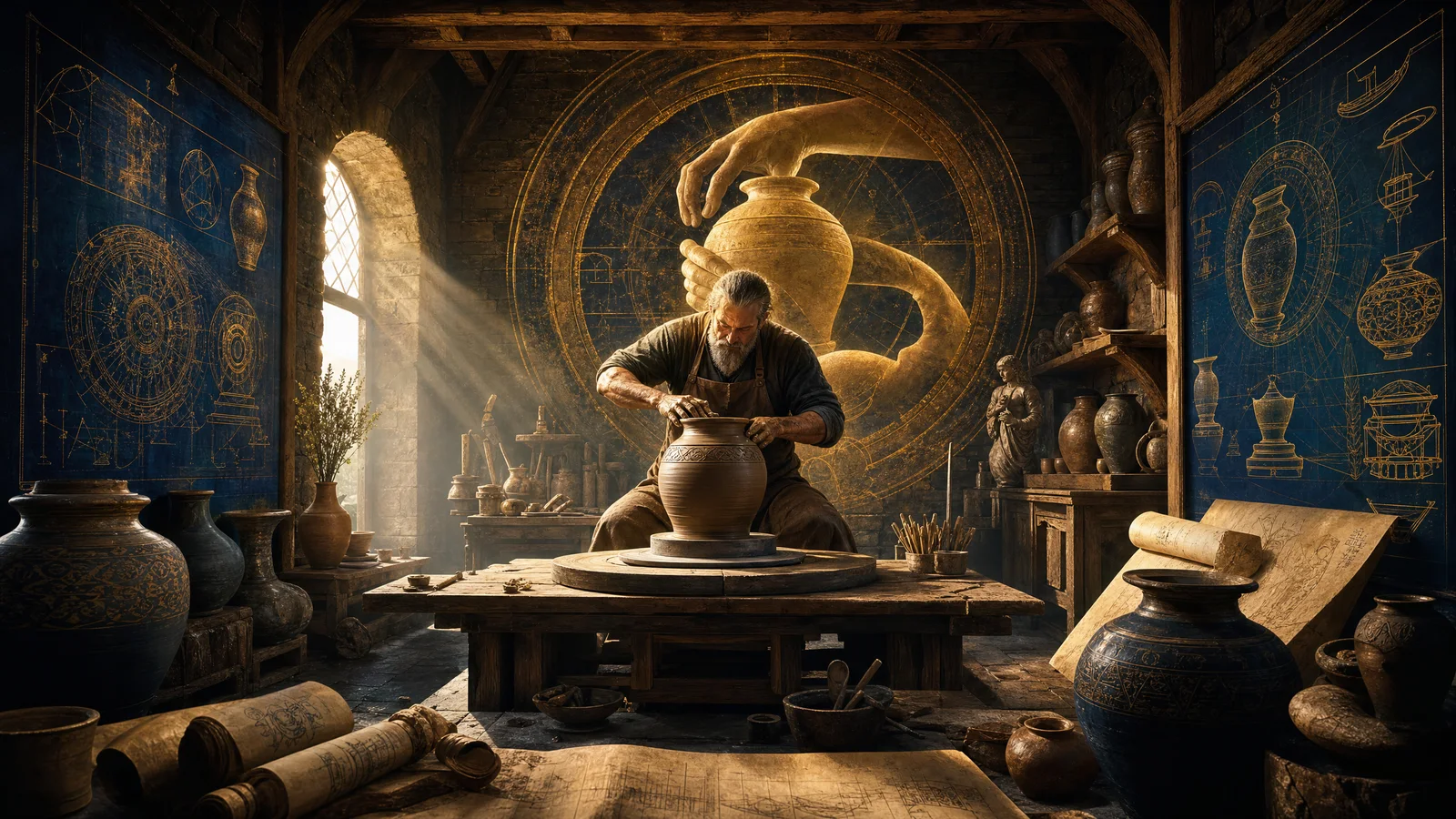
Complete Pottery, Ceramics, and Clay Vessel Construction Guide
Pottery stores water, cooks food, preserves grain, and filters water. Fired clay vessels are waterproof, fireproof, and last thousands of years. This campaign covers every technique from pinch pots to wheel-thrown vessels and kiln firing.
Chapter 1: Forming Techniques
| Technique | Skill Level | Speed | Vessel Size | Uniformity | Equipment |
|---|---|---|---|---|---|
| Pinch pot | Beginner | Slow | Small (cups, bowls) | Low | Hands only |
| Coil building | Beginner-intermediate | Moderate | Any size | Moderate | Hands, tools |
| Slab building | Intermediate | Moderate | Flat/angular forms | High | Rolling pin, knife |
| Wheel throwing | Advanced | Fast | Round forms (any size) | Very high | Potter's wheel |
| Mold pressing | Intermediate | Fast (once mold made) | Standardized shapes | Very high | Plaster mold |
| Slip casting | Advanced | Very fast (production) | Complex shapes | Very high | Plaster mold + liquid clay |
Chapter 2: Clay Preparation
| Step | Action | Purpose |
|---|---|---|
| 1 | Dig clay (river banks, road cuts, subsoil) | Raw material |
| 2 | Dry completely, crush to powder | Breaks down lumps |
| 3 | Soak in water (slake) for 24-48 hours | Fully hydrates clay particles |
| 4 | Screen through mesh (remove stones, roots) | Purity |
| 5 | Let settle, pour off excess water | Correct consistency |
| 6 | Dry to workable consistency on plaster or cloth | Ready to use |
| 7 | Wedge (knead like bread, 50-100 times) | Removes air bubbles, aligns particles |
| 8 | Test: form coil, wrap around finger | Good clay: no cracks. Too sandy: breaks. |
Temper (grog): Add 10-30% crushed fired pottery (grog), sand, or crushed shell to clay. Reduces shrinkage, prevents cracking during drying and firing. Essential for large vessels and cooking pots.
Chapter 3: Coil Building (Most Versatile Method)
| Step | Action | Details |
|---|---|---|
| 1 | Roll coils (rope-like pieces, 1/2 to 1 inch diameter) | Even thickness, no air pockets |
| 2 | Form base (flat disc or spiral coil) | Size of vessel bottom |
| 3 | Score and slip (scratch surface, apply wet clay paste) | Creates strong bond between coils |
| 4 | Stack coils on base, one at a time | Slightly inside or outside previous for shape |
| 5 | Smooth interior (fingers or tool) | Blends coils together for strength |
| 6 | Smooth or texture exterior (as desired) | Smooth = refined. Textured = decorative. |
| 7 | Build walls to desired height and shape | Let base firm up before building too high |
| 8 | Add rim (thickened, folded, or shaped) | Strengthens top edge |
| 9 | Dry slowly (1-3 weeks) | Cover loosely, turn daily, avoid drafts |
| 10 | Fire (see kiln section) | Transforms clay to ceramic |
Chapter 4: Potter's Wheel Construction
| Component | Material | Function |
|---|---|---|
| Flywheel (heavy disc at bottom) | Stone, concrete, or heavy wood | Stores momentum (keeps spinning) |
| Shaft (vertical axle) | Steel or hardwood | Connects flywheel to wheel head |
| Wheel head (throwing surface) | Wood or metal disc (12-14 inches) | Where clay is centered and thrown |
| Bearings | Metal bearings or greased wood socket | Low-friction rotation |
| Frame | Wood or metal | Supports everything at working height |
| Kick bar or treadle | Wood bar at foot level | Foot-powered spinning |
| Seat | Attached bench | Comfort during long throwing sessions |
Kick wheel: Kick flywheel with foot to spin. Momentum keeps it going. Throw clay on wheel head above. One person can throw 20-50 vessels per day on a kick wheel.
Chapter 5: Firing Temperatures and Results
| Temperature | Name | Result | Use |
|---|---|---|---|
| 1100-1300F (600-700C) | Low fire (earthenware) | Porous, colored (terra cotta) | Flower pots, decorative |
| 1600-1900F (900-1050C) | Medium fire (earthenware) | Less porous, harder | Cooking pots, storage (with glaze) |
| 1900-2100F (1050-1150C) | High earthenware/low stoneware | Dense, nearly waterproof | Functional ware |
| 2200-2400F (1200-1300C) | Stoneware | Vitrified, waterproof without glaze | Best functional pottery |
| 2300-2500F (1260-1370C) | Porcelain | Translucent, extremely hard | Fine ware (requires special clay) |
Chapter 6: Glazing (Waterproofing)
| Glaze Type | Ingredients | Temperature | Result |
|---|---|---|---|
| Salt glaze | Table salt thrown into kiln at peak temp | 2200F+ | Orange-peel texture, waterproof |
| Wood ash glaze | Wood ash + clay (50:50) | 2200F+ | Natural, variable, beautiful |
| Lead glaze (historical) | Lead oxide + silica | 1600F+ | TOXIC: historical only, do not use for food |
| Slip glaze (Albany-type) | High-iron clay, applied as liquid | 2200F+ | Brown/black, natural |
| Feldspar glaze | Feldspar + silica + clay + flux | 2200F+ | Clear or colored |
| Burnishing (no glaze) | Polish leather-hard surface with stone | Any temp | Semi-waterproof, beautiful sheen |
Simplest waterproofing: Burnish (polish with smooth stone at leather-hard stage) + fire to 1600F+. Or: apply thin coat of beeswax to interior of fired pot (for water storage only, not cooking).
Reference Card
- Wedge clay 50-100 times before use: removes air bubbles (bubbles explode in kiln)
- Add 10-30% grog (crushed fired pottery) to reduce cracking in large vessels
- Dry pottery SLOWLY (1-3 weeks): fast drying = cracking
- Bone-dry before firing: ANY moisture = steam explosion in kiln
- Coil building: score and slip every joint (scratch + wet clay paste = strong bond)
- Earthenware (1600-1900F) is porous: needs glaze for waterproofing
- Stoneware (2200-2400F) is naturally waterproof without glaze
- Simplest glaze: wood ash + clay (50:50), applied as liquid, fired to 2200F+