Sovereignty Module: Shape the Earth
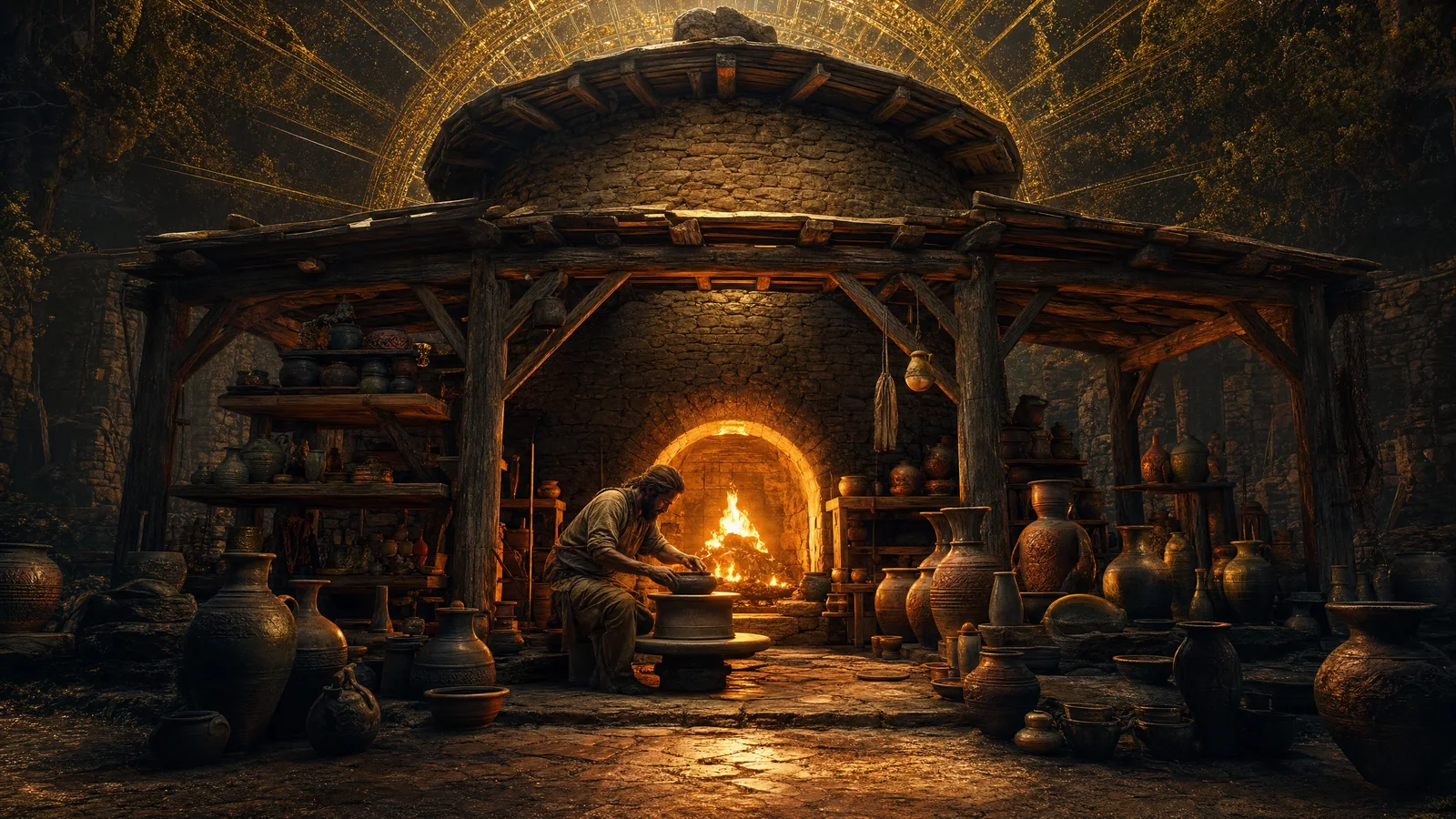
Complete Pottery, Ceramics, and Kiln Construction Guide
The Philosophy of Clay
Clay is the most abundant and versatile construction material on Earth. It can be shaped into vessels that store water and food, pipes that carry water, bricks that build cities, tiles that roof buildings, stoves that heat homes, and crucibles that melt metal. Fired clay (ceramics) is waterproof, fireproof, chemically inert, and lasts thousands of years. Every civilization in history has depended on pottery. This campaign covers the complete knowledge from finding and processing clay to building kilns and producing finished ceramics.
Chapter 1: Finding and Testing Clay
Where Clay Is Found:
Clay deposits occur wherever water has carried and deposited fine mineral particles over geological time. Common locations:
| Location | Clay Type | Quality | Notes |
|---|---|---|---|
| River banks (below topsoil) | Alluvial clay | Variable, often good | Most accessible source |
| Lake beds (dried or current) | Lacustrine clay | Often excellent | Fine-grained, plastic |
| Road cuts and excavations | Various | Variable | Exposed by construction |
| Beneath topsoil (2-6 feet down) | Subsoil clay | Variable | Dig test pits |
| Eroded hillsides | Residual clay | Often coarse | May need processing |
| Dry creek beds | Alluvial | Variable | Seasonal access |
Field Tests for Clay Quality:
| Test | Method | Good Result | Poor Result |
|---|---|---|---|
| Ribbon test | Roll clay into a snake, flatten into ribbon | Ribbon extends 2+ inches without breaking | Breaks immediately (too sandy) |
| Ball test | Form a golf-ball sized ball, drop from 3 feet | Holds shape, minor cracking | Shatters or flattens completely |
| Bite test | Bite a small piece | Smooth, sticks to teeth slightly | Gritty (too much sand/silt) |
| Shine test | Cut ball with knife | Cut surface is shiny/smooth | Dull, rough surface |
| Shrinkage test | Form a bar 10cm long, dry completely | Shrinks less than 10% | Shrinks more than 12% (will crack) |
| Fire test | Fire a small test piece | Does not crack or explode | Cracks, spalls, or explodes (needs processing) |
Chapter 2: Clay Processing
Removing Impurities:
Raw clay often contains rocks, roots, sand, and organic matter that must be removed.
Dry processing: Dry clay completely, crush to powder, sieve through window screen (removes rocks and debris), then re-hydrate.
Wet processing (slaking): Break dry clay into small pieces, soak in excess water for 24-48 hours. Stir vigorously. Pour through a screen into a settling container. Allow to settle 24 hours. Pour off clear water. Allow remaining slurry to dry to workable consistency.
Wedging (kneading):
Before use, clay must be wedged to remove air bubbles and create uniform consistency. Cut the clay ball in half, slam one half onto the other, and repeat 30-50 times. Air bubbles in clay explode during firing, destroying the piece.
Tempering (adding non-plastic materials):
Pure clay often shrinks too much during drying and firing, causing cracks. Adding temper (non-shrinking material) reduces shrinkage and improves thermal shock resistance.
| Temper Material | Amount (% by volume) | Effect | Best For |
|---|---|---|---|
| Sand (fine) | 10-30% | Reduces shrinkage, opens body | General pottery |
| Grog (crushed fired pottery) | 10-25% | Reduces shrinkage, improves thermal shock | Kiln furniture, cooking pots |
| Shell (crushed) | 10-20% | Reduces shrinkage, adds flux | Traditional Native American pottery |
| Iteite (volcanic rock, crushed) | 10-20% | Reduces shrinkage, lightweight | Where available |
| Straw/grass (chopped) | 5-15% | Reduces cracking during drying (burns out in firing) | Bricks, large vessels |
| Sawdust | 5-15% | Creates porous, lightweight body | Insulating bricks |
Chapter 3: Forming Methods
Pinch Pot (simplest):
Press thumb into a ball of clay, pinch walls thinner while rotating. Produces small bowls and cups. Maximum practical size: 4-6 inches.
Coil Building (most versatile hand method):
Roll clay into ropes (coils) 1/2 to 1 inch diameter. Stack coils in a spiral to build walls. Smooth inside and outside with fingers or a tool. Can produce vessels of any size, from cups to storage jars holding 50+ gallons.
Key principles:
- Each coil must bond firmly to the one below (score surfaces, apply slip/water)
- Build only 4-6 inches per session (let lower sections firm up before adding more)
- Keep walls uniform thickness (3/8 to 1/2 inch for most vessels)
- Support large vessels from inside with a curved tool (rib) while smoothing outside
Slab Building:
Roll clay flat (like pie dough) to uniform thickness using guide sticks. Cut shapes with a knife. Join slabs with slip (liquid clay) and scoring. Best for: boxes, tiles, rectangular forms, architectural elements.
Potter's Wheel (fastest, requires skill):
A spinning platform (wheel head) on which a ball of clay is centered and shaped by hand pressure while spinning. Produces symmetrical round forms rapidly.
Wheel types:
- Kick wheel: Heavy flywheel at bottom, kicked by foot. No power needed.
- Treadle wheel: Foot pedal drives flywheel through crank. Hands-free speed control.
- Electric wheel: Motor-driven. Requires electricity.
Building a kick wheel:
- Heavy concrete or stone flywheel (80-150 lbs), 24-30 inches diameter
- Vertical steel shaft (1 inch diameter, 30 inches long)
- Upper and lower bearings (can be hardwood with grease)
- Wheel head (flat disk, 12-14 inches) attached to top of shaft
- Frame to hold bearings at correct height (seated position)
Chapter 4: Drying
Drying is the most critical phase. Clay shrinks 5-12% as water evaporates. If drying is uneven (one side faster than another), stresses build up and the piece cracks.
Drying Rules:
| Rule | Why | Method |
|---|---|---|
| Dry slowly | Prevents cracking from uneven shrinkage | Cover loosely with plastic, dry over days/weeks |
| Dry evenly | All surfaces must lose moisture at same rate | Rotate pieces daily; cover thin edges |
| Dry completely | Any remaining moisture explodes in kiln | Piece should feel room temperature (not cool) |
| Thicker = slower | Thick walls take much longer to dry through | Allow 1-4 weeks for thick pieces |
| Attach handles/spouts when leather-hard | Too wet = deforms; too dry = won't bond | Leather-hard = firm but can still be carved |
Drying Time Estimates:
| Wall Thickness | Minimum Drying Time (room temperature) | Notes |
|---|---|---|
| 1/4 inch | 3-7 days | Small pieces, tiles |
| 3/8 inch | 5-14 days | Standard pottery |
| 1/2 inch | 7-21 days | Large vessels |
| 3/4 inch | 14-30 days | Thick sculptural work |
| 1+ inch | 30-60 days | Bricks, kiln furniture |
Chapter 5: Kiln Construction
Open Firing (pit/bonfire, simplest):
No kiln structure needed. Pots are placed in a pit or on the ground, surrounded by fuel, and fired. Temperatures: 600-900C (1,100-1,650F). Produces low-fired earthenware (porous, suitable for cooking and storage with sealing).
Method:
- Pre-heat pots near fire for 1-2 hours (prevents thermal shock)
- Place pots in pit on a bed of fuel (wood, dung, straw)
- Surround and cover with fuel
- Light from downwind side
- Maintain fire for 2-4 hours
- Allow to cool completely before removing (6-12 hours)
Updraft Kiln (simple brick/earth construction):
A permanent structure with a firebox below and a chamber above. Hot gases rise through the pots and exit at the top. Temperatures: 900-1,100C (1,650-2,000F). Produces fully vitrified stoneware.
Construction:
- Dig firebox trench (2 ft wide, 3 ft long, 2 ft deep)
- Build chamber walls above firebox (brick, stone, or cob), 3-4 ft diameter, 3-4 ft tall
- Floor of chamber has gaps/channels for heat to rise from firebox
- Dome or arch the top (leave a vent hole)
- Door opening in chamber wall for loading pots (sealed with bricks during firing)
Downdraft Kiln (most efficient, best temperature control):
Hot gases rise from firebox, are deflected by the domed ceiling downward through the pots, and exit through floor-level flues to a chimney. Most even temperature distribution.
Kiln Temperature Indicators (without thermometer):
| Temperature | Visual Indicator | Cone Equivalent |
|---|---|---|
| 500C (930F) | Dull red glow (barely visible in dark) | Below cone 022 |
| 700C (1,290F) | Cherry red | Cone 022-018 |
| 900C (1,650F) | Bright cherry red | Cone 010-08 |
| 1,000C (1,830F) | Orange | Cone 06-04 |
| 1,100C (2,010F) | Yellow-orange | Cone 02-1 |
| 1,200C (2,190F) | Yellow | Cone 4-6 |
| 1,300C (2,370F) | Light yellow/white | Cone 8-10 |
Chapter 6: Glazing
Glaze is a thin layer of glass fused to the pottery surface during firing. It makes pottery waterproof, easier to clean, and decorative.
Simple Glaze Recipes (from natural materials):
| Glaze Type | Ingredients | Firing Temperature | Result |
|---|---|---|---|
| Wood ash glaze | 50% wood ash + 50% clay (by volume) | 1,200-1,300C | Green/brown/tan (varies by ash source) |
| Salt glaze | Throw salt into kiln at peak temperature | 1,200-1,280C | Orange-peel texture, tan/brown |
| Slip glaze (Albany-type) | High-iron clay thinned to cream consistency | 1,200-1,300C | Dark brown/black |
| Lead glaze (CAUTION: toxic) | Litharge (PbO) + silica + clay | 900-1,100C | Clear, glossy (DO NOT use for food vessels) |
| Borax glaze | Borax + silica + clay | 900-1,050C | Clear to milky |
Wood Ash Glaze (safest, most accessible):
- Collect hardwood ash (oak, maple, fruit wood preferred)
- Sieve through fine mesh to remove charcoal chunks
- Mix 50% ash with 50% ball clay or local clay (by dry volume)
- Add water to cream consistency
- Sieve through 80-mesh screen
- Apply to bisque-fired pottery by dipping, pouring, or brushing
- Fire to cone 6-10 (1,200-1,300C)
Chapter 7: Specific Products
Water Storage Vessels:
Must be non-porous (glazed or high-fired stoneware). Thick walls (1/2 inch minimum). Wide mouth for filling and cleaning. Lid to prevent contamination. Capacity: 5-50 gallons depending on need.
Cooking Pots:
Must resist thermal shock (temper with grog or sand, 20-30%). Round bottom distributes heat evenly. Walls 3/8 inch thick. Fire to earthenware temperature (lower-fired clay handles thermal shock better than stoneware).
Roof Tiles:
Slab-formed, 10x14 inches, slightly curved. Thickness: 1/2 inch. Fire to stoneware temperature for durability. A typical roof requires 1,000-2,000 tiles.
Bricks:
Press clay into wooden molds (standard brick: 4x8x2.5 inches). Dry 2-4 weeks. Fire in a clamp kiln (bricks stacked with fuel channels between them; the bricks being fired ARE the kiln). Temperature: 900-1,100C.
Pipes (for water conveyance):
Form around a wooden mandrel (removable core). Join sections with slip. Fire to stoneware temperature for waterproofing. Standard length: 12-24 inches. Diameter: 2-6 inches.
Crucibles (for metalworking):
Must withstand extreme temperatures (1,300C+) and thermal shock. Use high-alumina clay tempered with 30-40% grog. Thick walls (3/4 inch). Small size (holds 1-5 lbs of metal). Fire to highest possible temperature before use.
Chapter 8: Troubleshooting
| Problem | Cause | Solution |
|---|---|---|
| Cracking during drying | Uneven drying, too fast, too thick | Dry slower, cover edges, make walls thinner |
| Exploding in kiln | Moisture remaining, air bubbles | Dry completely, wedge thoroughly, pre-heat slowly |
| Warping | Uneven wall thickness, uneven heat | Make walls uniform, load kiln evenly |
| Glaze crawling (pulling away) | Dusty/oily surface, glaze too thick | Clean bisqueware, apply thinner glaze |
| Glaze crazing (fine cracks) | Glaze shrinks more than clay body | Adjust glaze recipe (add silica) |
| Dunting (cracks after firing) | Cooled too fast (especially through 573C quartz inversion) | Cool kiln slowly, especially 600-500C range |
| Bloating (bubbles in clay) | Over-fired, organic matter in clay | Lower temperature, process clay more thoroughly |
| Pots sticking to kiln shelf | Glaze ran onto shelf | Apply kiln wash to shelves, wipe glaze from pot bottoms |
Chapter 9: Kiln Firing Schedule
Typical Bisque Firing (first firing, no glaze):
| Phase | Temperature Range | Rate | Time | Purpose |
|---|---|---|---|---|
| Water smoking | 20-120C (68-250F) | 50C/hour | 2 hours | Drive off atmospheric moisture |
| Dehydration | 120-350C (250-660F) | 80C/hour | 3 hours | Chemical water released from clay |
| Organic burnout | 350-700C (660-1,290F) | 100C/hour | 3.5 hours | Organic matter burns away |
| Quartz inversion | 573C (1,063F) | SLOW through this point | Critical | Quartz crystal structure changes; stress point |
| Sintering | 700-1,000C (1,290-1,830F) | 100C/hour | 3 hours | Clay particles begin to fuse |
| Soak | 1,000C (1,830F) | Hold | 30 min | Even heat penetration |
| Cooling | 1,000-573C | 50-80C/hour | 5+ hours | SLOW through quartz inversion |
| Final cooling | 573-20C | Natural | 8-12 hours | Do not open kiln until below 100C |
Total bisque firing: approximately 24-30 hours (including cooling)
Reference Card
POTTERY ESSENTIALS:
- Test clay before committing to a project (ribbon test, fire test)
- Wedge thoroughly (30-50 cuts minimum; air bubbles = explosions)
- Dry SLOWLY and EVENLY (the number one cause of failure is rushing)
- Dry COMPLETELY before firing (cool to touch = still wet inside thick walls)
- Fire SLOWLY through critical temperatures (especially 573C quartz inversion)
- Cool SLOWLY (cracking from fast cooling is as common as from fast heating)
- Temper clay for cooking vessels (20-30% grog or sand for thermal shock resistance)
- Wood ash makes free, food-safe glaze (50% ash + 50% clay, fired to cone 6-10)
This campaign provides the complete knowledge to find, process, form, and fire clay into pottery, bricks, tiles, pipes, and crucibles. A community with ceramic capability has waterproof storage, durable construction materials, cooking vessels, water conveyance, and the crucibles necessary for metalworking. Clay is free, abundant, and the products last millennia.