Sovereignty Module: Pour the Cup
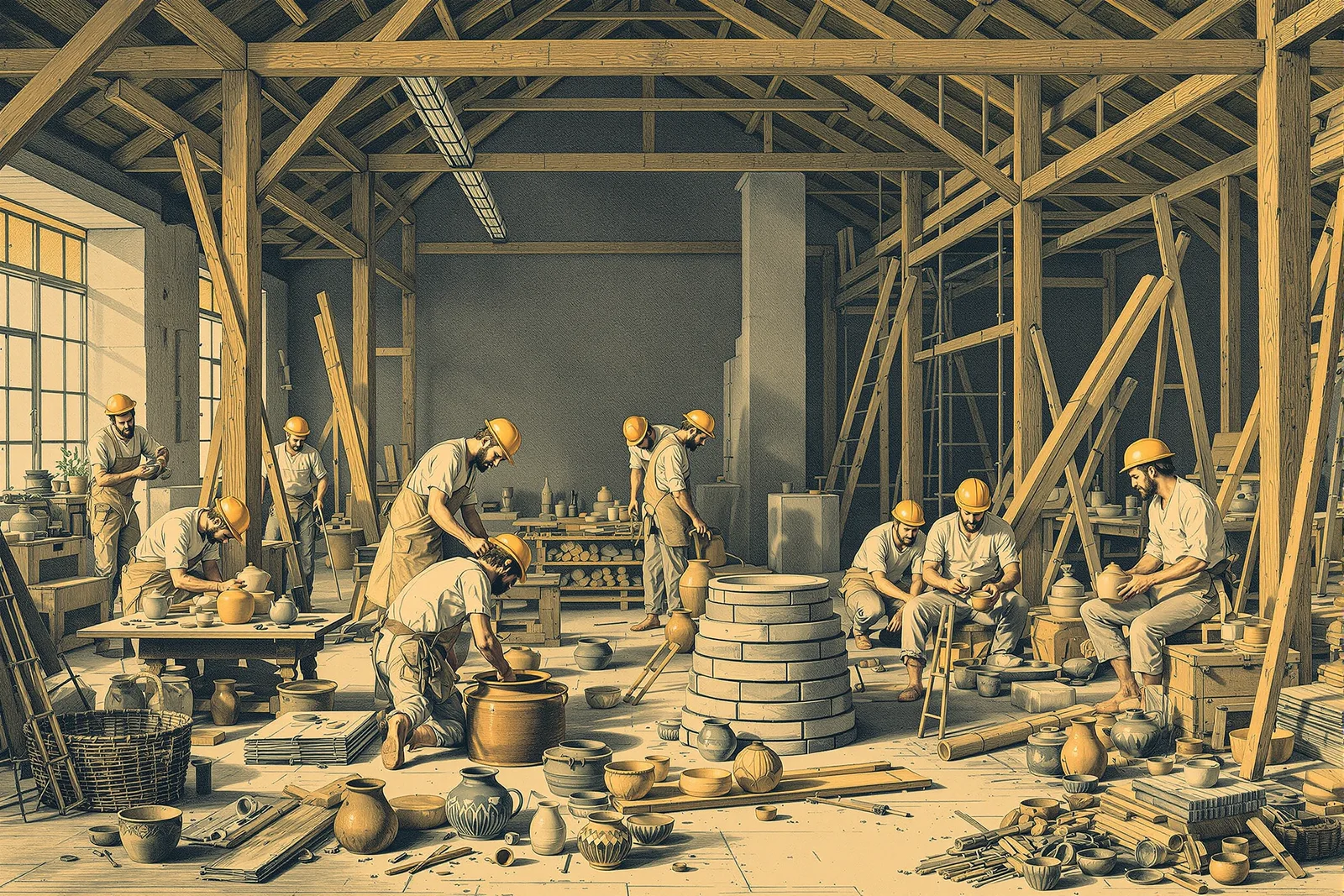
Complete Teapot Construction: From Wheel to Assembled Form
The teapot is pottery's most complex functional form, requiring multiple components assembled into a unified whole. This campaign covers body throwing, spout and handle making, lid fitting, and assembly.
Chapter 1: Teapot Components
| Component | Method | Critical Factor | Attachment |
|---|---|---|---|
| Body | Thrown on wheel | Volume, proportion | Base form |
| Lid | Thrown on wheel | Precise fit to gallery | Sits in gallery |
| Knob (finial) | Thrown, pulled, or modeled | Comfortable grip | Attached to lid |
| Spout | Thrown or hand-built | Pour quality, angle | Score and slip to body |
| Handle | Pulled, extruded, or slab | Comfortable grip, balance | Score and slip to body |
| Strainer | Pierced holes in body | Hole size and pattern | Integral to body |
| Foot ring | Trimmed from body | Stability | Integral to body |
Chapter 2: Body and Lid
Body throwing: 1) Center 2-3 pounds of clay. 2) Open and pull walls to desired shape. 3) Leave thick rim for gallery (lid seat). 4) Gallery: cut step or groove inside rim for lid to sit in. 5) Gallery must be round and level (lid must fit precisely). 6) Mark gallery diameter (measure for lid). 7) Trim foot ring when leather-hard.
Lid throwing: 1) Throw lid upside down on wheel. 2) Lid flange must match gallery diameter exactly. 3) Allow for shrinkage (clay shrinks 10-12% during drying and firing). 4) Throw lid slightly larger than gallery (will shrink to fit). 5) Trim knob from excess clay, or attach separately. 6) Test fit lid to body at leather-hard stage.
| Lid Type | Description | Difficulty | Seal Quality |
|---|---|---|---|
| Inset lid | Flange sits inside gallery | Moderate | Good |
| Cap lid | Sits over rim | Low | Fair |
| Flanged lid | Flange + cap combination | High | Excellent |
| Cork lid | Cylindrical plug fits in opening | Moderate | Excellent |
Chapter 3: Spout Making
| Spout Method | Shape | Pour Quality | Difficulty |
|---|---|---|---|
| Thrown spout | Cone, trimmed and shaped | Excellent | Moderate |
| Hand-built (slab) | Folded slab, seamed | Good | Low-moderate |
| Pulled spout | Pulled from body wall | Good | High |
| Extruded | Hollow tube | Fair | Low |
Thrown spout: 1) Throw small cone on wheel (1/2 pound clay). 2) Walls thin and even. 3) Cut from wheel at desired length. 4) Trim to shape: wider at base, narrow at tip. 5) Cut opening at base to match body attachment point. 6) Shape tip: slight upturn prevents dripping. 7) The spout tip must be higher than the lid opening (prevents overflow). 8) Attach to body at leather-hard stage.
Pour quality: 1) The spout must pour a clean stream without dripping. 2) Tip shape is critical: slight upturn and sharp edge. 3) Spout interior must be smooth (no obstructions). 4) Spout angle: 30-45 degrees from body. 5) Spout length: proportional to body size.
Chapter 4: Handle and Assembly
Handle types: 1) Pulled handle: traditional, organic shape. 2) Overhead handle (bail): wire or bamboo, arches over lid. 3) Side handle: extends from side (Japanese style). 4) Strap handle: slab of clay, shaped and attached.
Assembly sequence: 1) All components must be at same moisture level (leather-hard). 2) Mark spout position on body. 3) Pierce strainer holes at spout attachment point (before attaching spout). 4) Score and slip spout base and body. 5) Attach spout, blend joint. 6) Mark handle position (opposite spout, balanced). 7) Score and slip handle attachment points. 8) Attach handle, support until firm. 9) Test lid fit. 10) Allow to dry slowly (cover loosely).
| Assembly Step | Tool | Critical Factor |
|---|---|---|
| Mark positions | Ruler, pencil | Spout and handle aligned, balanced |
| Pierce strainer | Needle tool or drill bit | Even holes, correct size |
| Attach spout | Score tool, slip, fingers | Solid bond, smooth joint |
| Attach handle | Score tool, slip, support | Balanced, comfortable grip |
| Test lid | Fit check | Lid sits level, does not rattle |
| Final check | Visual inspection | Proportions, balance, alignment |
Chapter 5: Design Principles
| Principle | Explanation |
|---|---|
| Balance | Teapot should not tip when full (handle balances spout) |
| Pour | Spout tip higher than lid opening; clean pour, no drip |
| Grip | Handle comfortable for full teapot weight (2-3 lbs when full) |
| Lid retention | Lid stays in place when pouring (gallery or thumb rest) |
| Strainer | Holes small enough to catch leaves, large enough for flow |
| Proportion | Body, spout, handle, and lid in visual harmony |
Reference Card
- The gallery determines lid fit (the stepped or grooved rim where the lid sits must be perfectly round and level; an imprecise gallery produces a lid that rattles, sticks, or falls off when pouring). 2. The spout tip must be higher than the lid (if the spout opening is lower than the lid opening, tea will overflow from the lid before it pours from the spout; this is the most common teapot design error). 3. Pierce the strainer before attaching the spout (strainer holes must be pierced from inside the body at the spout attachment point; this is impossible after the spout is attached). 4. Balance is functional (a teapot that tips forward when full is dangerous; the handle must be positioned to balance the weight of the full body and spout). 5. All components must be the same moisture (attaching wet clay to dry clay creates a weak joint that cracks; all components must be leather-hard and at the same moisture level during assembly). 6. The spout tip prevents dripping (a slight upturn and sharp edge at the spout tip causes the tea stream to break cleanly; a blunt or downward-pointing tip causes dripping). 7. The teapot is pottery's masterwork (combining thrown body, fitted lid, functional spout, comfortable handle, and effective strainer into a unified, beautiful, functional form is the ultimate test of the potter's skill). 8. Every teapot tells a story (the proportions, surface, and details of a teapot reflect the maker's aesthetic, skill, and intention; a handmade teapot is a daily-use art object).