Sovereignty Module: Press the Sheet
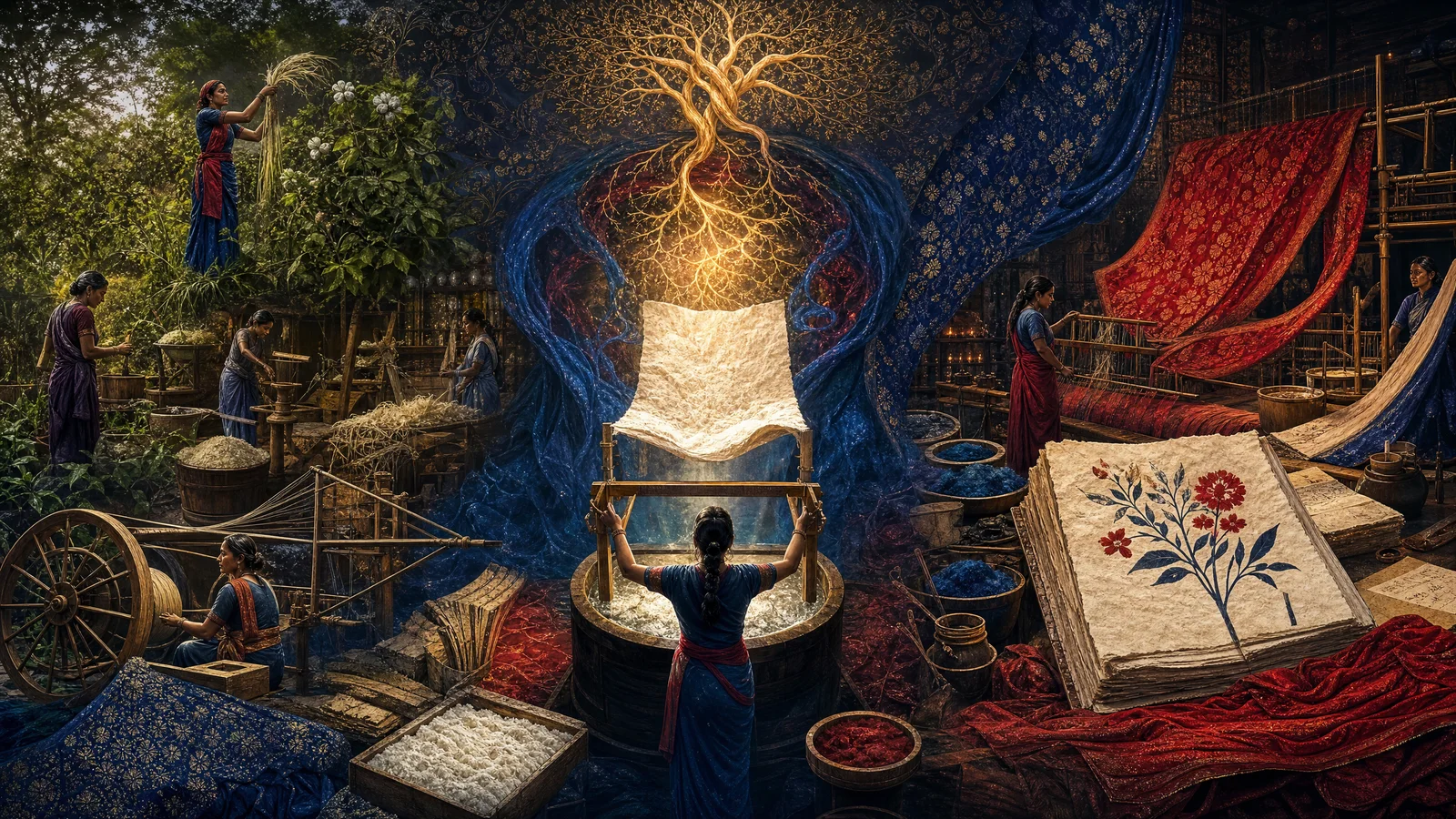
Complete Papermaking: From Plant Fiber to Written Page
Paper preserves knowledge across generations. This campaign covers fiber sources, pulp preparation, sheet forming, drying, and ink making.
Chapter 1: Fiber Sources
| Source | Fiber Quality | Availability | Processing | Paper Character |
|---|---|---|---|---|
| Cotton rags | Excellent (long fibers) | Moderate | Cut, cook, beat | Strong, archival, smooth |
| Linen rags | Excellent | Moderate | Cut, cook, beat | Very strong, archival |
| Wood (softwood) | Good (long fibers) | Abundant | Chip, cook extensively | Strong but acidic (needs treatment) |
| Wood (hardwood) | Moderate (short fibers) | Abundant | Chip, cook extensively | Smooth but weaker |
| Hemp/flax stalk | Very good | Moderate | Ret, cook, beat | Strong, durable |
| Bamboo | Good | Regional | Cook extensively | Smooth, moderate strength |
| Papyrus | Moderate (not true paper) | Regional (wetlands) | Slice, layer, press | Brittle, historical |
| Bark (mulberry, etc.) | Very good | Regional | Cook, beat | Strong, flexible (Japanese paper) |
| Grass/straw | Low-moderate (short fibers) | Abundant | Cook, beat | Weak, rough (blending material) |
| Recycled paper | Variable | Abundant | Soak, beat | Variable (weaker each cycle) |
Chapter 2: Pulp Preparation
| Step | Method | Time | Equipment | Purpose |
|---|---|---|---|---|
| Collect fiber | Gather rags, plant material | Variable | Hands, tools | Raw material |
| Cut/chop | Reduce to small pieces (1-2 inch) | 30-60 min | Scissors, knife, chipper | Increase surface area |
| Cook (alkaline) | Boil in alkali solution | 2-4 hours | Large pot, alkali (ash lye, soda ash) | Break down lignin, soften fiber |
| Rinse | Wash thoroughly in clean water | 30 min | Water, strainer | Remove chemicals and dissolved material |
| Beat/refine | Pound or blend fibers | 30-60 min | Mallet, hollander beater, or blender | Separate and fibrillate fibers |
| Screen | Remove chunks and debris | 15 min | Screen, strainer | Clean, even pulp |
Alkaline cooking: 1) Fill pot with chopped fiber material. 2) Cover with water. 3) Add alkali: wood ash lye (strong), soda ash (washing soda), or sodium hydroxide (lye). 4) For wood ash: 1 cup ash per gallon of water. 5) For soda ash: 2-3 tablespoons per gallon. 6) Boil gently for 2-4 hours (fiber should become soft, easily pulled apart). 7) Rinse thoroughly (3-4 water changes until water runs clear). 8) Alkali dissolves lignin (the glue holding plant fibers together). 9) Without this step, paper will be stiff, brown, and brittle.
Chapter 3: Sheet Forming
| Equipment | Function | Material | Difficulty to Make |
|---|---|---|---|
| Mould (screen frame) | Catches fibers from slurry | Wooden frame + fine screen/mesh | Moderate |
| Deckle (top frame) | Defines paper edges | Wooden frame (fits over mould) | Low |
| Vat | Holds pulp slurry | Large tub, basin | Very low |
| Felts/couching cloths | Receive wet sheets | Wool felt or smooth cloth | Very low (use fabric) |
| Press | Squeeze water from sheets | Boards + weight or screw press | Low-moderate |
Sheet forming process: 1) Fill vat with water. 2) Add beaten pulp (consistency of thin oatmeal). 3) Stir slurry thoroughly (even fiber distribution). 4) Place deckle on mould (screen side up). 5) Dip mould+deckle into vat at 45-degree angle. 6) Level under surface, lift straight up. 7) Let water drain through screen (fibers settle into sheet). 8) Remove deckle. 9) Flip mould onto felt (couching: transfer wet sheet to felt). 10) Press firmly and lift mould (sheet stays on felt). 11) Stack: felt, sheet, felt, sheet (post of sheets). 12) Press entire stack to remove water.
Chapter 4: Drying and Finishing
| Method | Time | Quality | Equipment | Best For |
|---|---|---|---|---|
| Air drying (on felt) | 1-3 days | Good (slightly textured) | Felts, drying space | Simple, small batches |
| Board drying | 1-2 days | Very good (smooth one side) | Smooth boards, clips | Better finish |
| Loft drying (hanging) | 1-2 days | Good | Clothesline, clips | Large batches |
| Hot press | Minutes | Excellent (very smooth) | Heated press or iron | Professional finish |
Sizing (making paper water-resistant): 1) Without sizing, paper absorbs ink like a sponge (feathering). 2) Internal sizing: add gelatin or starch to pulp before forming. 3) Surface sizing: dip finished dry sheets in gelatin solution. 4) Gelatin sizing: dissolve 1 tablespoon gelatin in 1 quart warm water. 5) Dip sheet briefly, drain, dry. 6) Result: ink sits on surface instead of soaking in. 7) Sized paper is essential for writing with liquid ink. 8) Unsized paper works fine for printing (ink is thicker).
Chapter 5: Ink Making
| Ink Type | Ingredients | Color | Permanence | Difficulty | Best For |
|---|---|---|---|---|---|
| Carbon ink (soot) | Soot + water + binder (gum arabic) | Black | Excellent (permanent) | Low | Writing, drawing |
| Iron gall ink | Oak galls + iron sulfate + gum arabic | Blue-black (darkens) | Very good | Moderate | Writing (historical standard) |
| Walnut ink | Walnut hulls + water | Brown | Moderate | Very low | Drawing, calligraphy |
| Berry ink | Berries + salt + vinegar | Red-purple | Poor (fades) | Very low | Temporary, children |
| Charcoal ink | Charcoal powder + water + binder | Grey-black | Good | Very low | Drawing |
| Lamp black ink | Collected soot + oil + binder | Deep black | Excellent | Low | Printing |
Carbon ink recipe: 1) Collect soot: hold plate over candle flame (soot deposits on plate). 2) Scrape soot into container. 3) Add water (small amount, to paste consistency). 4) Add binder: gum arabic (tree sap from acacia) dissolved in water. 5) Ratio: 1 part soot, 2 parts water, 1/2 part gum arabic solution. 6) Mix thoroughly (grind with mortar and pestle for smoothest ink). 7) Strain through fine cloth. 8) Store in sealed container. 9) This ink is permanent, waterproof when dry, and has been used for 4,000+ years.
Reference Card
- Long fibers make strong paper (cotton and linen rags produce the strongest, most archival paper). 2. Cook out the lignin (alkaline cooking removes lignin; lignin causes paper to yellow and become brittle). 3. Beat thoroughly (well-beaten pulp makes smooth, strong paper; under-beaten pulp is lumpy and weak). 4. Even slurry, even sheet (stir the vat before every dip; uneven distribution = uneven paper). 5. Size for writing (unsized paper bleeds ink; gelatin or starch sizing makes paper accept ink cleanly). 6. Carbon ink is permanent (soot-based ink lasts millennia; iron gall ink is also excellent but can corrode paper). 7. Press removes water (pressing is faster and produces smoother paper than air drying alone). 8. Paper preserves knowledge (the ability to make paper and ink is the ability to preserve civilization itself).