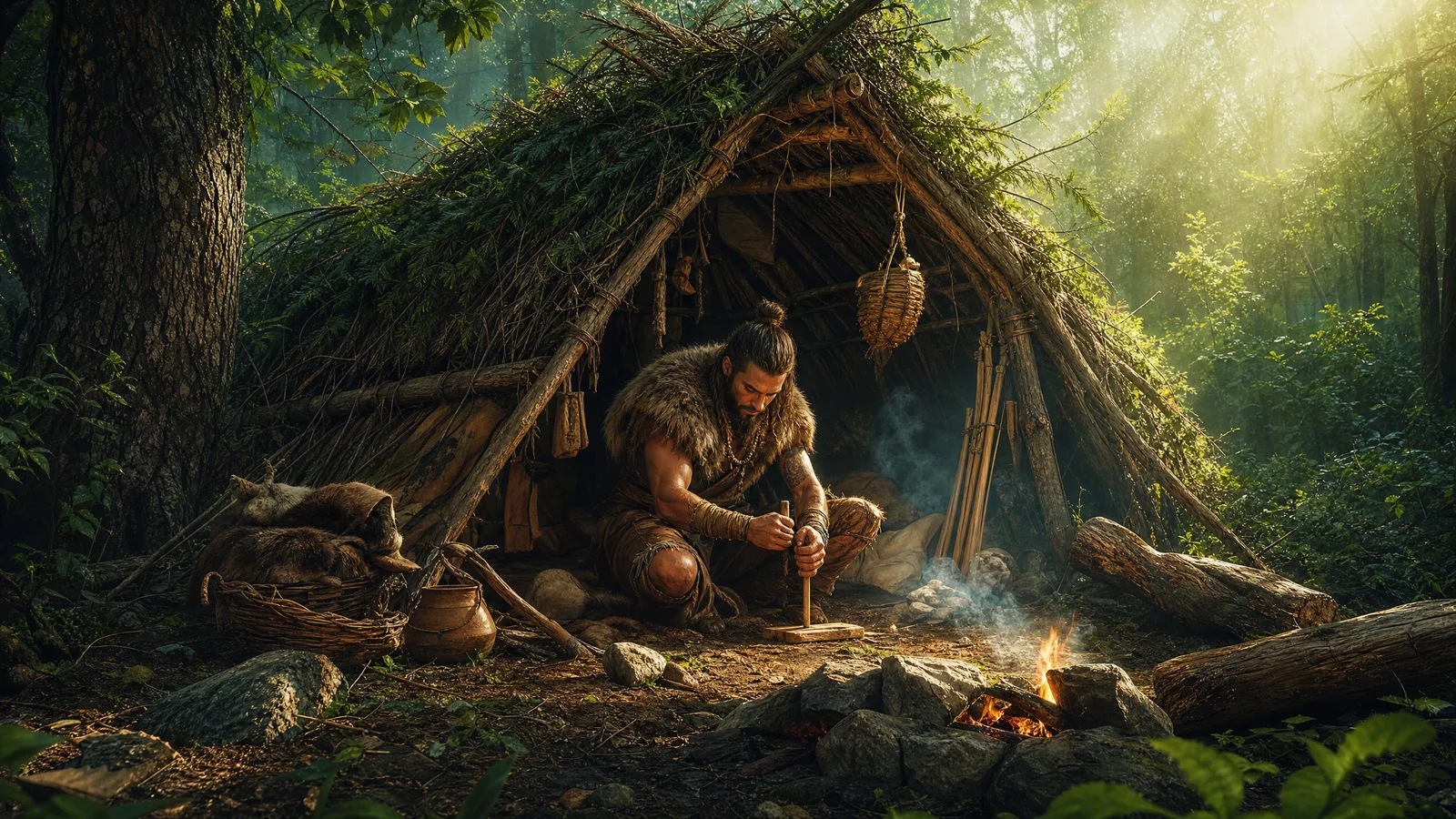
Complete Primitive Shelter: From Emergency to Permanent
Shelter is the first survival priority after immediate safety. This campaign covers emergency shelters, semi-permanent structures, and permanent primitive dwellings using only natural materials.
Chapter 1: Emergency Shelters (Built in Hours)
Type
Time to Build
Capacity
Warmth
Rain Protection
Materials
Best Climate
Debris hut
1-3 hours
1 person
Excellent (insulation)
Good (if thick)
Sticks, leaves, debris
Temperate, cold
Lean-to
30-60 min
1-3 people
Poor (open side)
Moderate
Poles, branches, leaves
Mild, short-term
Snow cave
2-4 hours
1-3 people
Good (32°F inside)
Excellent
Packed snow
Winter/arctic
Quinzhee
3-5 hours
2-4 people
Good (32°F inside)
Excellent
Loose snow (piled, settled)
Winter
Tarp shelter (A-frame)
15-30 min
1-2 people
Poor
Excellent
Tarp + cordage + poles
Any (with tarp)
Brush wickiup
2-4 hours
2-4 people
Moderate
Moderate
Poles, brush, bark
Temperate
Rock overhang (improved)
30-60 min
Variable
Moderate
Good (natural)
Existing overhang + wall
Any (where available)
Debris hut construction: 1) Find or place ridgepole (8-10 ft long, one end elevated 3 ft on stump/fork). 2) Lean ribs (sticks) along both sides at 45° angle, 6 inches apart. 3) Pile small sticks/brush perpendicular to ribs (lattice). 4) Pile leaves/debris 3-4 ft thick over entire structure. 5) Stuff interior with dry leaves (sleeping insulation). 6) Block entrance with stuffed debris bag or brush door. Critical: debris thickness determines warmth. 3 ft minimum for cold weather. Body heat alone warms interior to 50-60°F in freezing conditions.
Chapter 2: Semi-Permanent Structures (Days to Build)
Type
Time to Build
Capacity
Lifespan
Materials
Best Climate
Wattle and daub hut
1-2 weeks
2-6 people
5-15 years
Poles, woven sticks, clay/mud
Temperate, dry
Sod house
1-2 weeks
2-6 people
10-30 years
Sod blocks, timber frame
Prairie, grassland
Bark house (wigwam)
3-7 days
4-8 people
3-10 years
Saplings, bark sheets
Forest (birch/elm available)
Tipi/teepee
1-2 days (with hides)
4-8 people
5-15 years (hides)
Poles (15-20), hides/canvas
Plains, mobile
Pit house
2-4 weeks
4-8 people
20-50 years
Excavation, timber, earth
Cold climates
Thatch hut (round)
1-3 weeks
2-6 people
5-20 years
Poles, thatch grass, rope
Tropical, temperate
Adobe (sun-dried brick)
2-6 weeks
4-10 people
50-200+ years
Clay, sand, straw, water
Arid, semi-arid
Chapter 3: Permanent Dwellings (Weeks to Months)
Type
Time to Build
Capacity
Lifespan
Materials
Thermal Mass
Log cabin
2-6 weeks (2 people)
4-8 people
50-200+ years
Logs (8-12" diameter)
High
Stone house
2-6 months
4-10 people
200-1,000+ years
Stone, mortar (lime)
Very high
Timber frame
1-3 months
4-12 people
100-500+ years
Heavy timbers, joinery
Moderate (with infill)
Cob house
2-4 months
4-8 people
100-500+ years
Clay, sand, straw, water
Very high
Rammed earth
2-4 months
4-10 people
200-1,000+ years
Subsoil, forms, tamper
Very high
Cordwood masonry
1-3 months
4-8 people
50-100+ years
Short logs, mortar
High
Earthbag (superadobe)
2-6 weeks
2-6 people
50-100+ years
Bags, earth, barbed wire
Very high
Chapter 4: Roofing Systems
Type
Materials
Slope Required
Lifespan
Waterproofing
Weight
Difficulty
Thatch (grass/reed)
Long grass, reeds
45-55°
15-40 years
Excellent (if steep)
Light
Moderate
Bark (birch/elm)
Large bark sheets
30-45°
5-15 years
Good
Light
Low
Sod/earth
Sod, waterproof layer
10-30°
20-50 years
Good (with underlayer)
Very heavy
Moderate
Wood shingle/shake
Split wood (cedar best)
30-45°
20-50 years
Excellent
Moderate
Moderate-high
Slate/stone tile
Thin stone slabs
30-45°
100-200+ years
Excellent
Very heavy
High
Clay tile
Fired clay tiles
30-45°
50-100+ years
Excellent
Heavy
High (making tiles)
Metal (if available)
Sheet metal
15-30°
30-50+ years
Excellent
Light
Low (installation)
Thatch roofing: 1) Harvest material (reed, wheat straw, or long grass) when dry. Bundle into "yelms" (handfuls). 2) Start at eaves (bottom), work up. 3) Lay bundles with butt ends facing down and out. 4) Secure with horizontal rods (hazel) tied to rafters with twisted cord. 5) Each course overlaps previous by 2/3. 6) Build up 12-18 inches thick. 7) Ridge: fold thatch over top, secure with ridge roll. 8) Trim eaves and gable ends with shears. Steep pitch (45°+) is critical — water must shed quickly. Well-made thatch lasts 25-40 years. Insulates extremely well (R-value 30+).
Chapter 5: Heating Systems
System
Fuel
Efficiency
Heat Output
Complexity
Best For
Open fire (central)
Wood
10-15%
Low-moderate
Very low
Emergency, temporary
Fireplace (masonry)
Wood
15-25%
Moderate
High
Permanent homes
Wood stove (metal)
Wood
40-70%
High
High (to build)
All permanent structures
Rocket mass heater
Wood (small)
80-90%
High (sustained)
Moderate-high
Permanent, efficient
Hypocaust (under-floor)
Wood/charcoal
50-70%
Moderate (radiant)
Very high
Large structures
Kang (heated bed platform)
Wood/biomass
60-80%
Moderate (sleeping)
Moderate
Cold climate sleeping
Masonry heater (Russian)
Wood (one firing/day)
80-90%
High (12-24 hr release)
Very high
Cold climate permanent
Rocket mass heater: 1) Feed tube: 6" diameter, angled 45° (feeds sticks in). 2) Burn tunnel: 6" diameter, horizontal (combustion zone). 3) Heat riser: 6-8" diameter, vertical in insulated barrel (creates draft). 4) Barrel: 55-gallon drum over heat riser (radiates heat). 5) Exhaust: exits barrel bottom, runs through thermal mass (cob bench). 6) Chimney: short (4-6 ft), at end of bench run. Burns small wood (wrist-sized sticks) at extreme temperature. Smoke-free exhaust. Thermal mass bench stays warm 12-24 hours from one 2-hour firing. Uses 1/10 the wood of open fire.
Chapter 6: Foundation and Site
Foundation Type
Soil Requirement
Frost Depth
Load Capacity
Cost
Difficulty
Stone pier
Any stable soil
Below frost line
Moderate
Low
Moderate
Rubble trench
Well-drained
Below frost line
High
Low-moderate
Moderate
Dry-stack stone
Stable, not expansive
Below frost line
Very high
Moderate
High
Concrete (if available)
Any
Below frost line
Very high
High
Moderate
Earthbag
Stable
Surface (if insulated)
High
Low
Low-moderate
Post-in-ground
Well-drained
Below frost line
Moderate
Very low
Low
Gravel pad
Any
Surface (floating)
Moderate
Low
Low
Site selection criteria: 1) Water: within 200 yards of clean water source. 2) Drainage: slight slope (2-5%) away from structure. Never in a low spot. 3) Sun: south-facing exposure (northern hemisphere) for solar gain. 4) Wind: protected from prevailing winter winds (trees, hill). 5) Soil: stable, well-drained. Test: dig 3 ft, check for water/clay. 6) Materials: near building materials (timber, stone, clay). 7) Safety: above flood level, away from dead trees, not on unstable slope. 8) Access: reachable by transport for materials delivery.
Reference Card
Shelter priority: get out of wind and rain immediately. Debris hut in 2 hours saves your life. Improve later. Perfect is the enemy of alive.
Thermal mass: heavy materials (stone, earth, cob) absorb heat during day, release at night. Stabilizes temperature. Light materials (wood) heat fast but cool fast.
Insulation: dead air space = warmth. Debris, straw, wool, moss — anything that traps air. R-value matters. 12 inches of straw = R-40. Roof insulation most critical (heat rises).
Ventilation: sealed shelter = carbon monoxide death. Any fire needs fresh air inlet (low) and smoke outlet (high). Even without fire, moisture buildup causes rot and illness.
Roof pitch: steeper = better water shedding. Thatch needs 45°+. Shingles need 30°+. Metal can go 15°+. Flat roofs leak. Always.
Foundation: keep wood off ground (rot). Keep structure above water (flooding). Keep below frost line (heaving). Stone or gravel between earth and structure.
Size: build small first, expand later. 100 sq ft per person minimum. 200 sq ft comfortable. Heating a large space is expensive. Small + well-insulated beats large + drafty.
Fire safety: keep combustibles away from heat sources. Stone/earth around fireplace. Clear roof above chimney. Water/sand accessible. Fire destroys in minutes what took months to build.