Sovereignty Module: Multiply the Force
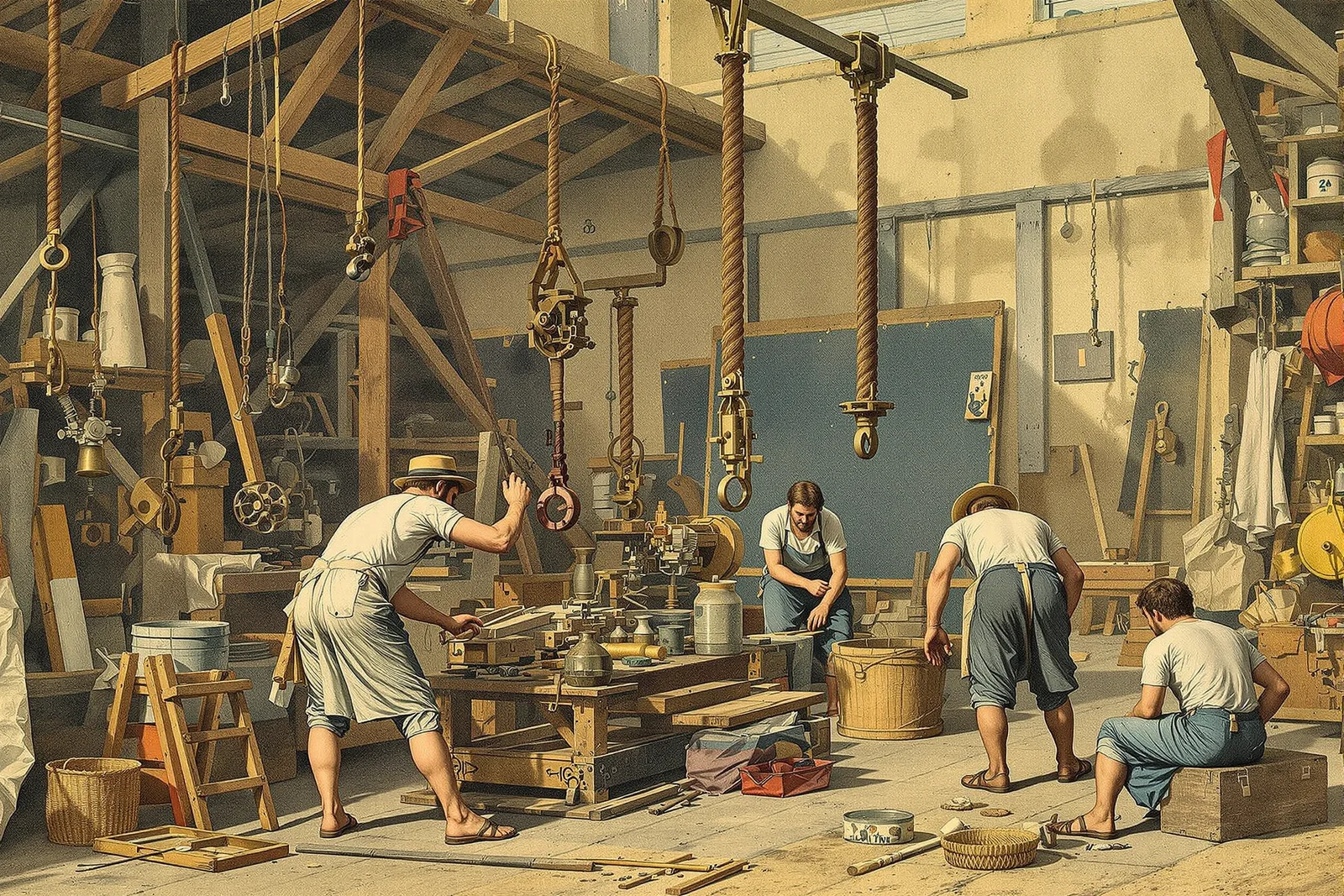
Complete Pulley Systems, Block and Tackle, and Mechanical Advantage Guide
A single person can lift 10,000 pounds with the right pulley system. Mechanical advantage multiplies human strength without engines or electricity. This campaign covers every lifting and pulling system from simple pulleys to complex compound machines.
Chapter 1: Mechanical Advantage Systems
| System | Mechanical Advantage | Rope Needed | Complexity | Max Practical Load |
|---|---|---|---|---|
| Single fixed pulley | 1:1 (direction change only) | 1x lift height | Very low | Unlimited (rope strength) |
| Single movable pulley | 2:1 | 2x lift height | Low | Rope strength / 2 |
| Double block and tackle | 4:1 | 4x lift height | Moderate | Rope strength / 4 |
| Triple block and tackle | 6:1 | 6x lift height | Moderate | Rope strength / 6 |
| Compound (block on block) | Up to 16:1+ | Multiplied | High | Limited by friction |
| Spanish windlass | 10-50:1 | Short rope + lever | Low | Limited by stick strength |
| Lever (Class 1) | Variable (fulcrum position) | N/A | Very low | Limited by lever strength |
| Inclined plane (ramp) | Length/height ratio | N/A | Very low | Unlimited |
| Screw jack | Circumference/pitch ratio | N/A | Moderate | Very high (tons) |
| Windlass/capstan | Drum radius / handle radius | Wraps on drum | Low-moderate | Very high |
Chapter 2: Block and Tackle Construction
| Component | Material | Specification | Function |
|---|---|---|---|
| Sheave (wheel) | Hardwood, metal, or plastic | Grooved for rope, free-spinning on axle | Redirects rope with low friction |
| Shell (block housing) | Hardwood or metal | Holds sheave(s), has hook or eye | Structural frame |
| Axle (pin) | Steel or hardwood | Through sheave center | Rotation axis |
| Becket (attachment point) | Rope loop or metal eye | On one block | Dead end of rope attaches here |
| Hook or eye | Forged steel or heavy wire | On shell | Attaches block to load or anchor |
| Rope | Manila, nylon, or polyester | Diameter matched to sheave groove | Transmits force |
Sheave diameter rule: Sheave diameter should be at least 6x the rope diameter. Smaller sheaves increase friction and wear rope faster. Example: 1/2 inch rope needs 3-inch minimum sheave diameter.
Chapter 3: Common Rigging Configurations
| Configuration | MA | Setup | Use Case |
|---|---|---|---|
| Gun tackle (1 fixed + 1 movable, single sheave each) | 2:1 | Fixed block on anchor, movable on load | Light lifting, general use |
| Luff tackle (1 single + 1 double) | 3:1 | Double on load, single on anchor | Medium loads |
| Double tackle (2 double blocks) | 4:1 | One on anchor, one on load | Heavy lifting |
| Gyn tackle (1 double + 1 triple) | 5:1 | Triple on load, double on anchor | Very heavy loads |
| Triple tackle (2 triple blocks) | 6:1 | One on anchor, one on load | Maximum hand-powered lifting |
| Trucker's hitch (rope only) | 3:1 | Loop in rope creates pulley effect | Tensioning loads, no hardware |
Chapter 4: Lifting Heavy Objects
| Task | Weight | Recommended System | People Needed |
|---|---|---|---|
| Raise roof beam | 200-500 lbs | Double tackle (4:1) + gin pole | 1-2 |
| Set foundation stone | 500-2,000 lbs | Triple tackle (6:1) + A-frame | 2-4 |
| Raise wall (timber frame) | 1,000-3,000 lbs | Multiple tackles + pike poles | 4-8 |
| Move large boulder | 2,000-10,000 lbs | Compound tackle + lever + rollers | 4-10 |
| Raise bridge beam | 1,000-5,000 lbs | Gin pole + triple tackle | 4-8 |
| Pull stump | 500-5,000 lbs | Spanish windlass or come-along | 1-2 |
Chapter 5: Gin Pole and A-Frame
| Structure | Use | Height | Load Limit | Setup |
|---|---|---|---|---|
| Gin pole (single pole, guyed) | Vertical lifting directly below | 15-30 feet | 1,000-3,000 lbs | Pole + 3 guy wires at 120 degrees |
| A-frame (bipod) | Lifting with some horizontal reach | 10-20 feet | 2,000-5,000 lbs | 2 poles lashed at top, spread at base |
| Tripod (shear legs) | Stable lifting, any direction | 10-20 feet | 3,000-8,000 lbs | 3 poles lashed at top |
| Crane (boom + mast) | Horizontal reach + vertical lift | Variable | Variable | Mast + pivoting boom + tackle |
Gin pole rule: Never stand under a suspended load. Never exceed 60-degree lean angle (measured from vertical). Guy wires must be anchored at distance equal to pole height.
Chapter 6: Friction and Efficiency
| Factor | Efficiency Loss | Mitigation |
|---|---|---|
| Each sheave in system | 5-10% per sheave | Grease axles, use roller bearings |
| Rope bending around sheave | 2-5% per bend | Use larger sheaves (6x rope diameter minimum) |
| Rope-on-rope friction | 10-20% | Keep ropes from crossing or rubbing |
| Knot in loaded rope | 30-50% strength reduction | Use splices instead of knots for permanent rigging |
| Wet rope (manila) | 10-20% strength loss | Use synthetic rope in wet conditions |
| UV degradation (synthetic) | Gradual over months | Store rope out of sunlight |
Real-world efficiency: A 6:1 theoretical mechanical advantage with 6 sheaves at 90% efficiency each = 6 x (0.9^6) = 6 x 0.53 = actual 3.2:1. Always oversize your system.
Reference Card
- Mechanical advantage = number of rope sections supporting the load
- Sheave diameter should be at least 6x rope diameter (reduces friction and wear)
- Each sheave loses 5-10% efficiency: a 6:1 system actually delivers about 3-4:1
- Trucker's hitch: 3:1 mechanical advantage with rope alone (no hardware)
- Never stand under a suspended load (EVER)
- Gin pole: guy wires at 120 degrees, anchored at distance equal to pole height
- Knots reduce rope strength 30-50%: use splices for permanent rigging
- Spanish windlass: stick twisted in rope loop gives 10-50:1 advantage (stump pulling)