Sovereignty Module: Raise the Cup
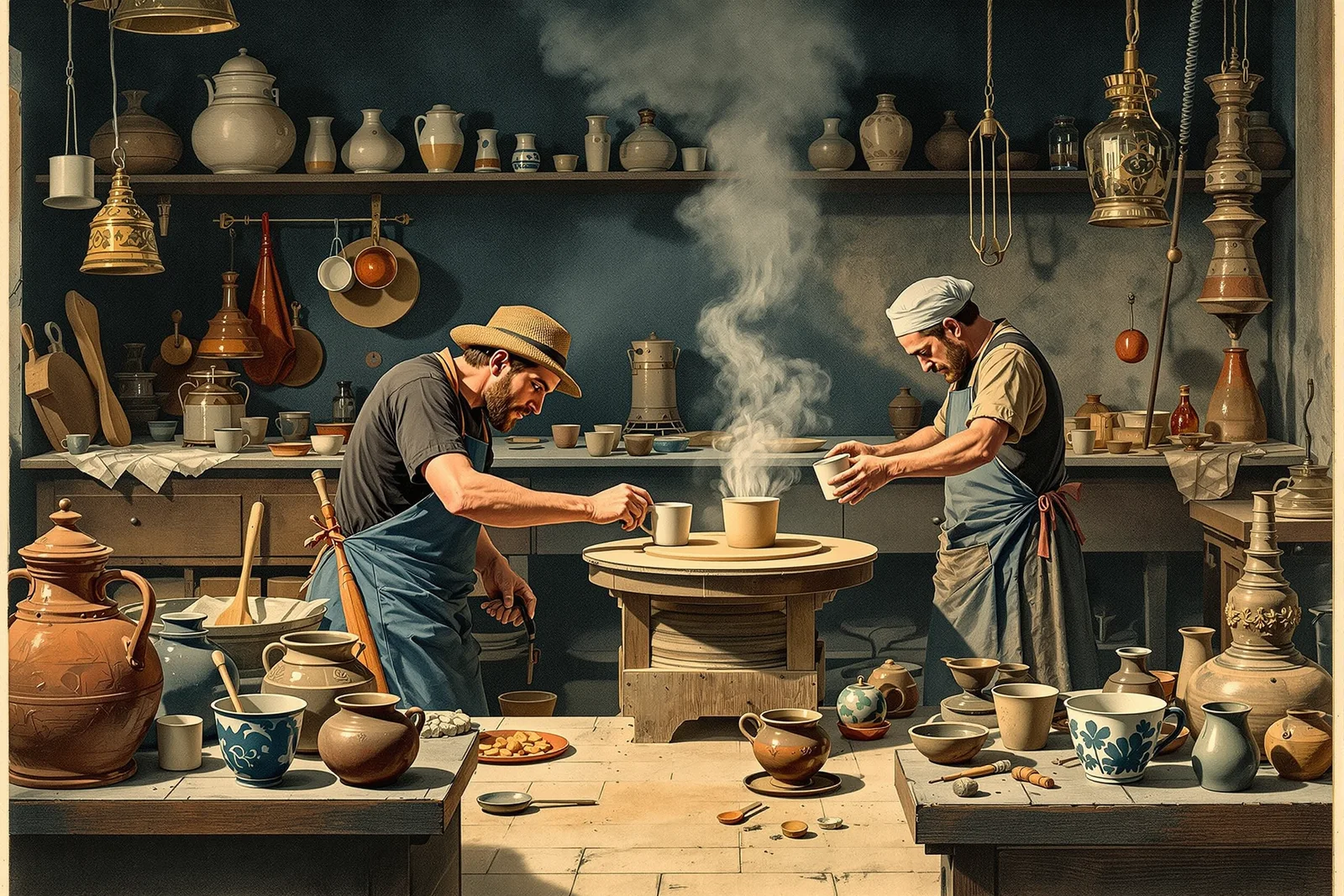
Complete Mug and Cup Making: From Wheel to Daily Vessel
The mug is the most personal pottery form, used daily and held close. This campaign covers throwing, trimming, handle pulling, glazing, and design principles for functional drinkware.
Chapter 1: Mug Specifications
| Type | Volume | Height | Diameter | Wall Thickness | Weight (empty) |
|---|---|---|---|---|---|
| Espresso cup | 3-4 oz | 2-2.5 inches | 2.5-3 inches | 3/16 inch | 4-6 oz |
| Tea cup | 6-8 oz | 3-3.5 inches | 3-3.5 inches | 3/16 inch | 6-8 oz |
| Coffee mug | 10-14 oz | 4-4.5 inches | 3.5-4 inches | 1/4 inch | 10-14 oz |
| Large mug | 16-20 oz | 5-5.5 inches | 4-4.5 inches | 1/4 inch | 14-18 oz |
| Travel mug | 16-20 oz | 6-7 inches | 3.5-4 inches | 1/4 inch | 16-20 oz |
Chapter 2: Throwing
Mug throwing: 1) Center 1-1.5 pounds of clay (for standard 12 oz mug). 2) Open to 3/4 inch from bat. 3) Pull walls to 4.5-5 inches tall (shrinks 10-12%). 4) Wall thickness: 1/4 inch (even from bottom to top). 5) Slight taper: narrower at bottom, wider at rim. 6) Shape rim: round and smooth (lips touch this). 7) Cut with wire, leave on bat to firm. 8) Trim foot ring when leather-hard. 9) Foot ring: 1/4 inch tall, 1/8 inch wide.
| Throwing Step | Tool | Critical Factor |
|---|---|---|
| Centering | Hands | Perfectly centered (no wobble) |
| Opening | Fingers/thumb | Even bottom thickness |
| Pulling walls | Fingers/rib | Even wall thickness |
| Shaping | Rib | Consistent profile |
| Rim finishing | Chamois/finger | Smooth, rounded rim |
| Cutting | Wire | Clean separation from bat |
| Trimming | Loop tool | Even foot ring, balanced weight |
Chapter 3: Handle Pulling
Handle pulling: 1) Wedge a fist-sized piece of clay. 2) Form into thick carrot shape. 3) Wet hands and begin pulling. 4) Squeeze and pull downward repeatedly. 5) Handle elongates and thins with each pull. 6) Target: 5-6 inches long, 3/4 inch wide, 3/8 inch thick. 7) Cross-section: slightly concave on underside (finger rest). 8) Allow to firm slightly (10-15 minutes). 9) Attach to mug at leather-hard stage.
| Handle Type | Cross-Section | Comfort | Style |
|---|---|---|---|
| Pulled (round) | Oval | Good | Traditional |
| Pulled (strap) | Flat, wide | Excellent | Modern |
| Extruded | Consistent profile | Good | Production |
| Slab | Flat, cut from slab | Fair | Contemporary |
| Twisted | Two strands twisted | Decorative | Artistic |
Chapter 4: Handle Attachment
Attachment: 1) Score attachment points on mug (top and bottom). 2) Apply slip to scored areas. 3) Press top of handle firmly to upper attachment point. 4) Blend joint with finger or tool. 5) Curve handle outward (comfortable grip arc). 6) Press bottom of handle to lower attachment point. 7) Blend lower joint. 8) Handle should be comfortable for 2-3 fingers. 9) Handle must support weight of full mug (1.5-2 lbs). 10) Allow to dry slowly (cover handle to prevent cracking).
| Attachment Factor | Specification | Why |
|---|---|---|
| Top position | 1/2 inch below rim | Comfortable grip height |
| Bottom position | 1-1.5 inches above foot | Balanced feel |
| Handle arc | 1-1.5 inches from wall | Room for fingers |
| Handle angle | Slight outward tilt | Natural wrist position |
| Joint blending | Smooth, no gaps | Structural integrity |
Chapter 5: Glazing and Finishing
| Glaze Type | Food Safe | Appearance | Application |
|---|---|---|---|
| Clear glaze | Yes | Shows clay body | Dip or pour |
| Celadon | Yes | Pale green-blue | Dip or pour |
| Tenmoku | Yes | Dark brown-black | Dip or pour |
| Shino | Yes | Orange-white | Dip or brush |
| Ash glaze | Yes (if tested) | Green-brown, natural | Dip or pour |
| Slip + clear | Yes | Colored surface | Brush slip, dip clear |
Glazing mugs: 1) Wax resist on foot ring bottom (prevents glaze sticking to kiln shelf). 2) Dip mug in glaze (hold by foot ring). 3) Glaze thickness: 1/16 inch (about 3 seconds dip). 4) Touch up any bare spots with brush. 5) Clean glaze from foot ring bottom. 6) Fire to appropriate cone for glaze.
Reference Card
- The rim is the most important surface (the rim touches the drinker's lips with every sip; it must be smooth, rounded, and free of glaze lumps; a rough rim ruins the drinking experience). 2. Even wall thickness controls weight (a mug that is too heavy feels clumsy; too light feels fragile; consistent 1/4 inch walls produce a mug that feels substantial without being heavy). 3. The handle must fit the hand (a handle that is too small pinches fingers; too large feels awkward; the handle arc should comfortably accommodate 2-3 fingers with room to spare). 4. Score and slip every joint (the handle-to-body joint is the most common failure point; thorough scoring and slipping creates a strong bond that survives thermal stress during firing). 5. The foot ring prevents heat transfer (a foot ring lifts the mug off the table surface; this prevents a hot mug from marking furniture and provides a comfortable grip point for lifting). 6. Food-safe glazes are essential (mugs hold hot liquids that contact the glaze surface; only tested, food-safe glazes should be used on the interior of drinking vessels). 7. A handmade mug is the most personal pottery (people develop deep attachment to their favorite mug; a handmade mug with comfortable handle, smooth rim, and beautiful glaze becomes a daily companion). 8. The mug is the potter's calling card (the quality of a potter's mugs reveals their skill level; throwing, trimming, handle pulling, and glazing must all be excellent for a great mug).