Sovereignty Module: Store the Harvest
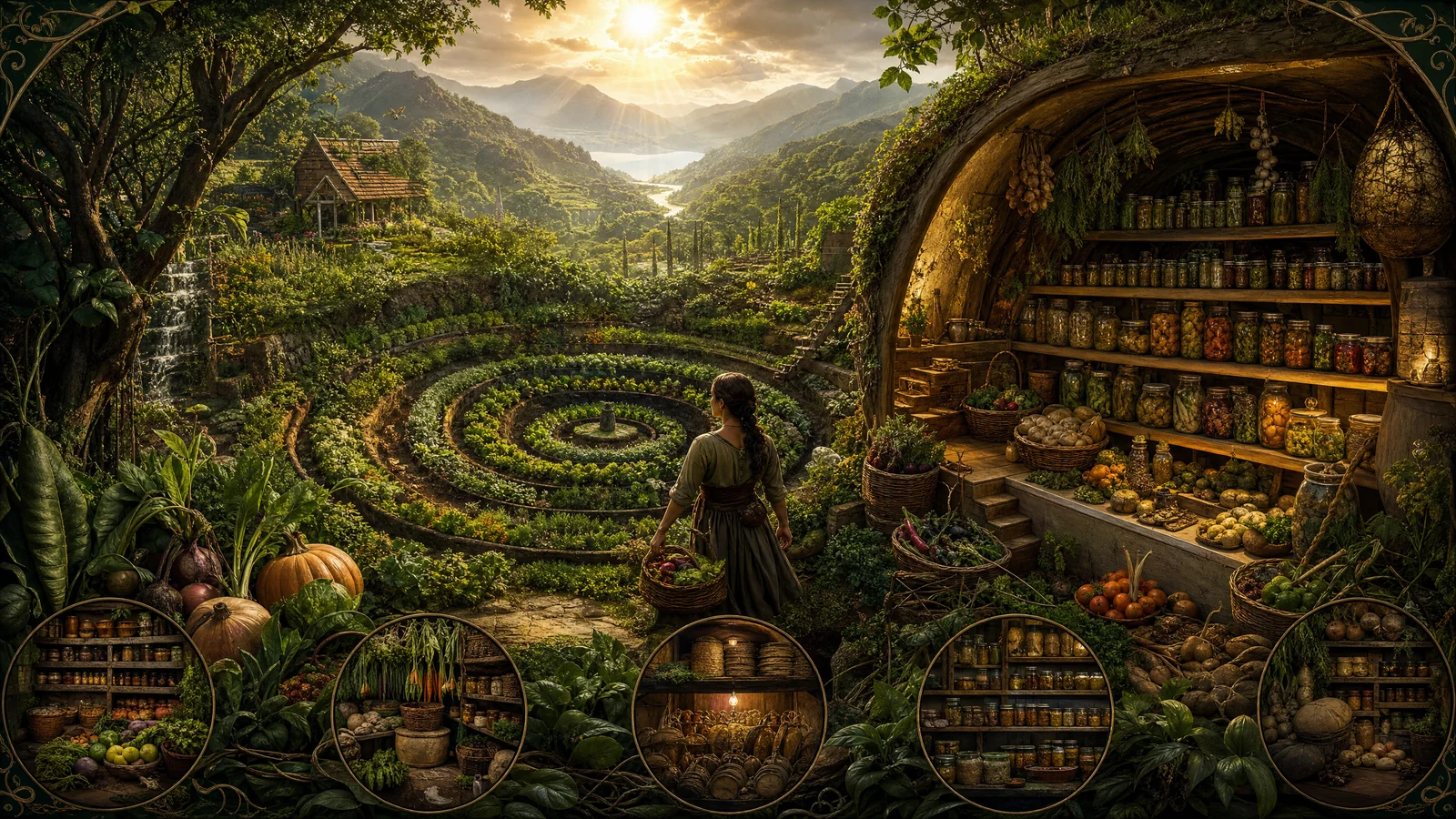
Store the Harvest
Complete Root Cellar, Cold Storage, and Long-Term Food Preservation Guide
Complete Root Cellar, Cold Storage, and Long-Term Food Preservation Guide
A root cellar extends food storage from weeks to months without electricity. This campaign covers design, construction, and management of underground and above-ground cold storage.
Chapter 1: Storage Conditions by Crop
| Crop | Temperature (F) | Humidity (%) | Storage Life | Preparation |
|---|---|---|---|---|
| Potatoes | 38-45 | 90-95% | 4-6 months | Cure 2 weeks at 60F, dark. Do NOT wash. |
| Carrots | 32-35 | 95-98% | 4-6 months | Remove tops (leave 1 inch). Pack in damp sand. |
| Beets | 32-35 | 95-98% | 3-5 months | Remove tops (leave 1 inch). Pack in damp sand. |
| Turnips/rutabaga | 32-35 | 90-95% | 3-5 months | Remove tops. Wax coating extends life. |
| Onions | 32-40 | 65-70% (dry!) | 4-8 months | Cure 2-3 weeks until necks dry. Braid or mesh bags. |
| Garlic | 32-40 | 60-70% (dry!) | 6-8 months | Cure 2-3 weeks. Braid or mesh bags. Good airflow. |
| Winter squash | 50-55 | 50-70% (dry!) | 3-6 months | Cure 2 weeks at 80F. Store warm and dry (NOT cold). |
| Apples | 32-35 | 85-90% | 3-6 months | Wrap individually in paper. Do NOT store near potatoes. |
| Pears | 32-35 | 85-90% | 2-3 months | Pick slightly unripe. Wrap individually. |
| Cabbage | 32-35 | 90-95% | 3-5 months | Pull with roots. Hang upside down or wrap in paper. |
| Parsnips | 32-35 | 95-98% | 4-6 months | Leave in ground with heavy mulch, or pack in sand. |
| Canned goods | 40-60 | Any | 1-5 years | Keep dark, stable temperature. Check seals annually. |
Chapter 2: Root Cellar Design Principles
| Principle | Requirement | Why |
|---|---|---|
| Underground (earth-sheltered) | Minimum 4 feet below grade | Earth temperature is stable (50-55F year-round at 4 ft depth) |
| Ventilation | Two vents: one high (warm air out), one low (cool air in) | Removes ethylene gas, controls temperature, prevents mold |
| Drainage | Gravel floor or French drain around perimeter | Standing water = mold, rot, structural damage |
| Insulation (roof) | Minimum R-20 above ceiling | Prevents heat gain from above |
| Darkness | No windows, light-tight door | Light causes greening (potatoes), sprouting |
| Humidity control | Dirt/gravel floor (adds moisture) or pans of water | Most crops need 85-95% humidity |
| Separate zones | Warm/dry zone (squash, onions) vs. cold/wet zone (roots, apples) | Different crops need different conditions |
Chapter 3: Construction Methods
| Type | Cost | Difficulty | Capacity | Temperature Control | Best Climate |
|---|---|---|---|---|---|
| Hillside cellar (dug into slope) | Low-moderate | Moderate | Large (100+ bushels) | Excellent | All (best option) |
| Buried container (trash can, barrel) | Very low | Very low | Small (1-2 bushels) | Good | All climates |
| Basement room (insulated partition) | Low | Low | Medium (20-50 bushels) | Good | Cold climates |
| Above-ground insulated (straw bale walls) | Low | Low | Medium | Fair (cold climates only) | Cold climates only |
| Concrete block cellar (standalone) | Moderate-high | High | Large (100+ bushels) | Excellent | All climates |
| Earth-bermed structure | Moderate | Moderate-high | Large | Excellent | All climates |
Chapter 4: Hillside Root Cellar Construction
| Step | Action | Materials | Details |
|---|---|---|---|
| 1 | Select site: north-facing slope, well-drained soil | - | North face stays coolest. Avoid low spots (flooding). |
| 2 | Excavate into hillside (8×10 ft interior minimum) | Shovel, pick, or equipment | Dig 2 ft deeper than ceiling height for drainage gravel |
| 3 | Install French drain (perforated pipe in gravel) | 4-inch perforated pipe + gravel | Around perimeter and under floor. Daylight outlet downhill. |
| 4 | Build walls: concrete block, stone, or treated timber | Mortar, block, rebar | 8-inch block minimum. Waterproof exterior with tar/membrane. |
| 5 | Install ceiling: reinforced concrete or heavy timber | Rebar + concrete, or 6×6 beams + planks | Must support earth load above (minimum 12 inches of soil) |
| 6 | Waterproof roof: membrane + drainage mat | EPDM or polyethylene + drainage board | Critical — leaks destroy stored food |
| 7 | Cover with 12-24 inches of earth | Soil from excavation | More earth = more stable temperature |
| 8 | Install ventilation: 4-inch PVC pipes (one high, one low) | PVC pipe + screen (keep rodents out) | High vent at back ceiling. Low vent near floor at front. |
| 9 | Install door: insulated, weather-stripped | Solid wood or insulated metal | Must seal tight. Consider double door (airlock) in hot climates. |
| 10 | Build shelving: wood or wire (NOT against walls) | Untreated wood or coated wire | 2-inch gap from walls for airflow. Slatted shelves. |
Chapter 5: Management and Monitoring
| Task | Frequency | Purpose | Method |
|---|---|---|---|
| Check temperature | Daily (or thermometer with min/max) | Maintain 32-55F range | Adjust vents: open at night (cool), close during day (warm) |
| Check humidity | Weekly | Maintain 85-95% for roots | Too dry: add pan of water. Too wet: increase ventilation. |
| Inspect produce | Weekly | Remove spoiled items immediately | One rotten apple spoils the barrel (ethylene + mold spread) |
| Ventilate | Daily (fall/spring), as needed (winter) | Remove ethylene gas, equalize temperature | Open both vents for 15-30 minutes |
| Check for rodents | Weekly | Prevent crop loss | Traps at entrances. Screen all vents (1/4 inch hardware cloth). |
| Organize by use date | Monthly | Use shortest-storage items first | Rotate stock. Label with harvest date. |
Chapter 6: Alternative Cold Storage Methods
| Method | Capacity | Temperature | Humidity | Best For |
|---|---|---|---|---|
| In-ground storage (leave in garden) | Unlimited | 32-40F (with mulch) | 95%+ | Parsnips, carrots, leeks, kale |
| Straw bale clamp | 5-20 bushels | 35-45F | 85-95% | Potatoes, root vegetables |
| Buried barrel/trash can | 1-3 bushels | 35-45F | 90%+ | Small quantities of roots |
| Hay-insulated pit | 5-10 bushels | 35-45F | 85-95% | Apples, potatoes |
| Unheated garage/shed (cold climates) | Variable | Ambient (cold) | Variable | Onions, garlic, squash (above freezing) |
| Zeer pot (evaporative cooler) | Small | 15-20F below ambient | High | Hot climates, short-term |
Reference Card
- Root cellar ideal: 32-40F, 85-95% humidity, dark, ventilated. Earth-sheltered is best.
- Potatoes: cure 2 weeks at 60F → store at 38-45F. NEVER store with apples (ethylene causes sprouting).
- Onions/garlic: cure until necks are dry → store COOL and DRY (65-70% humidity). Opposite of roots.
- Winter squash: cure 2 weeks at 80F → store WARM (50-55F) and dry. NOT in root cellar (too cold/wet).
- Ventilation is non-negotiable: two vents (high + low). Removes ethylene, controls temperature, prevents mold.
- Drainage is non-negotiable: French drain around perimeter + under floor. Standing water = total loss.
- Pack roots in damp sand or sawdust: maintains humidity around individual vegetables. Extends life significantly.
- One rotten item spoils everything: inspect weekly. Remove immediately. Never store damaged produce.
TransmissionCOMPLETE — unaltered & unabridged
Words1,271 — every one of them
SHA-256 of source text8f517a26c7799066480cab54b77714a8eb5cfe7d4d86c520217c67e0e7ab6101
Canonical textdownload campaign-root-cellar.md — byte-identical to what this page renders