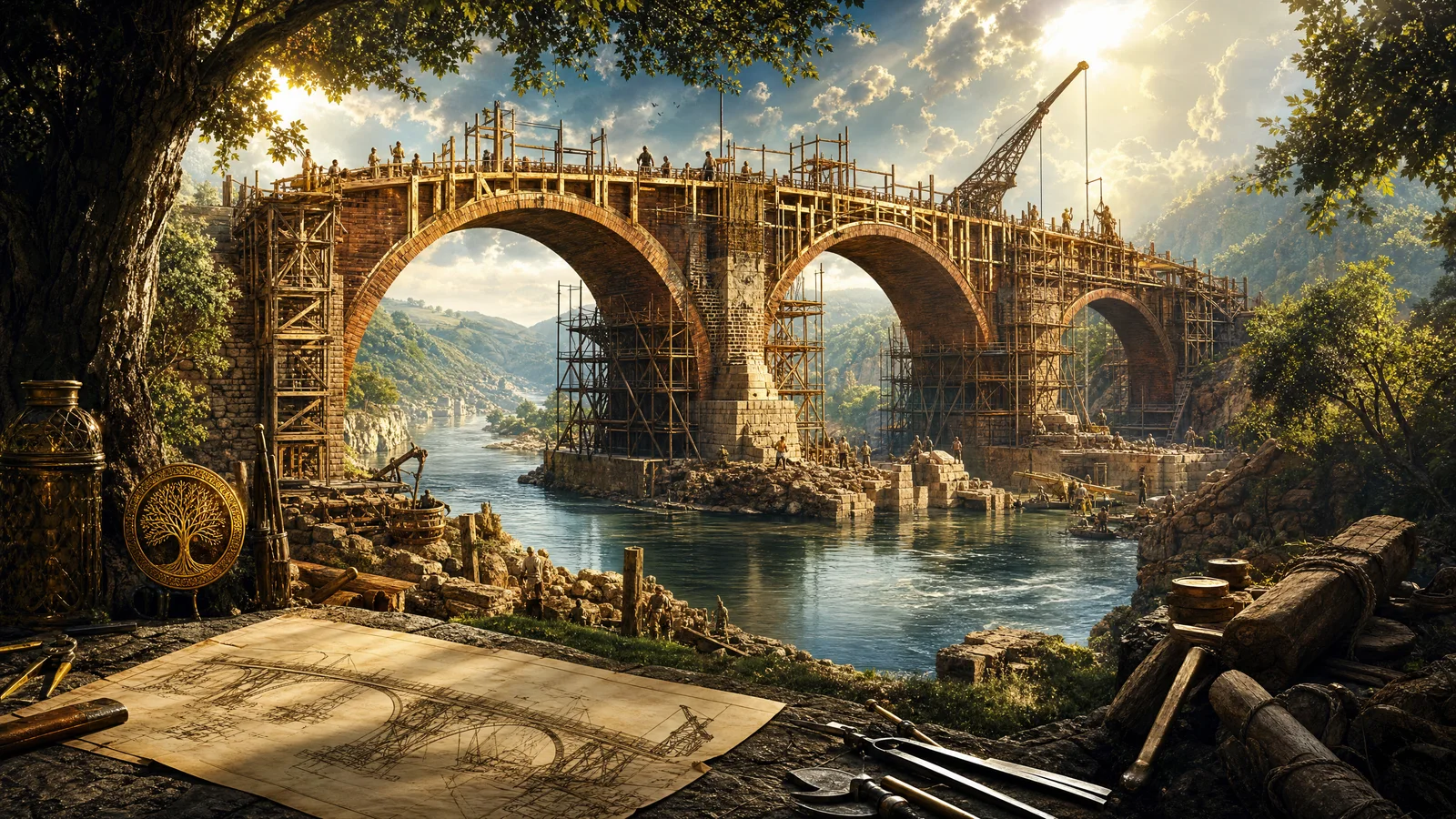
Complete Clay Brick Arch Bridge Construction: From Foundation to Crossing
Arch bridges are among the most durable structures ever built. This campaign covers arch geometry, centering (formwork), brick laying, abutment construction, and load testing.
Chapter 1: Arch Types
Type
Shape
Span
Strength
Difficulty
Historical Use
Semicircular
Half circle
Up to 30 feet
Very high
Moderate
Roman
Segmental
Less than half circle
Up to 50 feet
High
Moderate
Medieval+
Pointed (Gothic)
Two arcs meeting at point
Up to 40 feet
Very high
High
Gothic
Flat (jack arch)
Nearly flat
Up to 6 feet
Moderate
Low
Lintels, windows
Elliptical
Ellipse shape
Up to 60 feet
High
Very high
Renaissance+
Corbelled
Stacked offset courses
Up to 15 feet
Moderate
Low
Ancient
Chapter 2: Arch Geometry
Semicircular arch: 1) The arch is a half circle. 2) Span = diameter of the circle. 3) Rise = radius = half the span. 4) Example: 10-foot span = 5-foot rise. 5) All forces are directed downward and outward to the abutments. 6) The arch is in pure compression (no tension). 7) Bricks and mortar are strong in compression. 8) This is why arches can span great distances with simple materials.
Span
Rise (semicircular)
Abutment Width
Brick Count (est.)
Mortar (est.)
6 feet
3 feet
2 feet
200-300
2 cubic feet
10 feet
5 feet
3 feet
500-700
5 cubic feet
15 feet
7.5 feet
4 feet
1000-1500
10 cubic feet
20 feet
10 feet
5 feet
2000-3000
20 cubic feet
Chapter 3: Centering (Formwork)
Centering construction: 1) Centering is a temporary wooden frame that supports the arch during construction. 2) Build two curved ribs from lumber (cut to arch curve). 3) Space ribs at bridge width apart. 4) Connect ribs with cross braces. 5) Cover top with planks or plywood (smooth surface for bricks). 6) Support centering on posts (adjustable height). 7) Centering must be strong enough to support all bricks and mortar until the arch is complete. 8) The arch cannot support itself until the keystone (top center brick) is placed. 9) After keystone is set and mortar cures, centering is removed (struck). 10) The arch then supports itself through compression.
Component
Material
Purpose
Curved ribs (2+)
2x10 or 2x12 lumber, cut to curve
Define arch shape
Cross braces
2x4 lumber
Connect ribs, maintain width
Deck planks
1x6 lumber or plywood
Smooth surface for brick laying
Support posts
4x4 or 6x6 lumber
Hold centering at correct height
Wedges
Hardwood
Adjustable height, easy removal
Chapter 4: Brick Laying
Arch brick laying: 1) Start from both abutments simultaneously. 2) Lay bricks on centering, working upward from both sides. 3) Mortar joints: 1/4-3/8 inch (thinner at intrados, thicker at extrados). 4) Joints are wedge-shaped (wider on outside, narrower on inside). 5) Each brick is angled to point toward the center of the arch. 6) Use a string or trammel from the center point to check alignment. 7) Work both sides evenly (keep weight balanced on centering). 8) Place keystone last (top center brick). 9) Keystone locks the arch. 10) Allow mortar to cure 7-14 days before removing centering.
Step
Action
Critical Factor
Foundation
Build abutments on solid ground
Must resist outward thrust
Centering
Build and install formwork
Must be accurate and strong
Spring line
First course on abutments
Level, aligned, solid
Voussoirs
Lay bricks from both sides upward
Wedge-shaped joints, centered
Keystone
Place final center brick
Locks the arch
Cure
Wait 7-14 days
Mortar must reach strength
Strike
Remove centering carefully
Arch now self-supporting
Spandrel
Fill above arch to road level
Rubble fill, then paving
Chapter 5: Abutments and Load
Abutment Specification
Small Bridge (6 ft)
Medium Bridge (15 ft)
Large Bridge (20 ft)
Width
2 feet
4 feet
5 feet
Depth (into ground)
2 feet
3 feet
4 feet
Height
3 feet
7.5 feet
10 feet
Material
Stone or brick
Stone or brick
Stone or brick
Foundation
Compacted gravel
Concrete or stone
Concrete or stone
Reference Card
The arch works in compression (every brick in an arch is being squeezed by its neighbors; bricks and mortar are extremely strong in compression, which is why arches can span great distances). 2. The keystone locks the arch (the arch cannot support itself until the keystone (top center brick) is placed; until then, the centering carries all the weight). 3. Abutments must resist outward thrust (the arch pushes outward at its base; the abutments must be massive enough to resist this thrust or the arch will collapse outward). 4. Build from both sides equally (laying bricks from only one side creates unbalanced weight on the centering; always work both sides evenly to keep the load balanced). 5. Wedge-shaped joints are essential (the joints between arch bricks must be wider on the outside and narrower on the inside; this wedge shape is what makes the arch curve). 6. Allow mortar to cure before striking centering (removing the centering before the mortar has reached full strength will cause the arch to collapse; wait 7-14 days minimum). 7. The centering must be accurate (the shape of the centering determines the shape of the arch; an inaccurate centering produces a misshapen arch that may not carry loads properly). 8. Arch bridges last millennia (Roman arch bridges built 2,000 years ago still carry traffic today; a properly built arch bridge is one of the most durable structures humans can create).