Sovereignty Module: Spread the Word
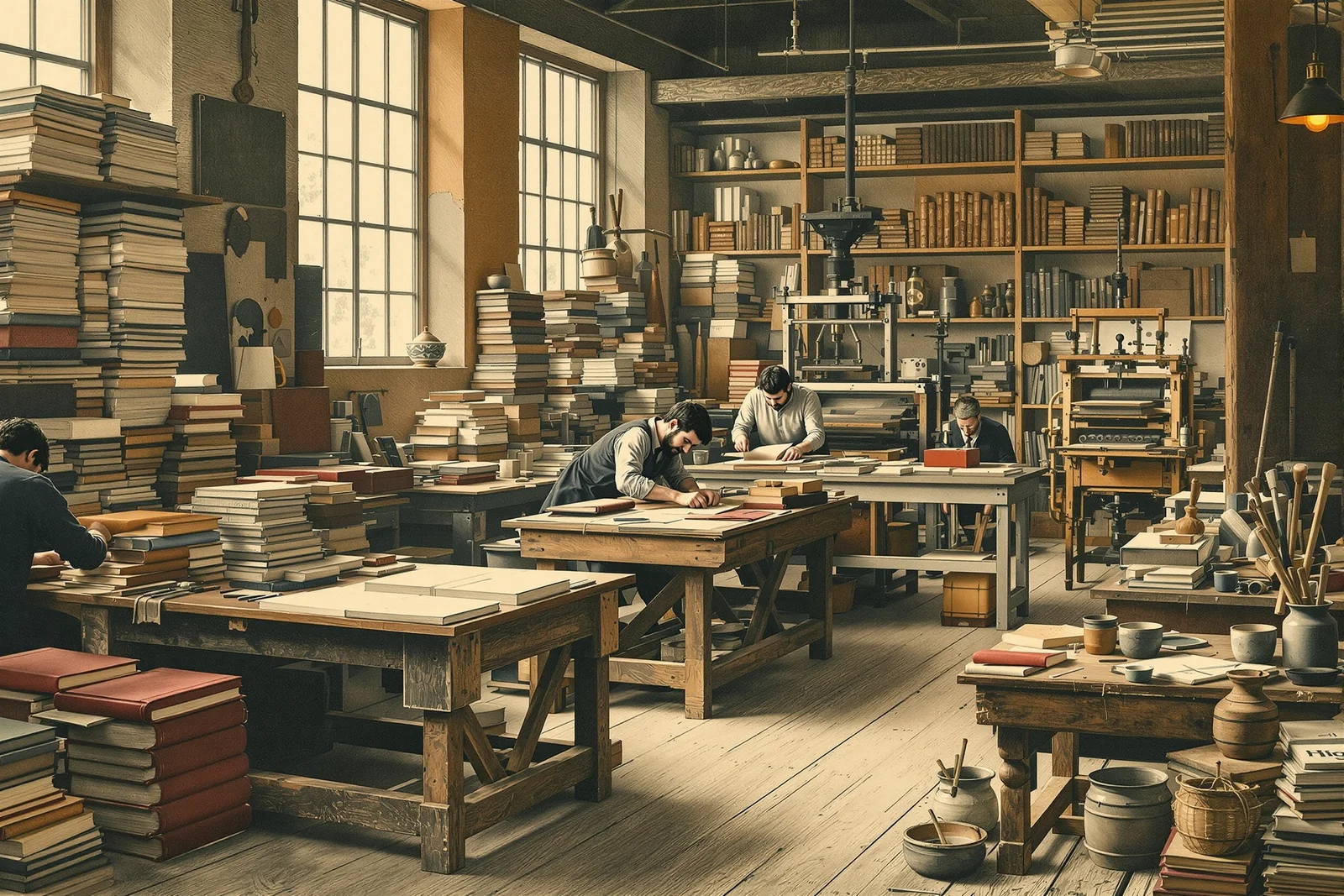
Complete Printing and Bookbinding: From Movable Type to Bound Volumes
The printing press is civilization's force multiplier — one book becomes a thousand. This campaign covers papermaking, ink production, movable type, press construction, and bookbinding.
Chapter 1: Papermaking
| Material | Fiber Quality | Availability | Processing | Paper Quality | Longevity |
|---|---|---|---|---|---|
| Cotton/linen rags | Excellent | Moderate (textile waste) | Beating, screening | Excellent | Centuries |
| Wood pulp (mechanical) | Low | Abundant | Grinding, screening | Poor (acidic, yellows) | Decades |
| Wood pulp (chemical) | Moderate | Abundant | Chemical cooking + screening | Moderate | Decades-century |
| Hemp/flax | Excellent | Cultivated | Retting, beating, screening | Excellent | Centuries |
| Papyrus | Moderate | Tropical/subtropical | Slicing, pressing | Moderate | Centuries (dry climate) |
| Bark (tapa) | Low-moderate | Tropical | Beating | Moderate | Decades |
| Rice straw | Low-moderate | Agricultural waste | Cooking, beating | Moderate | Decades |
Rag paper making: 1) Collect cotton/linen rags (old clothing, scraps). 2) Cut into small pieces (1-2 inch squares). 3) Soak in water with lime or lye (2-4 weeks — breaks down fibers). 4) Beat to pulp (stamping mill, hollander beater, or hand beating). 5) Dilute pulp in vat (consistency of thin soup). 6) Dip mold and deckle (screen frame) into vat. 7) Lift evenly — fibers settle on screen. 8) Couch (transfer wet sheet to felt). 9) Stack alternating sheets and felts. 10) Press to remove water. 11) Hang to dry. 12) Size with gelatin (prevents ink bleeding). 13) Press flat. Result: paper that lasts centuries.
Chapter 2: Ink Production
| Ink Type | Color | Ingredients | Permanence | Difficulty | Best For |
|---|---|---|---|---|---|
| Carbon ink (lampblack) | Black | Soot + gum arabic + water | Excellent | Low | Writing, printing |
| Iron gall ink | Blue-black | Oak galls + iron sulfate + gum | Very good (fades slightly) | Moderate | Writing |
| Printer's ink | Black | Lampblack + linseed oil (boiled) | Excellent | Moderate | Printing press |
| Sepia | Brown | Cuttlefish ink or walnut hull | Good | Low | Writing, art |
| Red (vermillion) | Red | Mercury sulfide (toxic) or iron oxide | Excellent | Moderate | Decoration, emphasis |
| Blue | Blue | Indigo or woad | Moderate | Moderate | Decoration |
Printer's ink recipe: 1) Boil linseed oil until thick and tacky (careful — flammable; heat slowly, stir constantly). 2) Test: drop on stone — should be thick like honey, slightly sticky. 3) Grind lampblack (soot) very fine (mortar and pestle, 30+ minutes). 4) Mix lampblack into boiled oil (ratio: approximately 1 part soot to 3 parts oil by volume). 5) Grind together on stone slab with muller (glass or stone grinding tool). 6) Grind until perfectly smooth (no grit, even consistency). 7) Adjust: more oil = thinner; more soot = blacker. 8) Good printer's ink is tacky, black, and smooth.
Chapter 3: Movable Type
| Component | Material | Tools | Difficulty | Quantity Needed |
|---|---|---|---|---|
| Punch (letter master) | Hardened steel | Files, gravers, hammer | Very high | 1 per character |
| Matrix (mold) | Copper or brass | Punch + striking block | Moderate | 1 per character |
| Type (individual letters) | Lead-tin-antimony alloy | Matrix + casting mold | Moderate | 100s per character |
| Composing stick | Wood + metal | Woodworking tools | Moderate | 1-2 |
| Type case | Wood (compartmented) | Woodworking tools | Low | 1-2 |
| Galley (tray) | Wood or metal | Basic metalwork | Low | Several |
Type casting: 1) Create punch: file letter shape (reversed/mirrored) into end of steel rod. 2) Harden punch. 3) Strike punch into copper blank (creates matrix — impression of letter). 4) Fit matrix into hand mold (adjustable for letter width). 5) Pour molten type metal (lead 60% + tin 25% + antimony 15%). 6) Open mold, extract type piece. 7) Dress type (file flat, remove flash). 8) Result: identical copies of each letter, all same height. 9) Need approximately 150-300 pieces per letter for a working font.
Chapter 4: Press Construction
| Component | Material | Function | Precision Needed | Difficulty |
|---|---|---|---|---|
| Frame (cheeks) | Heavy timber (oak) | Structural support | Moderate | Moderate |
| Platen | Flat hardwood or metal | Presses paper onto type | High (must be flat) | High |
| Screw mechanism | Metal (iron/steel) | Applies pressure | High | High |
| Bed (stone/metal) | Flat stone or iron | Holds type form | Very high (flat) | Moderate |
| Tympan | Frame + parchment | Holds paper in position | Moderate | Low |
| Frisket | Frame + paper (cut out) | Masks non-printing areas | Low | Low |
| Ink balls | Leather + wool stuffing | Apply ink to type | Low | Low |
| Rails | Wood strips | Guide bed under platen | Moderate | Moderate |
Printing procedure: 1) Compose text (set type letter by letter in composing stick, lines into galley). 2) Lock up form (tighten type in chase with quoins — everything must be immovable). 3) Ink type (roll ink balls over type surface — even, thin coat). 4) Position paper on tympan. 5) Fold tympan and frisket over type. 6) Slide bed under platen. 7) Pull press (screw drives platen down onto paper). 8) Release, remove paper. 9) Repeat for each sheet. 10) Rate: 200-300 sheets per hour (one side).
Chapter 5: Bookbinding
| Binding Style | Difficulty | Durability | Materials | Pages | Best For |
|---|---|---|---|---|---|
| Pamphlet stitch | Very low | Low | Thread, paper | 1-3 signatures | Booklets, zines |
| Coptic stitch | Low-moderate | Moderate | Thread, boards | Any | Journals, lay-flat books |
| Case binding (hardcover) | Moderate | High | Thread, boards, cloth/leather | Any | Books, reference |
| Perfect binding (glue) | Low | Low-moderate | Glue, paper cover | Any | Paperbacks |
| Japanese stab binding | Low | Moderate | Thread, covers | Single sheets | Art books, portfolios |
| Leather binding (full) | Very high | Very high | Leather, thread, boards, gold | Any | Fine/archival books |
Case binding (standard hardcover): 1) Print and fold signatures (groups of pages, usually 16 or 32). 2) Collate signatures in order. 3) Sew signatures together (kettle stitch on tapes or cords). 4) Glue spine (PVA or wheat paste). 5) Trim edges (plough or sharp knife + straightedge). 6) Attach endpapers. 7) Make case: two boards + spine piece, covered with cloth or leather. 8) Glue text block into case (paste endpapers to boards). 9) Press under weight overnight. 10) Result: durable book lasting centuries.
Reference Card
- Rag paper lasts centuries (wood pulp paper self-destructs in decades — use cotton/linen for permanence). 2. Printer's ink needs boiled oil (raw linseed oil won't work — boil until tacky for proper printing ink). 3. Type must be mirror-reversed (every letter is backwards on the type — prints correctly on paper). 4. Lock up tight (loose type shifts under pressure — everything in the form must be immovable). 5. Even inking is critical (too much = blurred; too little = faded; thin, even coat is the goal). 6. Sew, don't just glue (sewn bindings last centuries; glue-only bindings fail in years). 7. Press flat after binding (weight on fresh binding overnight = professional result). 8. One press changes everything (a single press can produce 1,000+ copies — knowledge multiplied infinitely).