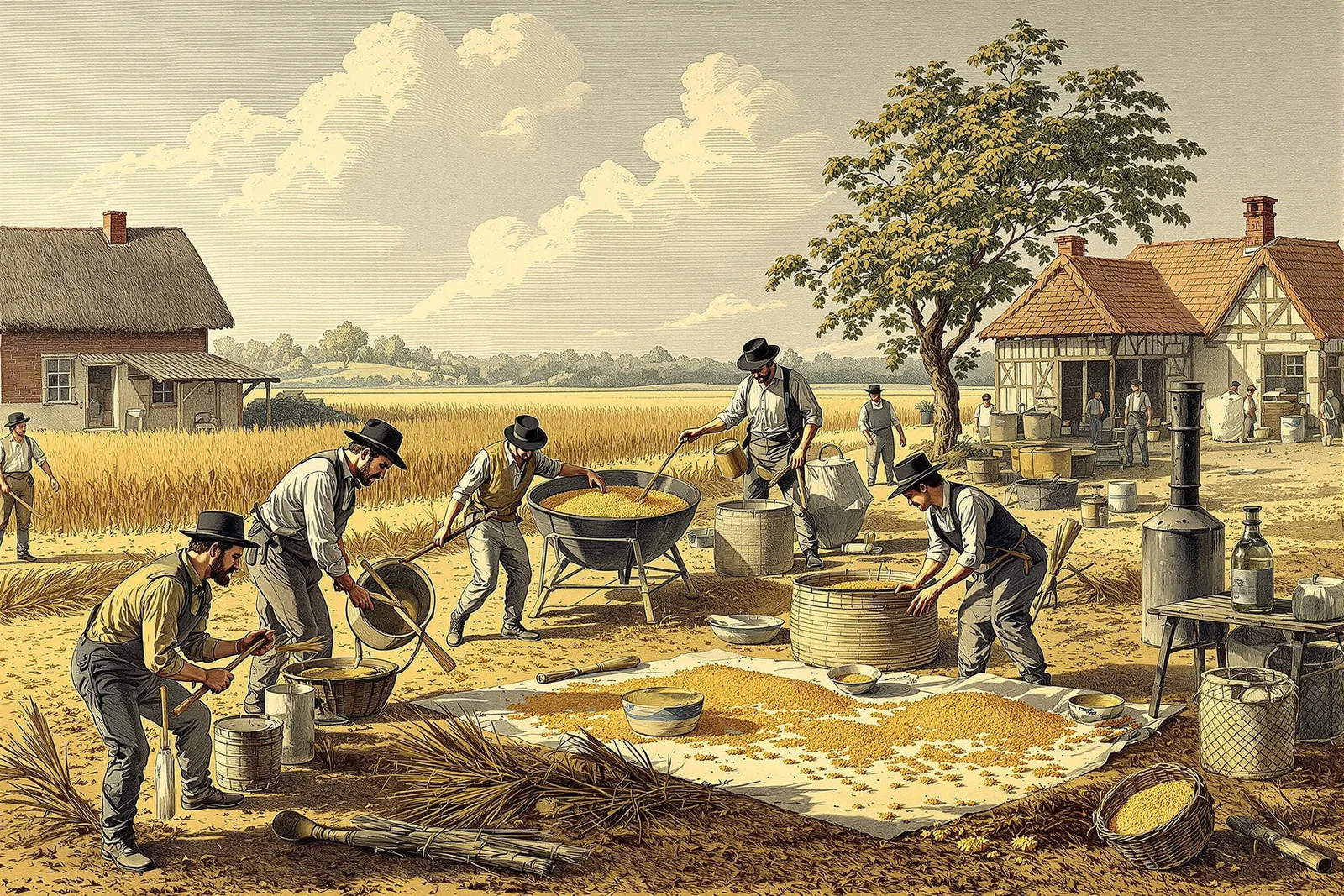
Complete Grain Alcohol and Spirits Production: From Mash to Proof
⟁ cover painted for this edition — the source module carried no illustrations
Complete Grain Alcohol and Spirits Production: From Mash to Proof
Distillation concentrates alcohol and produces spirits, fuel, and antiseptic. This campaign covers mashing, fermentation, still construction, distillation, and safety.
Chapter 1: Fermentation Basics
Fermentable
Sugar Source
Potential Alcohol
Difficulty
Flavor
Corn (maize)
Starch (needs conversion)
8-12%
Moderate
Sweet, smooth
Barley (malted)
Starch (self-converting)
6-10%
Moderate
Malty, rich
Wheat
Starch (needs conversion)
8-12%
Moderate
Smooth, neutral
Sugar (white/brown)
Direct sugar
10-15%
Very low
Neutral (rum-like)
Molasses
Direct sugar
8-12%
Low
Rich, dark (rum)
Fruit (any)
Fruit sugar
5-12%
Low
Fruity (brandy)
Honey
Direct sugar
10-14%
Low
Floral (mead)
Potatoes
Starch (needs conversion)
8-12%
Moderate
Neutral (vodka)
Chapter 2: Mashing (Starch Conversion)
Grain mashing process: 1) Mill grain coarsely (cracked, not flour). 2) Heat water to 165°F in large pot. 3) Add grain slowly (1 pound per gallon of water). 4) Stir to prevent clumping. 5) Temperature drops to 148-155°F (saccharification range). 6) Hold at 148-155°F for 60-90 minutes. 7) Enzymes in malted barley convert starch to sugar. 8) If using corn/wheat: add 20% malted barley as enzyme source. 9) Test with iodine: no color change means conversion complete. 10) Cool mash to 70-80°F. 11) Transfer to fermenter. 12) Pitch yeast (bread yeast works; distiller's yeast is better).
Mash Temperature
Enzyme Active
Result
Use
148-152°F
Beta-amylase
More fermentable, drier
Higher alcohol yield
152-158°F
Alpha-amylase
Less fermentable, sweeter
More body/flavor
Above 170°F
Enzymes denatured
No conversion
Avoid
Below 140°F
Enzymes inactive
Very slow conversion
Avoid
Chapter 3: Still Construction
Still Type
Complexity
Purity
Flavor Retention
Best For
Pot still
Low
Moderate (single run)
High
Whiskey, brandy, rum
Pot still (double run)
Low
Good
Moderate
Cleaner spirits
Reflux/column still
Moderate
Very high
Low
Vodka, neutral spirit, fuel
Thumper (doubler)
Moderate
Good
Moderate
Efficient pot distillation
Basic pot still components: 1) Pot (boiler): copper or stainless steel, 5-20 gallons. 2) Column/neck: copper pipe rising from pot lid. 3) Lyne arm: angled pipe from top of column to condenser. 4) Condenser: coiled copper pipe submerged in cold water. 5) Collection vessel: glass jar at condenser output. 6) Thermometer: at top of column (monitors vapor temperature). 7) All joints sealed with flour paste or food-grade silicone. 8) Copper is preferred (removes sulfur compounds, improves flavor).
Chapter 4: Distillation Process
Fraction
Temperature
Volume
Contents
Action
Foreshots
Below 174°F
First 1-2 oz per gallon of wash
Methanol, acetone
Discard (toxic)
Heads
174-185°F
Next 10-20%
Acetaldehyde, ethyl acetate
Set aside (harsh)
Hearts
185-196°F
Middle 30-50%
Ethanol (good spirit)
Keep (this is your product)
Tails
196-212°F
Final 20-30%
Fusel oils, water
Set aside (can redistill)
Distillation procedure: 1) Fill pot still 2/3 full with fermented wash. 2) Heat slowly (do not rush). 3) Monitor thermometer at top of column. 4) First drops appear around 170-174°F (foreshots). 5) Discard foreshots completely (contains methanol). 6) Collect heads separately (harsh, solvent smell). 7) Hearts begin when distillate smells clean and sweet. 8) Collect hearts (this is your product). 9) Tails begin when distillate becomes oily or harsh. 10) Collect tails separately (can add to next run). 11) Stop when temperature reaches 205°F or distillate is very weak. 12) Never distill to dryness (scorches, dangerous).
Chapter 5: Safety
Hazard
Cause
Prevention
Severity
Methanol poisoning
Foreshots not discarded
Always discard first 1-2 oz per gallon
Fatal
Explosion
Sealed system, no vent
Never seal still completely; always have open condenser end
Fatal
Fire
Alcohol vapor near flame
Distill outdoors, away from open flame
Severe
Burns
Hot still, steam
Protective equipment, careful handling
Moderate-severe
Carbon monoxide
Indoor heating source
Distill outdoors only
Fatal
Reference Card
Always discard the foreshots (the first 1-2 ounces per gallon of wash contain methanol and other toxic compounds; discarding foreshots is not optional). 2. Temperature tells you everything (a thermometer at the top of the column tells you exactly what is coming over; foreshots, heads, hearts, and tails each have distinct temperature ranges). 3. Copper improves flavor (copper reacts with and removes sulfur compounds from the vapor; a copper still or copper packing produces cleaner, better-tasting spirit). 4. Malted barley is the enzyme source (the enzymes in malted barley convert starch to sugar; add 20% malted barley to any grain mash that does not contain its own enzymes). 5. Never seal the still (a sealed still with no vapor outlet is a bomb; the condenser end must always be open to atmosphere). 6. Distill outdoors (alcohol vapor is heavier than air and extremely flammable; always distill in a well-ventilated outdoor area away from any flame). 7. Hearts are the prize (the middle fraction of the distillation run is clean, smooth ethanol; learning to make precise cuts between heads, hearts, and tails is the distiller's art). 8. Double distillation doubles quality (running the hearts through the still a second time produces significantly cleaner, smoother spirit).