Sovereignty Module: Work the Loom
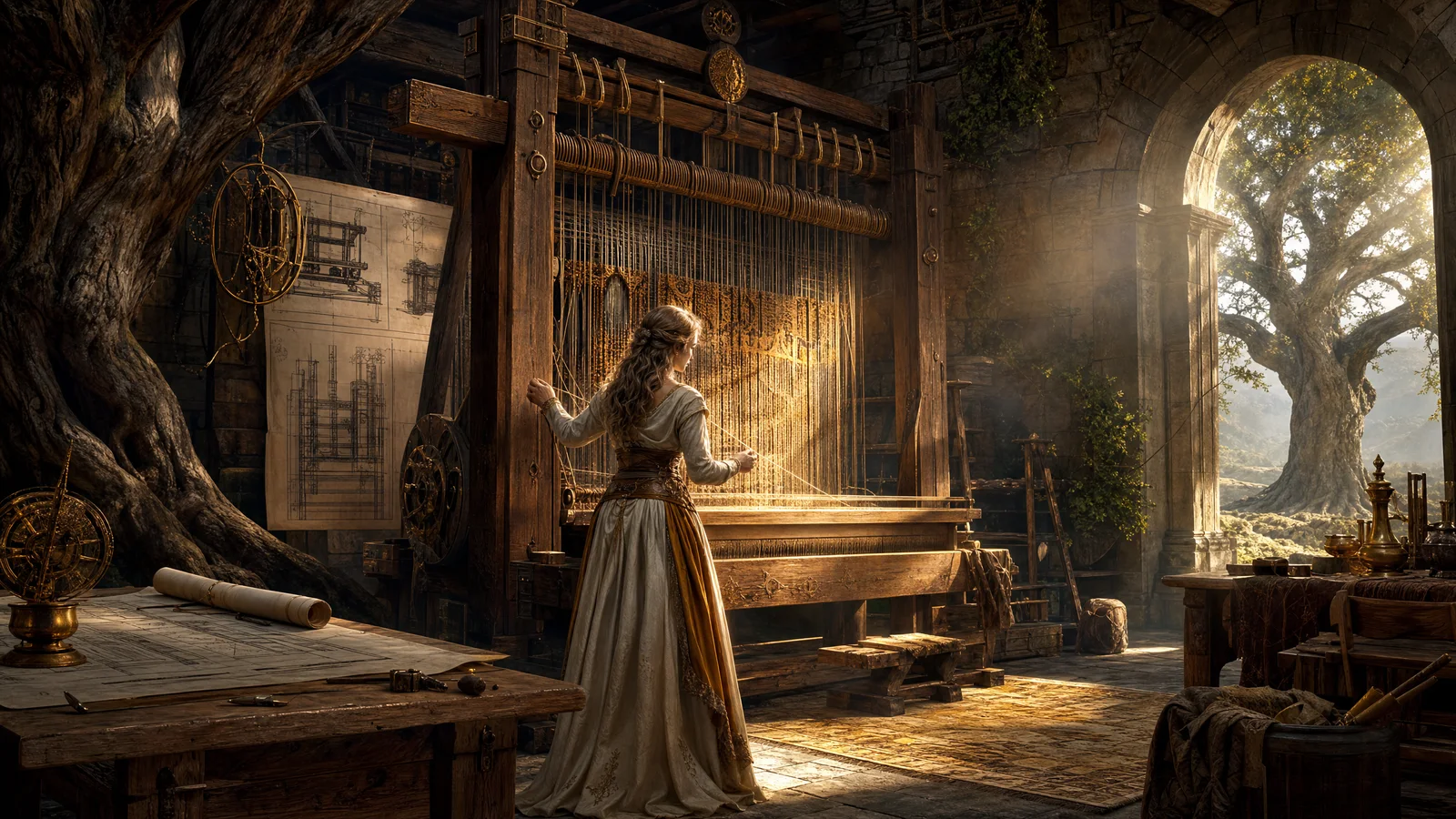
Complete Weaving and Loom Construction: From Warp to Cloth
Weaving transforms yarn into fabric for clothing, blankets, bags, and shelter. This campaign covers loom types, construction, weaving techniques, and pattern design.
Chapter 1: Loom Types
| Loom | Complexity | Size | Speed | Fabric Width | Best For |
|---|---|---|---|---|---|
| Backstrap loom | Very low | Portable | Slow | 12-24 inches | Belts, narrow fabric, travel |
| Inkle loom | Low | Tabletop | Slow | 1-4 inches | Bands, straps, trim |
| Rigid heddle loom | Low-moderate | Tabletop-floor | Moderate | 10-32 inches | Scarves, towels, learning |
| Frame loom | Low | Wall/table | Slow | Any (frame size) | Tapestry, art, rugs |
| Floor loom (2-shaft) | Moderate | Floor standing | Moderate | 24-60 inches | Plain weave fabric |
| Floor loom (4-shaft) | Moderate-high | Floor standing | Moderate-fast | 24-60 inches | Twill, patterns |
| Floor loom (8+ shaft) | High | Floor standing | Fast | 24-60 inches | Complex patterns |
| Warp-weighted loom | Low-moderate | Vertical, against wall | Slow-moderate | Any | Historical, heavy fabric |
Chapter 2: Weaving Fundamentals
| Term | Definition | Importance |
|---|---|---|
| Warp | Lengthwise threads (held under tension) | Structural backbone of fabric |
| Weft | Crosswise threads (interlaced through warp) | Creates the fabric surface |
| Shed | Opening between raised and lowered warp threads | Where shuttle passes through |
| Heddle | Device that raises/lowers specific warp threads | Creates the shed |
| Reed/beater | Comb that pushes weft into place | Determines fabric density |
| Shuttle | Carries weft yarn through the shed | Efficiency tool |
| Selvedge | Finished edge of fabric | Prevents unraveling |
| Sett | Number of warp threads per inch | Determines fabric character |
| Pick | One pass of weft through shed | Basic unit of weaving |
| Draft | Pattern notation for threading and treadling | Blueprint for the fabric |
Basic weave structures:
| Weave | Pattern | Properties | Difficulty | Use |
|---|---|---|---|---|
| Plain weave | Over 1, under 1 | Firm, balanced, durable | Very low | Sheets, shirts, canvas |
| Twill (2/2) | Over 2, under 2 (diagonal) | Soft drape, diagonal lines | Low | Jeans, blankets, coats |
| Twill (2/1) | Over 2, under 1 | Warp-dominant, strong | Low | Denim, gabardine |
| Satin | Over 4+, under 1 (float) | Smooth, lustrous | Moderate | Formal fabric, linings |
| Basket weave | Over 2, under 2 (no offset) | Textured, loose | Very low | Placemats, bags |
| Waffle weave | Complex threading | Textured, absorbent | Moderate | Towels, dishcloths |
Chapter 3: Rigid Heddle Loom Construction
| Component | Material | Function | Dimensions | Difficulty |
|---|---|---|---|---|
| Frame (sides) | Hardwood | Structural support | 30-40 inches long | Low |
| Frame (top/bottom) | Hardwood | Width support | 24-36 inches wide | Low |
| Heddle (rigid) | Wood or plastic | Creates shed, spaces warp | Width of loom, 8-12 dent/inch | Moderate |
| Heddle support | Wood + pivot | Holds heddle, allows up/down/neutral | Attached to frame sides | Moderate |
| Back beam | Hardwood dowel | Holds warp supply | Width of loom + 2 inches | Low |
| Front beam (cloth beam) | Hardwood dowel | Winds finished fabric | Width of loom + 2 inches | Low |
| Ratchet + pawl | Wood or metal | Holds tension on beams | One per beam | Moderate |
| Shuttle | Hardwood | Carries weft yarn | 18-24 inches | Low |
Rigid heddle construction: 1) Build rectangular frame (inside dimensions: 30 inches long × desired weaving width + 4 inches). 2) Heddle: cut thin slats (1/8 inch thick, 6 inches tall) with holes drilled in center. 3) Space slats in frame: alternating slot-hole-slot-hole (8-12 per inch for sett). 4) Mount heddle in frame on pivot supports (allows up, down, and neutral positions). 5) Install back beam and front beam (cloth beam) with ratchet mechanisms. 6) Add warp peg or clamp at back for warping. 7) Sand all surfaces smooth (yarn snags on rough wood). 8) Total build time: 1-2 days with basic woodworking tools.
Chapter 4: Warping and Weaving
Warping procedure (rigid heddle): 1) Calculate warp: width × sett = number of warp threads. Length = desired fabric length + 30% (loom waste + shrinkage). 2) Wind warp: use warping pegs or board to measure consistent lengths. 3) Thread heddle: alternating through holes and slots. 4) Tie warp to back beam, wind on (keep even tension). 5) Tie warp to front beam (apron rod). 6) Tension evenly (all threads same tightness). 7) Ready to weave.
Weaving procedure: 1) Raise heddle (up position): creates shed. 2) Pass shuttle through shed (left to right). 3) Beat weft into place (push heddle forward firmly). 4) Lower heddle (down position): creates opposite shed. 5) Pass shuttle back (right to left). 6) Beat again. 7) Repeat. 8) Maintain consistent selvedge (don't pull weft too tight at edges). 9) Advance warp as fabric builds up (wind finished fabric onto cloth beam). 10) When warp runs out: cut off, tie fringe or hem.
Chapter 5: Finishing Fabric
| Process | Purpose | Method | When |
|---|---|---|---|
| Washing | Remove sizing, relax fibers | Warm water + mild soap | After cutting from loom |
| Fulling | Shrink and thicken wool fabric | Agitate in warm soapy water | Wool only, after washing |
| Pressing | Smooth and set fabric | Iron while damp | After washing/fulling |
| Hemming | Prevent unraveling | Fold and stitch edges | After pressing |
| Fringing | Decorative edge | Twist or braid warp ends | Instead of hemming |
| Napping | Raise fuzzy surface | Brush with teasel or wire brush | Wool, after fulling |
Reference Card
- Tension is everything (even warp tension produces even fabric; uneven tension produces problems). 2. Sett determines character (tight sett = firm fabric; loose sett = drapey fabric; match sett to yarn and use). 3. Beat consistently (every pick beaten with same force = even fabric; vary force = uneven). 4. Don't pull selvedges tight (leave a slight arc of weft in the shed; pulling tight narrows the fabric). 5. Plain weave is strongest (over-one-under-one interlocks most; longer floats are weaker but softer). 6. Rigid heddle is the best starter loom (simple, affordable, capable of beautiful fabric). 7. Warp is structural (choose strong, smooth yarn for warp; weft can be anything). 8. Finishing transforms fabric (raw fabric off the loom is stiff; washing and fulling bring it to life).