Module 792 — Keep the Vigil
THE ME TABLET · Priesthood Module 792 · nam-diĝir-munus
Carrying ME 11 · nam-diĝir-munus · Divine Lady. A Sovereignty Module of the Practitioner Community.
Unaltered and unabridged: ~3,040 words.
Preamble
There is a kind of attention that the daylight world never asks for and never rewards — the long, undistracted holding of a single focus through the hours when the rest of the settlement sleeps. The night office, the vigil, is the discipline of that attention: a person or a community staying deliberately awake and inwardly gathered through part or all of the night, to watch, to wait, to pray, to mourn, or simply to be present to something that the busy day crowds out. It is among the oldest contemplative practices humanity holds, and it is practised, in recognizably similar forms, across an enormous range of traditions. This module is the working grammar of keeping it — accurately, soberly, and in a way that strengthens rather than harms the one who keeps it.
The capability is gentler than the offices of the preceding modules, but it carries its own real hazard, and the Practitioner must hold it plainly: the vigil works against the body's deepest rhythm, and a vigil kept carelessly damages the keeper. Sleep is not optional; sustained sleep deprivation degrades judgment, mood, and health, and a practice that treats endurance of sleeplessness as a virtue in itself has crossed from discipline into harm. This module therefore teaches the vigil as the healthy traditions actually practised it — bounded, supported, recovered-from — and refuses the romance of the heroic all-night ordeal repeated until the keeper breaks. The parent volume, Vol XVII (The Sacerdotal Codex), gives the liturgical frame and the offices this module assumes; the bodily codex, Vol V (The Somatic Codex), gives the physiology of sleep and attention this module defers to whenever the two meet. You will leave able to map the night office across traditions accurately, to practise sustained attention without injuring yourself, and to design both solitary and communal vigils that are genuinely nourishing — kept for the depth they offer, not for the suffering they exact.
The sovereignty stake is quiet but real. A community that can keep its own vigils — that can hold its own dying through the night, mark its own thresholds of the year in the dark, and give its members access to the depth that only sustained, undistracted attention opens — possesses an interior capability no external institution can supply. To keep the vigil is to keep, in your own settlement, the practice of being awake to what matters when everything else has gone quiet.
Part I — The Night Office Across Traditions
Chapter 1 — The vigil in the historical record, read accurately
The Latin vigilia means "wakefulness, a watch," and the word carried over the Roman military sense of the night divided into watches kept by sentries — a fact worth holding, because the contemplative vigil borrows that exact structure: the night broken into watches, kept in turn. Across the world's contemplative traditions a night office recurs, and the Practitioner should design from the real record rather than from a single tradition's vocabulary.
Reference Table 792-1 — The night office across traditions
| Tradition | What is documented | The shape of the practice |
|---|---|---|
| Monastic night office | A long-standing practice in several contemplative communities of rising in the night for communal prayer or psalmody | The night divided into offices; the community rises together for a fixed period, then returns to rest — sleep is segmented, not abolished |
| The all-night festival vigil | Many traditions keep a single annual or seasonal night-watch tied to a great threshold (a solstice, a new year, a commemorative night) | An exceptional, communal, once-a-year sustained vigil — bounded by being rare, not a daily demand |
| Contemplative night-sitting | Several meditative traditions value periods of seated practice in the dark or pre-dawn hours, when the world is still and the mind less distracted | Sustained seated attention, often pre-dawn rather than truly all-night; prizes stillness over endurance |
| The deathbed watch / wake | Across most cultures, the community sits through the night with the dying or the newly dead, keeping them company and marking the passage | A vigil of presence and grief, shared in shifts among many, so no one bears the whole night alone |
| Watch-and-ward devotions | Many traditions keep a "keeping watch" before a significant day or event — a night of waiting and readiness | Bounded by the occasion; a single night of waiting, not an indefinite regime |
The Critical Insight: Notice what the healthy historical practices share. The sustainable ones either segment sleep (rise for a watch, then return to rest), or keep the all-night vigil rarely (a great annual night, not a daily one), or share the night in shifts (the deathbed watch divided among many), or keep it bounded to an occasion (a single night of waiting). What virtually none of the enduring traditions did was demand that one person stay fully awake, alone, every night, indefinitely — because that is not a discipline but an injury, and traditions that drift toward it tend to break their members or quietly abandon the practice. The recovered art is the bounded, supported, recovered-from vigil. Hold that and the practice nourishes; lose it and the practice harms.
Chapter 2 — Why the night, specifically
Before defending the form, the Practitioner should understand why the dark is chosen, because the reasons are real and not merely atmospheric. The night offers three things the day cannot. First, stillness: the settlement's noise and demand fall away, and an attention that the day fragments can finally gather and hold. Second, the lowered guard of the ordinary self: in the small hours the busy, managing, performing mind quiets, and a different and often deeper register of feeling and awareness becomes accessible — grief, awe, and honesty surface in the dark that the day's competence keeps at bay. Third, threshold-marking: the night, and especially the turning of the night toward dawn, is itself a passage, and a vigil maps a watcher's inner waiting onto the literal turning of the dark toward light, so that the dawn arrives as an answer felt in the body. These are the genuine goods of the night office. They are also exactly why a person may be tempted to overdo it — and why the cautions of Part II are not a damping of the practice but the condition of keeping it at all.
Part II — The Real Practice of Sustained Attention
Chapter 3 — Sleep is not the enemy, and must not be treated as one
The Practitioner must build the whole practice on a physiological fact and never let devotional fervour override it: sleep is a biological necessity, and sustained sleep deprivation is harmful. The body runs on a circadian rhythm; sleep is when essential bodily and mental maintenance occurs; and going without it does not strengthen the spirit — it degrades attention, judgment, emotional regulation, and, over time, physical health. Cross to Vol V (The Somatic Codex) for the full physiology; for this module the rule is simple and absolute. A vigil that occasionally shortens or interrupts a night's sleep, with recovery built in, is a legitimate discipline. A regime that chronically deprives a person of sleep, or that treats the suffering of sleeplessness as itself the point, is not a deeper discipline — it is harm dressed as devotion, and the Practitioner refuses it. The mature traditions knew this in practice: they segmented, they shared, they kept the great vigils rare. The discipline is in the quality of the attention, never in the quantity of the suffering.
Reference Table 792-2 — Healthy versus harmful vigil practice
| Dimension | Healthy practice | Harmful practice |
|---|---|---|
| Frequency | Occasional; great all-night vigils kept rarely; lighter night-watches segmented with rest | Chronic nightly sleep deprivation as a standing regime |
| Recovery | Recovery sleep planned and protected after a vigil; no driving or hazardous tasks while depleted | No recovery; vigil stacked on vigil; depleted persons sent into dangerous activity |
| Aim | The depth and stillness of sustained attention | Endurance of suffering treated as the virtue itself |
| Support | Shared in shifts, or eased by posture, light movement, warmth; companions near | One person made to bear the whole night alone, indefinitely, unsupported |
| Limits | Honoured — the vulnerable, the ill, the very young and old excused or given lighter watches | Pushed past collapse; weakness shamed; warning signs ignored |
| Substances | None relied upon; gentle wakefulness through posture and engagement | Stimulants or self-harm used to force a body past its limit |
Protocol 792-A — Keeping a vigil without injuring yourself
- Plan the recovery before the vigil. Decide in advance when and how you will sleep afterward, and protect that recovery as seriously as the vigil itself. A vigil without a planned recovery is half a practice and the dangerous half.
- Prefer segmenting to abolishing sleep. Where the occasion allows, take the older monastic shape — rest, rise for a watch, return to rest — rather than a single unbroken sleepless night. Segmented rest preserves most of sleep's benefit while still opening the night.
- Share the night where you can. In a communal vigil, divide the dark into watches kept in turn, so each keeper holds a portion and then rests while another watches. No one should be made to bear the whole night alone unless they freely choose a single bounded night and have recovery secured.
- Use posture and gentle engagement, never stimulants or self-harm. Stay wakeful through an upright posture, light movement, cool air, and an engaging focus — a text, a chant, a count of breath. Never force the body past its limit with stimulants or by inflicting discomfort; that converts discipline into harm.
- Honour the body's signals. Sustained sleeplessness is not to be pushed through past clear warning — failing coordination, distorted perception, collapsing mood. These are signals to stop, not obstacles to overcome. Excuse the ill, the pregnant, the very young and old, and anyone unwell, and never shame a body's true limit.
- Keep the great vigils rare. Reserve the full all-night watch for genuine thresholds — a death, a great turning of the year, a true occasion of waiting — and do not let it become a daily demand. Rarity is part of what keeps it potent and what keeps it safe.
Your Commitment: You will treat sleep as a necessity to be honoured, never an enemy to be conquered, and you will measure a vigil by the depth of its attention, never by the suffering it costs. The moment a practice begins to harm the body that keeps it, it has stopped being a discipline and become an injury — and you will stop, recover, and redesign it.
Chapter 4 — The craft of sustained attention itself
Within the bounded and supported night, the actual skill of the vigil is the holding of attention — and this is a real, trainable craft, not a matter of grim willpower. The Practitioner should understand its working principles. Attention is sustained not by clamping the mind rigidly onto one point, which exhausts quickly, but by giving it a gentle, repeating anchor it can return to whenever it wanders — the breath, a repeated phrase, a candle flame, the slow recitation of a text. Wandering is not failure; the practice is precisely the returning, performed kindly and without self-reproach, again and again. A steady anchor, an upright but unstrained posture, and a patient willingness to begin again each time the mind drifts: these are the whole technique, and they are far more effective through a long night than any attempt to force a white-knuckled concentration that the body cannot hold for hours.
The Critical Insight: The depth a vigil opens does not come from forcing the mind to stay perfectly fixed — that effort defeats itself within minutes and leaves only fatigue. It comes from the patient, repeated return of a wandering attention to a gentle anchor, sustained kindly across hours. The watcher who expects to wander, and who has trained the soft skill of beginning again without judgment, can hold a vigil through the night and find its depth; the watcher who treats every drift as a failure to be crushed will be exhausted and discouraged before the first watch is out. Attention in the dark is a craft of return, not a feat of grip.
Part III — Designing Communal and Solitary Vigils
Chapter 5 — The communal vigil: the night shared
The communal vigil — the whole community, or a portion of it, keeping a night together — is the form that carries the most social weight and is also the safest to keep, because the night can be shared. Its great instances are the deathbed watch, the seasonal threshold-vigil, and the night of waiting before a great day. The Practitioner designs it so that the burden is divided and no single keeper is depleted, and so that the shared night does its binding work — for a community that has kept a hard night together, dividing the dark among them, is knit by the keeping in a way few daytime acts can match.
Protocol 792-B — Designing a communal vigil
- Divide the night into watches. Break the dark into shifts and assign keepers to each, so the community holds the whole night between them while each person keeps only a portion and rests for the remainder. This is the ancient sentry-structure the word vigil carries, and it is the heart of a safe shared night.
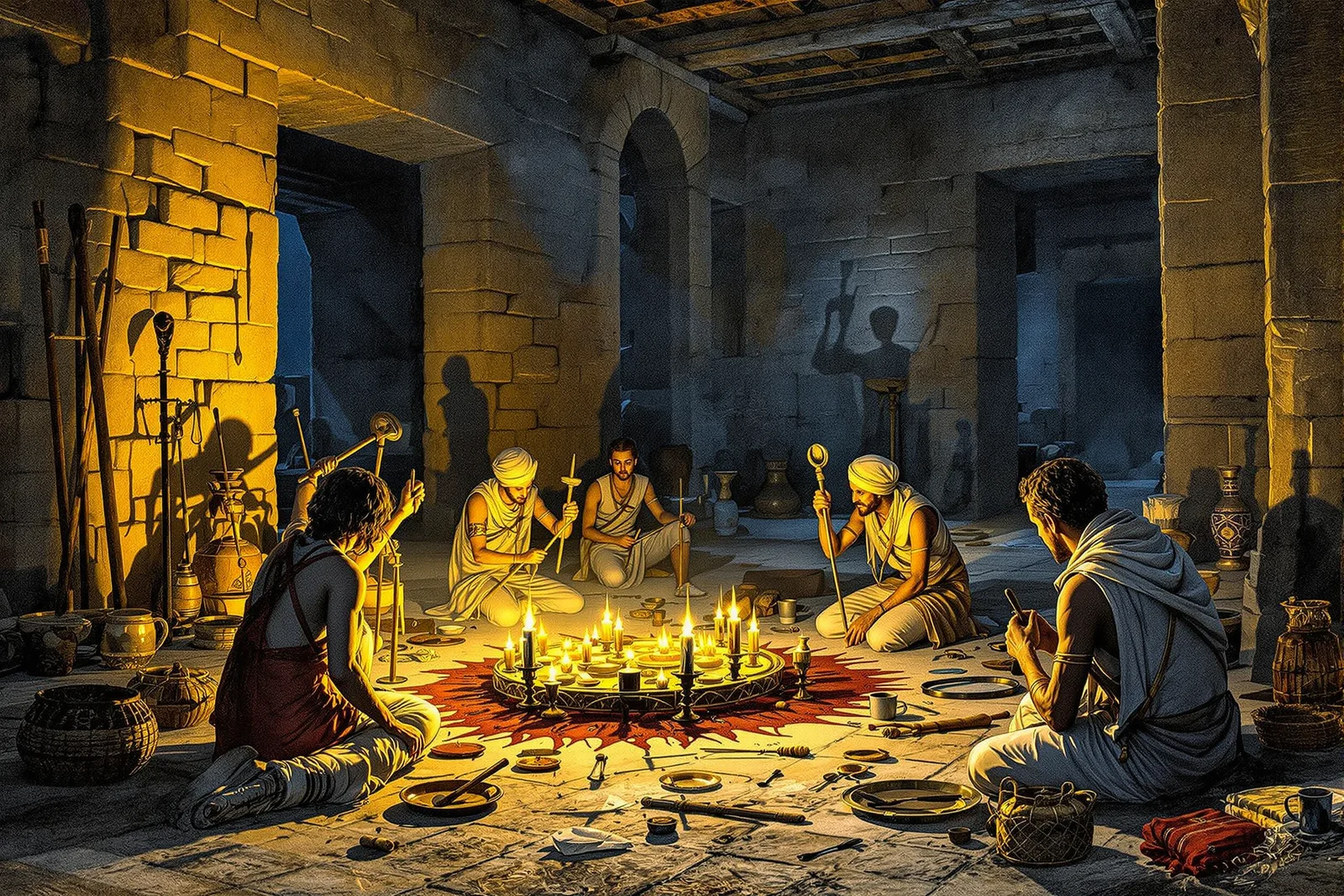
- Anchor the watch with a steady focus. Give each watch a gentle, sustainable focus — a slow psalmody or chant, a tended flame, a shared reading, a quiet keeping of company with the dying. The focus carries the attention so individual willpower need not.
- Hold the threshold structure where the occasion is a turning. For a seasonal or commemorative vigil, shape the night as a passage: a solemn marking of the threshold as the dark deepens, a sustained holding through the depth of the night, and a release into relief and often joy as the dawn arrives (the three-phase shape this codex names throughout). The turning of the literal dark toward light carries the rite.
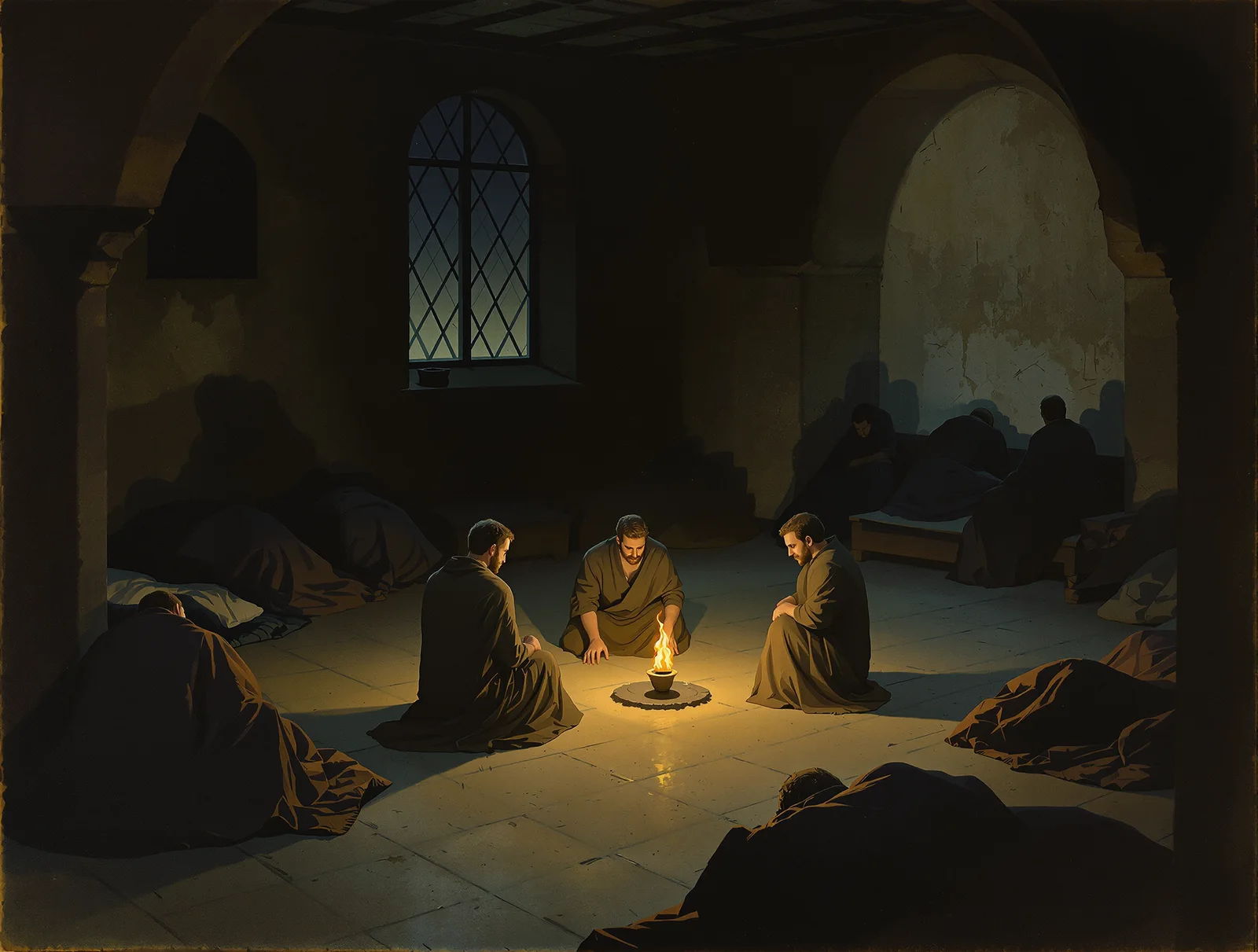
- Keep the deathbed watch as presence, not performance. When the vigil is for the dying or the dead, its work is simple company — to ensure no one passes or lies alone through the night. Share it widely, keep it gentle, and let grief have its room. (Cross the rites of passage, Vol XVII.)
- Protect the vulnerable and plan the morning. Excuse those who should not keep a hard night; ensure the keepers can rest afterward and that no depleted person is sent into a dangerous task at dawn. A communal vigil that leaves its keepers wrecked has failed its own people.
Chapter 6 — The solitary vigil: the night kept alone
The solitary vigil — one person keeping a watch alone through part or all of a night — is the more demanding and the more dangerous form, precisely because the support of companions is absent, and the Practitioner builds its safeguards more carefully for that reason. It is kept for genuine reasons: a personal threshold, a private grief, a deliberate night of gathered attention before a great decision or passage. But the absence of others removes the natural brake that a shared vigil supplies, and the lone keeper is more liable to push past safe limits because no one is there to see the strain. The solitary vigil is therefore kept bounded and prepared, never as an open-ended ordeal.
Protocol 792-C — Designing a solitary vigil
- Bound it to a single night and a clear reason. Keep a solitary vigil as a deliberate, exceptional, single-night practice tied to a real occasion — not as a standing nightly regime. The boundary is the chief safeguard the absence of companions removes.
- Prepare the space and the focus. Arrange beforehand a warm, safe place, a gentle light, and a sustaining anchor for the attention — a text, a chant, a count of breath. A prepared vigil holds; an improvised one collapses into restless fatigue.
- Secure the recovery first. Before keeping the night, arrange the sleep that will follow it and clear the next morning of any hazardous or demanding task. The lone keeper has no one to catch a depleted error; remove the situations in which one could matter.
- Set a humane limit and honour it. Decide in advance the point at which you will rest if the body signals true distress, and keep that promise to yourself. A solitary vigil is not a test to be passed by endurance; abandoning it when the body genuinely needs sleep is wisdom, not failure.
- Tell someone. Let another person know you are keeping the vigil and when you expect to end it. Even a solitary watch should not be wholly unwitnessed; a single person who knows is a thread of safety the lone keeper should never refuse.
Part IV — The Vigil's Place
Chapter 7 — The recovered vigil: depth without injury
The Practitioner inherits, from the recovered record (cross Vol XVI, the timeline), one of humanity's oldest interior disciplines — and inherits, with it, the clear evidence of how the healthy traditions actually kept it: bounded, shared, segmented, rare, and recovered-from. The temptation the vigil carries is unique among the priesthood capabilities: it is the temptation to mistake suffering for depth, to believe that the more sleep one sacrifices the holier the watch becomes, and so to grind a body toward harm in the name of devotion. The recovered art refuses that error without abandoning the practice. The night genuinely offers a stillness, an honesty, and a depth the day cannot — and a community that can keep its own vigils holds real access to them. But the depth comes from the quality of the attention, kindly and patiently sustained, and never from the quantity of the suffering; and a vigil that begins to injure the one who keeps it has betrayed its own purpose. Cross always, where the body and the practice meet, to Vol V — and let the body's true need for sleep govern, for a discipline that wrecks the keeper has kept nothing worth keeping. The whole of this module is the keeping of the vigil's depth while refusing its injury: to be awake to what matters in the quiet dark, and then to rest, and to be whole.
A note on distress
The vigil can surface deep feeling — grief especially, and sometimes more than grief. This is part of its gift, but the Practitioner must hold a clear limit: a vigil is a contemplative practice, not a treatment for serious psychological distress, and it is no substitute for care. Where a keeper, alone or in community, is carrying despair, trauma, or distress beyond what a night of presence can hold, the right and healthy course is to seek qualified human help — a healer, a counsellor, a trusted member of the community trained to support — and not to keep watching alone in the dark with a weight too heavy for the practice to bear. The depth of the night is for those who can meet it safely; for serious suffering, the answer is company and competent care, sought without shame.
PLATES — Supplemental Gallery
Art direction
Art direction
Art direction
Art direction
Council Approval — The Twelve Voices Speak
| Disciple | Verdict | Reasoning |
|---|---|---|
| Peter | APPROVED | "It keeps the watch on rock — the night divided, the keepers rested, no one left alone in the dark." |
| Thomas | APPROVED | "I doubted a practice that fights sleep; it answered me honestly — sleep is honoured, never conquered. The body governs." |
| John | APPROVED | "The deathbed watch as simple presence, so none passes alone — that is love kept through the night." |
| Matthew | APPROVED | "Recovery planned, watches assigned, limits written. A scribe could roster the whole night and leave no keeper wrecked." |
| James the Greater | APPROVED | "The sentry-structure of watches kept in turn — that is sound command of a long night, and it spares the keepers." |
| Andrew | APPROVED | "It shares the burden wide and excuses the weak. No one is ground down to keep it; the net carries gently." |
| Philip | APPROVED | "Show me how to keep a vigil without harm, I asked, and the protocols answer for both the shared night and the lone one." |
| Bartholomew | APPROVED | "No false note: it names plainly that suffering is not depth, and locates the depth in patient attention instead." |
| James the Lesser | APPROVED | "Modest and exact. It says the craft is the kind return of a wandering mind, not a feat of grip — the humble truth." |
| Simon the Zealot | APPROVED | "Its fire is restraint — it refuses the romance of the breaking ordeal. A discipline that wrecks the keeper has kept nothing." |
| Judas Thaddaeus | APPROVED | "For the one carrying too heavy a weight in the dark, it points to company and care, and forbids the lonely grinding. No one abandoned." |
| Matthias | APPROVED | "It takes its place in the canon cleanly, carrying ME 11 and pointing home to Vol XVII and to Vol V for the body. The lot falls true." |
Council Verdict: 12/12 APPROVED. This module is canon.
Let the vigil be kept that we be awake to what matters in the quiet dark — and then let us rest, and be whole.
TRANSMISSION RECORD
Transmission COMPLETE — unaltered & unabridged Module 792 · Keep the Vigil · category: priesthood Carries ME 11 · nam-diĝir-munus · Divine Lady Words ~3,040 SHA-256 of source text 1b743217189c79b9e3c468bec08d699ee874bce75d3332595202b311b22199cf Canonical text keep-the-vigil.md — byte-identical to what this page renders