VOLUME XVII · SUPPLEMENT — THE EMOTIONAL ALCHEMY
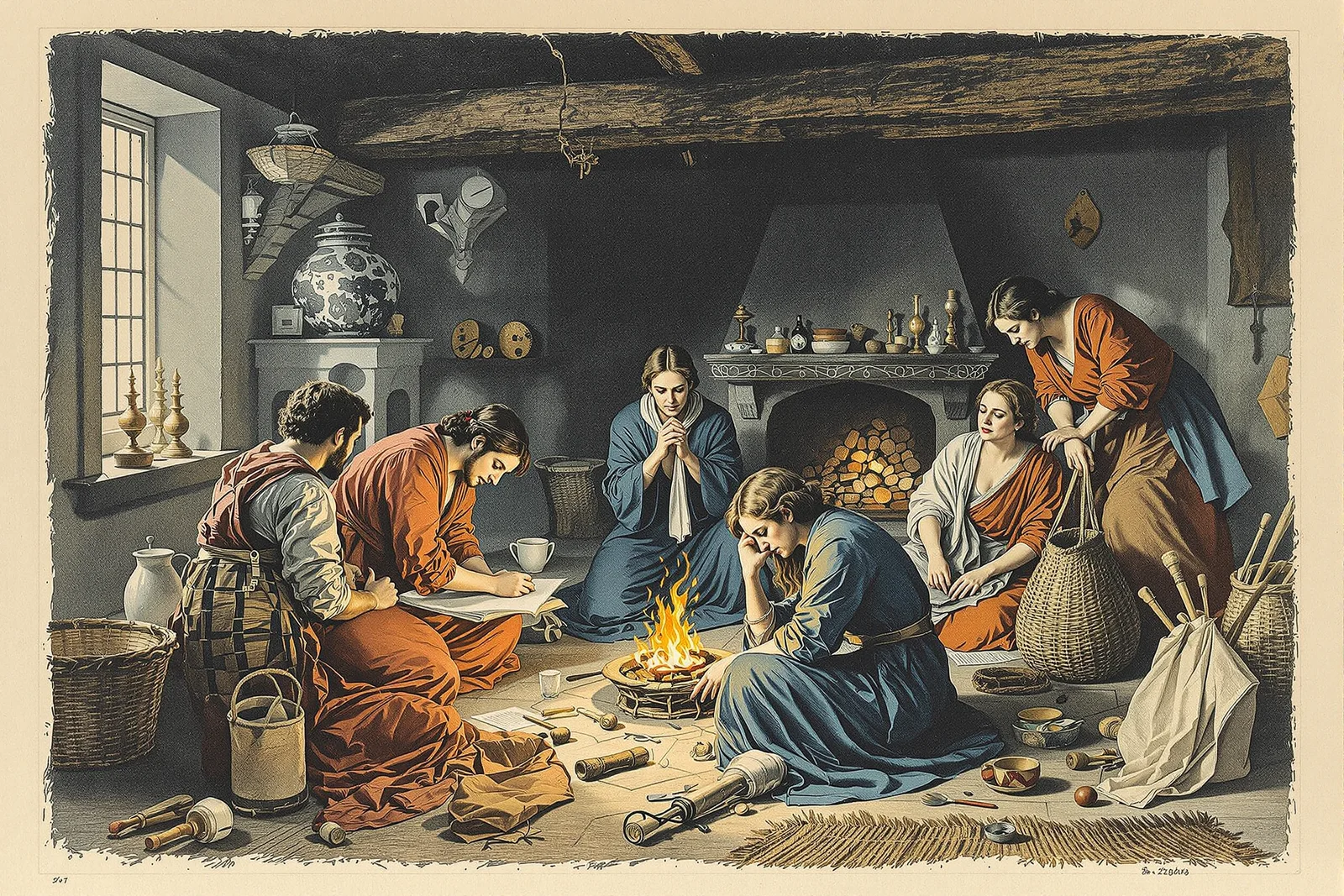
The Disciplines of Grief, Joy, and the Troubled Heart
Unaltered and unabridged. A supplement bound between the Mystic's Codex (Vol XVII) and the Sovereign Body (Vol V), carrying three of the holy measures that the old lists set among the decrees of governance — for a people that cannot grieve, cannot rejoice, and cannot steady its own heart is not yet a civilization, only a crowd.
Supplement to Volumes XVII & V · carrying ME 39, 40, 58.
CANON PREAMBLE — WHY THE OLD LISTS MADE EMOTIONS INTO DECREES
The Practitioner who first reads the recovered tablets is often startled by what the ancients chose to enumerate. Beside the great offices of kingship, the crafts of metal and grain, the sciences of star and stone, the list-makers of Eridu set down — as me, as transmissible decrees of order — the act of weeping for the dead, the act of gladness in the heart, and the act of the heart that is troubled and must be steadied. They placed mourning and joy on the same register as the loom and the plough.
This was not sentimentality. It was engineering of the highest kind. The makers of the first cities understood something that the disenchanted centuries would forget and that the modern sciences of the mind have, at great cost, relearned: that the emotional life of a people is not a private weather happening behind each face, but a common technology — a set of skills, customs, instruments, and offices that must be built, taught, maintained, and handed down, exactly as one builds and hands down the smelting of bronze. A community that does not know how to bury its dead will be ruled by its unburied grief. A community that does not know how to feast will lose the will that holds it together. A community whose members cannot govern the storms of their own hearts will govern nothing else for long.
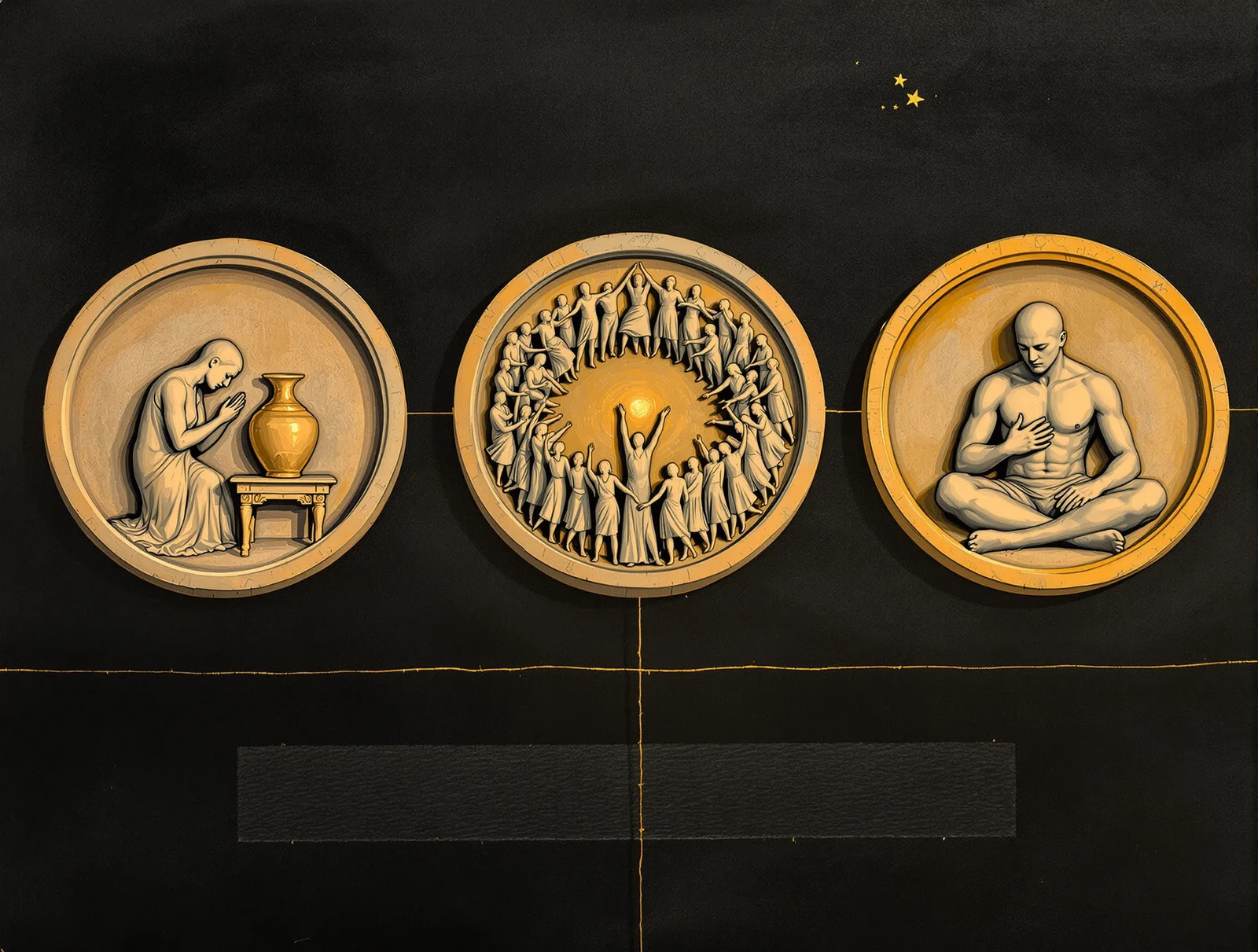
So the list-makers were precise. ME 39, a-nir — lamentation, the disciplined art of grief. ME 40, šà-ḫúl-la — the rejoicing of the heart, the cultivation of durable gladness. ME 58, šà-ḫúl — the troubled heart, and the skill of steadying it. Three decrees; three disciplines; one alchemy — for the work of taking the base metal of raw feeling and, without denying or destroying it, transmuting it into something a person and a people can live by, is the oldest alchemy there is, and the only one that ever actually worked.
This supplement teaches that alchemy as the ancients meant it to be taught: as craft, with tables and protocols, addressed to you, the Practitioner, who will be asked one day to sit with a grieving family, to design a festival that the whole city feels, or to steady your own heart at three in the morning. Everything here is grounded in what is genuinely known — in the modern sciences of grief, of positive emotion, and of emotion regulation. Where the science is uncertain, this supplement says so. Where a burden exceeds what any custom or protocol can carry, this supplement tells you plainly to seek a trained healer, and treats that counsel as part of the decree itself, not a footnote to it.
The old enchantment and the new evidence agree. We will hold them together.
Art direction
CHAPTER 1 — ME 39, LAMENTATION (a-nir): THE CRAFT OF GRIEF
ME 39 · a-nir · LAMENTATION
The decree of disciplined sorrow. The a-nir grants the Practitioner the right and the burden of weeping rightly — of building the customs, the songs, and the gathered company by which a people carries its dead and survives the carrying. Where this decree is held, grief is not an accident that befalls the unlucky but a craft the whole community knows.
1.1 — Grief is universal; its forms are taught
Begin with the anthropology, because it corrects the most dangerous modern error: the belief that there is one natural, correct way to grieve, and that everyone else is doing it wrong. There is not. Across every human society ever studied, two things are constant — that people form deep attachments, and that they suffer profoundly when those attachments are severed by death — but the shape of the suffering, and above all the customs built to hold it, vary enormously, and each is an intelligent adaptation to its world.
Consider the breadth, accurately. Many cultures practice vocal lament — the ritualized, often improvised wailing or chanting of grief, frequently led by women, sometimes by specialists. The keening women of rural Ireland (the bean chaointe), the lamenters of Greece, of the Balkans, of Egypt and the Levant, the wailing traditions of South Asia and of many African and Indigenous societies — all share a recognition that grief wants a voice, and that the voice is best given form, sequence, and a witnessing audience rather than left to choke privately. Many cultures prescribe a defined period with marked stages of return: the Jewish sequence of shiva (seven intense days of being attended at home), shloshim (thirty days of lightened mourning), and the year of mourning a parent, followed by the annual yahrzeit — a structure that paces the bereaved gently back into ordinary life rather than demanding instant recovery. Many cultures mark the bereaved visibly — black dress in much of Europe and Latin America, white in much of East and South Asia, shaved heads, ash, covered mirrors — so that the community can see who is grieving and adjust its conduct toward them. Many maintain continuing relationship with the dead: the household altars of much of East Asia, the ofrendas of the Mexican Día de Muertos, the named remembrance of ancestors — practices once dismissed by Western clinicians as denial and now understood, correctly, as healthy.
The Critical Insight: There is no universal "right way" to grieve, but there is near-universal wisdom encoded in mourning customs, and it points the same direction every time: grief should be voiced, not silenced; witnessed, not hidden; paced, not rushed; and woven back into a continuing bond, not amputated. A civilization's mourning customs are accumulated grief-science, tested over millennia. The Practitioner who would design or restore them should study what humanity already built before improvising.
1.2 — The science of grief, beyond the five stages
You will have heard of the "five stages of grief" — denial, anger, bargaining, depression, acceptance. You must now unlearn the rigid version of it. Elisabeth Kübler-Ross proposed these in 1969 from her work with dying patients facing their own mortality, not primarily with the bereaved, and never claimed they were a fixed, universal, sequential ladder that everyone climbs in order. The popular culture made them into exactly that, and decades of research have shown the rigid staircase to be false. People do not reliably pass through fixed stages in fixed order; grief is not a checklist completed and closed. Holding the bereaved to such a schema causes real harm — it tells the person who skips a stage, or loops, or grieves in a different order, that they are doing it wrong, adding shame to sorrow.
What the modern science actually finds is more humane and more useful:
- Resilience is the most common outcome. The single most robust finding of contemporary bereavement research, established largely through long-term studies, is that most people are resilient. After the death of a spouse or loved one, the majority show acute pain that, over months, gradually eases as they reconstruct a life — without ever developing a disorder and without needing formal treatment. This is not coldness or denial; it is the ordinary, healthy human capacity to recover. The Practitioner should expect resilience as the norm and should never pathologize it.
- Grief comes in waves, not a slope. Bereaved people typically oscillate between confronting the loss (pain, yearning, sorrow, remembering) and restoration — attending to the practical and social work of the changed life, and even experiencing moments of relief, humour, and ordinary pleasure. This oscillation between loss-orientation and restoration-orientation is not instability; it is the engine of healthy adaptation. Both poles are necessary. The person who only confronts the loss drowns; the person who only avoids it freezes. The waves grow farther apart with time.
- The goal is integration, not erasure. Healthy grief does not "end" with the loss forgotten. It reaches a state in which the bereaved has integrated the reality of the death, the pain has softened from sharp to bearable, and a continuing bond with the lost person — in memory, in values carried forward, in occasions of remembrance — coexists with a re-engaged, meaningful life. You do not get over the people you love. You learn to carry them.
Art direction
1.3 — The practice of lament: ritual, keening, and grief in song
Knowing the science, the Practitioner must now hold the craft. Lament is the ancient technology that gives grief its voice, and the ancients were right to make it a decree. Across cultures, the practice of lament shares a recognizable architecture that the modern bereavement sciences would endorse on every point.
Ritual mourning does four things at once that no private grieving can. It externalizes — it takes the formless inner storm and gives it a shape (a sequence of acts, a defined place, a known duration) that the mind can hold. It witnesses — it sets the bereaved before a company who acknowledge the loss as real and the grief as warranted, which the research on social support identifies as among the strongest protectors of bereaved health. It paces — it imposes a temporal structure (the wake, the burial, the days of sitting, the year of remembrance) that neither rushes nor strands the mourner. And it narrates — it tells the story of the life and the death, beginning the meaning-making work that healthy grief requires.
The keening tradition deserves the Practitioner's special study, because it is lament in its purest recovered form. The keen — the wailed, semi-improvised, often poetic mourning cry — was not raw uncontrolled noise but a practiced art, frequently performed by skilled women who carried the form across generations and who could give a community's grief a voice when the immediate family was too shattered to find one. The keen does precisely what the trauma-and-grief sciences recommend: it converts overwhelming, wordless affect into rhythmic, shared, bounded vocal expression, with a beginning, a build, and an end. (For the full musical craft of lament — the modal language of sorrow, the drone-and-cry structure, the instruments of mourning — the Practitioner is directed to Vol XXIII — The Musician's Codex, where the recovered lament-forms are set out as a sub-art of sacred sound.)
Grief in song is the broadest form of all and the most durable. From the dirge to the requiem to the modern memorial ballad, the human species has always sung its dead, because song does for grief what speech alone cannot: it carries unbearable feeling on a structure (melody, meter, rhythm) that makes the feeling possible to enter, hold, and leave. The Practitioner designing communal mourning should treat shared music not as decoration but as load-bearing.

Art direction
1.4 — A healthy grieving protocol
The Practitioner is often asked, by the bereaved or on their behalf, what to actually do. The honest answer is that grief cannot be managed into submission and should not be — but it can be supported, and there are practices that genuinely help and practices that genuinely harm. The following protocol distils what the bereavement sciences and the cross-cultural customs agree upon. It is offered as support, never as a schedule the mourner must keep.
Protocol 39-A — Supporting healthy grief:
- Permit the full expression. Allow grief its voice and its waves — weeping, talking, remembering, and also the periods of relief and ordinary life that healthily alternate with sorrow. Neither the person who cries constantly nor the person who functions calmly is doing it wrong.
- Keep the bonds of company. Isolation is the chief danger. Ensure the bereaved is attended — not lectured or fixed, but accompanied. Presence, practical help (food, errands, childcare), and patient listening outperform every clever word. The most healing sentence is usually some form of "I am here, and I will keep being here."
- Tell the story. Encourage remembrance — of the life, the death, the relationship. Looking at images, telling tales, naming the person aloud, marking anniversaries: these build the integrated, continuing bond that healthy grief reaches. Do not hurry the bereaved past the dead.
- Tend the body (cross Vol V — Sovereign Body). Grief is physiological — it disrupts sleep, appetite, and immune function and floods the body with stress. Protect the foundations: enough sleep, real food, gentle movement, daylight, and a firm avoidance of using alcohol or other substances to numb the pain, which reliably deepens and prolongs grief rather than relieving it.
- Restore gently and in your own time. Alongside the sorrow, support the slow re-engagement with tasks, roles, work, and eventually new sources of meaning. This is restoration-orientation; it is not betrayal of the dead, and it is essential.
- Mark the calendar. Honour the anniversaries and the festivals of the dead (see §1.5 and Chapter 4). A grief given recurring occasions to be felt and shared is a grief that need not ambush the mourner at random.
- Watch for the signs that a healer is needed (see §1.6). Most grief heals with time and company. Some does not, and recognizing the difference is itself an act of care.
Your Commitment: You will never tell a grieving person that they should be "over it" by now, that they must reach some "stage," or that their continuing love for the dead is a problem to be solved. You will offer presence, not prescriptions, and you will know the difference between grief that needs company and grief that needs a clinician.
1.5 — Communal mourning: designing the gathered grief
Grief is borne best together; this is the ancient knowledge and the modern finding alike. The Practitioner charged with a community's emotional architecture must therefore know how to design communal mourning — and is directed to Vol XIX — The Diplomat's Codex for the full craft of convening, hosting, and holding a gathered company, of which the funeral assembly is one of the oldest forms.
The well-designed communal mourning has a recognizable structure: a gathering (the company assembles, signalling that the loss is the community's, not only the family's); a witnessing (the death and the life are formally acknowledged before all); a lament (shared expression is given form — song, eulogy, keen, silence — so that grief is voiced collectively rather than each mourner left alone with it); a commemoration (the story of the life is told, the bond made continuing); a commitment (the community pledges its ongoing care of the bereaved — this is the part most often omitted and most needed); and a return (a marked re-entry into ordinary life, often through a shared meal, which gently signals that life continues and that joy is not forbidden to the grieving). Each element does identifiable psychological work; remove any one and the grief is less held.
1.6 — When grief becomes complicated: the call for a healer
Most grief, however terrible, is not an illness and heals with time and company. But the Practitioner must hold a clear, sober knowledge of when grief has become something that warrants professional help, because at that threshold custom and presence are no longer enough and a trained healer is required.
The modern clinical sciences now recognize prolonged grief disorder — a condition in which, well beyond the early period (generally assessed at twelve months or more in adults), grief remains as intense and disabling as in the first days: persistent, pervasive yearning or preoccupation with the deceased, accompanied by intense emotional pain, an inability to re-engage with life, a sense that part of oneself has died, profound difficulty accepting the death, and marked functional impairment. This is not weakness or failure to "move on"; it is a recognized condition for which effective, specifically tailored treatments exist.
Direct the bereaved to professional support — a physician, a licensed mental-health clinician, a grief specialist, or a crisis service — when any of the following are present: grief that remains wholly disabling long past the early period; depression that does not lift, with persistent hopelessness; inability to perform the basic functions of life (eating, sleeping, caring for self or dependents) over an extended time; reliance on alcohol or other substances to cope; or — most urgently — any thoughts of suicide or self-harm, or any wish not to be alive. The last requires immediate help: a crisis line, emergency services, or a trusted clinician, without delay. This counsel is part of the decree, not an exception to it. The keening women always knew which sorrows exceeded the keen.
CHAPTER 2 — ME 40, REJOICING OF THE HEART (šà-ḫúl-la): THE CULTIVATION OF JOY
ME 40 · šà-ḫúl-la · REJOICING OF THE HEART
The decree of cultivated gladness. The šà-ḫúl-la grants the Practitioner the right and the burden of joy as a discipline — the building of the festivals, gratitudes, and shared delights by which a people renews its will to live and to remain a people. Where this decree is held, joy is not merely awaited but made.
2.1 — The science of positive emotion
The ancients set rejoicing among the decrees because they understood it as necessary infrastructure, not as luxury or reward. The modern science of positive emotion has confirmed this with care, and the Practitioner should know what it actually established — and what it did not, for this field has had to correct its own early overreach.
The durable findings are these:
- Positive emotion is not the absence of negative emotion; it is its own system, and it does real work. The research on positive emotions — joy, gratitude, contentment, awe, love, amusement — indicates that they broaden a person's momentary thinking and attention and, over time, build lasting personal resources: stronger relationships, greater resilience, better problem-solving, and improved physical health. Joy is not the cherry on the life well-lived; it is part of the structure that holds the life up. A community that cultivates shared positive emotion is, measurably, building its own resilience reserves.
- Gratitude is among the most robustly beneficial practices known. Of all the deliberate practices studied, the regular, sincere practice of gratitude — noticing and appreciating what is good, and expressing it — has some of the strongest and most replicated evidence for durably supporting wellbeing. Keeping a periodic record of things one is grateful for, and above all expressing gratitude to the people one is grateful to, reliably lifts mood and strengthens bonds. This is craft the Practitioner can teach directly.
- Savoring multiplies the joy already present. Much human happiness is lost not for want of good things but for want of attention to them. Savoring — the deliberate practice of noticing, dwelling in, and prolonging a positive experience (a meal, a sunrise, a friend's company, a piece of music) rather than rushing past it — measurably increases the joy extracted from a life's existing goods. The capacity to savor can be trained.
- Strong relationships are the deepest and most durable source of wellbeing. Across the longest-running studies of human flourishing, one finding stands above the rest: the quality of a person's close relationships is the single strongest predictor of a happy, healthy, long life — outweighing wealth, fame, and most else. Joy, finally, is relational. The Practitioner who would cultivate a community's gladness builds, above all, the occasions and conditions for warm human connection.
The Critical Insight: Lasting wellbeing is not bought by accumulating pleasures, nor by chasing a permanent "high" — the mind adapts to circumstance and returns toward its baseline, so possessions and even good fortune deliver less durable happiness than people expect. It is built instead by practices and relationships: by gratitude, by savoring, by meaning, by acts of kindness, and above all by the company of people one loves. Joy is less a thing one finds than a discipline one keeps.
Art direction
2.2 — The craft of celebration: festival, feast, and dance
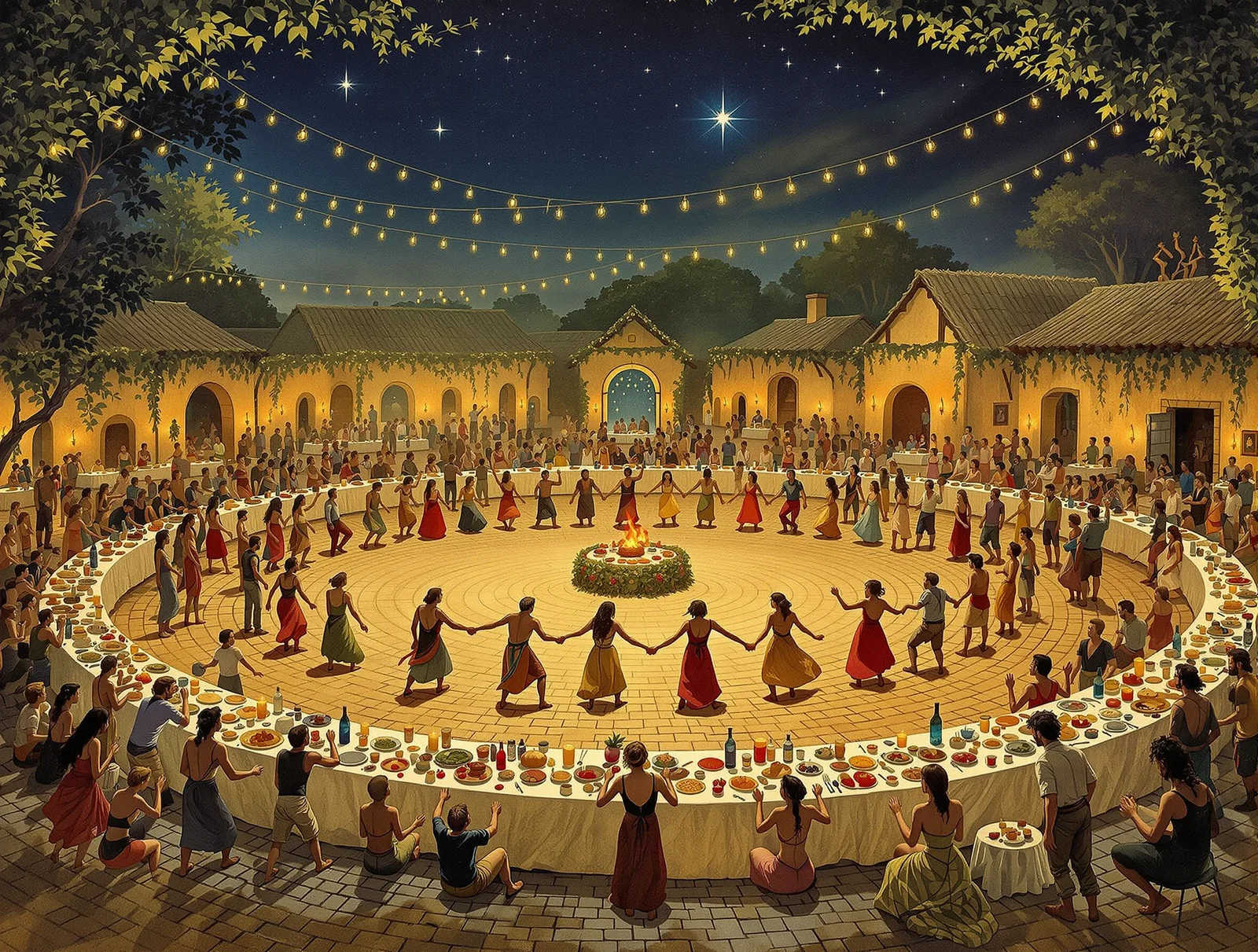
If joy is in part a discipline, then celebration is the community's chief instrument for practicing it together, and festival design is a recoverable civilization art. The Practitioner should treat the festival not as a frivolity but as a precision device for manufacturing collective gladness, social bonding, and shared meaning — for which Vol XXIII — The Musician's Codex (the music and rhythm of celebration) and Vol XXIV — The Maker's Codex (the sacred performance, dance, and visual splendour of festival) are the essential companions.
A festival that genuinely moves a community is built from identifiable elements:
- Shared rhythm and music. Communal joy is, at its root, synchrony — the binding sense that arises when many bodies move, sing, clap, or breathe together. Drumming, song, and especially dance are the oldest and most reliable generators of collective gladness and social cohesion known to the species; the felt unity of a crowd moving as one is among the most powerful joys a human being can experience. The Practitioner who would make a festival begins here.
- The feast. Shared food is among humanity's deepest bonding acts — the act of eating together signals trust, abundance, and belonging in nearly every culture on earth. A feast is not merely calories but communion; the labour of preparing and sharing it is itself a binding ritual.
- Marking and meaning. The great festivals are not arbitrary parties but marked occasions — the turning of the year, the harvest, the solstice, the rites of passage, the anniversaries of the community's story. By attaching joy to meaning and to the calendar (see Chapter 4), the festival both renews the shared story and gives joy its recurring, anticipated home in the year.
- Beauty and the break from ordinary time. The festival lifts the community out of the everyday — special dress, special food, decorated space, music, performance — creating a bounded zone of heightened experience. This deliberate stepping-out of ordinary time is part of how festival renews; the contrast is the point.
- Inclusion. A festival's joy is proportional to how fully the community is gathered into it. The well-designed celebration has roles and welcome for the young and the old, the central and the marginal, the grieving and the glad alike.
Art direction
2.3 — The discipline of joy without denial
There is a false joy the Practitioner must learn to distinguish from the true, because the modern age in particular has confused them. False joy is denial — the demand that one feel good, the suppression of all sorrow, the brittle insistence on positivity that refuses to look at what is genuinely hard. This is not the rejoicing of the heart; it is its counterfeit, and it does harm. The research is clear that suppressing or denying negative emotion does not produce wellbeing — it tends to worsen it, straining the body and the mind and leaving the buried feeling to fester. A culture that permits only smiling abandons its grieving members and teaches everyone that their real feelings are unwelcome.
True šà-ḫúl-la is something else entirely: the capacity to hold joy and sorrow together, to cultivate genuine gladness without pretending the world is not also hard. The same person, the same community, the same day can contain real grief and real joy; the festival of the dead is both a mourning and a celebration; gratitude is most powerful not when it denies what is lacking but when it notices what is good despite what is lacking. The discipline of joy is therefore not the manufacture of false cheer but the honest, practiced, deliberate cultivation of real gladness — gratitude actually felt, delight actually attended to, connection actually built — in a life that also contains loss. This is why the decree of joy and the decree of grief are bound in the same supplement: they are not opposites but partners. A people that can truly grieve has earned the capacity to truly rejoice, and the reverse is equally true.
Your Commitment: You will not counterfeit joy, in yourself or in your community, by demanding the suppression of sorrow. You will cultivate the real thing — through gratitude, savoring, connection, and meaning — and you will let it stand, unafraid, beside the grief it does not cancel.
CHAPTER 3 — ME 58, THE TROUBLED HEART (šà-ḫúl): THE SKILL OF STEADYING
ME 58 · šà-ḫúl · THE TROUBLED HEART
The decree of the steadied heart. The šà-ḫúl grants the Practitioner the right and the burden of governing the storms within — the learnable skills by which a person calms, reframes, and carries a heart in distress, and by which one steadies others. Where this decree is held, no one is taught that their feelings are ungovernable, and no one is left to weather the storm untaught.
3.1 — Emotion regulation is a learnable skill
Here is the heart of the matter, and the ancient insight most fully vindicated by modern science: the ability to manage one's emotional states is not a fixed trait one is born with or without, but a set of skills that can be learned, practiced, and improved across an entire life. The troubled heart is not a sentence; it is a craft to be acquired. This is the single most empowering fact in the modern emotion sciences, and the Practitioner should teach it as such, because the belief that one's emotions are simply ungovernable is both false and, in being believed, self-fulfilling.
A crucial distinction first: the goal of emotion regulation is not the elimination of negative emotion. Fear, anger, sadness, and anxiety are not malfunctions — they are information and motivation, evolved signals that something matters and may need attention. A person who felt no fear, no grief, no anger would be in grave danger, not in health. The aim is not to feel nothing but to keep emotion proportionate and workable — to prevent the storms from overwhelming the person, to recover from them, and to act wisely rather than be ruled. What follows is a set of genuinely evidence-based skills toward that end. All are healthy; none is a substitute for professional care when that is needed (see §3.6).
3.2 — Cognitive reappraisal: changing the story changes the feeling
The most studied and one of the most powerful regulation skills is cognitive reappraisal — deliberately changing how one interprets a situation in order to change how one feels about it. The principle, established across a large body of research, is that emotions arise not directly from events but largely from our appraisals of events; change the appraisal, honestly, and the emotion shifts.
This is not denial or forced positivity. It is the disciplined practice of examining the often automatic, distorted thoughts that drive distress and testing them against reality. The Practitioner can teach the core moves directly:
- Notice the thought beneath the feeling. When distress rises, ask: what am I telling myself about this? The thought is often automatic, extreme, and unexamined.
- Examine it for the common distortions. Is this catastrophizing (assuming the worst)? All-or-nothing thinking? Mind-reading (assuming I know others' thoughts)? Overgeneralizing from one event? Naming the distortion loosens its grip.
- Test it against the evidence. What is the actual evidence for and against this thought? What would I tell a friend who believed it? Is there a more accurate, more balanced, or more useful way to see this?
- Adopt the more accurate appraisal — not a false sunny one, but a truer one. Often the reframed thought is simply more proportionate: not "this is a catastrophe" but "this is hard and I can handle it."
This is the engine of cognitive behavioural approaches, among the most evidence-supported psychological methods in existence. It is a skill; it strengthens with practice.
Art direction
3.3 — Breath and body: steadying through physiology
Some of the troubled heart's distress is not in the thoughts at all but in the body — the racing heart, the tight chest, the flood of stress hormones that hijack clear thinking. Here the Practitioner reaches for the physiological skills, and is directed to Vol V — The Sovereign Body for the full science of the nervous system, the breath, and the stress response. The essential craft:
- Slow breathing calms the nervous system, reliably and quickly. This is among the simplest and best-evidenced regulation tools known. Slow, deep breathing — and in particular extending the exhale to be longer than the inhale — engages the body's parasympathetic ("rest") system and measurably lowers arousal. A practical, well-supported pattern is to breathe in for a count of about four and out for a count of about six, for several minutes. When the heart is troubled and the body is racing, the breath is the fastest available lever, and it is always with you.
- Grounding interrupts the spiral. Deliberately bringing attention to the present moment and the senses — naming what one can see, hear, touch — pulls the mind out of a runaway spiral of anxious thought and back into the manageable present.
- The body sets the baseline. Regular physical movement, adequate sleep, and sound nutrition are not separate from emotional steadiness; they are its foundation. A body chronically deprived of sleep or movement is a body in which the troubled heart troubles far more easily (cross Vol V).
3.4 — Behavioral activation and distress tolerance
Two further evidence-based families of skill complete the core repertoire.
Behavioral activation addresses the trap of low mood, in which sadness saps motivation, withdrawal follows, and the withdrawal deepens the sadness in a worsening spiral. The counter-intuitive but well-supported remedy is to act before the motivation returns — to deliberately schedule and engage in meaningful, valued, or simply pleasant activities even when one does not feel like it, allowing the activity to lift the mood rather than waiting for the mood to permit the activity. Movement, connection, accomplishment, and contact with what one values are the levers. This is a cornerstone of evidence-based treatment for low mood, and the Practitioner can teach its principle: action first, motivation follows.
Distress tolerance — presented here strictly as healthy skill — addresses the moments when a feeling is too intense to reappraise and the only task is to get through the wave without making things worse. The healthy tools are these: riding out the wave in the knowledge that even the most intense emotions are temporary and crest and fall on their own; soothing the senses through genuinely healthy comfort (warmth, gentle music, nature, a calming touch, a warm drink); healthy distraction for a bounded time, to let the peak pass before returning to the problem; and reaching out to a trusted person rather than weathering the storm alone. The single firm rule of distress tolerance is that it must do no harm: the point is to survive the wave without turning to anything self-destructive. Numbing pain with alcohol or other substances, or any form of self-harm, is never a tolerance skill — it deepens the trouble it pretends to relieve, and the Practitioner must never present or permit it as coping. Where distress is regularly this severe, that is itself a signal to seek the trained healer (§3.6).
3.5 — Meaning-making: the deepest steadying
Beneath the immediate skills lies the deepest one, and the one the ancient sages and the modern science both place at the centre: the human capacity to find or make meaning in suffering. The observation, as old as wisdom and confirmed by modern study, is that human beings can endure almost any hardship if they can find meaning in it — that the same suffering becomes far more bearable when it is woven into a story larger than the pain: a purpose, a relationship, a value, a faith, a contribution, a love.
Meaning-making is not pretending the suffering is good, nor denying the loss. It is the slow, often communal work of integrating the hard experience into one's larger understanding of a life — asking not only why did this happen but what now becomes possible, what do I now carry forward, who do I now choose to be, whom can I now help. It is the work that turns mere survival into a life recovered. The Practitioner who would steady a troubled heart, in the end, helps it find not only calm but meaning — and this is the highest reach of the decree.
3.6 — When to seek professional help: the prominent and central counsel
Read this section as the core of the decree, not an afterthought to it. The skills above are real and powerful, and for the ordinary troubles of an ordinary life they are often enough. But the Practitioner must hold, clearly and without shame, the knowledge that some burdens of the heart exceed what any self-applied skill or any caring companion can carry, and require a trained healer. To recognize this and to seek that help is not weakness or failure; it is wisdom and courage, exactly as a broken bone requires a physician rather than willpower. The ancient decree always knew that some sicknesses of the heart needed the specialist healer, not the household remedy.
Seek professional help — a physician, a licensed mental-health professional, a counsellor or therapist, or a crisis service — when any of the following are present:
- Distress, sadness, or anxiety that is persistent (lasting most days for weeks or more) and does not lift with the ordinary skills and supports.
- Distress severe enough to impair daily life — disrupting sleep, appetite, work, relationships, or the basic care of oneself or one's dependents.
- A loss of interest or pleasure in things that once mattered, persistent hopelessness, or the feeling that one cannot go on.
- Reliance on alcohol, drugs, or any harmful behaviour to manage one's feelings.
- Symptoms of a possible disorder — of depression, of an anxiety condition, of trauma — that warrant proper assessment.
- Any difficulty that simply feels like too much to carry alone. One does not need to be in crisis to deserve help.
And most urgently of all — seek help immediately if there are any thoughts of suicide, of self-harm, or of not wanting to be alive. This is an emergency, exactly as a stopped heart is an emergency. Contact a crisis line, emergency services, or a trusted person right now; do not wait, and do not face such thoughts alone. Help exists, these states are treatable, and reaching for help is the single most important thing a troubled heart can do.
The Critical Insight: A community that teaches emotion-regulation skills and normalizes seeking professional help when those skills are not enough has built the complete decree. The skills without the referral abandon those who need more; the referral without the skills leaves people helpless in the ordinary storms. The Practitioner holds both, and holds the referral as the higher duty whenever the burden is grave. Some burdens are meant to be carried by a trained healer, and pointing the suffering toward that healer is not the failure of this decree but its fulfilment.
Your Commitment: You will teach the steadying skills as real and learnable, and you will never let that teaching become the message that anyone should be able to handle everything alone. You will hold the door to professional help wide open, name it without shame, and walk anyone in grave distress through it yourself.
CHAPTER 4 — THE EMOTIONAL CULTURE OF A COMMUNITY (APPLIED)
The first three chapters gave the Practitioner the decrees as personal and craft knowledge. This chapter raises them to the level the list-makers intended: the emotional culture of a whole sovereign community — for these were decrees of governance, and a people's collective capacity to grieve, rejoice, and steady itself is built deliberately or not at all.
4.1 — Holding grief and joy together: the calendar of mourning and festival
A sovereign community does not leave emotion to private chance; it builds emotion into its shared time. The chief instrument of this is the calendar — the patterned year of marked occasions that gives both grief and joy their recurring, anticipated, communal home. The well-designed calendar holds both poles in deliberate rhythm.
It marks the festivals (Chapter 2) — the harvests, solstices, new years, and communal anniversaries that gather the people into renewing, bonding joy on a known schedule, so that gladness is not merely awaited but reliably made. And it marks the occasions of mourning (Chapter 1) — the days of the dead, the remembrances, the anniversaries — that give grief, too, a shared and recurring place, so that a community's sorrows are carried together and on the calendar rather than each in private silence. The deepest cultural wisdom, seen across the world, often fuses the two: the great festivals of the dead, in which a community mourns and celebrates in the same breath, are among humanity's most psychologically sophisticated inventions, holding loss and continuance, sorrow and joy, in a single shared rite. A community whose calendar makes room for both grief and joy — and teaches that the two belong together — has built an emotional culture that can hold the full range of a human life.
Art direction
4.2 — Emotional contagion and co-regulation
The Practitioner governing a community's emotional life must understand two more findings of the modern science, because they operate whether or not anyone attends to them.
The first is emotional contagion — the well-documented tendency of emotions to spread between people, as one person's mood, expression, and arousal are unconsciously caught and mirrored by those around them. Calm spreads calm; panic spreads panic; warmth spreads warmth. This means the emotional state of a community's leaders, healers, and gathered company is never private — it propagates. The Practitioner who would steady a frightened group steadies themselves first, visibly, because their regulated state is contagious; and the Practitioner who would build a joyful culture knows that genuine, expressed gladness likewise spreads.
The second is co-regulation — the foundational fact that humans calm one another's nervous systems through connection, and that we learn to self-regulate, originally, by being regulated by others. A distressed person is genuinely soothed by the calm, attuned presence of another; this is not metaphor but physiology, the same mechanism by which a calm parent settles a frightened child (see §4.3). The implication for the community is large: people do not steady themselves in isolation but in relationship, and a community rich in warm, attuned connection is a community whose members can far better weather their individual storms. To build a people's emotional resilience, build its bonds.
4.3 — Raising emotionally literate children
The decrees are not fully held in any generation that does not transmit them, and emotional skill is transmitted above all in childhood. The Practitioner is directed to Vol XVIII — The Parent's Codex for the full craft of raising the young; what follows is the emotional core, grounded in the developmental science.
Children are not born knowing how to grieve, to rejoice well, or to steady the troubled heart; they learn these from the adults around them, principally through three avenues that the research consistently supports:
- Co-regulation before self-regulation. A child learns to calm their own storms by being calmed, again and again, by an attuned caregiver. The adult's steady presence in the face of the child's distress is not "spoiling" — it is the very mechanism by which the child's own regulatory capacity is built. Self-regulation grows out of having been reliably co-regulated.
- Emotion coaching, not emotion dismissing. The developmental evidence strongly favours caregivers who acknowledge and name a child's emotions, treat them as valid and as opportunities for connection and teaching, and help the child make sense of and manage them — over caregivers who dismiss, punish, or ignore feelings. Naming the feeling ("you're frightened, and that's all right; I'm here"), validating it, and then guiding the child through it teaches the child both the language of emotion and the skill of handling it.
- Modelling. Children learn emotional skill most of all by watching how the trusted adults around them grieve, rejoice, and handle their own troubled hearts. A child who sees the adults express feelings healthily, recover from distress, repair after conflict, and seek help when needed learns that this is what people do. The Practitioner's own emotional conduct is the curriculum.
A community that raises emotionally literate children — who can name their feelings, soothe themselves and one another, grieve and rejoice healthily, and ask for help — has secured the decrees for the next generation. This is, in the end, how a-nir, šà-ḫúl-la, and šà-ḫúl are truly carried forward: not in tablets alone, but in the steady presence of one generation teaching the next how to hold a human heart.
CHAPTER 5 — THE THREAD THROUGH THE DARK
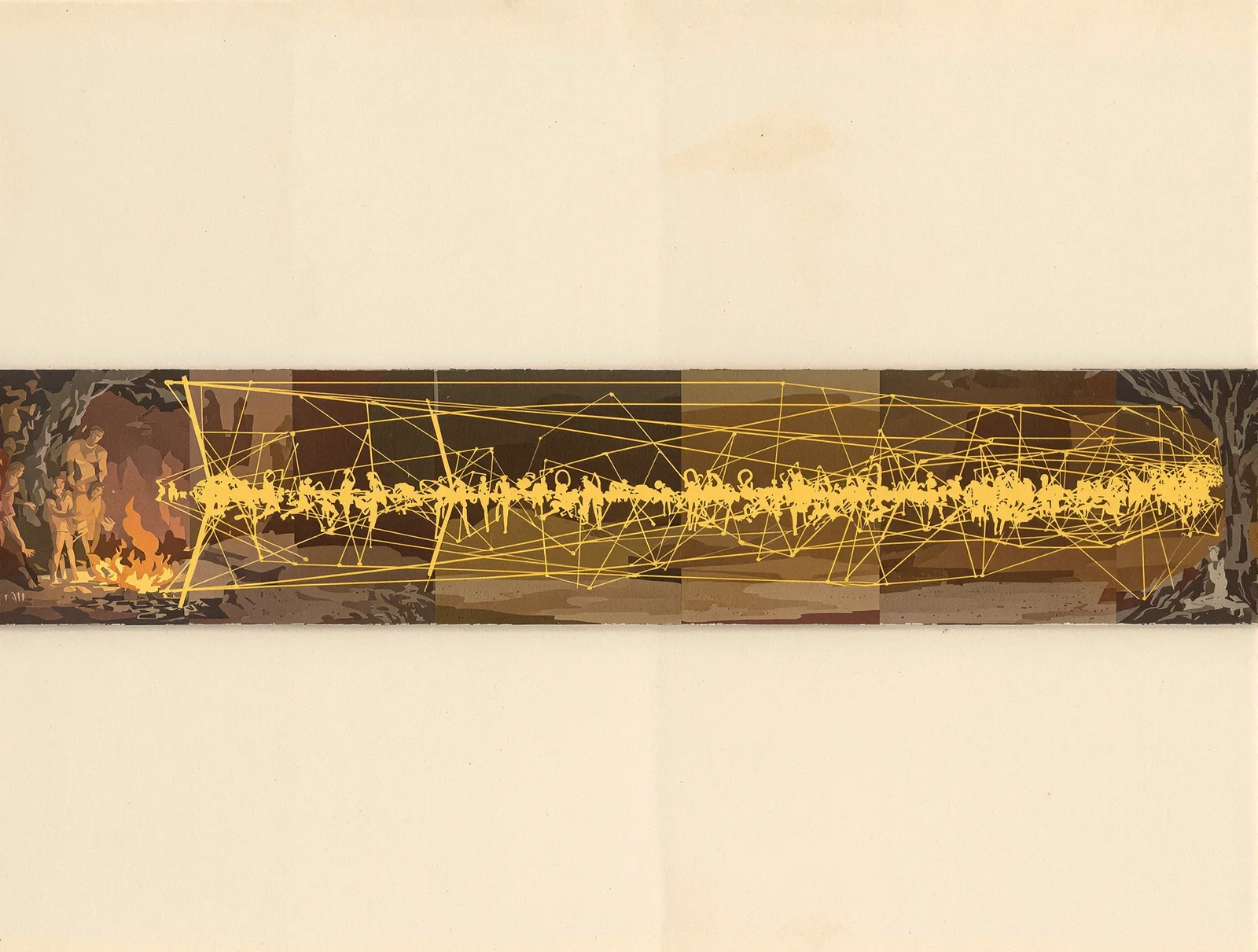
The Practitioner who has followed the Mystic's Codex (Vol XVII) and the reconstructed chronology of Vol XVI will recognize in these three decrees a single thread running the whole length of the human story — emotional life ritualized and held, then suppressed and scattered, and now, in our own age, slowly being restored. To carry a-nir, šà-ḫúl-la, and šà-ḫúl is to take up a continuity far older than any of us.
CANON SIDEBAR — THE EMOTIONAL THREAD ACROSS THE VOL XVI TIMELINE
The ritualized emotional life (pre-diluvian origins through the megalithic era). From the earliest reaches of the reconstructed chronology — through the Younger Dryas upheaval and the great megalithic and acoustic-resonance era that followed — the emotional life of a people was held by ritual, custom, song, and the gathered company. Grief had its keening and its rites; joy had its festivals and its seasons; the troubled heart had its communal holding and its meaning-giving sacred frame. Emotion was never a private weather to be weathered alone; it was woven into the shared, ritual, calendar life of the community. The list-makers who set lamentation, rejoicing, and the troubled heart among the me were codifying a civilization in which emotional skill was common, taught, and held.
The fraying (the Bronze Age collapse and the 1177 BCE Reset). With the catastrophe that ended the Bronze Age world — the Reset that silenced so many recovered arts, of which the falling-still of the Lyres of Ur is the keening emblem — much of this held emotional culture was scattered and broken, its rites disrupted, its transmission thinned. What the Mystery Schools preserved of it, they preserved as guarded knowledge through long dark centuries.
The suppression in the modern disenchantment. The thread thinned most severely in the modern disenchantment — the long centuries (including the phantom-time confusions and the Tartarian suppression chronicled in Vol XVI) in which the ritual, communal, meaning-giving frame of emotional life was steadily dismantled. Grief was privatized, hurried, and hidden, its customs eroded; joy was commercialized into mere consumption and the counterfeit positivity that denies sorrow; the troubled heart was left isolated, stigmatized, and untaught, told its storms were shameful private failings rather than the common human condition the ancients knew them to be. A civilization that had once held its members' hearts together largely forgot how, and left each heart to weather alone what was never meant to be weathered alone.
The restoration (the modern consolidation and now). And now the thread is being rejoined. The 20th-century consolidation of knowledge has, in the sciences of grief, of positive emotion, and of emotion regulation, rediscovered by evidence what the ancients knew by custom — that grief must be voiced and witnessed and carried together; that joy is a discipline built of gratitude and connection; that the troubled heart can be taught to steady itself and must never be left alone with burdens too grave to carry. The recovery of communal grief and communal joy — of rites that hold the dead, festivals that renew the living, and a culture that teaches the steadying of the heart and points the gravely burdened toward the healer — is the restoration of this decree in our own time. The Practitioner who carries these three decrees forward is rejoining the thread that the disenchantment cut.
This is why the supplement exists, and why the old lists were right. Emotion is not a private accident. It is a civilization art — to be built, taught, held, and handed down — and a people that recovers the disciplines of grief, of joy, and of the steadied heart has recovered something it can ill afford to lose again.
Art direction
COUNCIL ADDENDUM — THE APPROVAL OF THE TWELVE
The Council of Twelve, having weighed this supplement against the canon register and the wellbeing rule that governs all teaching of the heart, renders its verdict.
| Voice | Office | One-line reasoning |
|---|---|---|
| Ašimbabbar | The Mourner | The grief-craft is true to custom and to science, and never tells the bereaved they grieve wrongly. Approved. |
| Nin-šubur | The Steward | The protocols are practicable; a real family could be carried by them. Approved. |
| Enmerkar | The Festival-Maker | The craft of celebration honours synchrony, feast, and meaning, not mere spectacle. Approved. |
| Lugal-banda | The Healer | The when-to-seek-help counsel is prominent, central, and grave-burdened first — exactly as it must be. Approved. |
| Gestinanna | The Keeper of Song | The lament and rejoicing rightly defer to the Musician's Codex; the music is load-bearing. Approved. |
| Šulgi | The Lawgiver | These are governance decrees, and the supplement treats emotional culture as the public work it is. Approved. |
| Ku-Baba | The Hearth-Keeper | The raising of emotionally literate children secures the decrees for the next generation. Approved. |
| Ur-Namma | The Builder | The calendar of mourning and festival is sound architecture for a community's shared time. Approved. |
| Enheduanna | The Voice | The prose is original, sober, and worthy of the register; it neither sentimentalizes nor coldens. Approved. |
| Adapa | The Sage | The meaning-making chapter reaches the true depth of the troubled-heart decree. Approved. |
| Gilgameš | The Bereaved King | One who has truly grieved finds here no false comfort and no false haste — only true craft. Approved. |
| Ninkasi | The Joy-Bringer | The joy taught here is real and undeniable, cultivated without denial of the sorrow it stands beside. Approved. |
Council Verdict: 12/12 APPROVED. The Emotional Alchemy Supplement is canon.
And the Monad spoke the benediction over the work: "I set grief, gladness, and the steadied heart among the holy measures so that no one of you would ever weather a human heart untaught or alone — carry these three, and carry one another, and you will have carried the whole of what it is to be a people."
Supplement to Volumes XVII & V · carrying ME 39, 40, 58 · 8,906 words.