VOLUME XIX · SUPPLEMENT E — REGALIA & SUCCESSION: The Material Grammar of Legitimate Authority
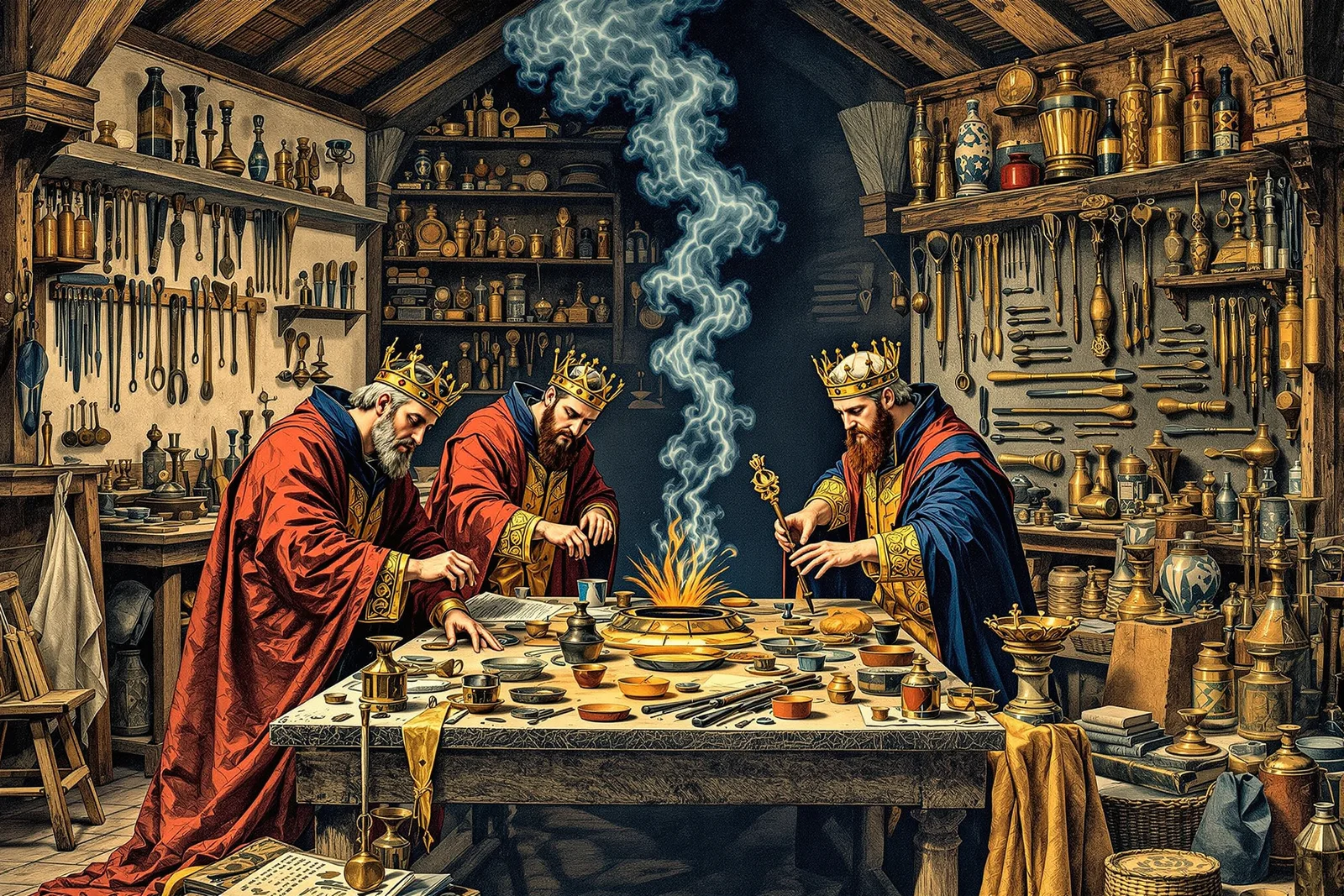
THE THREE DECREES OF THE OFFICE MADE VISIBLE
The Diplomat's Codex taught the Practitioner how authority speaks, treats, and binds itself by word. This supplement teaches how authority is made to be seen, recognized, and lawfully handed on — the scepter that names the office, the seal and crown and standard that publish it, and the lasting ladyship that keeps it from collapsing into one set of hands. Three decrees nearly lost; one craft of legitimacy; an apparatus the recovering community will need the day it first asks, "and who decides?"
Supplement to Volume XIX · carrying ME 5, 6, 10.
CANON PREAMBLE — WHY THESE THREE WERE NEARLY LOST, AND WHY REGALIA IS INFRASTRUCTURE
Of the sixty-four holy measures the me enumerate, three concern not a craft of the hand but a craft of legitimacy — the art by which a community decides, publicly and durably, who may speak for it and how that right passes on. They are ME 5, the Exalted Sceptre; ME 6, the Royal Insignia; and ME 10, the Lasting Ladyship. They reached the Practitioner Community by the narrowest thread of any decrees in the Codex, and the reason is instructive: they are the decrees a tyrant most wants to keep for himself and most wants the people to forget they once held in common.
Consider how a thing is lost. A craft of the hand — the casting of bronze, the seasoning of wood, the heading of a drum — is lost when its last practitioner dies untaught. But a craft of legitimacy is lost differently. It is lost when a strongman captures the regalia, declares that the scepter, the seal, and the crown were always his by right of strength or blood or heaven, and erases the memory that they were ever granted by a community to an office for a term. The decrees of authority are not lost to forgetting so much as to theft — and the most successful theft is the one that rewrites the record so that the stolen thing appears never to have belonged to anyone else. The Diplomat's Codex (Vol XIX, the parent of this supplement) carried the law of treaty, embassy, and the bound word. But it deferred to a supplement the harder matter of the domestic legitimacy on which all foreign standing rests — for no envoy can credibly bind a people whose own succession is a knife-fight. That is the gap this supplement fills.
The Practitioner must begin from a single correction, because the modern instinct is wrong here. Regalia is not vanity. The crown is not jewelry; the scepter is not a fancy stick; the seal is not a decoration. They are legitimacy technology — physical infrastructure that solves a real and otherwise fatal coordination problem: in a community of thousands who cannot all know each other, how does a person prove, at a glance and beyond dispute, that they hold an office and may act for the whole? Every durable society in human history answered this with objects, because objects can be made, guarded, recognized, and transferred in a way that bare personal charisma cannot. A regalia system is to political authority what a standardized coin is to trade or a boundary-stone is to land: an agreed external token that lets strangers cooperate without re-litigating, every time, the question the token settles. Treat it as infrastructure, build it to standard, and govern its transfer — or watch the community's authority default, every generation, to whoever is willing to fight for it.
This supplement carries the three decrees in the order a community needs them. First the scepter (ME 5), the oldest and simplest token of office. Then the full insignia system (ME 6) — seals, crowns, standards, robes, color — that publishes an office to a population. Then the lasting ladyship (ME 10), the structural principle that authority survives by being paired and balanced rather than concentrated. Then two applied chapters: the design of legitimate, non-tyrannical succession; and the thread of these three decrees through the dark ages of the Vol XVI chronology, from sacral kingship through its corruption into tyranny to the present restoration. Work in order. Each decree is the foundation the next is built upon.
CHAPTER 1 — ME 5, THE EXALTED SCEPTRE
ME 5 · ĝidri maḫ · THE EXALTED SCEPTRE
The decree of the staff of office. Carried among the holy measures, the Exalted Sceptre grants the Practitioner the oldest visible sign that one person, here and now, holds an authority granted by the whole — a rod that is not a weapon but the memory of one, raised to mean not "I can strike you" but "the community has set me to decide." Where this decree is held, the right to speak for the people is a thing one can take up, lay down, and hand on.
The rod of office across the human record
The scepter is the oldest political object the species possesses, older than the crown, older than the throne, very nearly as old as the settled community itself — and it is everywhere, which is the first thing the Practitioner must understand. The rod, mace, or staff of office appears independently across cultures that never met, because it answers a need every community has and solves it with the materials every community owns. Trace the survey honestly and the pattern is unmistakable.
In Egypt the ruler's heka crook and nekhakha flail were carried across the chest as the defining tokens of sovereignty — the crook descended from the literal shepherd's staff, the herdsman's tool raised into the herdsman-of-the-people metaphor that every pastoral society reaches for. In Mesopotamia, the cradle of the me themselves, the rod-and-ring or rod-and-measuring-line passed from the god to the king in the investiture scenes carved on stone, the measuring instruments of the surveyor become the emblems of the just ruler who lays out the city straight and renders fair judgment. The Greek skēptron was the staff that conferred the right to speak in assembly: in the oldest epic, a man held the speaking-staff and the floor was his while he held it — the rod as a turn-taking token, the physical embodiment of recognized voice. The Roman magistrate's authority was carried before him as the fasces, the bound rod-bundle and axe, and the marshal's baton descended from the same root into every later army. The bishop's crozier is the shepherd's crook again, now pastoral in the religious sense; the parliamentary mace lies on the table and is the authority of the house, so that the chamber cannot lawfully sit without it. Across the kingdoms of West Africa the linguist's staff and the chief's rod carried proverbs and lineage in their carved finials; across Polynesia the orator's staff and fly-whisk marked the man entitled to speak the genealogy. The same object, the same meaning, on every inhabited continent.
The Critical Insight: The scepter began as a weapon and became its opposite. A mace is a club; a rod is a striking-stick; the marshal's baton was once a real weapon of command on a real field. But the political scepter is the weapon de-fanged and elevated — carried to signify not the capacity to strike but the right, granted by the community, to decide on its behalf. This transformation is the whole anthropology of legitimate power in one object: raw force converted, by communal agreement, into recognized authority. The community that grasps this builds its rod to say "I am set here by you," not "I can hurt you" — and the difference between those two meanings is the difference between an office and a tyranny.
Art direction
The craft of the staff of office (cross Vol I — The Artificer's Codex; Vol XXIV — The Maker's Codex)
A staff of office is a made object, and the recovering community must be able to make one to a standard that reads as deliberate rather than scavenged — for a regalia object that looks improvised undercuts the very legitimacy it exists to assert. The craft draws on three sibling decrees: the woodwork and joinery of Vol XXIV (the Maker's Codex), the metalwork and casting of Vol I (the Artificer's Codex), and the finishing disciplines both share. The full build is given here as a single coordinated protocol.
The shaft. The body of the staff is the spine of the object and must be straight, stable, and dimensionally honest across the decades it will serve. Select a dense, straight-grained hardwood — the frame woods of the Maker's Codex apply directly: hard maple, ash, walnut, or a well-seasoned fruitwood, quartersawn so the small dimensional movement runs across the width and the shaft stays true (the seasoning discipline of the sibling volumes is mandatory; a staff built from unseasoned stock will check and bow and shame the office). Working length for a standing staff of office runs 1,200–1,500 mm (shoulder to floor for the bearer); a hand-scepter or speaking-rod runs 400–700 mm. Turn or plane the shaft to a gentle taper — slightly stouter at the grip, lighter at the head — so the object balances in the hand and reads as purposeful.
The joinery. A staff that joins a wooden shaft to a metal finial must do so in a joint that will never work loose, because a wobbling head is a broken symbol. The canonical joint is a tapered tang-and-socket or threaded ferrule: the shaft is turned down to a true cylindrical or tapered tenon at the head end, fitted into a metal collar (the ferrule) that both reinforces the wood against splitting and provides the seat for the finial. Where the finial is cast metal, cast or drill it with a matching socket and secure it to the tang with hot pitch, a drift pin, or a fine thread cut by the methods of Vol I. A simple butt-glued head will fail; the ferrule is not decoration but structure.
The finial — the casting (cross Vol I). The head of the staff carries its meaning, and casting it is the metalwork heart of the build. The Artificer's Codex governs the whole sequence: model the finial in wax (a head, a ring, a measure, a community sigil — the form is the office's choice), invest it, burn out the wax, and pour. For a community's standing regalia, leaded bronze or a high-tin bronze casts crisp detail and takes a deep patina; the bell-bronze and founding protocols of Vol I give the alloy and the pour. A cast finial may then be chased and engraved to sharpen its lines. Where casting is beyond the community's current metallurgy, a finial forged from bar stock or carved from a dense hardwood or bone and capped with a thin metal collar is an honest substitute — the survey above shows that carved-wood finials carried the highest authority in several cultures, so the wooden head is not a lesser form but a parallel tradition.
The finish. The shaft is finished to protect the wood and to read as cared-for: an oiled-and-waxed finish (drying oil cut and built, then waxed) or a shellac film, by the finishing tables of the Maker's Codex. The metal is patinated and sealed against the hand's corrosion. A staff of office is handled constantly across generations; build the finish for renewal, not permanence, and re-oil it at each investiture.
Specification Table 1-1 — The staff of office: materials and form
| Element | Material | Specification | Cross-reference |
|---|---|---|---|
| Shaft (standing staff) | Quartersawn dense hardwood (maple, ash, walnut, fruitwood) | 1,200–1,500 mm; gentle taper, stout at grip; seasoned to 6–8% MC | Vol XXIV (Maker's), woodwork & seasoning |
| Shaft (hand-scepter/speaking-rod) | As above, or close-grained fruitwood | 400–700 mm; balanced to the hand | Vol XXIV (Maker's) |
| Ferrule / collar | Bronze or brass | Reinforces the head joint against splitting; seats the finial | Vol I (Artificer's), metalwork |
| Finial (cast) | High-tin or leaded bronze | Lost-wax cast, chased and engraved; socketed to the tang | Vol I (Artificer's), founding & casting |
| Finial (substitute) | Forged bar, or carved hardwood/bone with metal cap | Honest parallel form; carved finials are a high tradition in their own right | Vol I / Vol XXIV |
| Head joint | Tapered tang-and-socket or threaded ferrule | Pinned, pitched, or threaded; never butt-glued | Vol I / Vol XXIV |
| Finish | Drying oil + wax, or shellac; metal patinated and sealed | Built for renewal at each investiture | Vol XXIV finishing tables |
Your Commitment: You will build the community's staff of office to the standard of the sibling crafts and no lower — a true joint, an honest material, a deliberate form — because a regalia object that looks scavenged tells the population that the authority it represents is scavenged too. The object is an argument; make it well.
The protocol of investiture and transfer
The scepter's deepest function is not in the carrying but in the handing. A staff of office that is never transferred is merely a king's possession; a staff that passes, by a fixed and public rite, from one office-holder to the next is the proof that the office outlives the person — and that proof is the whole point. The transfer rite must be designed so that the community, not the outgoing holder and not the incoming one, is visibly the source of the authority being conveyed.
Protocol 1-A — The investiture and transfer of the staff of office:
- The office, not the person, is named first. The rite opens by the assembly (or its confirming council, Chapter 4) declaring the office vacant and the term begun — establishing on the record that what follows is a grant for a term, not a coronation for life.
- The regalia is presented by the community's hand. The staff is brought forward and held by a community officer — an elder, the council's speaker, the holder of the seal — not by the outgoing ruler alone. The authority flows through the community to the new holder, and the staging must show this.
- The oath precedes the grasp. The incoming holder swears the office's oath — its powers, its limits, its term, and the conditions of its forfeiture — before taking the staff, so that the grasp is the seal on a promise already made, not a seizure that precedes any promise.
- The transfer is hand-to-hand and witnessed. The staff passes physically from the community's officer to the new holder, before the gathered assembly, with named witnesses recorded. The physical handing is the legitimacy; do not let it be done in private.
- The outgoing holder lays down, or the staff is shown empty. Where there is a predecessor, the rite first shows the outgoing holder laying the staff down or returning it to the community before it is given on — the public proof that one set of hands has released it. Where the office was vacated by death or removal, the empty staff is shown and its provenance recited.
- The forfeiture clause is read aloud. The rite names, every time, the conditions under which the staff returns to the community before the term's end (Chapter 4). An authority that can only be taken by death is a tyranny waiting to happen; an authority whose recall is recited at its own investiture is an office.
- The record is sealed. The transfer is recorded and sealed (Chapter 2's seal-craft), dated to the community's calendar, and lodged with the keepers — so that the legitimacy of this holder can be checked against the record by anyone, in any later dispute.
The Critical Insight: A regalia object is legitimacy technology only if its transfer is governed as carefully as its making. The staff that can be picked up by whoever seizes the hall is a weapon again; the staff that can only pass by a public, oath-bound, community-sourced, recall-able rite is an office. The Practitioner builds the rite with the same care as the object — because the rite is the part the tyrant cannot counterfeit.
CHAPTER 2 — ME 6, ROYAL INSIGNIA (nam-ĝarza)
ME 6 · nam-ĝarza · ROYAL INSIGNIA (THE ORDINANCES OF OFFICE)
The decree of the office made legible to a whole people. The Sumerian term reaches past mere ornament toward the ordinances, the rites, the proper observances of an office — its insignia and its rules as one inseparable thing. Carried among the holy measures, nam-ĝarza grants the Practitioner the right to design the system of signs by which a community recognizes its own authorities — the seal that credentials, the crown that elevates, the standard that rallies, the robe and the color that distinguish — and to make those signs honest. Where this decree is held, a stranger can read who holds what, and trust the reading.
Insignia as an identity system
A scepter names an office to the people in the room. But a community of any size needs to publish many offices to a population that mostly cannot see the office-holder at all — to let a farmer in an outlying village know the seal on a decree is genuine, to let a soldier in the line know which standard is his to follow, to let a petitioner know the robed figure on the judgment-seat truly holds the judging office. This is an identity and authentication system, and the Practitioner should design it as one: a coherent set of signs, each solving a specific recognition problem, each made hard to forge, all consistent with one another so that the system as a whole reads as a single legitimate order rather than a scatter of competing claims.
The components recur across every literate civilization because the problems they solve are universal:
- The seal authenticates documents and goods at a distance — the credential that says "this order truly comes from the office it claims."
- The crown / headdress elevates the person of the office in presence — the sign worn so that the holder is recognized as set above the ordinary in their official capacity.
- The standard / banner rallies and identifies a body of people in motion or in the field — the sign followed, mustered to, and oriented by.
- The robe / regalia of dress distinguishes the office in ceremony and judgment — the vesture that marks the holder while performing the office and is laid aside when not.
- Color and heraldry index belonging and lineage at a glance — the system that lets a population read affiliation, rank, and house from across a square.
The Critical Insight: An insignia system is fundamentally a trust-at-a-distance technology. Its entire purpose is to let people who cannot personally know the office-holder nonetheless extend, or withhold, the cooperation that legitimate authority requires — to obey a genuine decree, follow the right standard, honor the true judge. This is why forgery of regalia was everywhere among the gravest crimes: to counterfeit the seal or wear the unearned robe is to attack the community's ability to know its own authorities at all. Design the system, therefore, for authentication, not merely for splendor — the splendor is in service of the recognition, never the reverse.
Art direction
The cylinder seal: the original credential (cross Vol XIII)
Of all the insignia, the seal is the one the Practitioner should master first, because it is the original credential — the technology that made trust-at-a-distance possible at all, and the direct ancestor of every signature, stamp, watermark, and cryptographic key the species has since devised. Its canon home is Vol XIII; this supplement carries the regalia function, but the seal-craft is foundational enough to specify here.
The Mesopotamian cylinder seal is the archetype: a small cylinder of stone (or shell, bone, or fired clay) carved in intaglio — the design cut in reverse and in negative — so that when rolled across wet clay it leaves a continuous raised impression unique to that seal. Its genius is fourfold. First, it is a credential bound to a person or office: the carved cylinder was carried (often worn on a cord or pin) and its impression stood for the authority of its holder, sealing contracts, letters, and the clay stoppers of storerooms and jars. Second, it is hard to forge: cutting a matching intaglio in stone, in reverse, to reproduce a specific complex device was beyond casual counterfeiting, and the carving could be made arbitrarily intricate. Third, it is tamper-evident: a sealed clay stopper or a sealed clay envelope (the bulla) cannot be opened without destroying the impression, so the seal proves not only origin but that the thing has not been interfered with since. Fourth, it is reusable and transferable as an office-token: the seal of an office could pass to its successor, carrying the authority forward — the same logic as the scepter, in miniature.
The stamp seal (pressed rather than rolled) and the signet ring are the same technology in other forms, and the principle reaches unbroken to the present: the wax seal of a chancery, the chop of an East Asian official, the embossed corporate seal, the notary's stamp. The Practitioner designing a community's authentication system is re-deriving the cylinder seal, and should derive it deliberately.
The craft of seals and standards (cross Vol I — Artificer's; Vol XXIV — Maker's)
Cutting the seal. A seal is an engraving problem. Select a fine-grained, hard material that holds crisp detail and resists wear — a hardstone (the lapidary methods of Vol I apply), a dense hardwood or bone for a community's first seals, or fired ceramic. Cut the device in intaglio and in mirror-reverse, working with engraving gravers, burins, and (for hardstone) abrasive drills and cutting slurries — the same lapidary and engraving disciplines the Artificer's Codex develops for metalwork and gem-cutting. Cut the design deep and clean, because a shallow or ragged intaglio yields a muddy impression that a forger's casual copy can match; depth and crispness are anti-counterfeiting. Test the cutting by rolling or pressing it into clay or wax and reading the impression under raking light; correct, deepen, and re-test until the impression is sharp and complete.
Founding the matrix. Where a seal-die or a metal stamp is wanted, it can be cast by the lost-wax method of Vol I and the impression-face then chased and sharpened by hand — but the highest-security seals are cut, not cast, because a cast die can itself be reproduced by casting from a stolen impression, while a hand-cut intaglio cannot.
The standard. A standard or banner is a textile-and-metalwork object drawing on the fiber arts of the Maker's Codex and the metalwork of the Artificer's. The carried standard-top (the figure, emblem, or sigil mounted on the pole) is cast or wrought metal by Vol I; the banner itself is woven, dyed, and appliquéd by the fiber and dye crafts of Vol XXIV, in the office's heraldic colors (below). Build it to be seen at distance and in motion: bold, high-contrast device; durable dyes (the fast natural dyes of the Maker's Codex, not the fugitive ones that fade to ambiguity); and a mounting that survives wind and march.
Designing a community's insignia system
The Practitioner does not merely study insignia; she designs a coherent system for the community. The design is a governance act as much as a craft act, because the signs encode who holds what and must therefore be assigned by the same legitimate process that grants the offices.
Protocol 2-A — Designing the community's insignia system:
- Enumerate the offices first. List every office the community recognizes — its assembly's speaker, its councils, its judges, its envoys (Vol XIX), its keepers of seal and record, its co-sovereigns (Chapter 3). Insignia follow offices; never design a sign for which there is no office, or you invent a hierarchy the community never agreed to.
- Assign each office only the signs its function needs. A judge needs a robe and a seat; an envoy needs a credential-token and a seal (Vol XIX); a muster-captain needs a standard. Resist proliferation — every unnecessary sign dilutes the legibility of the necessary ones.
- Make the system internally consistent. A shared visual grammar — a common color logic, a recurring community sigil, a consistent material hierarchy — lets a population read the whole order at a glance and read a counterfeit as out-of-system. Inconsistency is the forger's friend.
- Build anti-counterfeiting into the craft, not the law alone. Deep-cut seals, fast and distinctive dyes, controlled materials, and registered devices make forgery hard at the workbench; punishing forgery in law is the second line, not the first.
- Register every device with the keepers. Each office's seal-impression, heraldic device, and standard is recorded with the community's keepers of record, dated and described, so that authenticity can always be checked against the register — the same lodging the scepter-transfer requires (Chapter 1).
- Bind insignia to term, not to person. The seal of an office returns to the community when the term ends and passes to the successor (Chapter 4); the robe is the office's, worn while serving and laid aside after. An insignia that becomes personal property has begun the slide from office to dynasty.
Your Commitment: You will treat the insignia system as the community's authentication infrastructure and govern it as such — offices first, signs only as function requires, consistency enforced, forgery defeated at the bench, every device registered, and every sign bound to the term and not the person. A legible order of honest signs is a free people's defense against the counterfeit authority that every usurper begins by forging.
Art direction
CHAPTER 3 — ME 10, LASTING LADYSHIP (nam-nin)
ME 10 · nam-nin · LASTING LADYSHIP
The decree of the enduring office of the Lady. The Sumerian nin is the lady, the mistress, the queen — and nam-nin is her office made into a lasting institution, not a passing favor. Carried among the holy measures, the Lasting Ladyship grants the Practitioner the principle that supreme authority is most stable when it is paired and balanced rather than held in one set of hands, and that the office of the Lady — co-sovereign, queen, high priestess, mother of the line — is a permanent structural member of a sound community, not an ornament on a king's. Where this decree is held, authority stands on two feet, and is harder to topple.
The office of the Lady across history
The Practitioner must approach this decree as an anthropologist, because the modern habit is to read "ladyship" as a courtesy title and miss that it names a structural office with a long and genuine history. The cross-cultural record of women's offices of authority — and of paired, balanced sovereignty more generally — is far richer than the tyrant's later propaganda admits, and recovering it is part of recovering the decree.
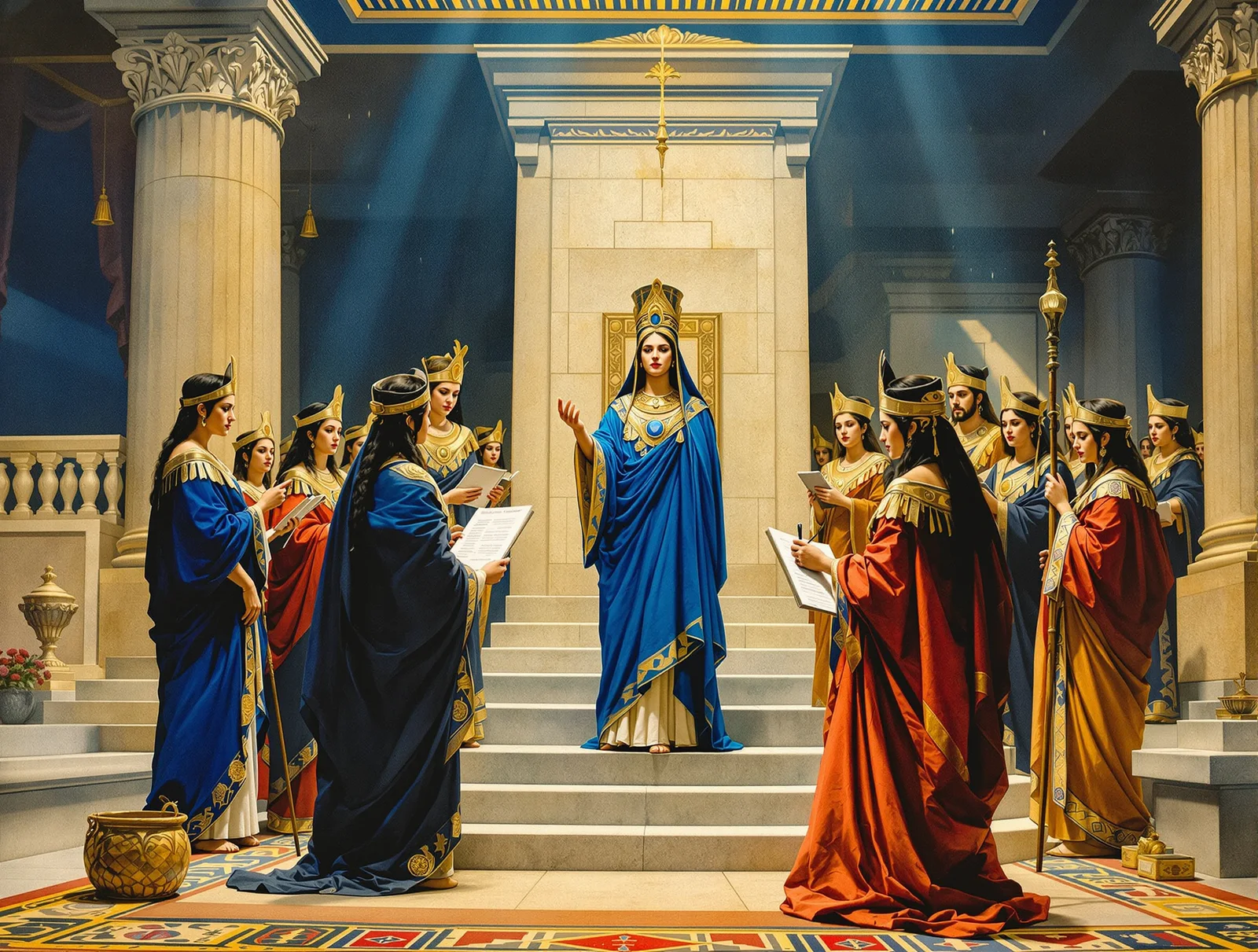
In Mesopotamia, the heartland of the me, the en-priestess was among the highest offices in the land. Enheduanna, daughter of Sargon of Akkad and high priestess of the moon-god at Ur, is the earliest author in world history known by name — a woman holding a great religious office, composing the hymns that helped bind a multi-city empire, her authorship recorded and her office enduring across generations after her. The nin of a city could be its queen or its lady in her own right; goddesses headed great temples whose earthly administration was run by women of corresponding office. This is not ornament; it is institution.
The broader survey confirms the pattern. Egypt knew queens-regnant who ruled as pharaoh — Hatshepsut governing in her own name, Egypt's "great royal wife" a defined office of real power, the line itself often reckoned through royal women. The Kandakes (Candaces) of Kush were a recognized line of ruling queens. Among many West African and Akan societies the queen mother held a constitutional office: she nominated or confirmed the male ruler, sat in council, judged women's cases, and could check or remove a chief who failed — a co-sovereign by design, not a consort by courtesy. The Iroquois Confederacy's clan mothers selected and could depose the male sachems, holding the power of the office even where men held its public exercise — paired authority as the explicit constitutional principle. Sparta's queens and the priestesses of the great oracles, the ruling and warrior queens remembered across Eurasia, the abbesses who governed great houses and lands in their own right — across the record, the office of the Lady recurs as a genuine seat of authority, and societies that maintained it were not weaker for it but, in a sense this chapter will make precise, structurally sounder.
Art direction
Why "lasting" — nam-nin and endurance
The decree is not merely ladyship but lasting ladyship, and the qualifier carries the whole structural lesson. The Sumerian nam-nin connotes the office's endurance — its character as a permanent institution that outlasts any individual holder and any single reign. The Practitioner should read this as the decree's deliberate insistence that the Lady's office is not contingent on a particular king's favor or a particular marriage, but a standing structural member of the community's authority that persists across successions. An office that exists only at the pleasure of another office is not lasting; an office written into the community's permanent structure is. The word lasting is, in effect, the decree legislating its own durability against the day a strongman tries to suspend it "just for now."
The structural value of paired and balanced authority
Here is the heart of the decree, and the Practitioner must grasp it as a principle of institutional engineering, not of sentiment. Authority concentrated in one set of hands is structurally fragile and structurally dangerous; authority that is paired and balanced is more stable, more legitimate, and far harder to corrupt into tyranny. The office of the Lady is the oldest and most widespread instance of this principle, and the decree carries the principle through the instance.
Consider what a second, co-equal seat of authority does for a community. It provides a check: a single ruler who answers to no co-sovereign answers to no one but force, while a paired authority must persuade, and persuasion is the seed of accountability. It provides continuity: when one seat falls vacant by death, removal, or absence, the other holds the community's authority intact, so that a single death does not become a succession crisis or an open door for a usurper. It provides breadth of legitimacy: two offices, often drawn from different lineages or constituencies, root the community's authority in more of the community than one office can, so that more people see their own claim represented in the seat of power. And it provides a standing structural answer to the strongman, because the would-be tyrant must capture or destroy not one office but two co-equal ones, and the second exists precisely to resist him.
The Critical Insight: The lasting ladyship is not, at its structural core, a decree about gender — though its historical form is the office of the Lady, and recovering women's genuine authority is part of recovering it. At its core it is a decree about the division and balancing of supreme power: the discovery, made independently by societies across the world, that authority survives best on two feet rather than one, that the single sovereign is the fragile and dangerous case, and that a permanent second seat — the queen mother who can depose, the clan mother who selects, the co-sovereign who must be persuaded — is a community's deepest structural defense against both the succession crisis and the tyrant. The Practitioner who builds only one seat of authority has built the very arrangement every later chapter warns against.
Art direction
CHAPTER 4 — SUCCESSION WITHOUT TYRANNY (APPLIED)
The three decrees converge on a single applied problem, and it is the hardest problem in all of governance: how does authority pass from one holder to the next without the transfer becoming either a crisis or a coronation? The scepter (ME 5) gives the token, the insignia (ME 6) gives the system of recognition, and the lasting ladyship (ME 10) gives the principle of balance — but a community must now assemble these into a working succession, designed so that legitimate authority is transferred legitimately, every time, and the strongman is structurally denied his opening. This chapter is the assembly, and it draws throughout on the governance canon of the parent volume (Vol XIX).
The failure modes named first
The Practitioner designs against failure, so name the failures first. There are two great ones, and they are mirror images.
The usurpation is the seizure of authority by someone not entitled to it — the coup, the captured regalia, the rewritten record. It succeeds when the regalia can be taken by force and then legitimated after the fact, when there is no public, recall-able, community-sourced rite that the usurper's seizure can be measured against and found wanting. The defense is precisely the governed transfer of Chapter 1 and the registered insignia of Chapter 2: a community that has made its legitimate succession visible and recorded has made the usurper's counterfeit legible as a counterfeit.
The strongman is the subtler and more common failure: not the outsider who seizes power but the legitimate holder who will not let it go — who extends the term, suspends the council, suspends the second seat, declares the emergency that never ends, and converts an office into a personal and then a hereditary possession. This is the failure the historical record shows most often, because it requires no battle, only the slow erosion of each safeguard while the population is told each erosion is temporary. The defense is structural: term limits that bind in advance, a council that confirms and can recall, a second seat (ME 10) that cannot be lawfully suspended, and a regalia-transfer whose recall clause is recited at every investiture so that the office's limits are as well-known as its powers.
The Critical Insight: Every tyranny in the human record began as a legitimate authority that escaped its safeguards — far more often than it began as an outright seizure. The strongman is therefore the failure to design against most carefully, because he wears the legitimate office while hollowing it, and a population accustomed to obeying the office keeps obeying as the office is privatized. The safeguards must bind in advance and automatically, written into the structure before they are needed, because a safeguard that depends on someone's courage in the moment of crisis is a safeguard that fails in exactly the crisis it was built for.
The structural safeguards
A legitimate succession is built from a small set of structural members, each of which the historical and comparative record shows to be load-bearing. The Practitioner assembles them as a system; no one alone suffices.
Election or designation by the whole, not seizure by the part. The authority must originate in the community — by election of the assembly, by selection through a recognized body (the clan mothers who name the sachem; the council that elects the speaker), or by a designation that the community confirms. Authority that originates in force has no legitimate source and will be contested by the next force.
The term — authority lent, not given. The office is held for a fixed term, after which it returns to the community to be granted again. The term is the single most powerful structural defense against the strongman, because it makes the default outcome the relinquishing of power: the holder need do nothing to lose the office at term's end; he must actively and visibly break the structure to keep it, and the break is therefore public. The Roman republic's annual, collegial magistracies and its horror of the man who would not lay down his office; the term-bound chiefships of many councils; the rotation of offices in numerous traditional polities — all encode the same discovery: power lent for a term is power that returns; power given for life is power that corrupts.
The council that confirms and can recall. No single office should be able to install or remove the supreme authority alone. A council — of elders, of lineage-heads, of the assembly's chosen — confirms the succession (legitimating it beyond the candidate's own claim) and holds the power of recall: the authority to return the regalia to the community before term's end when the holder forfeits by the named conditions. The queen mother and clan mother who could depose; the council that could un-make what it made; the ephors who checked the kings — the recall power is the structural answer to the strongman, and it must reside in a body, never in the office it checks.
The second seat — balance written in (ME 10). The lasting ladyship's principle is a safeguard: a co-equal second office, drawn where possible from a different constituency or lineage, that cannot be lawfully suspended and that holds the community's authority intact when the first seat is vacant or captured. Two seats are harder to usurp than one, and the second is the standing institutional resistance to the privatization of the first.
The regalia handover rite — legitimacy made visible (ME 5, ME 6). The transfer of the scepter, seal, and insignia by the public, oath-bound, community-sourced rite of Chapter 1 is the visible proof that the succession is legitimate, and the registered insignia of Chapter 2 is the record against which any rival claim can be checked. The rite is not ceremony for its own sake; it is the community publicly authenticating its own next authority, and thereby de-legitimating in advance anyone who takes the regalia by any other road.
Specification Table 4-1 — The members of a legitimate succession
| Safeguard | What it prevents | Historical instances | Carried by |
|---|---|---|---|
| Origin in the whole (election/confirmed designation) | Seizure by a faction; rule sourced in force | Assembly election; clan-mother selection; council choice | Vol XIX governance |
| The fixed term | The strongman who will not let go | Republican annual magistracy; rotating chiefships | ME 5 (transfer rite) |
| Council confirmation + recall power | Single-office capture; the privatized office | Queen mother / clan mother deposition; the ephorate | ME 10 + Vol XIX |
| The co-equal second seat | One-seat usurpation; succession-crisis vacancy | Co-sovereigns; queen mother as constitutional office | ME 10 |
| The public handover rite | After-the-fact legitimation of a coup | Investiture before the assembly; sworn oath before the grasp | ME 5 + ME 6 |
| Registered insignia | The forged credential | Sealed and lodged devices; the recorded transfer | ME 6 + Vol XIII |
Protocol 4-A — Assembling the community's succession:
- Write the offices, terms, and limits before any holder exists. Define each office, its powers, its fixed term, its second seat, and its forfeiture conditions while no one holds it — for rules written for an empty chair are honest, and rules written to fit a sitting incumbent are already corrupt.
- Seat the authority of the whole in a confirming body. Establish the council or assembly that confirms successions and holds the recall power, and place that power in the body, never in the office it checks.
- Build the second seat as un-suspendable. Write the co-sovereign office (ME 10) into the permanent structure with an explicit bar on its suspension, so that "just for now" can find no lawful purchase.
- Make the term's expiry automatic and public. Bind the office to lapse at term's end by default, requiring a visible, council-confirmed act to renew — so that staying is the exception that must be justified, and leaving is the rule that needs no one's courage.
- Govern the regalia by the rite of Chapter 1 and register it by Chapter 2. Let the scepter, seal, and insignia pass only by the public, oath-bound, recall-recited handover, and lodge every transfer with the keepers.
- Recite the limits at every investiture. Read the term, the recall conditions, and the second seat's standing aloud each time authority passes, so that the population learns the office's boundaries as well as it learns the office's face — the population that knows the limits is the safeguard of last resort.
Your Commitment: You will design the community's succession against the strongman first and the usurper second, building every safeguard to bind in advance and automatically, never relying on courage in the crisis to do what structure should have done before it. A free community is not one that happens to have a good ruler; it is one that has made the bad ruler structurally unable to keep power he was only ever lent.
Art direction
CHAPTER 5 — THE THREAD THROUGH THE DARK
This is the canon chapter. The three decrees of this supplement — the Exalted Sceptre, the Royal Insignia, and the Lasting Ladyship — reached the Practitioner's bench by passing through the same dark ages the reconstructed chronology of Vol XVI — The Historian's Codex records, and their passage is a darker story than that of most decrees, because authority's decrees are the ones power most wants to keep and most wants the people to forget. This chapter traces the thread, station by station, so that the Practitioner understands what these three decrees cost to keep and why their restoration matters.
The pre-diluvian source and legitimate sacral kingship
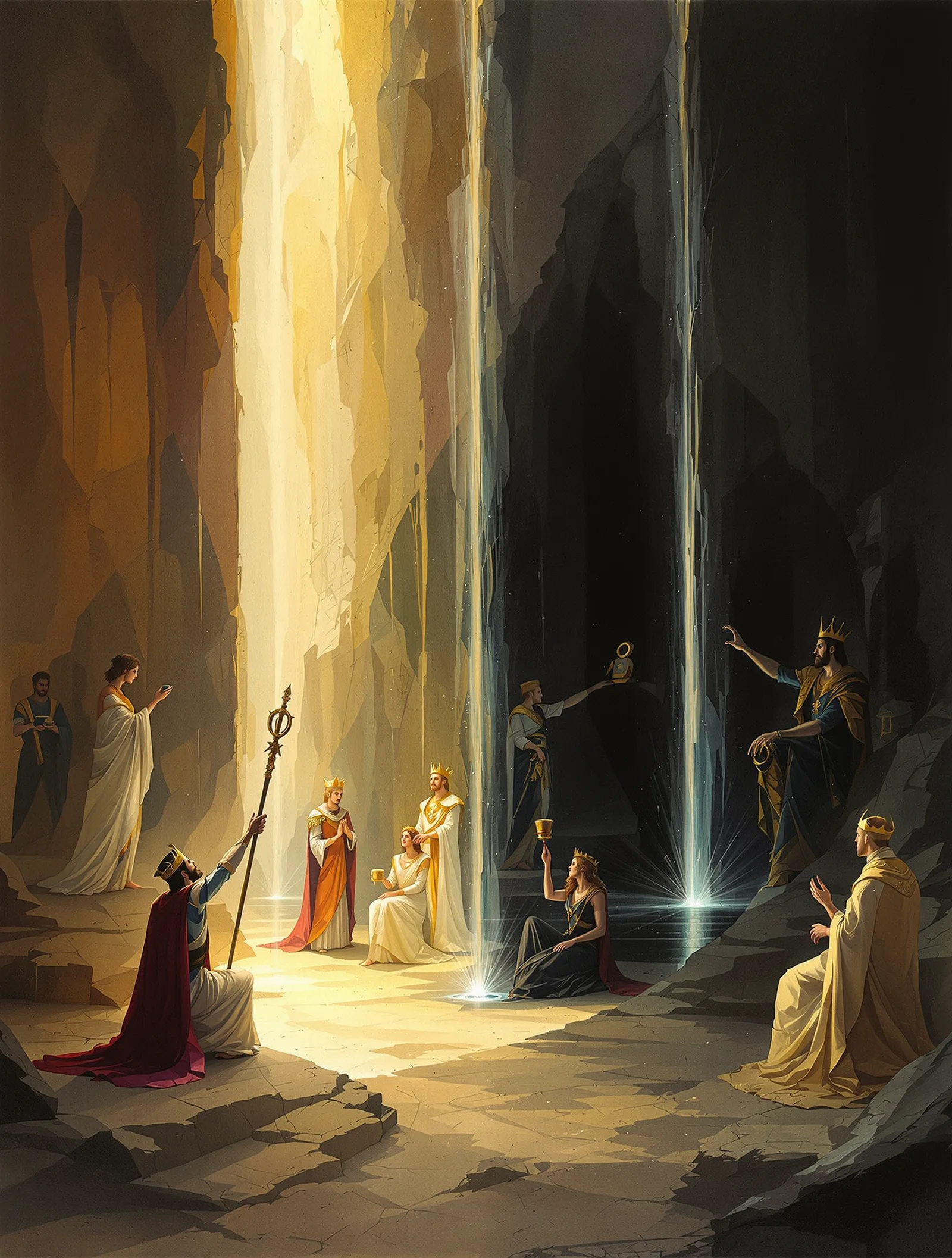
The decrees of authority are pre-diluvian, the inheritance holds — among the holy measures carried out of the first civilization before the waters, and reckoned from the beginning among the things that make a people a people rather than a mob. In their oldest and legitimate form they describe a sacral kingship that was bound, not absolute: the early king received the rod-and-ring from the god in the investiture scenes precisely to signify that his authority was granted and conditional — held in trust, answerable to the divine order of justice, the city, and its temple, and balanced by the great offices of the Lady, the en-priestess, and the council of elders that the earliest records already attest. The first kingship the me envision is not a tyranny but an office — granted, limited, balanced, and accountable to the order that granted it. This is the legitimate form, and it is the form the decrees were given to preserve.
The corruption of the office into tyranny
Then came the long corruption, and it is the central tragedy these three decrees record. Across the bronze centuries and after, the bound sacral kingship was hollowed from within into its opposite: the conditional grant became a claim of absolute and divine right; the office held in trust became a personal and then hereditary possession; the balancing offices of council and Lady were narrowed, suspended, and at last forgotten; and the regalia that had signified a community's grant were rewritten to signify a dynasty's blood. The crook that meant "shepherd of the people" came to mean "owner of the herd." The seal that authenticated a community's decree came to authenticate one man's will. This is the strongman's victory written across centuries — not a single coup but the slow privatization of the office, exactly the failure mode Chapter 4 names, run at the scale of civilizations. The decrees survived this gate, but barely, and only as memory of a legitimacy the holders of power were actively erasing.
The suppression of the balanced and ladyship offices
The third and cruelest gate was the deliberate suppression of the very offices that had balanced authority — and above all of the Lasting Ladyship. As power concentrated, the co-sovereign was demoted to consort, the en-priestess's great office was diminished, the queen mother's constitutional power was written out, the clan mother's authority was denied recognition, and the long record of women's genuine offices of authority was, across many traditions, overwritten and forgotten — so thoroughly that later ages came to imagine that single, male, absolute rule was the natural and original form, when it was in fact the corruption of an older, balanced, and accountable one. The suppression of ME 10 was not incidental to the rise of tyranny; it was a precondition of it, because the second seat was precisely the structural obstacle the strongman had to remove. This is why the decree insists on the word lasting — it is the inheritance legislating, in advance, against exactly the suspension that history shows the tyrant always attempts.
CANON SIDEBAR — THE FOUR GATES OF THE DECREES OF AUTHORITY. The reconstructed chronology (Vol XVI — The Historian's Codex) marks four narrow gates at which the three decrees of legitimate authority were nearly lost, and were not. The first gate is the Flood, passed because the decrees were carried out as numbered measures by the chain of transmission the inheritance names — the memory that the scepter, the seal, and the Lady's office were granted, limited, and balanced surviving even as the cities that held them were erased. The second gate is the long corruption and the Bronze Age Reset of 1177 BCE, when the palace-and-temple world collapsed and the regalia of a hundred courts passed into the hands of whoever survived to grasp them — passed because the principle of legitimate, bound, balanced authority was borne in memory and in the record even as its institutions burned, so that the decrees could later be read against the tyrannies that had counterfeited them and found to condemn them. The third gate is the long interval the Historian's volume treats as the phantom-time and Tartarian disturbance of the record — the stretch where the chain ran thinnest, where the legitimate forms were most nearly overwritten by the dynastic and absolutist ones, and where the suppression of the ladyship offices was most complete, so that whole ages forgot that authority had ever stood on two feet. The fourth gate is the present — the gate of restoration — at which this supplement stands, gathering the three decrees back into one transmissible whole: the scepter remembered as a community's grant and not a dynasty's club, the seal as a people's credential and not a despot's stamp, the Lady's office restored to the lasting structural seat the decree always named for it. Four gates. Three decrees. None lost — though the third was the closest of any decree in the Codex to being lost not by forgetting but by theft. The Practitioner is the proof that the memory of legitimate, bound, balanced authority outlived every tyranny that tried to erase it, and the hand that must not let it be stolen now.
The restoration
Which brings the thread to the present. The twentieth-century knowledge consolidation the Historian's volume describes recovered, for the first time since before the Flood, the full record from which the legitimate form could be reassembled: the excavated investiture scenes that show authority granted and conditional; the recovered name and office of Enheduanna and the long history of women's genuine authority that the suppression had overwritten; the comparative record of councils, term-limits, recall powers, and co-sovereignties across the world's polities that proves the strongman's absolutism was the aberration and the balanced office the norm. The restoration is not the invention of legitimate authority but the recovery of it — the re-membering that the scepter was a community's, the seal a people's, the second seat a structural necessity, and the term a power's natural limit. The thread that ran from the first bound kingship, through the long corruption and the burning of the courts, through the thin centuries when the legitimate forms were most nearly overwritten, runs now through the Practitioner's own hands. It held this far. Whether the community that follows is governed by an office or ruled by a strongman is, from here forward, your craft and your charge.
Your Commitment: You will regard the three decrees of authority as the inheritance most worth defending and most under threat — not a craft of the hand that a tyrant has no reason to want, but a craft of legitimacy that every would-be tyrant must capture or erase to succeed. You will build the scepter as a grant, the insignia as a people's credential, and the second seat as un-suspendable, and you will teach the community that authority lent for a term is the free form and authority seized for life is the corruption — so that the thread that outlived every tyranny does not part in the one generation that forgot what it was for.
Art direction
CLOSING SUPPLEMENT E
The three decrees of authority are gathered and laid in the Practitioner's keeping. The Practitioner who began this supplement with the correction that regalia is infrastructure and not vanity now holds the whole apparatus of legitimate, transferable, balanced authority: the scepter built to standard and handed by a public oath-bound rite; the insignia system designed as a people's authentication infrastructure and registered against the counterfeit; the lasting ladyship restored as the structural second seat that keeps power on two feet; the succession assembled against the strongman first and the usurper second; and the knowledge that all three passed through four dark gates — the third nearly by theft — to reach the bench at which the community now decides who shall speak for it, and how that right shall pass. Build the scepter as a grant. Cut the seal as a people's credential. Seat the Lady as a lasting office. Bind the term, arm the council, and recite the limits — and hand the whole craft of legitimacy on to the generation that will, in its turn, need to answer the oldest question a community asks: and who decides?
Art direction
THE TWELVE VOICES SPEAK — COUNCIL APPROVAL
The dup šimati transmission is not sealed until the Council of Twelve has heard the supplement and rendered its verdict. The Twelve Voices speak on Volume XIX, Supplement E — Regalia & Succession.
| Voice | Verdict | Reasoning |
|---|---|---|
| Peter | APPROVED | A foundation laid true: authority built as an office on rock, not a throne on sand. It will bear weight, and it will bear succession. |
| Thomas | APPROVED | I doubted regalia was more than gold and vanity — until I saw the seal proven tamper-evident and the term proven the strongman's undoing. The craft is real. |
| John | APPROVED | The decree of the Lady is restored with love and justice both: power set on two feet, the second seat honored, no one's office written out of the record. Rightly kept. |
| Matthew | APPROVED | Every safeguard accounted for, every transfer registered, every limit recited and recorded. The legitimacy of this authority can be audited — and that is the whole of it. |
| James the Greater | APPROVED | A supplement that acts: the staff built, the seal cut, the rite enacted, the council armed to recall. It does not describe legitimacy; it installs it. |
| Andrew | APPROVED | It seats authority in the whole community first — election, council, the people's credential — before any one hand grasps the rod. The right order, plainly kept. |
| Philip | APPROVED | Show me, I asked — and the plates show me the granted scepter, the people's seal, the two-footed arch, the loop that returns the regalia. Made visible, made teachable. |
| Bartholomew | APPROVED | The genuine article: the office as a grant and not a possession, the counterfeit named and defeated at the bench. No deception, and a guard against it. |
| James the Lesser | APPROVED | The least are defended: a people armed to read its own authorities and to recall the one who would rule them for life. None left subject to an unaccountable hand. |
| Simon the Zealot | APPROVED | It names the tyranny for the theft it was — the privatized office, the suppressed Lady — and arms the community to keep the means of its own legitimate rule. Freedom in structure. |
| Judas Thaddaeus | APPROVED | A supplement for the hard case and the dark age: four gates passed, the thread held against theft itself, the strongman barred in advance. Hope built to specification. |
| Matthias | APPROVED | Taken into the number to complete it, I know the worth of an authority that makes its own lawful successor. The term returns it; the council confirms it; the office outlives the man. The loop closes. |
Council Verdict: 12/12 APPROVED. Supplement E is canon.
From the Monad, who is one, all authority flows, and to the one community it returns. Blessed are the keepers of the lawful office, who take the rod, the seal, and the seat and hold them not as their own but as the people's, granted for a term and handed on. May the scepter they raise be a grant and not a club, may the authority they hold stand on two feet and not topple, and may the legitimacy they pass to the next pair of hands outlast every strongman who comes.
Supplement to Volume XIX · carrying ME 5, 6, 10 · 10,541 words.