Sovereignty Module: Bend the Bow
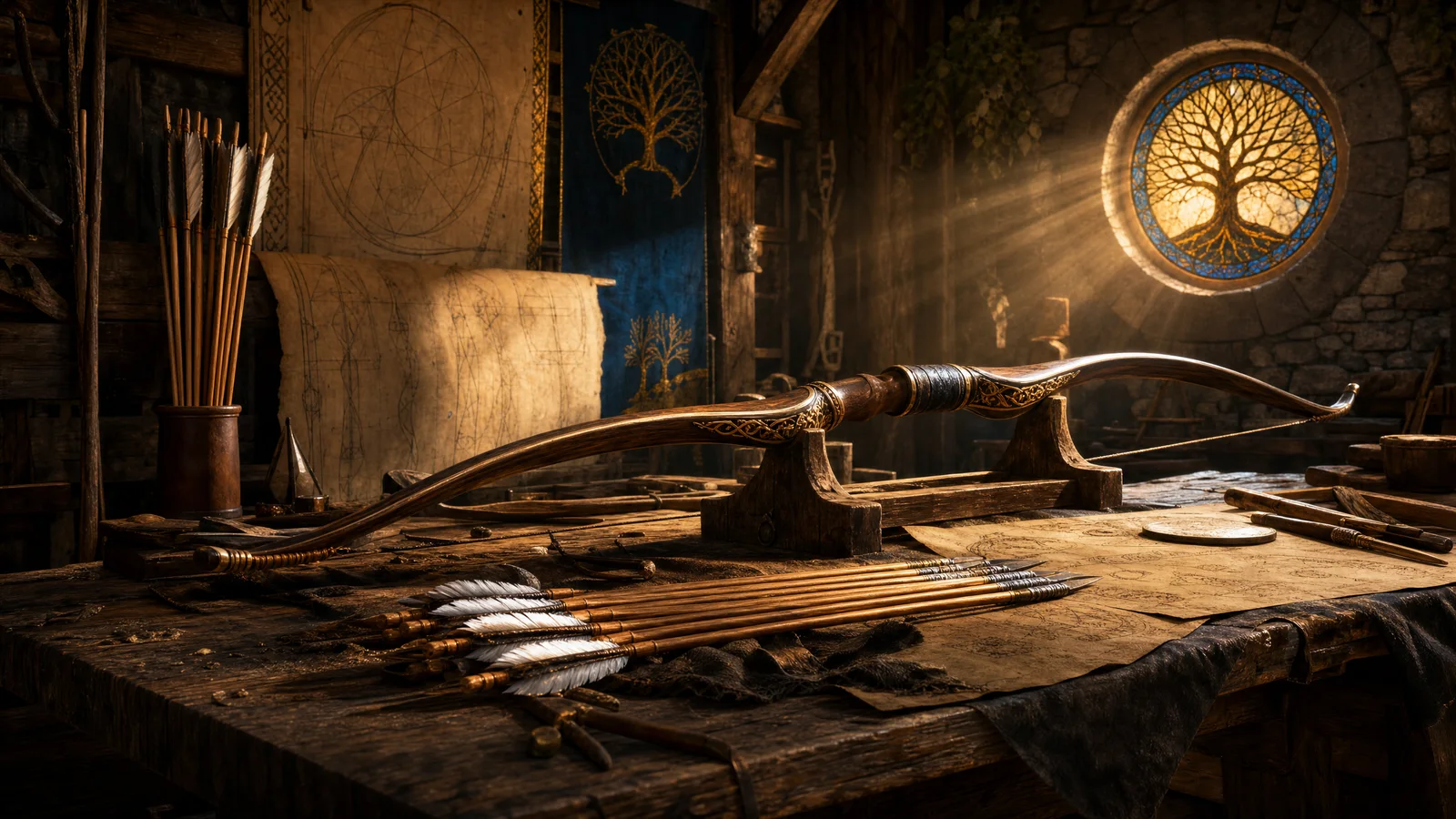
Complete Bow Making, Arrow Crafting, and Archery Guide
The Philosophy of the Bow
The bow is humanity's first machine: a device that stores energy slowly (during the draw) and releases it rapidly (at release), multiplying human power beyond what muscles alone can achieve. For 30,000+ years, the bow was the supreme weapon for hunting and warfare. It remains the most effective ranged weapon that can be built entirely from natural materials with hand tools. This campaign covers bow construction, arrow making, and the shooting technique to use them effectively.
Chapter 1: Bow Wood Selection
Best Bow Woods (ranked by performance):
| Wood | Density | Compression Strength | Tension Strength | Overall Rating | Availability |
|---|---|---|---|---|---|
| Osage orange (Maclura) | High | Excellent | Excellent | Best (the gold standard) | Central/Eastern US |
| Yew (Taxus) | Medium | Excellent (heartwood) | Excellent (sapwood) | Best (European standard) | Europe, Pacific NW |
| Black locust | High | Excellent | Very good | Excellent | Eastern US |
| Hickory | High | Good | Excellent (best tension wood) | Very good | Eastern US |
| Elm | Medium | Good | Very good | Good | Widespread |
| Ash | Medium | Good | Good | Good | Widespread |
| Oak (white) | High | Good | Moderate | Acceptable | Widespread |
| Maple (hard) | High | Good | Good | Good | Eastern US/Canada |
| Bamboo | Medium | Good | Excellent | Very good (laminate backing) | Tropical/subtropical |
| Juniper/cedar | Low-medium | Good | Moderate | Acceptable (short bows) | Western US |
Why These Properties Matter:
A bow works by bending. The back (facing the target) is stretched (tension). The belly (facing the archer) is compressed. The wood must resist both forces without breaking.
- Back (tension): needs strong, flexible fibers that stretch without breaking
- Belly (compression): needs dense wood that compresses without crushing
- Yew is ideal because its sapwood (outer) handles tension and heartwood (inner) handles compression naturally
Chapter 2: Bow Construction (Self Bow)
Stave Selection and Preparation:
- Select a straight section of trunk or branch, 6+ inches diameter, 6+ feet long
- Split the log in half (or quarters for larger logs) immediately after felling
- The back of the bow (outer ring) must be a single, unbroken growth ring
- Seal the ends with glue, wax, or paint to prevent checking (end-grain cracks)
- Season (dry slowly) for 6-12 months in a cool, dry place
- Alternatively: floor-tiller a green stave (rough shape and slowly dry while periodically checking bend)
Shaping the Bow (tillering):
| Step | Action | Tools | Notes |
|---|---|---|---|
| 1 | Rough out stave | Hatchet, drawknife | Remove bark, sapwood (except one ring on back), excess wood |
| 2 | Layout | Pencil, straightedge | Mark centerline, handle, limb width taper |
| 3 | Rough shaping | Drawknife, rasp | Reduce to approximate dimensions |
| 4 | Floor tiller | Hands, eyes | Flex bow gently, observe bend. Both limbs must bend evenly. |
| 5 | Remove wood from stiff spots | Rasp, scraper | ONLY remove wood from the belly (never the back) |
| 6 | String the bow (low brace) | Tillering string | Brace height 3-4 inches initially |
| 7 | Tiller on tree | Tillering stick, mirror | Pull to increasing draw lengths, observe limb curve |
| 8 | Final tiller | Scraper, sandpaper | Both limbs should form a smooth, even arc at full draw |
| 9 | Finish | Oil, wax, or varnish | Seal against moisture |
Critical Dimensions (for a 28-inch draw, 50-lb longbow):
| Measurement | Dimension | Notes |
|---|---|---|
| Overall length | 66-72 inches | Longer = more forgiving, less hand shock |
| Handle width | 1.25-1.5 inches | Does not bend |
| Handle depth | 1.5-2 inches | Thickest point |
| Mid-limb width | 1.25-1.5 inches | Tapers toward tips |
| Mid-limb depth | 0.6-0.75 inches | Tapers toward tips |
| Tip width | 0.5-0.6 inches | Narrow for string nock |
| Tip depth | 0.4-0.5 inches | Thin but not fragile |
| Brace height (strung) | 6-7 inches | Fistmele (fist + thumb from belly to string) |
Chapter 3: Composite and Backed Bows
Backed Bow (adding a tension layer):
If the available wood is weak in tension (oak, maple), glue a backing of strong tension material to the back:
| Backing Material | Strength | Application | Notes |
|---|---|---|---|
| Rawhide | Good | Glue strip to back with hide glue | Simplest backing; adds safety margin |
| Sinew | Excellent | Layer sinew fibers with hide glue | Dramatically increases performance |
| Bamboo | Excellent | Glue thin bamboo strip to back | Strong, available, easy to work |
| Hickory | Excellent | Glue thin hickory strip to back | Best wood backing |
| Linen/silk | Good | Glue fabric to back with hide glue | Prevents splinters, adds safety |
Composite Bow (horn + wood + sinew):
The most powerful bow design per unit length. Used by mounted warriors (Mongols, Turks, Hungarians) because short bows are needed on horseback.
Construction: Horn belly (excellent compression) + wood core + sinew back (excellent tension). Glued with hide glue. Recurved (tips bend away from archer when unstrung, storing more energy).
Performance: A 40-inch composite bow can match or exceed a 72-inch wooden longbow in power.
Chapter 4: Bowstrings
String Materials:
| Material | Strength | Stretch | Durability | Source |
|---|---|---|---|---|
| Linen (flax) | Very good | Low (fast) | Good | Flax plant (spun and plied) |
| Sinew (twisted) | Excellent | Moderate | Good | Animal tendon |
| Rawhide (twisted) | Good | Moderate | Moderate | Animal skin |
| Silk | Excellent | Very low (fastest) | Moderate | Silkworm |
| Dacron (modern) | Excellent | Low | Excellent | Purchased |
| Hemp | Good | Moderate | Good | Hemp plant |
Making a Flemish Twist String:
- Cut 12-16 strands of waxed linen thread, each 3x the bow length
- Divide into two bundles of equal strands
- Twist each bundle clockwise (Z-twist)
- Lay the two twisted bundles together and twist them counter-clockwise around each other (S-twist)
- Form a loop at each end by separating the bundles, looping back, and twisting back together
- Wax the finished string with beeswax
- Serve (wrap with thin thread) the center section where the arrow sits (nocking point)
Chapter 5: Arrow Making
Arrow Components:
| Component | Material | Function | Critical Property |
|---|---|---|---|
| Shaft | Straight-grained wood (cedar, poplar, birch, pine) | Main body | Straightness, consistent spine (stiffness) |
| Point (head) | Flint, bone, antler, metal | Penetration | Sharpness, weight (affects balance) |
| Fletching | Feathers (turkey, goose, hawk) | Stabilization (drag on rear) | Consistent size, secure attachment |
| Nock | Self (notch in shaft) or added (bone, antler, plastic) | Engages bowstring | Proper fit (not too tight, not too loose) |
Shaft Preparation:
- Select straight shoots or split billets from straight-grained wood
- Rough to round (5/16 to 3/8 inch diameter for most bows)
- Straighten: heat over coals or steam, bend straight, hold until cool
- Sand smooth and check straightness by rolling on flat surface
- Spine test: support at both ends, hang weight from center. Deflection should match bow weight.
Spine Matching (critical for accuracy):
| Bow Draw Weight | Arrow Spine (deflection in inches with 2-lb weight on 26-inch span) | Shaft Diameter |
|---|---|---|
| 30-40 lbs | 0.7-0.9 inches | 5/16 inch |
| 40-50 lbs | 0.5-0.7 inches | 5/16-11/32 inch |
| 50-60 lbs | 0.4-0.6 inches | 11/32 inch |
| 60-80 lbs | 0.3-0.5 inches | 11/32-3/8 inch |
| 80-100 lbs | 0.2-0.4 inches | 3/8 inch |
Fletching:
- Split feather down the center of the quill
- Trim to desired shape (shield, parabolic, or straight)
- Length: 4-5 inches for hunting, 2-3 inches for target
- Attach three fletchings equally spaced (120 degrees apart) with hide glue and thread binding
- One fletching (the cock feather) points away from the bow when nocked
Arrow Points:
| Type | Material | Use | Making Method |
|---|---|---|---|
| Field point (bullet) | Bone, antler, hardwood | Target practice, small game | Carve and glue to shaft |
| Broadhead | Flint, obsidian, metal | Large game, warfare | Knap or forge; hafted with sinew |
| Bodkin (narrow) | Bone, metal | Armor penetration | Forge or grind to narrow point |
| Blunt | Hardwood, rubber, bone | Small game (stuns, doesn't penetrate) | Carve wide, flat tip |
| Fish point | Bone, metal with barbs | Fishing | Barbed to prevent fish escaping |
Chapter 6: Shooting Technique
The Shot Sequence:
| Step | Action | Key Points |
|---|---|---|
| 1. Stance | Feet shoulder-width, perpendicular to target | Weight evenly distributed, relaxed |
| 2. Nock | Place arrow on string at nocking point | Cock feather away from bow |
| 3. Grip | Bow hand: relaxed, pressure on pad of thumb | Do NOT grip tightly (torques bow) |
| 4. Hook | String fingers: index above arrow, middle and ring below | First joint of fingers on string |
| 5. Set | Raise bow toward target, begin drawing | Shoulders down, back engaged |
| 6. Draw | Pull string to anchor point using back muscles | Elbow behind the arrow line |
| 7. Anchor | String hand touches same spot every time (corner of mouth, chin, cheekbone) | Consistency is everything |
| 8. Aim | Focus on target (instinctive) or use arrow point as reference (gap shooting) | Pick a small spot |
| 9. Release | Relax string fingers (do not pluck or throw) | Back tension continues through release |
| 10. Follow-through | Bow hand stays up, string hand drifts back along face | Do not drop bow arm |
Common Errors:
| Error | Symptom | Fix |
|---|---|---|
| Plucking the string | Arrows go left (right-handed) | Relax fingers; let string push them out of the way |
| Gripping the bow | Arrows scatter randomly | Open hand; let bow jump forward at release |
| Dropping bow arm | Arrows hit low | Maintain aim through follow-through |
| Inconsistent anchor | Arrows scatter vertically | Touch same spot every single shot |
| Punching the release | Arrows go right (right-handed) | Use back tension; surprise yourself with the release |
| Creeping (letting draw shorten) | Arrows hit low, weak | Maintain full draw until release |
Chapter 7: Hunting with the Bow
Effective Range:
| Target | Maximum Ethical Range | Notes |
|---|---|---|
| Deer-sized game | 20-30 yards | Must hit vital zone (heart/lungs) |
| Elk/large game | 20-25 yards | Requires heavy bow (50+ lbs) and sharp broadheads |
| Small game (rabbit, squirrel) | 15-20 yards | Blunt or small points |
| Birds (grouse, turkey) | 10-20 yards | Flu-flu arrows (large fletching, short range) |
| Fish | 5-15 yards (with refraction correction) | Aim below the fish (light bends at water surface) |
Shot Placement (deer):
The vital zone (heart and lungs) is located behind the front leg, in the lower third of the chest. A well-placed arrow through both lungs produces a quick, ethical kill. The animal typically runs 50-100 yards and expires within seconds to minutes.
Chapter 8: Bow Maintenance
| Task | Frequency | Method |
|---|---|---|
| Unstring when not in use | Always | Prevents set (permanent bend) |
| Check for cracks | Before every use | Run fingers along belly; look for lifts or chrysals |
| Wax/oil the bow | Every few months | Thin coat of linseed oil or beeswax |
| Wax the string | Weekly during use | Rub beeswax into string fibers |
| Check string for wear | Before every use | Look for fraying, especially at loops and nocking point |
| Store horizontally or hung vertically | Always | Never lean against wall (causes warp) |
| Replace string | When frayed or stretched | Before it breaks (broken string can damage bow and archer) |
Chapter 9: Crossbow Construction
The crossbow sacrifices rate of fire for ease of use and power. It can be aimed like a rifle, held at full draw indefinitely, and requires minimal training compared to a longbow.
Simple Crossbow:
| Component | Material | Construction |
|---|---|---|
| Prod (bow) | Same as any bow (shorter, heavier draw) | 24-36 inches, 100-200+ lbs draw weight |
| Stock (tiller) | Dense hardwood (oak, maple, walnut) | Carved channel for bolt, trigger mechanism |
| Trigger (nut and lever) | Metal or bone | Rotating cylinder holds string; lever releases it |
| Bolt (quarrel) | Short, heavy arrow (12-18 inches) | Heavier than arrow; shorter fletching |
Spanning (drawing) Methods:
| Method | Draw Weight Capacity | Speed |
|---|---|---|
| Hand (belt hook + body weight) | Up to 150 lbs | Moderate |
| Goat's foot lever | Up to 300 lbs | Moderate |
| Windlass (crank) | Up to 1,000+ lbs | Slow |
| Cranequin (rack and pinion) | Up to 500 lbs | Slow |
Chapter 10: Arrow and Bow Production Rates
For a community preparing for defense or sustained hunting:
| Item | Skilled Craftsman Output | Time per Unit | Notes |
|---|---|---|---|
| Self bow (longbow) | 1 per week (after seasoning) | 20-40 hours labor | Plus 6-12 months seasoning |
| Arrows (complete) | 6-12 per day | 1-2 hours each | Batch production is faster |
| Bowstrings | 2-3 per day | 2-3 hours each | Flemish twist method |
| Crossbow | 1 per 2-3 weeks | 40-80 hours labor | More complex mechanism |
| Crossbow bolts | 12-20 per day | 30-45 minutes each | Simpler than arrows |
Arrow Consumption:
- Practice: 6-12 arrows per day per archer (most recovered)
- Hunting: 1-3 arrows per hunt (some lost)
- Warfare: 20-60 arrows per engagement (most not recoverable)
- Recommended stock: 24-48 arrows per archer minimum
Reference Card
ARCHERY ESSENTIALS:
- The back of the bow (facing target) must be one unbroken growth ring (or backed)
- Only remove wood from the BELLY during tillering (never the back)
- Both limbs must bend evenly (tiller by removing wood from stiff spots)
- Arrow spine must match bow weight (too stiff or too weak = inaccuracy)
- Consistency is accuracy: same anchor, same grip, same release, every shot
- Unstring the bow when not in use (prevents permanent set)
- A sharp broadhead kills by hemorrhage; shot placement is everything
- Practice at half the distance you intend to hunt (if you can hit at 15 yards, hunt at 30)
This campaign provides the complete knowledge to build bows, craft arrows, and shoot effectively for both hunting and defense. A community with archery capability has a silent, renewable ranged weapon system that requires no ammunition supply chain, no gunpowder, and no industrial manufacturing, only wood, feathers, stone, and skill.