Sovereignty Module: Split the Bamboo
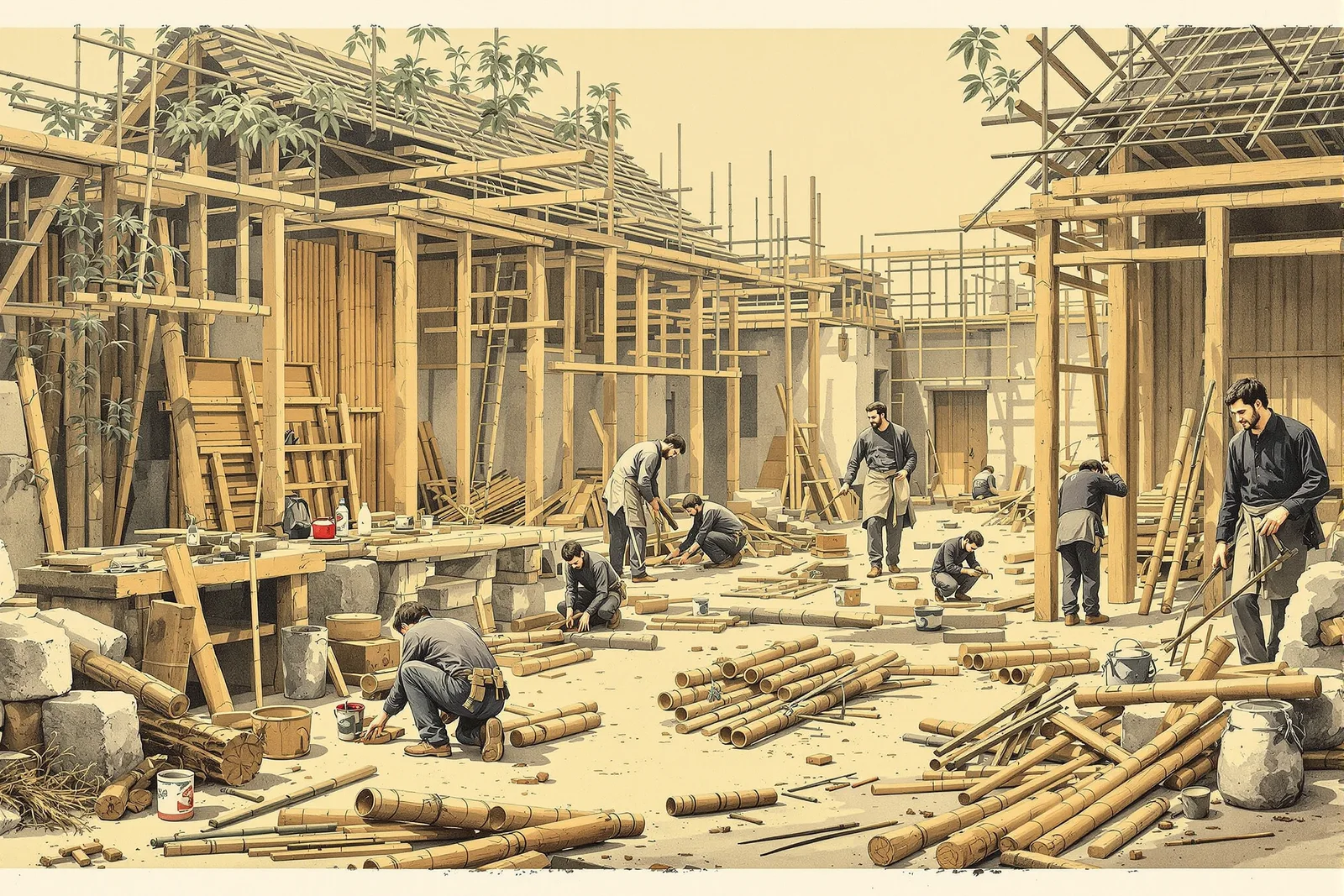
Complete Bamboo Construction, Joinery, and Craft Guide
Bamboo is the fastest-growing structural material on earth — reaching full height in 3-4 months. This campaign covers harvesting, treatment, joinery, and construction applications.
Chapter 1: Bamboo Properties
| Property | Value | Comparison | Significance |
|---|---|---|---|
| Tensile strength | 28,000 PSI | Equal to mild steel | Excellent for tension members |
| Compressive strength | 8,000-14,000 PSI | Equal to concrete | Good for columns, posts |
| Growth rate | 3-5 feet/day (some species) | 30× faster than trees | Renewable in 3-5 years |
| Density | 0.4-0.8 g/cm³ | Lighter than most hardwoods | Easy to transport and work |
| Natural durability (untreated) | 1-3 years outdoor | Poor without treatment | Must be treated for longevity |
| Treated durability | 15-25 years | Comparable to treated lumber | Borax or smoke treatment |
| Fire resistance | Moderate (thick-walled) | Better than softwood | Hollow = burns inside if ignited |
Chapter 2: Harvesting and Treatment
| Step | Action | Timing | Details |
|---|---|---|---|
| 1 | Select mature culms (3-5 years old) | Dry season | Mature = hard, dark color, lichens present |
| 2 | Cut at ground level (above first node) | Early morning (low starch) | Starch attracts insects. Low starch = longer life. |
| 3 | Vertical soak treatment (borax/boric acid) | Immediately after cutting | Stand fresh-cut culms in 5% borax solution 7-10 days |
| 4 | OR smoke treatment | After cutting | Suspend over low fire 2-4 weeks (traditional method) |
| 5 | OR heat treatment | After cutting | Torch surface until oils emerge, wipe (seals surface) |
| 6 | Dry in shade (2-4 weeks) | After treatment | Avoid direct sun (causes splitting) |
| 7 | Store horizontally on racks | Long-term | Off ground, under cover, good airflow |
Borax solution: 1 lb borax + 1 lb boric acid per 5 gallons water. Penetrates bamboo tissue, prevents insects and fungus. Non-toxic to humans. Extends life to 15-25 years.
Chapter 3: Joinery Methods
| Joint Type | Strength | Difficulty | Tools Needed | Best For |
|---|---|---|---|---|
| Lashing (rope/wire) | Moderate | Low | Rope, wire | Temporary, furniture, scaffolding |
| Through-bolt | High | Low | Drill, bolt, washer | Structural connections |
| Fish-mouth (saddle joint) | High | Moderate | Saw, rasp, sandpaper | Perpendicular connections |
| Mortise and tenon (bamboo) | Very high | High | Chisel, saw, drill | Permanent structural |
| Dowel pin (internal) | High | Moderate | Drill, hardwood dowel | Hidden connections |
| Cement fill (at joints) | Very high | Low | Cement, sand | Structural posts, foundations |
| Steel gusset plate | Very high | Moderate | Steel plate, bolts | Heavy structural, trusses |
Fish-mouth joint: Cut the end of one bamboo to fit the curve of another (like a saddle). Trace the receiving culm's curve onto the joining piece, cut with coping saw, file to fit. Lash or bolt together. Strongest traditional joint.
Chapter 4: Construction Applications
| Application | Bamboo Size | Treatment | Lifespan | Notes |
|---|---|---|---|---|
| House frame (posts/beams) | 4-6 inch diameter | Borax + cement-filled base | 20-30 years | Fill first 2 feet with cement (ground contact) |
| Roof structure (rafters/purlins) | 2-4 inch diameter | Borax or smoke | 15-25 years | Split bamboo for battens/lath |
| Scaffolding | 3-5 inch diameter | Untreated (temporary) | Months | Lashed joints, traditional in Asia |
| Water pipe | 3-4 inch diameter | Borax, sealed joints | 5-10 years | Remove internal nodes, seal with resin |
| Fencing | 2-3 inch diameter | Borax or heat | 10-15 years | Woven or post-and-rail |
| Furniture | 1-3 inch diameter | Heat treatment (aesthetic) | 20+ years (indoor) | Bent with heat, lashed or doweled |
| Reinforcement (bamboo rebar) | 1-2 inch diameter | Coated with bitumen | Life of concrete | Replaces steel rebar in concrete |
| Flooring | Split + flattened | Borax, sealed | 15-20 years | Flatten by splitting and pressing |
Chapter 5: Split Bamboo Techniques
| Product | Method | Uses |
|---|---|---|
| Strips (thin) | Split with knife, scrape smooth | Basket weaving, binding, mats |
| Slats (wide) | Split into quarters/eighths, flatten | Flooring, wall panels, fencing |
| Woven panels | Weave strips over/under | Walls, screens, mats, baskets |
| Flattened boards | Score nodes inside, split open, press flat | Flooring, table tops, doors |
| Shingles | Split into overlapping pieces | Roofing (layered like wood shingles) |
Flattening procedure: 1. Select straight culm (3-4 inch diameter). 2. Split lengthwise into 2-4 pieces. 3. Score/remove internal node membranes. 4. Soak in water 24-48 hours. 5. Press flat under weight (or hammer flat). 6. Dry under weight to prevent curling. Result: flat boards 3-6 inches wide.
Chapter 6: Bamboo Species Selection
| Species | Diameter | Wall Thickness | Climate | Best For |
|---|---|---|---|---|
| Moso (Phyllostachys edulis) | 4-6 inches | Thick | Temperate (to -5°F) | Construction, flooring, shoots |
| Guadua (Guadua angustifolia) | 4-6 inches | Very thick | Tropical | Heavy construction (strongest species) |
| Dendrocalamus asper | 5-8 inches | Thick | Tropical | Large construction, water pipes |
| Bambusa vulgaris | 3-5 inches | Moderate | Tropical | General purpose, widely available |
| Phyllostachys bambusoides | 3-5 inches | Thick | Temperate (to 0°F) | Construction, crafts |
| Tonkin cane (Pseudosasa) | 1-2 inches | Thin | Temperate | Fishing rods, plant stakes, crafts |
Reference Card
- Harvest mature bamboo (3-5 years old) in dry season, early morning. Immature = weak. Over-mature = brittle.
- Treat with borax: 1 lb borax + 1 lb boric acid per 5 gallons water. Soak 7-10 days. Extends life to 15-25 years.
- Never dry bamboo in direct sun (splits). Shade dry 2-4 weeks. Store horizontal, off ground, under cover.
- Fish-mouth joint: strongest traditional connection. Cut saddle shape to fit receiving culm. Lash or bolt.
- Fill base of structural posts with cement (first 2 feet). Prevents rot at ground contact and adds strength.
- Bamboo tensile strength equals mild steel. Use for tension members (trusses, reinforcement).
- Split bamboo: versatile material for weaving, flooring, panels. Soak before splitting for clean cuts.
- Guadua angustifolia: strongest bamboo species. Used for multi-story buildings in South America.