Sovereignty Module: Bend the Stave
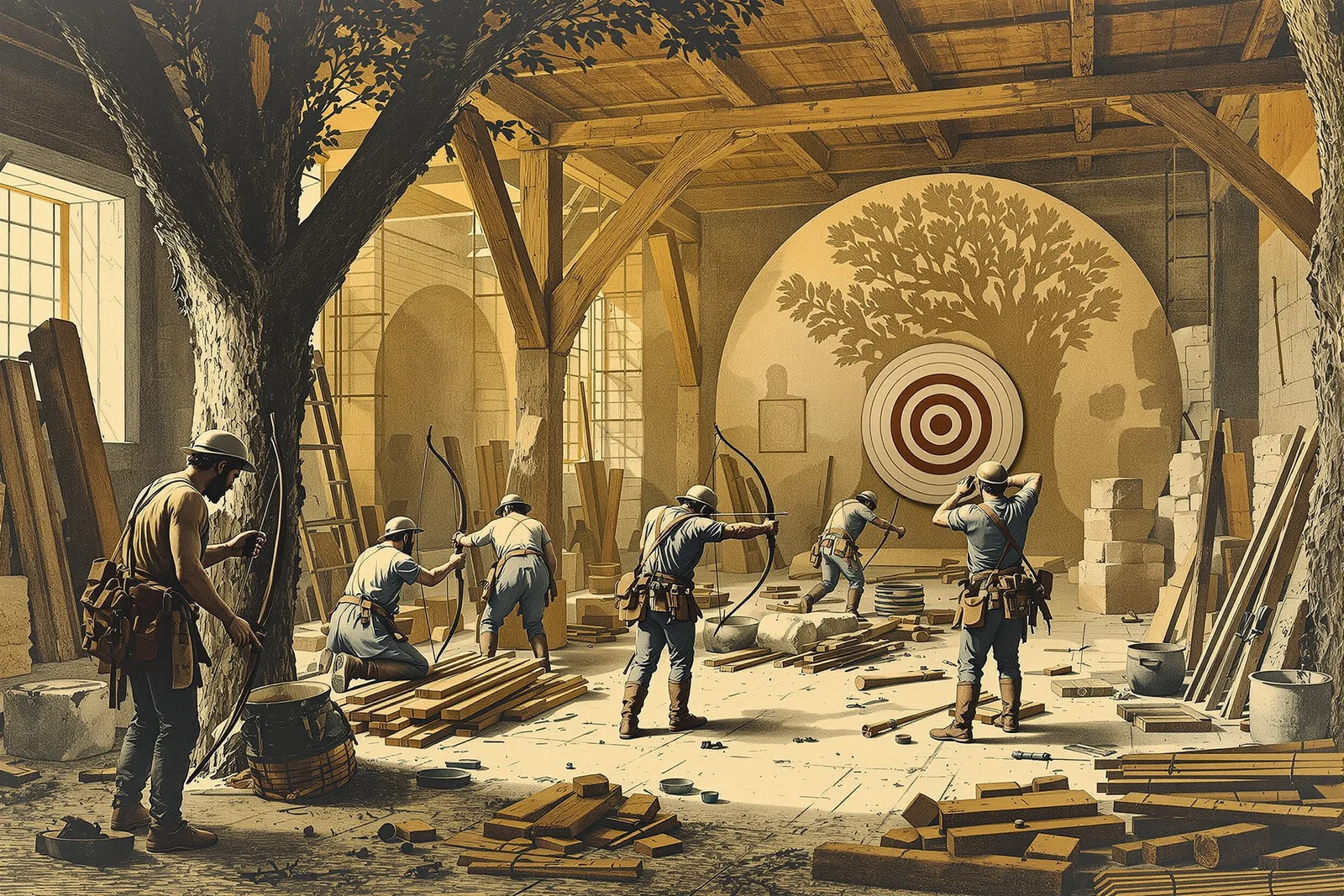
Complete Bow Making and Archery: From Tree to Target
The bow is one of humanity's most important inventions. This campaign covers wood selection, bow design, tillering, arrow making, and archery fundamentals.
Chapter 1: Bow Wood Selection
| Wood | Quality | Availability | Difficulty | Draw Weight Potential | Notes |
|---|---|---|---|---|---|
| Osage orange | Excellent | Central US | Moderate | Very high (60+ lbs) | The gold standard of bow woods |
| Yew | Excellent | Pacific NW, Europe | Moderate | Very high | Traditional English longbow wood |
| Black locust | Very good | Eastern US | Moderate | High (50+ lbs) | Dense, durable |
| Hickory | Very good | Eastern US | Low-moderate | High (50+ lbs) | Excellent backing wood, good alone |
| Elm | Good | Widespread | Low | Moderate-high | Flexible, forgiving |
| Ash | Good | Widespread | Low | Moderate | Wide-limbed bows |
| Maple (hard) | Good | Widespread | Low-moderate | Moderate | Common, reliable |
| Bamboo | Good | Warm climates | Low | Moderate-high | Excellent lamination material |
| Oak (red/white) | Fair-good | Widespread | Moderate | Moderate | Heavy, but works |
| Mulberry | Very good | Widespread | Moderate | High | Underrated bow wood |
Stave selection: 1) Select straight, knot-free section of trunk or large branch. 2) Diameter: 4-8 inches. 3) Length: 6+ feet (for longbow). 4) Split log in half (or quarters for large logs). 5) The back of the bow (facing target) must be a single growth ring. 6) Seal ends with glue or wax (prevents checking/cracking). 7) Season: air dry 6-12 months (or longer). 8) Faster with debarked stave in covered, ventilated area. 9) Green wood can be used in emergency but will need re-tillering as it dries.
Chapter 2: Bow Design
| Bow Type | Length | Draw Weight | Difficulty | Materials | Best For |
|---|---|---|---|---|---|
| Flat bow | 64-72 inches | 30-60 lbs | Low-moderate | Single stave | Beginners, hunting |
| Longbow (English) | 66-72 inches | 40-80+ lbs | Moderate | Yew, ash, elm | Hunting, war |
| Self bow (any design) | 60-72 inches | 30-60 lbs | Low-moderate | Any bow wood | General purpose |
| Backed bow | 60-72 inches | 40-70 lbs | Moderate-high | Stave + backing (rawhide, sinew, bamboo) | Higher performance |
| Recurve (primitive) | 54-64 inches | 30-60 lbs | High | Laminated or heat-bent | Compact, higher speed |
| Horse bow (composite) | 48-56 inches | 30-60 lbs | Very high | Horn, wood, sinew | Mounted archery |
Flat bow dimensions (beginner): 1) Length: 66-68 inches (nock to nock). 2) Handle: 4-6 inches long, 1.5 inches wide, full thickness. 3) Fade: 2 inches each side (transition from handle to limb). 4) Limbs: taper from 1.5 inches wide at fade to 0.5 inches at tip. 5) Thickness: taper from 3/4 inch at fade to 3/8 inch at tip. 6) Cross section: flat (rectangular), slight crown on back. 7) Tips: narrow for string nocks. 8) Draw length: your arm span ÷ 2.5 (approximately). 9) Target draw weight for hunting: 40-50 lbs minimum.
Chapter 3: Tillering
| Stage | Action | Tool | Goal |
|---|---|---|---|
| Rough shaping | Remove wood to approximate dimensions | Hatchet, drawknife | Bow-shaped stave |
| Floor tiller | Flex bow on floor, check bend | Drawknife, rasp | Even bend both limbs |
| Long string tiller | String with long string, pull gently | Scraper, rasp | Identify stiff spots |
| Brace height tiller | String at 5-6 inches, pull on tiller tree | Scraper, sandpaper | Even arc, correct weight |
| Final tiller | Pull to full draw on tiller tree | Scraper, sandpaper | Target draw weight, even tiller |
| Exercise | Pull 100+ times | Hands | Settle the bow, check for problems |
Tillering process: 1) Mount bow horizontally on tiller tree (or use long stick with notches). 2) Pull string to increasing distances (start at 10 inches). 3) Step back and observe the bend of both limbs. 4) Both limbs should bend evenly (mirror image). 5) Stiff spots: remove wood from the BELLY (facing you) of the stiff area. 6) Weak spots: do NOT remove wood (leave them alone; remove from stiff areas). 7) NEVER remove wood from the back (facing target). 8) Increase draw distance gradually (2 inches at a time). 9) Check tiller at each increment. 10) Continue until reaching full draw length at target weight. 11) This is the most critical and time-consuming step (patience prevents broken bows).
Chapter 4: Arrow Making
| Component | Material | Function | Sizing |
|---|---|---|---|
| Shaft | Wood (cedar, pine, poplar, bamboo) | Arrow body | Spine must match bow weight |
| Point (head) | Stone, bone, metal, field point | Penetration | Weight affects flight |
| Fletching | Feathers (turkey, goose) | Stabilize flight | 3 feathers, 4-5 inches long |
| Nock | Self-nock (notch in shaft) or plastic | Holds arrow on string | Must fit string snugly |
Arrow shaft preparation: 1) Select straight-grained wood (cedar is ideal). 2) Split or saw into 3/8 inch square blanks. 3) Round with plane, sandpaper, or dowel plate. 4) Final diameter: 5/16 to 3/8 inch (match to bow weight). 5) Length: draw length + 1-2 inches (safety margin). 6) Straighten: heat over flame or steam, bend straight, hold until cool. 7) Spine test: support shaft at both ends, hang weight from center, measure deflection. 8) All arrows in a set should have matching spine (consistent flight).
Fletching: 1) Use feathers from same wing (all left or all right). 2) Split feather down center of quill. 3) Trim to 4-5 inches long, 1/2 inch high (parabolic or shield cut). 4) Attach 3 feathers equally spaced (120 degrees apart). 5) One feather perpendicular to nock (cock feather, faces away from bow). 6) Attach with sinew wrapping and hide glue (or modern glue). 7) Feathers create spin (stabilizes arrow like rifling stabilizes bullet). 8) Natural feathers are self-correcting in flight (forgiving of release errors).
Chapter 5: Archery Fundamentals
| Element | Correct Form | Common Error | Fix |
|---|---|---|---|
| Stance | Perpendicular to target, feet shoulder-width | Facing target | Turn sideways |
| Grip | Relaxed, pressure on thumb pad | Death grip (torques bow) | Open fingers after release |
| Draw | Pull to anchor point with back muscles | Arm muscles only | Squeeze shoulder blades |
| Anchor | Consistent point (corner of mouth, chin) | Inconsistent anchor | Practice same point every time |
| Aim | Gap shooting or instinctive | Overthinking | Pick a spot, trust your practice |
| Release | Relax fingers, let string push them open | Plucking (pulling fingers away) | Focus on relaxing, not releasing |
| Follow-through | Hold position until arrow hits | Dropping bow arm | Keep aiming after release |
Reference Card
- The back is sacred (never cut into the back of the bow; the back is a single growth ring that handles tension; cutting it causes breakage). 2. Tiller slowly (remove small amounts of wood, check often; you can always remove more but never add back). 3. Stiff limbs get thinned (if one spot doesn't bend, thin the belly there; never thin a weak spot). 4. Spine must match bow (arrow stiffness must match bow draw weight; mismatched spine = erratic flight). 5. Consistent anchor wins (accuracy comes from doing exactly the same thing every time; anchor point is the foundation). 6. Season your stave (green wood makes weak bows; air dry 6-12 months minimum for best performance). 7. Feathers from the same wing (mixing left and right wing feathers causes erratic spin; use all from one side). 8. The bow is in the wood (your job is to find the bow that the wood wants to be; work with the grain, not against it).