Sovereignty Module: Hammer the Iron
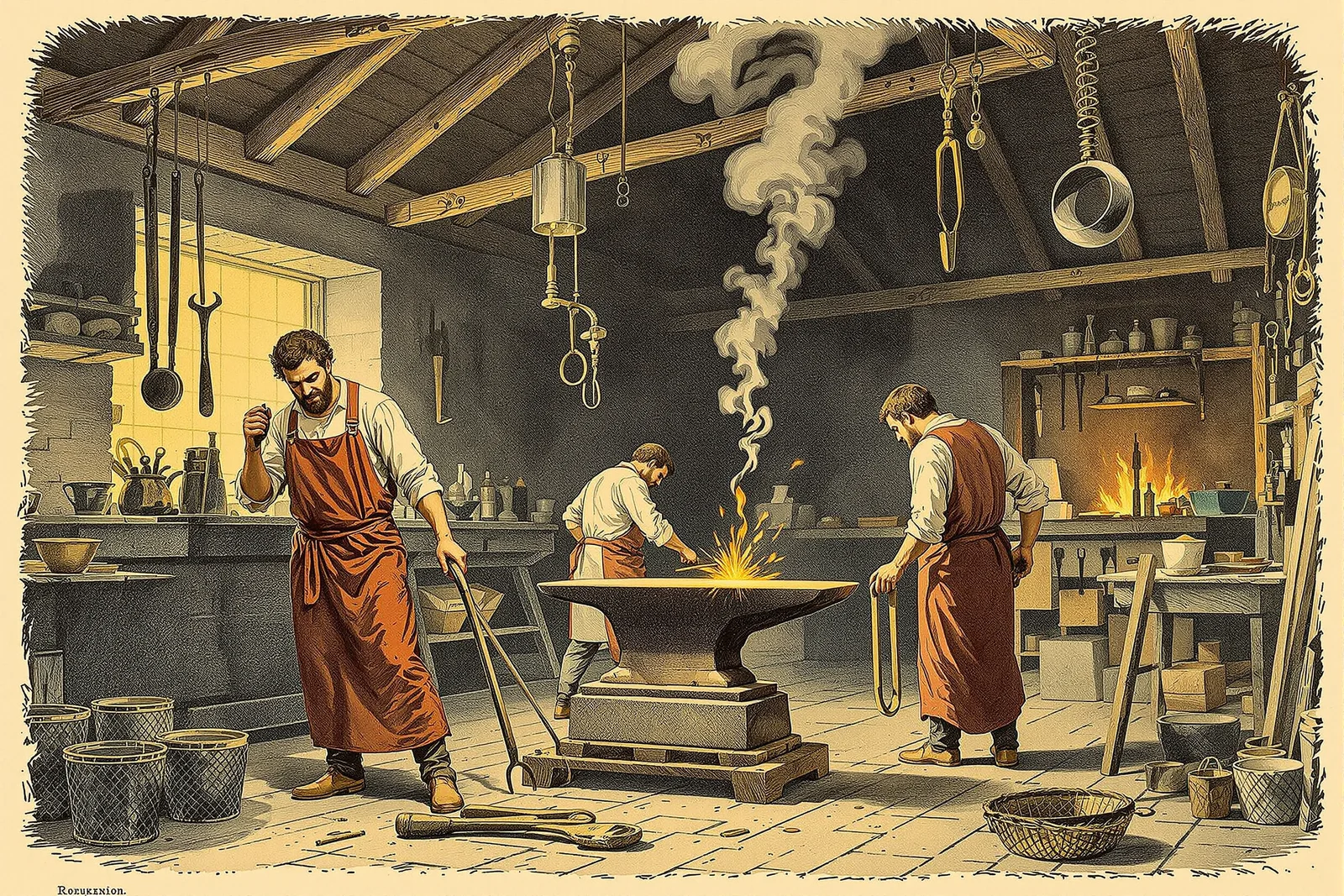
Hammer the Iron
Complete Blacksmithing Tools, Techniques, and Project Guide
Complete Blacksmithing Tools, Techniques, and Project Guide
The blacksmith transforms raw iron into every tool civilization requires: axes, plows, nails, hinges, knives, chains, horseshoes, and weapons. This campaign covers forge setup, essential techniques, and critical projects.
Chapter 1: Forge Setup Requirements
| Component | Function | Options | Minimum Spec |
|---|---|---|---|
| Forge (fire pot) | Contains and concentrates heat | Brake drum, firepot, stone hearth | 8-12 inch fire pot, 2-4 inch deep |
| Air supply (bellows/blower) | Forces air into fire (increases temp) | Hand bellows, electric blower, hand crank | Must deliver 200+ CFM |
| Fuel | Burns to heat iron | Charcoal (best for beginners), coal, coke | Charcoal: hardwood lump only |
| Anvil | Solid surface for hammering | Railroad track, large steel block, actual anvil | 50+ lbs minimum, flat face |
| Hammer (cross-peen) | Primary forming tool | 2-3 lb cross-peen | Properly fitted handle |
| Tongs | Hold hot metal | Various jaw shapes for different stock | Flat-jaw and wolf-jaw minimum |
| Vise (post/leg vise) | Holds work for filing, bending | Blacksmith leg vise (absorbs hammer blows) | 4+ inch jaws |
| Quench tank | Cools/hardens metal | Metal bucket or trough | Large enough for longest piece |
| Wire brush | Cleans scale from hot metal | Stiff steel wire brush | Keep at anvil |
| Slack tub | Water for cooling tools/hands | Barrel or bucket | Always full, always nearby |
Chapter 2: Heat Colors and Temperatures
| Color | Temperature (F) | What You Can Do | Steel Behavior |
|---|---|---|---|
| Black heat (no glow) | Below 900F | Nothing (too cold to work) | Will crack if hammered |
| Faint red (barely visible in dark) | 900-1,000F | Light bending only | Minimal plasticity |
| Dark red | 1,100-1,200F | Bending, light forging | Becoming workable |
| Cherry red | 1,400-1,500F | General forging, drawing out | Good working heat |
| Bright cherry | 1,500-1,600F | Heavy forging, upsetting | Excellent working heat |
| Orange | 1,700-1,800F | Forge welding (wrought iron) | Very plastic |
| Light orange/yellow | 1,900-2,100F | Forge welding (mild steel) | Maximum plasticity |
| White/sparkling | 2,200F+ | BURNING (ruining metal) | Grain destruction, unusable |
RULE: Work at cherry red to orange. Below cherry = cracking risk. Above light yellow = burning. Forge welding requires orange-yellow with flux (borax).
Chapter 3: Essential Techniques
| Technique | Purpose | Method | Heat Required |
|---|---|---|---|
| Drawing out | Make metal longer/thinner | Hammer on far edge of anvil, rotate 90° between blows | Cherry-orange |
| Upsetting | Make metal shorter/thicker | Heat end, hammer on end (like driving a nail backward) | Bright cherry |
| Bending | Create angles/curves | Hammer over anvil edge or in hardy hole | Cherry |
| Punching | Create holes | Drive punch halfway, flip, drive from other side | Cherry-orange |
| Drifting | Enlarge/shape holes | Drive tapered drift through punched hole | Cherry |
| Splitting | Divide metal | Hot chisel (hardy) driven partway through | Cherry |
| Forge welding | Join two pieces permanently | Heat both to orange-yellow, flux (borax), hammer together | Orange-yellow |
| Scrolling | Decorative curves | Hammer tip over anvil horn, working back gradually | Cherry |
| Fullering | Create grooves/necks | Fuller tool (rounded edge) driven into hot metal | Cherry-orange |
| Swaging | Shape round/octagonal | Swage block or top/bottom swage tools | Cherry |
Chapter 4: Heat Treatment (Hardening and Tempering)
| Step | Action | Temperature | Medium | Result |
|---|---|---|---|---|
| 1. Normalize | Heat to cherry, air cool | 1,500F → air | Air | Relieves stress, refines grain |
| 2. Harden | Heat to cherry, quench rapidly | 1,475F → quench | Oil (safer) or water (harder) | Glass-hard but brittle |
| 3. Temper | Reheat to specific color, quench | 375-600F | Air or oil | Reduces brittleness, retains hardness |
Tempering colors (after polishing hardened steel):
| Color | Temperature | Hardness | Best For |
|---|---|---|---|
| Pale straw | 375-400F | Very hard | Razors, engraving tools, scrapers |
| Straw/gold | 420-450F | Hard | Knives, chisels, axes |
| Bronze/brown | 470-500F | Medium-hard | Scissors, cold chisels, punches |
| Purple | 520-550F | Medium | Springs, swords, saw blades |
| Blue | 560-600F | Tough (less hard) | Springs, screwdrivers |
Chapter 5: Essential First Projects
| Project | Difficulty | Techniques Used | Time | Stock |
|---|---|---|---|---|
| S-hook | Beginner | Drawing, scrolling, bending | 15-30 min | 1/4" round, 8" long |
| Nail | Beginner | Drawing, heading | 5-10 min | 1/4" square, 4" long |
| J-hook | Beginner | Drawing, bending, scrolling | 15-20 min | 3/8" round, 10" long |
| Bottle opener | Beginner | Punching, bending, scrolling | 30-45 min | 1/4" × 1" flat, 8" long |
| Knife (simple) | Intermediate | Drawing, beveling, heat treat | 2-4 hours | 1/4" × 1.5" flat, 8" long |
| Tongs | Intermediate | Drawing, bending, riveting | 2-4 hours | 3/8" round, 18" long (×2) |
| Axe/hatchet | Advanced | Drawing, punching, drifting, welding, heat treat | 4-8 hours | 1" × 2" flat, 6" long |
| Chain link | Intermediate | Bending, forge welding | 20-30 min/link | 3/8" round, 8" per link |
Chapter 6: Fuel Comparison
| Fuel | Temperature Achievable | Forge Welding? | Availability | Clinker/Ash | Cost |
|---|---|---|---|---|---|
| Hardwood charcoal | 2,400F+ (with blast) | Yes | Make yourself (see Charcoal campaign) | Very little ash | Free (if self-made) |
| Bituminous coal | 2,800F+ | Yes (easily) | Coal mines, suppliers | Heavy clinker | Moderate |
| Coke (processed coal) | 3,000F+ | Yes (best) | Industrial supply | Minimal | Moderate-high |
| Anthracite coal | 2,600F+ | Difficult (hard to light) | Coal regions | Little | Moderate |
| Propane (gas forge) | 2,350F | Barely (with flux) | Hardware stores | None | Moderate |
| Wood (raw) | 1,800F max | No | Everywhere | Heavy ash | Free |
Charcoal is the traditional blacksmith fuel: clean, hot enough for all work including forge welding, produces no sulfur (which ruins welds), and can be made from any hardwood. See Campaign on Charcoal Production.
Reference Card
- Work at cherry red (1,400-1,500F): below = cracking, above yellow = burning metal.
- Forge welding: both pieces to orange-yellow + borax flux + fast, firm hammer blows. Clean surfaces essential.
- Quench in oil for most tools (safer, less cracking). Water quench = harder but more brittle.
- Temper after hardening: polish, heat slowly, quench at straw/gold color (420-450F) for knives/axes.
- Anvil: railroad track works. Mount solidly at knuckle height. Face must be flat and hard.
- Charcoal fuel: make your own from hardwood. Clean, hot, no sulfur. Best beginner fuel.
- Tongs must fit the work: loose tongs = dropped hot metal = burns. Make tongs for each stock size.
- Let the hammer do the work: grip loosely, swing from shoulder for heavy blows, wrist for control.
TransmissionCOMPLETE — unaltered & unabridged
Words1,251 — every one of them
SHA-256 of source text700b6c4cacd00e7502523da85e02c1cee7865eea035d392e6223caf14191bc97
Canonical textdownload campaign-blacksmith-tools.md — byte-identical to what this page renders