Sovereignty Module: Shape the Stone
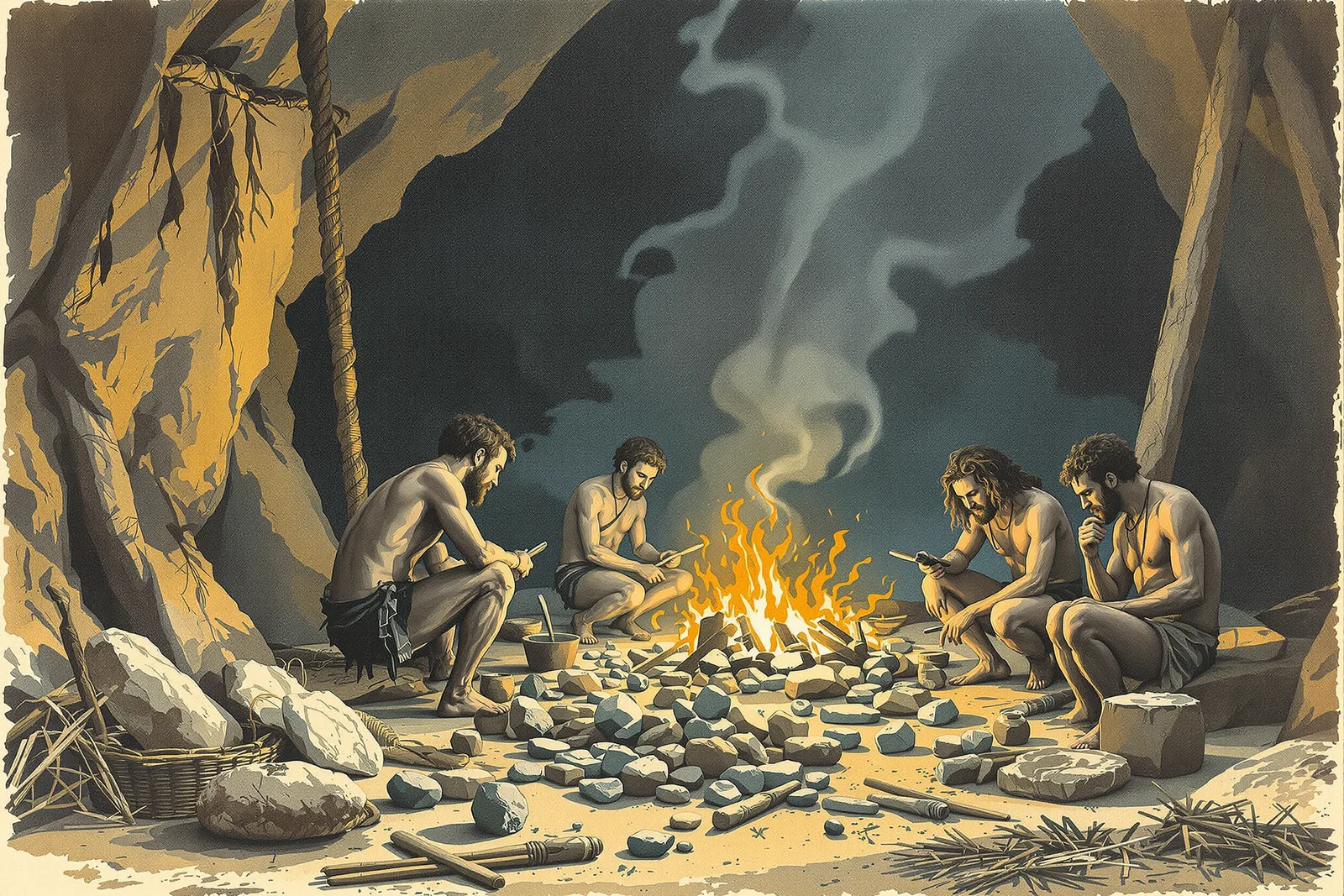
Complete Flintknapping, Stone Tool Production, and Lithic Technology Guide
Stone tools sustained humanity for 3.3 million years. Knapped stone is sharper than surgical steel, available everywhere, and requires no metal or fire. This campaign covers every technique from basic flake tools to precision arrowheads.
Chapter 1: Knappable Stone Types
| Stone | Conchoidal Fracture | Hardness | Availability | Edge Quality | Color |
|---|---|---|---|---|---|
| Obsidian | Excellent | 5-5.5 | Volcanic regions | Surgical (sharper than steel) | Black, mahogany |
| Flint/chert | Excellent | 6.5-7 | Limestone regions, riverbeds | Excellent | Gray, brown, tan |
| Jasper | Good | 6.5-7 | Widespread | Good | Red, yellow, green |
| Chalcedony/agate | Excellent | 6.5-7 | Riverbeds, desert | Excellent | Translucent, banded |
| Quartzite | Fair | 7 | Very common | Good (coarser) | White, gray, pink |
| Basalt | Fair | 5-6 | Volcanic regions | Moderate | Dark gray, black |
| Plate glass (practice) | Excellent | 5.5 | Everywhere (modern) | Good | Clear, green |
| Porcelain (practice) | Good | 6-7 | Toilets, sinks | Good | White |
Key property: Conchoidal fracture — stone breaks in smooth, curved surfaces (like glass) rather than along grain. This allows controlled shaping. Test: strike stone with hammer — if it breaks with smooth, shell-like surface, it's knappable.
Chapter 2: Tools Required
| Tool | Material | Function | When Used |
|---|---|---|---|
| Hammerstone (hard hammer) | Round river cobble (quartzite, granite) | Initial shaping, platform creation | Rough shaping, decortication |
| Billet (soft hammer) | Antler tine, copper rod, dense hardwood | Controlled flake removal | Thinning, shaping |
| Pressure flaker | Antler tip, copper nail in handle, bone | Precision edge work | Final shaping, notching |
| Abrader | Sandstone, rough granite | Platform preparation (strengthening) | Before every flake removal |
| Leather pad | Thick leather (palm-sized) | Protects hand holding workpiece | Always |
| Knee pad | Thick leather over thigh | Supports workpiece during pressure flaking | Pressure flaking stage |
Chapter 3: Basic Flake Tool (Simplest Stone Tool)
| Step | Action | Details |
|---|---|---|
| 1 | Select core: fist-sized nodule of knappable stone | Look for smooth, fine-grained, no cracks |
| 2 | Identify platform: flat area at edge (less than 90° angle) | Angle between platform and face must be acute |
| 3 | Strike platform with hammerstone (sharp, decisive blow) | Strike INTO the mass, not at the edge |
| 4 | Flake detaches with sharp edge | Usable immediately as cutting tool |
| 5 | Repeat: rotate core, find new platforms, remove more flakes | Each flake is a tool |
A single flake tool cuts meat, scrapes hide, shaves wood, and processes plant fiber. Sharper than any metal knife when fresh. This is the tool that built human civilization for 3 million years.
Chapter 4: Biface (Hand Axe) Production
| Stage | Tool | Action | Result |
|---|---|---|---|
| 1. Decortication | Hammerstone | Remove outer weathered layer (cortex) | Exposes fresh stone |
| 2. Primary shaping | Hammerstone | Rough oval shape, remove large flakes | Thick biface blank |
| 3. Secondary shaping | Billet (antler) | Thin the piece, refine edges | Thinner, more symmetrical |
| 4. Platform preparation | Abrader | Grind small platform before each flake | Prevents platform collapse |
| 5. Thinning | Billet | Remove long, thin flakes across face | Thin cross-section |
| 6. Edge refinement | Pressure flaker | Small, controlled flakes along edge | Sharp, even edge |
Biface: The Swiss Army knife of prehistory. Cuts, chops, scrapes, digs, and butchers. A well-made biface lasts weeks of heavy use and can be resharpened repeatedly.
Chapter 5: Arrowhead (Projectile Point) Production
| Step | Action | Tool | Details |
|---|---|---|---|
| 1 | Select thin flake or small biface blank | - | 2-3 inches long, relatively thin |
| 2 | Shape outline: triangular or leaf-shaped | Billet | Remove flakes to create basic shape |
| 3 | Thin (most critical step) | Billet + abrader | Must be thin enough (1/4 inch or less) |
| 4 | Refine edges | Pressure flaker | Even, sharp edges all around |
| 5 | Create notches (for hafting) | Pressure flaker (fine tip) | Small notches at base for cord attachment |
| 6 | Sharpen tip | Pressure flaker | Needle-sharp point |
Notching: The most difficult step. Use finest pressure flaker tip. Support point on leather pad. Apply pressure into the edge at notch location. Remove tiny flakes alternating sides. Notches allow secure lashing to arrow shaft.
Chapter 6: Edge Sharpness Comparison
| Edge Type | Sharpness (angstroms) | Durability | Best For |
|---|---|---|---|
| Obsidian (fresh knapped) | 30 angstroms (3 nanometers) | Very low (brittle) | Surgery, fine cutting |
| Surgical steel scalpel | 300-500 angstroms | High | Surgery |
| Flint/chert (fresh) | 50-100 angstroms | Moderate | General cutting, butchering |
| Razor blade (steel) | 1,000 angstroms | Moderate | Shaving |
| Kitchen knife (steel) | 2,000-5,000 angstroms | High | Food preparation |
Obsidian is 10x sharper than a surgical scalpel. Some modern surgeons use obsidian blades for procedures where minimal scarring is critical. A freshly knapped obsidian flake is the sharpest edge achievable by any material.
Reference Card
- Test stone: strike with hammer. Smooth, curved break (conchoidal fracture) = knappable.
- Platform angle must be less than 90°: strike INTO the mass, not at the edge.
- Abrading platforms before striking prevents crushing and gives clean flake removal.
- Soft hammer (antler billet): longer, thinner flakes than hard hammer. Essential for thinning.
- Pressure flaking: push (don't strike) with antler/copper tip for precision edge work.
- Obsidian: sharper than surgical steel (30 angstroms vs 300+). Available in volcanic regions.
- A single flake is a complete tool: cuts meat, scrapes hide, shaves wood. No further work needed.
- Safety: wear eye protection. Stone chips are razor-sharp. Work on leather pad. Never knap barefoot.