Sovereignty Module: Master the Fire
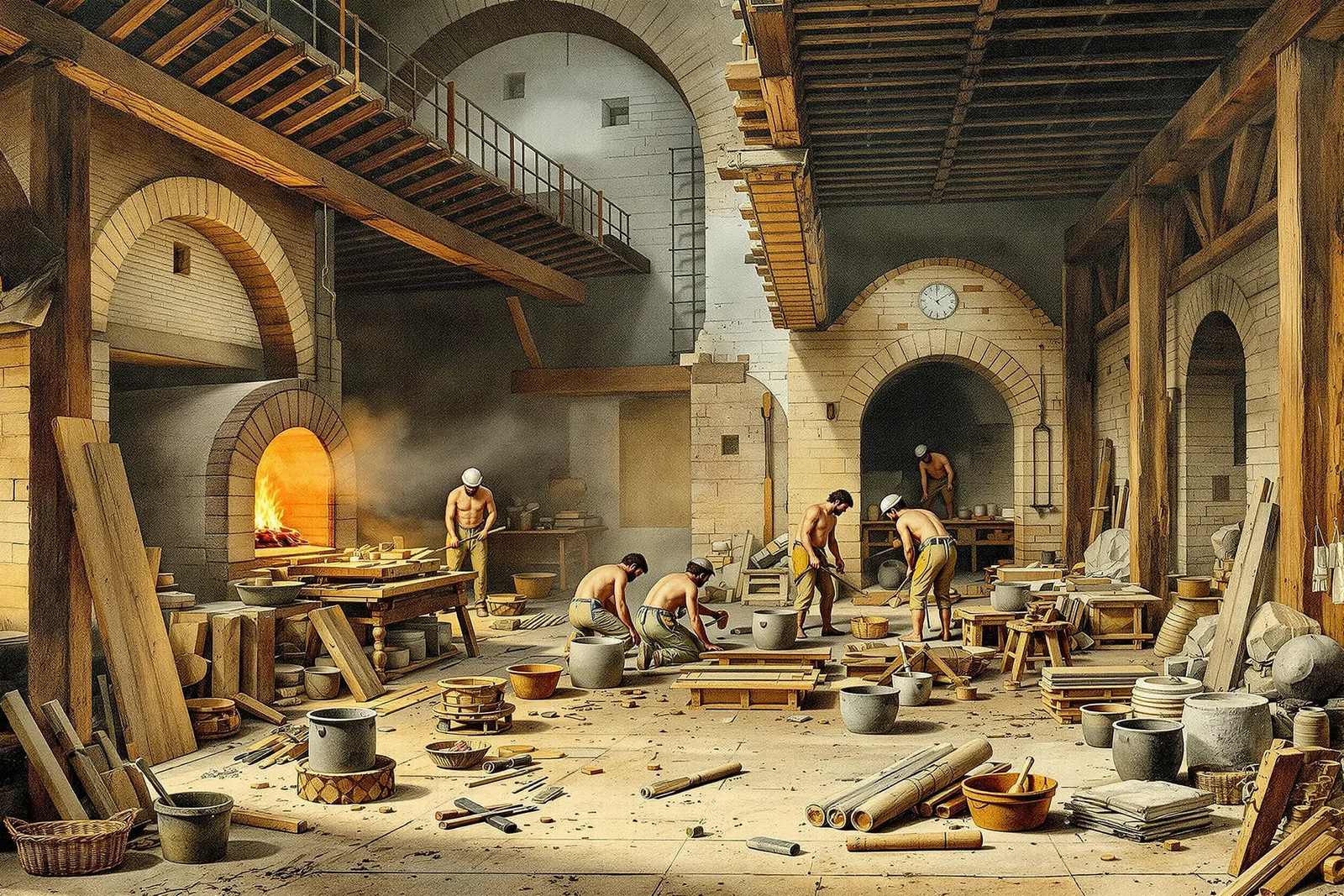
Complete Earthen Oven, Kiln, and Furnace Construction Guide
Controlled fire transforms raw materials into civilization: clay into pottery, ore into metal, grain into bread, lime into mortar. This campaign covers construction of every thermal structure from simple bread ovens to metal-smelting furnaces.
Chapter 1: Thermal Structures Compared
| Structure | Temperature Range | Primary Use | Build Time | Materials | Fuel |
|---|---|---|---|---|---|
| Earth oven (pit) | 300-500F | Slow cooking, smoking | 2-4 hours | Hole + rocks + earth | Wood, coals |
| Cob oven (beehive) | 500-900F | Bread, pizza, roasting | 1-3 days | Clay, sand, straw, firebrick | Wood |
| Rocket stove | 1,000-1,200F | Efficient cooking, heating | 2-4 hours | Brick, cob, or metal | Small sticks |
| Pottery kiln (updraft) | 1,800-2,200F | Firing pottery, ceramics | 2-5 days | Firebrick, clay, stone | Wood (large quantity) |
| Charcoal kiln (mound) | 500-700F (oxygen-starved) | Charcoal production | 1-2 days | Earth, logs | Self (wood being converted) |
| Lime kiln | 1,650-2,000F | Burning limestone to quickite | 3-7 days | Stone, firebrick | Wood or charcoal |
| Bloomery furnace | 2,200-2,500F | Iron smelting from ore | 1-3 days | Clay, stone, bellows | Charcoal |
| Blast furnace (small) | 2,800-3,000F | Cast iron production | 1-2 weeks | Stone, firebrick, bellows | Charcoal |
Chapter 2: Cob Bread Oven (Beehive Oven)
| Step | Action | Time | Details |
|---|---|---|---|
| 1 | Build foundation: stone or brick platform, 4 feet square, 2-3 feet high | 1 day | Level, solid, fireproof. Waist height for comfort. |
| 2 | Lay oven floor: firebrick or flat stones (tight-fitted) | 2-4 hours | Thermal mass stores heat for baking |
| 3 | Build sand dome (temporary form): wet sand in dome shape | 1-2 hours | 24-30 inch interior diameter, 16 inch height |
| 4 | Cover with newspaper (separation layer) | 15 minutes | Allows sand removal later |
| 5 | Apply thermal layer: 3-4 inches of cob (clay + sand, 1:3 ratio) | 2-4 hours | Dense, heavy — stores heat |
| 6 | Let dry 2-3 days, then remove sand through door opening | 2-3 days | Hollow dome remains |
| 7 | Apply insulation layer: 3-4 inches of clay + straw (light mix) | 2-4 hours | Keeps heat inside |
| 8 | Cut door opening: 63% of interior dome height | 30 minutes | Correct ratio for proper draft |
| 9 | Build chimney (optional): small flue above door | 1-2 hours | Improves draft, reduces smoke |
| 10 | Cure: series of small fires over 1 week (increasing size) | 1 week | Prevents cracking from thermal shock |
Oven use: Build fire inside for 2-3 hours. Rake out coals. Floor temperature: 700-800F (bread), 600F (roasts), 400F (slow cooking). Retained heat bakes for 4-8 hours after fire removal. One firing = multiple batches.
Chapter 3: Rocket Stove (Most Efficient Cooking)
| Component | Material | Dimension | Function |
|---|---|---|---|
| Feed tube (fuel inlet) | Brick, cob, or metal pipe | 4-6 inch square/diameter | Where sticks are inserted |
| Burn tunnel (horizontal) | Same | 4-6 inch, 8-12 inches long | Primary combustion |
| Heat riser (vertical chimney) | Insulated (perlite, vermiculite, ash) | 4-6 inch diameter, 24-36 inches tall | Creates powerful draft, secondary combustion |
| Cooking surface | Metal plate or pot support | At top of heat riser | Where pot sits |
| Insulation | Perlite, vermiculite, wood ash, pumice | Surrounds heat riser | Keeps heat riser hot (drives draft) |
Rocket stove efficiency: Burns 60-70% less wood than open fire. Produces almost no smoke (complete combustion). Reaches cooking temperature in 5-10 minutes. Fuel: sticks and twigs (no need to split large logs). The most important appropriate technology for developing world cooking.
Chapter 4: Pottery Kiln (Updraft)
| Step | Action | Time | Details |
|---|---|---|---|
| 1 | Dig firebox: pit below kiln floor (2×2×2 feet) | 2-4 hours | Where fuel burns |
| 2 | Build kiln walls: firebrick or dense clay (circular, 3-4 foot diameter) | 1-2 days | Walls 4-6 inches thick |
| 3 | Install grate/shelf above firebox (supports pottery) | 2-4 hours | Firebrick shelf with gaps for heat flow |
| 4 | Build dome or stack pottery with gaps for airflow | 2-4 hours | Heat must circulate around all pieces |
| 5 | Leave chimney hole at top (adjustable) | - | Controls draft and temperature |
| 6 | Load kiln: bone-dry pottery only (any moisture = explosion) | 1-2 hours | Space between pieces for heat circulation |
| 7 | Fire slowly: warm-up phase (8-12 hours to 500F) | 8-12 hours | Drives off remaining moisture safely |
| 8 | Full fire: raise to target temperature (1,800-2,200F) | 4-8 hours | Stoke continuously |
| 9 | Hold at temperature for 1-2 hours (soaking) | 1-2 hours | Ensures even heating throughout |
| 10 | Cool slowly (24-48 hours, kiln sealed) | 24-48 hours | Fast cooling = cracking |
Temperature indicators: Red glow = 1,000F. Cherry red = 1,400F. Orange = 1,800F. Yellow-white = 2,200F+. Cone system: small clay cones that bend at specific temperatures (most accurate method).
Chapter 5: Bloomery Furnace (Iron Smelting)
| Component | Material | Dimension | Function |
|---|---|---|---|
| Shaft | Clay/cob walls, 6-8 inch internal diameter | 3-5 feet tall | Reaction chamber |
| Tuyere (air inlet) | Clay pipe, 1-2 inch diameter | At base, angled slightly down | Delivers air from bellows |
| Bellows | Wood frame + leather | Large (delivers 300+ liters/min) | Provides oxygen for combustion |
| Tap hole | Pluggable hole at base | At bottom of shaft | Drains slag during smelt |
| Charge | Alternating layers of charcoal + ore | Fill shaft | Fuel and raw material |
Bloomery process: Pack shaft with alternating layers of charcoal and crushed iron ore. Light from bottom. Pump bellows continuously for 6-12 hours. Charcoal burns at 2,200F+ with forced air. Carbon monoxide reduces iron oxide to metallic iron. Result: spongy iron "bloom" (2-10 lbs) mixed with slag. Hammer while hot to expel slag = wrought iron.
Chapter 6: Charcoal Production (Mound Method)
| Step | Action | Time | Details |
|---|---|---|---|
| 1 | Stack wood: dense hardwood, split, 4-6 inch pieces | 2-4 hours | Dome or cone shape, 6-10 feet diameter |
| 2 | Cover with leaves/grass (insulation layer) | 1-2 hours | Prevents earth from filling gaps |
| 3 | Cover with earth/clay (6-8 inches thick) | 2-4 hours | Seals oxygen out |
| 4 | Leave vent holes at base and chimney at top | - | Controls airflow |
| 5 | Light from top (fire burns downward) | 15 minutes | Start chimney, let fire establish |
| 6 | Monitor: white smoke = water evaporating (good). Blue smoke = charcoal forming (good). Yellow smoke = too much air (close vents) | 2-5 days | Adjust vents to control burn rate |
| 7 | When smoke nearly stops: seal all vents | - | Smothers remaining fire |
| 8 | Cool completely (2-3 days sealed) | 2-3 days | Opening early = re-ignition |
| 9 | Break open, sort charcoal from brands (partially burned) | 2-4 hours | Good charcoal: black, shiny, rings when struck |
Yield: 1 cord of hardwood (128 cubic feet) produces approximately 25-35 bushels of charcoal (20-25% by weight). Charcoal burns hotter than wood (2,200F+ vs 1,500F) and is essential for metalworking.
Reference Card
- Cob oven: clay+sand (1:3) over sand dome. Door height = 63% of dome height. Cure with small fires.
- Rocket stove: burns 60-70% less wood than open fire. Insulated heat riser is the key component.
- Pottery kiln: BONE DRY pieces only. Warm slowly (12 hours to 500F). Fast heat = explosions.
- Bloomery iron: charcoal + crushed ore + forced air (bellows) for 6-12 hours = iron bloom.
- Charcoal: stack wood, cover with earth, burn with limited air 2-5 days. 20-25% yield by weight.
- Temperature by color: red=1000F, cherry=1400F, orange=1800F, yellow-white=2200F+.
- Cob oven retains heat 4-8 hours: fire once, bake multiple batches (bread → roasts → slow cook).
- Lime kiln: burn limestone at 1650F+ for 24-48 hours = quicklime. Add water = slaked lime (mortar).