Sovereignty Module: Forge the Edge
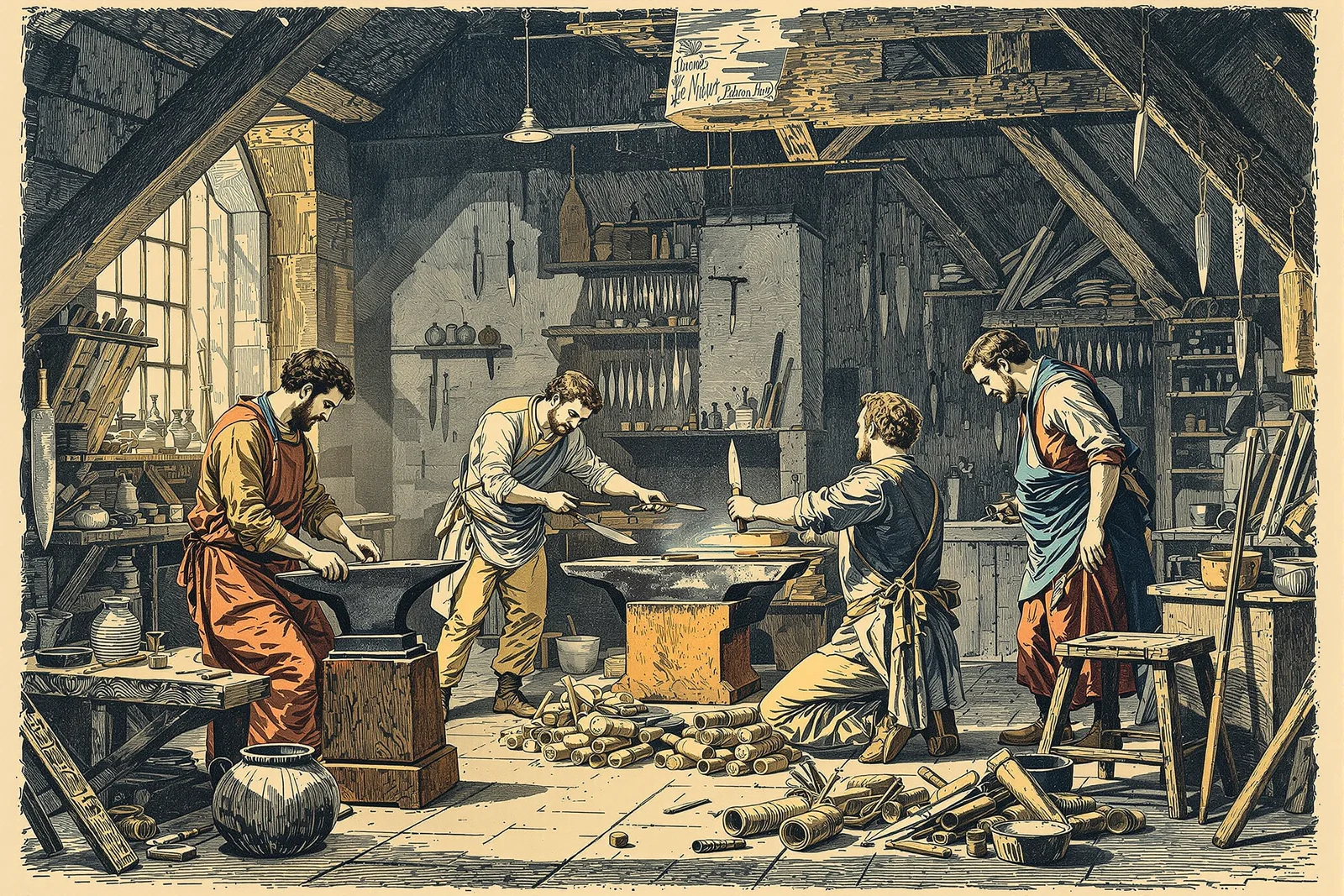
Complete Knife Making, Blade Forging, and Edge Tool Construction Guide
The knife is the most essential tool. Every other craft depends on a cutting edge. This campaign covers making blades from raw steel, heat treatment, handle fitting, and sharpening to a razor edge.
Chapter 1: Blade Steel Selection
| Steel Type | Carbon % | Hardness (HRC) | Edge Retention | Toughness | Ease of Sharpening | Source |
|---|---|---|---|---|---|---|
| Mild steel (1018) | 0.18% | 55-58 | Poor | Excellent | Very easy | Hardware store |
| Medium carbon (1045) | 0.45% | 58-60 | Moderate | Very good | Easy | Springs, axles |
| High carbon (1075) | 0.75% | 60-62 | Good | Good | Moderate | Leaf springs, files |
| Very high carbon (1095) | 0.95% | 62-65 | Excellent | Moderate | Moderate-hard | Old files, saw blades |
| Tool steel (W1) | 1.0% | 63-66 | Excellent | Moderate | Hard | Drill bits, taps |
| Damascus (pattern welded) | Variable | Variable | Good-excellent | Good | Variable | Forge-welded layers |
Scrap steel sources: Old files (1095-W1), leaf springs (5160), coil springs (1075), railroad spikes (1045), circular saw blades (L6), ball bearings (52100). All make excellent knives.
Chapter 2: Blade Forging Process
| Step | Action | Temperature | Details |
|---|---|---|---|
| 1 | Heat steel to forging temperature | Bright orange-yellow (1600-1900F) | Even heat throughout |
| 2 | Draw out blade shape (hammer to thin, lengthen) | Maintain orange heat | Work from tang toward tip |
| 3 | Set bevels (angle the edge side thinner) | Orange heat | Hammer at angle on anvil edge |
| 4 | Refine profile (shape outline) | Orange-cherry heat | Hot cut or grind to final shape |
| 5 | Straighten (check for warps, correct while hot) | Cherry red | Tap gently on anvil |
| 6 | Normalize (heat to non-magnetic, air cool) x3 | Just above non-magnetic (1475F for 1095) | Refines grain structure |
| 7 | Anneal (heat to non-magnetic, cool as slowly as possible) | Same as normalize | Bury in vermiculite or ash (cools over hours) |
| 8 | Grind/file to final shape and edge geometry | Room temperature | Annealed steel files/grinds easily |
| 9 | Heat treat (harden + temper) | See Chapter 3 | Critical step |
| 10 | Final grind, sharpen, handle | Room temperature | Finish work |
Chapter 3: Heat Treatment
| Step | Action | Details |
|---|---|---|
| 1 | Harden: heat blade evenly to non-magnetic temperature | Test with magnet: when blade stops attracting magnet = austenite transformation |
| 2 | Quench: plunge into quenchant (oil for most steels, water for W1) | Edge first, straight down, move in figure-8 |
| 3 | Test hardness: file should skate off hardened blade (won't bite) | If file bites = not hardened (repeat) |
| 4 | Temper IMMEDIATELY (within minutes of quench) | Do not leave blade fully hard (will crack) |
| 5 | Temper: heat to 375-450F for 1 hour (twice) | Oven, torch, or oil bath |
| 6 | Test: blade should flex slightly without breaking | Fully hard = snaps. Tempered = springs back. |
Tempering colors (polished steel surface): Straw (400F) = maximum hardness, files/razors. Bronze (450F) = knives, chisels. Purple (500F) = springs, swords. Blue (550F) = springs, screwdrivers.
Chapter 4: Blade Geometry
| Grind Type | Cross Section | Use | Edge Angle |
|---|---|---|---|
| Flat grind | Flat taper from spine to edge | General purpose, strong | 15-20 degrees per side |
| Hollow grind | Concave (ground on wheel) | Razors, skinning, slicing | 12-18 degrees per side |
| Convex grind | Slightly curved outward | Axes, choppers, tough use | 20-30 degrees per side |
| Scandi grind | Single flat bevel to edge (no secondary) | Woodworking, bushcraft | 12-15 degrees (single bevel) |
| Chisel grind | Flat one side, beveled other | Japanese knives, chisels | 15-20 degrees (one side) |
Edge angle rule: Lower angle = sharper but more fragile. Higher angle = more durable but less sharp. Kitchen knives: 15 degrees. Hunting knives: 20 degrees. Axes/machetes: 25-30 degrees.
Chapter 5: Handle Construction
| Material | Durability | Grip (wet) | Weight | Workability | Appearance |
|---|---|---|---|---|---|
| Hardwood (walnut, maple, oak) | Good | Good | Light | Easy | Beautiful grain |
| Birch bark (stacked) | Excellent | Excellent (best wet grip) | Light | Moderate | Traditional, warm |
| Antler/bone | Excellent | Moderate | Moderate | Moderate | Rustic, unique |
| Leather (stacked washers) | Good | Excellent | Light | Easy | Classic, warm |
| Micarta (linen/canvas + resin) | Excellent | Excellent | Moderate | Moderate (power tools) | Modern, tough |
| Cord wrap (paracord) | Moderate | Good | Very light | Easy | Tactical, replaceable |
Tang types: Full tang (strongest, blade steel extends through entire handle). Stick tang (narrow tang inserted into handle, pinned or epoxied). Through tang (stick tang extends through handle, peened over washer).
Chapter 6: Sharpening
| Method | Grit Equivalent | Use | Speed |
|---|---|---|---|
| Coarse stone (100-400 grit) | Reshaping, repair | Setting new bevel, removing chips | Fast material removal |
| Medium stone (600-1000 grit) | General sharpening | Regular maintenance, establishing edge | Moderate |
| Fine stone (2000-6000 grit) | Polishing edge | Final sharpening, keen edge | Slow, precise |
| Strop (leather + compound) | 8000+ equivalent | Final polish, maintaining edge | Very fine, alignment |
| Steel (honing rod) | N/A (realignment) | Straightening rolled edge (not sharpening) | Instant, between uses |
Sharpening technique: Maintain consistent angle (use finger as guide or angle guide). Alternate sides equally. Raise a burr on one side, then the other, then remove burr on strop. A sharp knife reflects no light along the edge (a dull edge shows a bright line).
Reference Card
- Non-magnetic test: when steel stops attracting magnet, it's ready to quench
- Quench in oil (most steels) or water (W1): edge first, straight down
- Temper IMMEDIATELY after quench: 375-450F for 1 hour, twice
- Old files and leaf springs are excellent knife steel (high carbon, free)
- Normalize 3 times before hardening (refines grain = tougher blade)
- Edge angle: 15 degrees (kitchen), 20 degrees (hunting), 25-30 degrees (chopping)
- A sharp knife reflects no light along the edge: if you see a bright line, it's dull
- Strop after every use: maintains edge between sharpenings (leather + compound)