Sovereignty Module: Bend the Wood
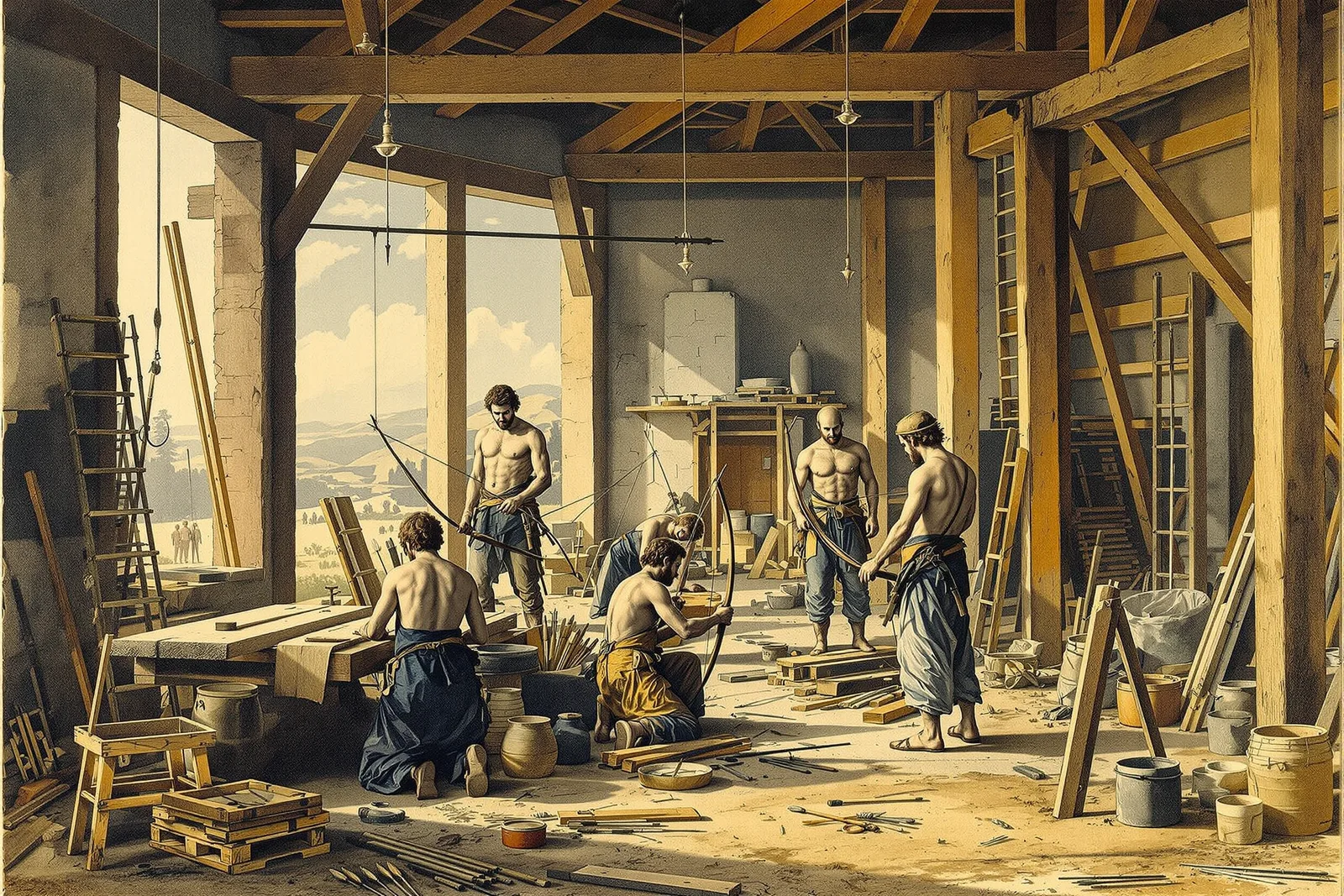
Complete Bow Making, Arrow Construction, and Archery Guide
The bow is humanity's first stored-energy weapon. It projects force at distance, enabling hunting and defense without close combat. A well-made bow from local materials equals manufactured equipment in effectiveness. This campaign covers bow construction from stave to string.
Chapter 1: Bow Types
| Type | Length | Draw Weight | Material | Difficulty | Range |
|---|---|---|---|---|---|
| Self bow (longbow) | 60-72 inches | 30-80 lbs | Single stave (yew, osage, ash) | Moderate | 150-250 yards |
| Flatbow | 60-68 inches | 30-60 lbs | Wide, flat limbs (any hardwood) | Low-moderate | 100-200 yards |
| Recurve (laminated) | 48-62 inches | 30-60 lbs | Wood + horn + sinew (composite) | Very high | 200-300 yards |
| Short bow | 36-48 inches | 20-40 lbs | Any suitable wood | Low | 50-150 yards |
| Crossbow | N/A (stock) | 50-200 lbs | Wood/steel prod, wood stock | High | 150-350 yards |
Chapter 2: Bow Wood Selection
| Wood | Quality | Properties | Availability | Notes |
|---|---|---|---|---|
| Osage orange | Excellent | Dense, elastic, rot-resistant | Central N. America | Best bow wood in the world |
| Yew | Excellent | Sapwood stretches, heartwood compresses | Europe, Pacific NW | Traditional English longbow |
| Black locust | Very good | Dense, strong, durable | Eastern N. America | Excellent, underrated |
| Hickory | Very good | Flexible, strong in tension | Eastern N. America | Best backing wood, good self bow |
| Ash | Good | Light, fast, adequate | Widespread temperate | Good beginner bow wood |
| Elm | Good | Follows string well, tough | Widespread temperate | Wide flatbow design |
| Maple (hard) | Good | Strong, available | Widespread temperate | Adequate, common |
| Bamboo | Good | Strong in tension, light | Tropical/subtropical | Excellent lamination material |
| Oak (white) | Moderate | Heavy, adequate | Widespread | Acceptable if nothing better |
Stave selection: Straight grain, no knots in the belly (compression side), small diameter branch (3-5 inches) or split from larger log. Cut in winter (less sap, less checking). Seal ends immediately with glue or wax.
Chapter 3: Self Bow Construction
| Step | Action | Time | Details |
|---|---|---|---|
| 1 | Select and cut stave (straight, knot-free, 6 feet+) | Day 1 | Winter-cut, seal ends immediately |
| 2 | Split stave (if from log) or use whole branch | Day 1 | Split with wedges, follow grain |
| 3 | Season (dry slowly) | 3-12 months | Slow drying prevents cracks. Bark on = slower, safer. |
| 4 | Layout: mark handle center, limb lengths, tip widths | After seasoning | Symmetrical from center |
| 5 | Rough shaping: remove wood from belly (flat side) | 2-4 hours | Drawknife, rasp. Leave back (bark side) untouched. |
| 6 | Floor tillering: flex limbs, check for even bend | Ongoing | Both limbs must bend equally |
| 7 | Tiller on tillering tree (brace with short string, pull to increasing weights) | 2-4 hours | Remove wood from stiff spots only |
| 8 | Reach target draw weight at target draw length | Final tiller | 28 inches draw typical for adult |
| 9 | Cut nocks (string grooves at tips) | 15 minutes | File or knife |
| 10 | Sand, seal with oil or finish | 30 minutes | Protects from moisture |
| 11 | String (Flemish twist or endless loop) | 30 minutes | Brace height: 6-7 inches from handle |
CRITICAL RULE: Never remove wood from the back (outer/bark side) of the bow. The back is in tension; cutting across grain fibers on the back causes catastrophic failure (bow explodes). All shaping is done on the belly (inner/flat side).
Chapter 4: Arrow Construction
| Component | Material | Specification | Function |
|---|---|---|---|
| Shaft | Straight-grained hardwood (birch, ash, poplar, cedar) | 28-32 inches, 5/16-3/8 inch diameter | Projectile body |
| Point (head) | Flint, bone, antler, steel, or fire-hardened wood | Sized to shaft | Penetration |
| Fletching | Feathers (turkey, goose) split and trimmed | 3 feathers, 4-5 inches long | Stabilizes flight |
| Nock | Self-nock (slot in shaft) or added nock (horn/bone) | Fits bowstring snugly | Holds arrow on string |
Arrow spine (stiffness) must match bow weight. Too stiff = arrow flies left (right-handed). Too flexible = arrow wobbles. Test: support arrow at ends, hang weight from center, measure deflection.
Chapter 5: Fletching and Assembly
| Step | Action | Details |
|---|---|---|
| 1 | Straighten shafts (heat over coals, bend, hold until cool) | Must be perfectly straight |
| 2 | Cut to length (1-2 inches past bow at full draw) | Consistent length for all arrows |
| 3 | Sand smooth (uniform diameter) | No bumps or rough spots |
| 4 | Cut nock (slot for string, perpendicular to grain) | 1/4 inch deep, string-width |
| 5 | Attach point (socket, tang, or lash with sinew) | Secure, aligned with shaft |
| 6 | Split feathers (along quill center) | 3 matched feathers per arrow |
| 7 | Trim feathers to shape (shield or parabolic) | 4-5 inches long, 1/2 inch tall |
| 8 | Glue feathers to shaft (120 degrees apart) | Hide glue, pitch, or modern glue |
| 9 | Wrap thread at front and back of fletching | Secures feathers, prevents peeling |
| 10 | Seal shaft with oil or thin finish | Moisture protection |
Chapter 6: Bowstring Materials
| Material | Strength | Stretch | Availability | Lifespan |
|---|---|---|---|---|
| Linen (flax) | Good | Low | Cultivated (temperate) | Moderate (protect from wet) |
| Sinew (animal tendon) | Excellent | Moderate | Any large animal | Good (if kept dry) |
| Rawhide (twisted) | Good | Moderate | Any animal hide | Moderate |
| Silk | Excellent | Very low | Cultivated (specialty) | Good |
| Dacron (modern) | Excellent | Very low | Manufactured | Excellent |
| Plant fiber (dogbane, milkweed) | Moderate | Low | Wild (seasonal) | Short-moderate |
| Hemp | Good | Low | Cultivated | Good |
Flemish twist string: Two bundles of fiber, each twisted clockwise (Z-twist), then twisted together counter-clockwise (S-ply). Forms loops at each end. Strongest traditional string construction.
Reference Card
- Never remove wood from the back (bark side) of a bow: causes catastrophic failure
- All shaping is done on the belly (inner side): thin the limbs from the belly only
- Both limbs must bend equally (tiller): remove wood from stiff spots
- Season bow stave 3-12 months minimum (slow drying prevents cracks)
- Arrow spine must match bow weight: too stiff or too flexible = poor accuracy
- Osage orange and yew are the finest bow woods; hickory and ash are good alternatives
- Brace height (string to handle): 6-7 inches for most bows
- Three feathers at 120 degrees stabilize arrow flight; cock feather points away from bow