Sovereignty Module: Span the Gap
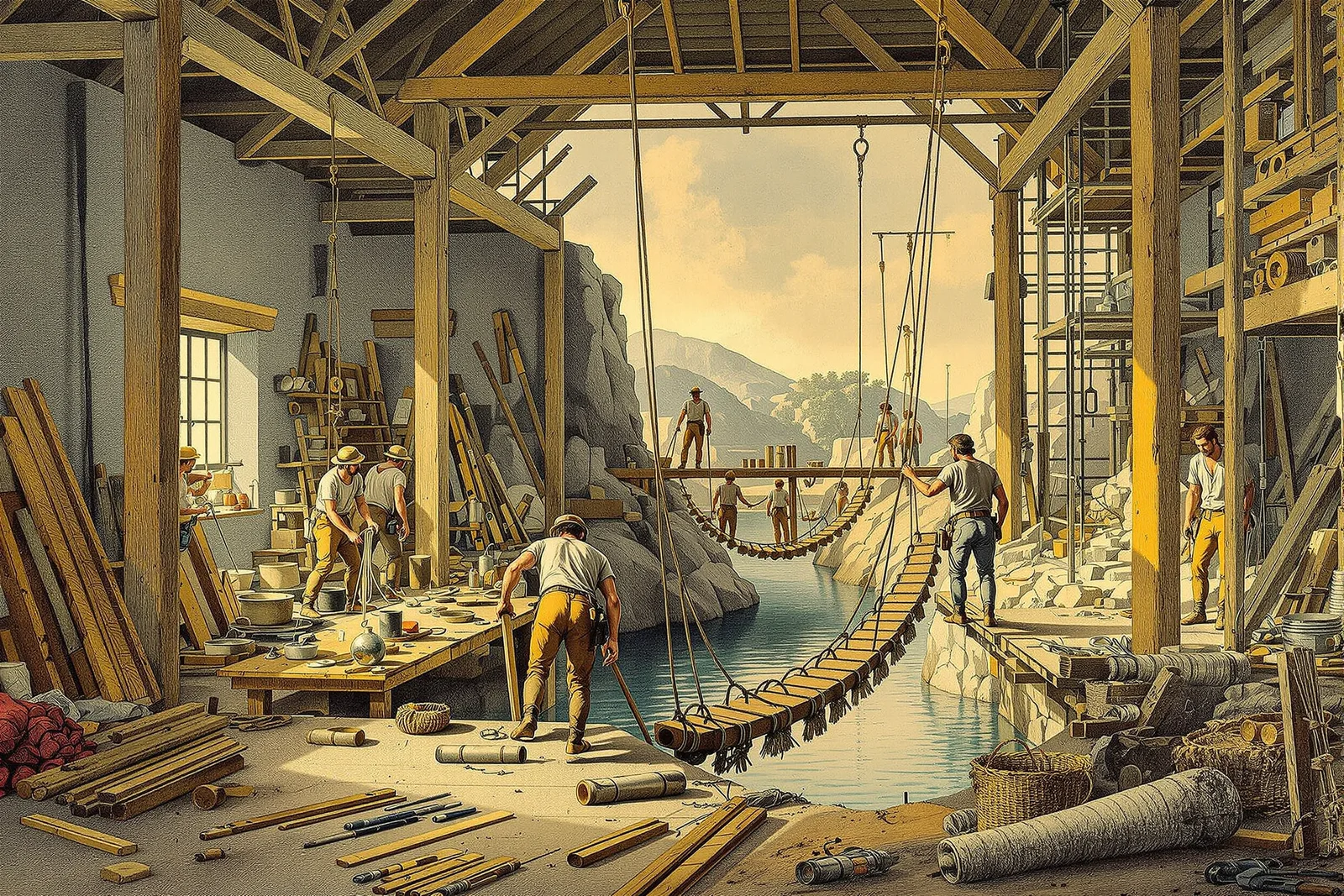
Span the Gap
Complete Rope Bridge, Suspension Structure, and River Crossing Guide
Complete Rope Bridge, Suspension Structure, and River Crossing Guide
Bridges connect communities, enable trade, and provide escape routes. Rope and cable bridges can span distances impossible for simple beam bridges. This campaign covers every type of rope bridge from simple crossings to multi-cable suspension structures.
Chapter 1: Bridge Types by Complexity
| Type | Span | Capacity | Materials | Difficulty | Build Time |
|---|---|---|---|---|---|
| Fallen log (beam) | 10-30 feet | 1 person | Single tree | Very low | Minutes |
| Simple rope bridge (single cable + hand ropes) | 30-100 feet | 1 person | 3 ropes/cables | Low | 1-2 days |
| V-bridge (2 foot cables, 1 hand cable) | 30-80 feet | 1 person | 3 cables | Low-moderate | 1-2 days |
| Plank suspension bridge | 50-200 feet | Multiple people, light loads | Cables + planks | Moderate | 3-7 days |
| Rope and bamboo bridge | 50-150 feet | Multiple people | Rope + bamboo/poles | Moderate | 2-5 days |
| Cable-stayed bridge | 100-500 feet | Vehicles, heavy loads | Steel cables + timber deck | High | Weeks-months |
| Stone arch bridge | 20-100 feet | Heavy loads, permanent | Cut stone + mortar | Very high | Months |
Chapter 2: Rope and Cable Requirements
| Span | Minimum Main Cable | Hand Rail Cable | Anchor Requirement |
|---|---|---|---|
| 30 feet | 1/2 inch rope (3,000 lb breaking) | 3/8 inch rope | Trees or posts |
| 50 feet | 5/8 inch rope (5,000 lb breaking) | 1/2 inch rope | Large trees or deadman anchors |
| 100 feet | 3/4 inch cable (8,000 lb breaking) | 5/8 inch rope | Deadman anchors or rock bolts |
| 200 feet | 1 inch cable (15,000+ lb breaking) | 3/4 inch cable | Massive anchors, engineered |
Safety factor: Main cables must support 10x the expected maximum load. A 200 lb person on a 100-foot span creates approximately 800-1,200 lbs of cable tension (due to sag geometry). Cable must handle 8,000-12,000 lbs.
Chapter 3: Anchor Systems
| Anchor Type | Holding Power | Terrain | Construction |
|---|---|---|---|
| Living tree (12+ inch diameter) | 10,000+ lbs | Forest | Wrap cable around trunk, protect bark |
| Deadman (buried log) | 5,000-20,000 lbs | Any soil | Bury 6-8 foot log 4+ feet deep, cable attached at center |
| Rock bolt (drilled and epoxied) | 5,000-15,000 lbs | Rock | Drill hole, insert bolt with epoxy |
| Multiple stakes (picket holdfast) | 3,000-8,000 lbs | Firm soil | 3-5 stakes driven at angle, lashed together |
| Concrete anchor (poured) | 10,000-50,000 lbs | Any | Poured concrete block with embedded cable loop |
| Natural rock feature | Variable | Rock | Cable around solid rock outcrop |
Chapter 4: Simple Three-Rope Bridge Construction
| Step | Action | Details |
|---|---|---|
| 1 | Select crossing point (narrow, solid banks, anchor points both sides) | Avoid deep water, strong current |
| 2 | Get first rope across (throw, swim, shoot arrow with line) | Light messenger line first, pull heavy cable after |
| 3 | Tension foot cable (main support) at waist height on far side | Sag should be 3-5% of span |
| 4 | Install two hand cables (shoulder height, 18-24 inches outside foot cable) | Both sides for balance |
| 5 | Connect hand cables to foot cable with vertical ties every 3-5 feet | Prevents spreading apart |
| 6 | Tension all cables and secure to anchors | Turnbuckles or lashing |
| 7 | Test with weight before crossing (hang heavy load at center) | Must not sag excessively |
| 8 | Cross: feet on bottom cable, hands on side cables, shuffle sideways | One person at a time |
Chapter 5: Plank Suspension Bridge
| Step | Action | Details |
|---|---|---|
| 1 | Install two main cables (parallel, 18-24 inches apart) | These support the deck |
| 2 | Install two hand rail cables (48-54 inches above deck cables) | Safety rails |
| 3 | Lay deck planks across main cables (lash or bolt to cables) | 2x6 or 2x8 planks, 24-30 inches long |
| 4 | Space planks 0-2 inches apart (close enough to walk) | Lash each plank at both ends |
| 5 | Install vertical suspenders connecting deck to hand rails every 3-5 feet | Prevents rail from separating from deck |
| 6 | Add cross-bracing if span exceeds 100 feet | Prevents excessive swaying |
| 7 | Install approach ramps at both ends | Smooth transition from bank to bridge |
Chapter 6: Maintenance and Safety
| Task | Frequency | Purpose |
|---|---|---|
| Inspect all cables for wear, rust, fraying | Weekly (high use) or monthly | Catch failure before it happens |
| Check anchors for movement or erosion | Monthly | Ground shifts over time |
| Replace worn lashings | As needed | Lashings wear faster than cables |
| Load limit signage | Permanent | One person at a time (simple bridges) |
| Remove debris (branches, leaves that trap moisture) | After storms | Moisture causes rot and rust |
| Re-tension cables (they stretch over time) | Monthly initially, then quarterly | Maintains proper sag |
Reference Card
- Safety factor: cables must support 10x maximum expected load
- Cable tension increases dramatically as sag decreases (low sag = very high tension)
- Optimal sag: 3-5% of span length (100-foot span = 3-5 feet of sag at center)
- Get first line across with messenger line (throw, swim, arrow), then pull heavy cable
- One person at a time on simple rope bridges (resonance from multiple people is dangerous)
- Deadman anchor: bury 6-8 foot log 4+ feet deep perpendicular to cable direction
- Inspect cables weekly for fraying: a single broken strand means replacement soon
- Plank bridges need cross-bracing above 100-foot spans to prevent lateral sway
TransmissionCOMPLETE — unaltered & unabridged
Words1,041 — every one of them
SHA-256 of source textde761c72fe1528b3b7d8c31d241da9219391a3b4cb75e423551362d87b83173d
Canonical textdownload campaign-rope-bridge.md — byte-identical to what this page renders