Sovereignty Module: Fire the Earth
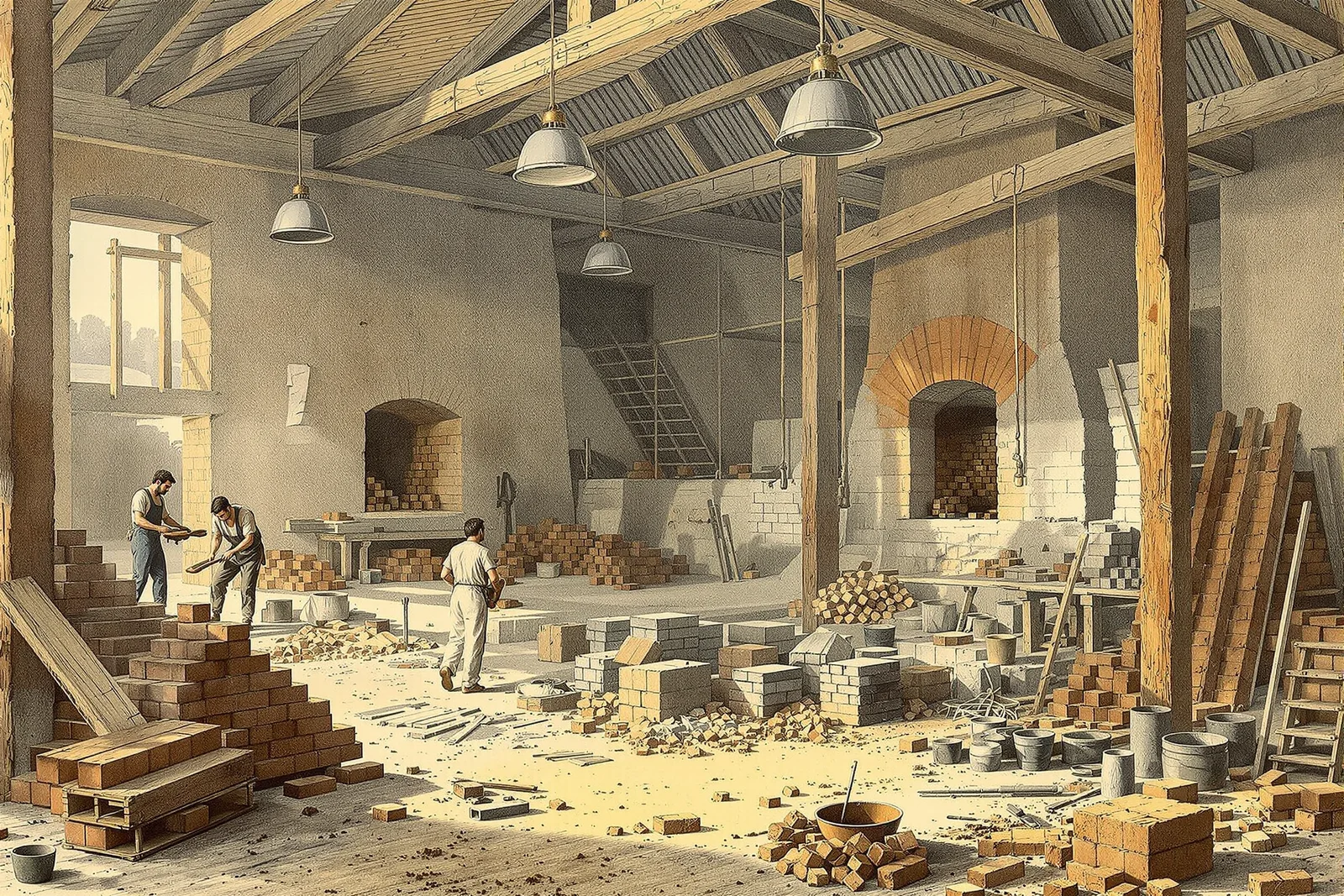
Complete Brick Making, Kiln Construction, and Fired Clay Building Materials Guide
Fired brick is the most durable common building material. It resists water, fire, insects, and rot. Bricks last centuries with zero maintenance. This campaign covers finding clay, forming bricks, building kilns, and firing to produce permanent building materials.
Chapter 1: Clay Identification and Testing
| Test | Method | Good Clay Result |
|---|---|---|
| Ribbon test | Roll clay into rope, flatten into ribbon | Holds together 4+ inches without breaking |
| Ball drop test | Form 2-inch ball, drop from 3 feet | Cracks but doesn't shatter (too sandy = shatters, too much clay = no cracks) |
| Shrinkage test | Form 6-inch bar, dry completely, measure | 5-8% shrinkage ideal (more = too much clay, cracks during drying) |
| Bite test | Bite a small piece | Smooth, slightly sticky = clay. Gritty = too sandy. |
| Shake test | Form ball, shake in palm | Water rises to surface = silt (not ideal). Stays firm = clay (good). |
| Color | Visual inspection | Red/orange = iron-rich (common). Grey/white = low iron. Blue-grey = deep clay. |
Clay sources: River banks, road cuts, construction excavations, pond bottoms, anywhere soil is sticky when wet and cracks when dry. Dig below topsoil (2-3 feet down typically).
Chapter 2: Brick Forming
| Method | Speed | Quality | Equipment |
|---|---|---|---|
| Hand-molded (slop mold) | 200-400/day (1 person) | Moderate (irregular) | Wood mold, flat surface |
| Table-molded (stock mold) | 400-800/day (1 person) | Good (uniform) | Wood mold with bottom, table |
| Wire-cut (extruded) | 1,000+/day | Very good (uniform) | Pug mill, wire cutter |
| Pressed (mechanical) | 2,000+/day | Excellent (dense, uniform) | Brick press |
Standard brick size: 8 x 4 x 2.5 inches (allows one-hand grip, modular coursing). Make mold 8-10% larger than desired finished size (clay shrinks during drying and firing).
Chapter 3: Brick Making Process
| Step | Action | Time | Details |
|---|---|---|---|
| 1 | Dig clay, remove stones and roots | 1 day | Stockpile near work area |
| 2 | Soak clay in water (slake) | 1-3 days | Breaks down lumps, hydrates fully |
| 3 | Mix clay with sand (if too sticky) or straw (reduces cracking) | 1-2 hours | Ratio: test batches first. Typically 20-30% sand. |
| 4 | Wedge/knead clay (remove air bubbles) | 5 min per batch | Like kneading bread |
| 5 | Fill mold (press clay firmly into all corners) | 30 seconds per brick | Wet mold first (prevents sticking) |
| 6 | Strike off excess with wire or straight edge | 5 seconds | Level with mold top |
| 7 | Turn out onto drying surface (sand-covered ground) | Immediately | Tap mold, brick slides out |
| 8 | Dry slowly (1-3 weeks depending on climate) | 1-3 weeks | Turn bricks after 2-3 days. Protect from rain and direct sun. |
| 9 | Stack dried bricks for kiln loading | After fully dry | Must be bone-dry before firing (moisture = explosion) |
Chapter 4: Kiln Types
| Kiln Type | Capacity | Temperature | Fuel | Complexity | Reusable |
|---|---|---|---|---|---|
| Clamp kiln (open stack) | 1,000-50,000 bricks | 1600-1900F | Wood, coal | Low | No (single use) |
| Scotch kiln (3-wall) | 5,000-20,000 bricks | 1700-2000F | Wood, coal | Low-moderate | Yes |
| Updraft kiln (chimney) | 500-5,000 bricks | 1800-2200F | Wood | Moderate | Yes |
| Downdraft kiln | 1,000-10,000 bricks | 1900-2400F | Wood, coal, gas | High | Yes |
| Tunnel kiln (continuous) | Unlimited (continuous) | 1900-2200F | Any fuel | Very high | Yes |
Chapter 5: Clamp Kiln Firing (Simplest Method)
| Step | Action | Time | Details |
|---|---|---|---|
| 1 | Level ground, lay fuel channels (wood/coal in trenches) | Day 1 | Channels every 12-18 inches |
| 2 | Stack dried bricks in lattice pattern (air gaps between) | Day 1-2 | Leave fire channels open at bottom |
| 3 | Enclose sides with already-fired bricks or mud plaster | Day 2 | Reduces heat loss |
| 4 | Light fires in channels (start slow, increase gradually) | Day 3 | Too fast = cracking from thermal shock |
| 5 | Increase temperature over 24-48 hours to full heat | Days 3-5 | Cherry red to orange visible at night |
| 6 | Maintain full heat for 24-48 hours | Days 5-7 | Ensures complete vitrification |
| 7 | Seal all openings, let cool slowly (3-7 days) | Days 7-14 | Fast cooling = cracking |
| 8 | Unstack and sort (well-fired, under-fired, over-fired) | Day 14+ | Center bricks best, edges may be under-fired |
Yield: Expect 60-80% good bricks from a clamp kiln. Under-fired bricks (soft, pale) can be re-fired or used for interior walls. Over-fired bricks (dark, warped) are extremely hard and durable.
Chapter 6: Mortar and Bricklaying
| Mortar Type | Recipe | Strength | Use |
|---|---|---|---|
| Lime mortar | 1 lime putty : 3 sand | Moderate (flexible) | General construction, historical |
| Cement mortar | 1 cement : 3 sand | High (rigid) | Modern construction |
| Mud mortar | Clay soil + straw + water | Low (temporary) | Non-structural, interior |
| Lime-cement blend | 1 cement : 1 lime : 6 sand | Moderate-high | Best of both (strong + workable) |
Bricklaying rules: Stagger joints (running bond minimum). Mortar joints 3/8 to 1/2 inch. Butter both brick and bed. Level every course. Plumb every corner. Build corners first, fill between with string line.
Reference Card
- Clay shrinks 5-8% when drying and 2-5% more when firing: make molds oversized
- Bricks MUST be bone-dry before firing (moisture in brick = steam explosion in kiln)
- Dry bricks slowly (1-3 weeks): fast drying causes cracking
- Clamp kiln: simplest method, stack bricks with fuel channels, fire for 5-7 days
- Firing temperature: 1700-2000F (cherry red to orange) for 24-48 hours minimum
- Cool kiln slowly (3-7 days): fast cooling cracks bricks
- Standard brick: 8 x 4 x 2.5 inches (one-hand grip, modular coursing)
- One person can hand-mold 200-400 bricks per day with simple wood mold