Sovereignty Module: Color the World
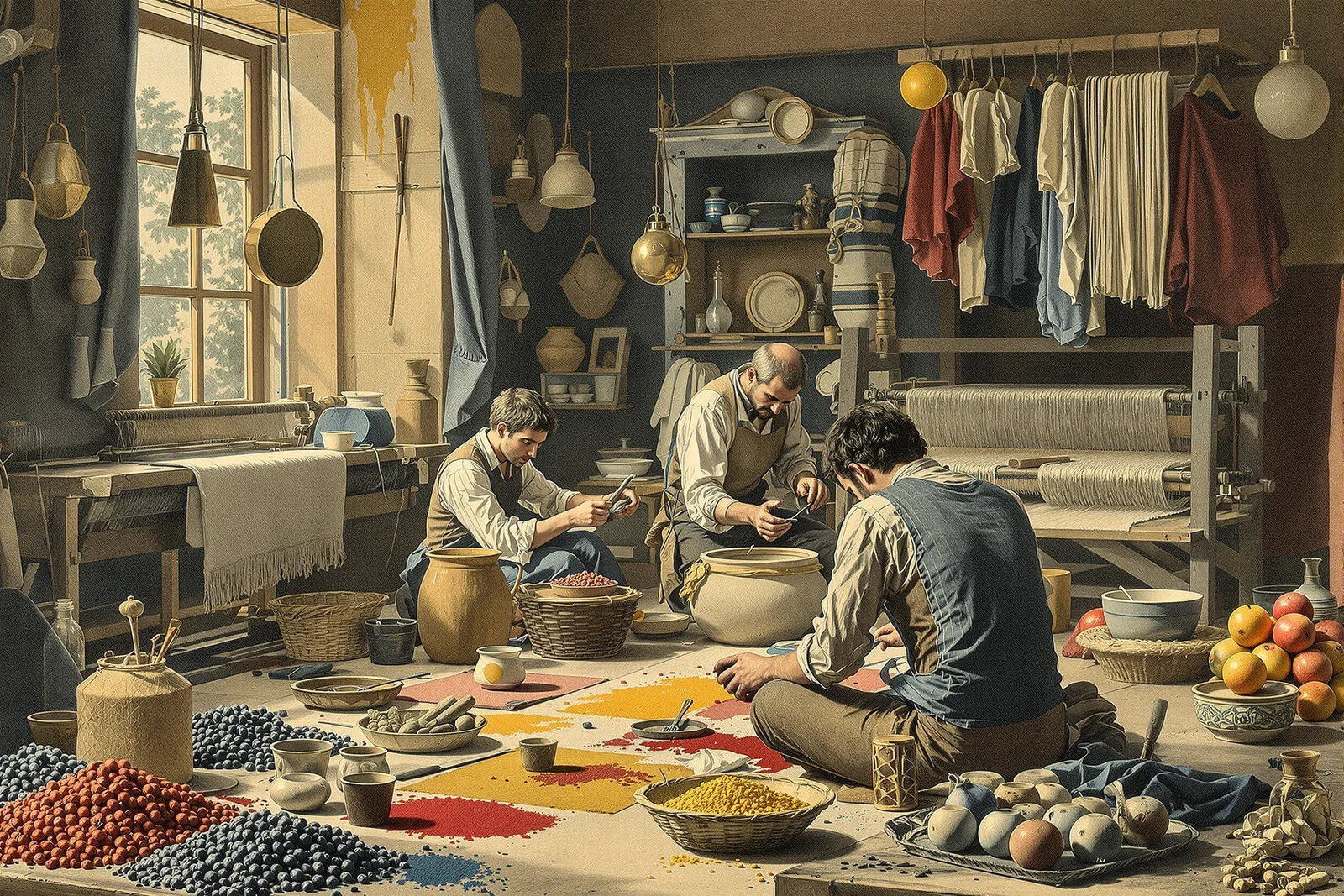
Complete Natural Dyes, Pigments, Paints, and Inks Guide
Color communicates, identifies, protects, and beautifies. Before synthetic chemistry, all color came from earth, plants, and animals. This campaign covers making permanent dyes for fabric, pigments for paint, and inks for writing.
Chapter 1: Dye Sources by Color
| Color | Source | Fastness | Mordant Needed | Availability |
|---|---|---|---|---|
| Blue | Indigo (Indigofera), woad (Isatis) | Excellent | No (vat dye) | Tropical (indigo), temperate (woad) |
| Red | Madder root (Rubia), cochineal (insect) | Excellent | Alum | Widespread (madder), Americas (cochineal) |
| Yellow | Onion skins, weld (Reseda), turmeric, goldenrod | Good-excellent | Alum | Universal |
| Orange | Madder + turmeric, annatto seeds | Moderate-good | Alum | Widespread |
| Green | Indigo overdye on yellow (weld + indigo) | Excellent | Alum (for yellow step) | Requires both blue and yellow |
| Purple | Indigo + madder overdye, elderberry | Good-excellent | Alum (for red step) | Requires both blue and red |
| Brown | Walnut hulls, oak bark, tea, cutch | Excellent | Often none needed | Universal |
| Black | Iron + tannin (oak galls + iron), logwood | Excellent | Iron mordant | Universal |
| Pink | Avocado pits/skins, madder (weak bath) | Moderate-good | Alum | Widespread |
Chapter 2: Mordanting (Fixing Dyes to Fiber)
| Mordant | Concentration | Effect on Color | Fiber Type | Source |
|---|---|---|---|---|
| Alum (potassium aluminum sulfate) | 15-20% weight of fiber | Brightens, truest color | All fibers | Mineral deposits, pharmacy |
| Iron (ferrous sulfate) | 2-5% weight of fiber | Darkens, saddens color | All fibers | Rusty nails in vinegar (homemade) |
| Copper (copper sulfate) | 2-5% weight of fiber | Greens/shifts color | All fibers | Pennies in vinegar, blue vitriol |
| Tannin (oak galls, sumac) | 8-12% weight of fiber | Helps mordant bond to cellulose | Cotton, linen, plant fibers | Oak galls, bark, leaves |
| Cream of tartar | 6% weight of fiber | Brightens, evens dyeing | Wool, silk | Winemaking byproduct |
Mordanting process: Dissolve mordant in hot water. Add pre-wetted fiber. Simmer 1 hour (wool) or soak overnight (cotton). Do not rinse before dyeing.
Chapter 3: Indigo Vat (Blue Dyeing)
| Step | Action | Details |
|---|---|---|
| 1 | Extract indigo (ferment leaves in water 12-24 hours, beat to oxidize, settle, collect sediment) | Or use purchased indigo powder |
| 2 | Build vat: warm water + indigo + alkali (lye or lime) + reducing agent | Reducing agent: fermentation (fruit, bran), or sodium hydrosulfite |
| 3 | Wait for vat to reduce (liquid turns yellow-green, no blue visible) | 1-24 hours depending on method |
| 4 | Gently lower pre-wetted fabric into vat (minimize air introduction) | Fabric appears yellow-green underwater |
| 5 | Soak 5-30 minutes | Longer = darker blue |
| 6 | Remove fabric, squeeze gently, expose to air | Oxidation turns yellow-green to BLUE (magic moment) |
| 7 | Repeat dips for darker blue (3-6 dips for navy) | Rinse between dips, let oxidize fully |
| 8 | Final rinse in cool water, dry | Color is permanent, improves with washing |
Indigo is unique: it does not dissolve in water normally. Must be chemically reduced (oxygen removed) to become soluble. When fabric is removed from vat, oxygen in air re-oxidizes indigo INTO the fiber = permanent bond.
Chapter 4: Paint and Pigment Making
| Pigment | Source | Color | Preparation |
|---|---|---|---|
| Ochre (yellow/red/brown) | Iron-rich clay/earth | Yellow, red, brown | Grind, wash, dry, grind fine |
| Charcoal black | Burned wood or bone | Black | Grind charcoal very fine |
| Chalk white | Limestone, chalk deposits | White | Grind, wash, dry |
| Green earth (terre verte) | Celadonite/glauconite clay | Grey-green | Grind, wash |
| Ultramarine | Lapis lazuli (rare) | Brilliant blue | Complex extraction |
| Verdigris | Copper + vinegar (corrosion) | Blue-green | Hang copper over vinegar, scrape |
| Lead white | Lead + vinegar + manure heat | Brilliant white | TOXIC: historical only |
| Burnt sienna | Ochre heated (calcined) | Red-brown | Heat yellow ochre until red |
| Bone black | Charred bones | Deep black | Burn bones in closed container |
| Lamp black | Soot from oil lamp | Pure black | Collect soot from flame on cool surface |
Chapter 5: Binders (Making Paint from Pigment)
| Binder | Type | Drying Method | Use | Durability |
|---|---|---|---|---|
| Egg yolk (tempera) | Protein | Evaporation + oxidation | Panel painting, illustration | Excellent (centuries) |
| Linseed oil | Drying oil | Oxidation (polymerizes) | Canvas, wood, exterior | Excellent |
| Gum arabic | Water-soluble gum | Evaporation | Watercolor, calligraphy | Good (interior) |
| Hide glue (rabbit skin) | Protein | Evaporation | Gesso, sizing, distemper | Good |
| Beeswax (encaustic) | Wax | Cooling (heated application) | Painting, wood finish | Excellent |
| Casein (milk protein) | Protein | Evaporation + curing | Wall paint, wood | Very good |
| Lime (fresco) | Mineral | Chemical (carbonation) | Wall painting (wet plaster) | Exceptional (millennia) |
Paint recipe (basic): Grind pigment to finest possible powder. Mix with binder at ratio that produces smooth, brushable paste. Add thinner (water or turpentine) for consistency. Test on scrap surface.
Chapter 6: Ink Making
| Ink Type | Recipe | Color | Use | Permanence |
|---|---|---|---|---|
| Iron gall ink | Oak galls + iron sulfate + gum arabic + water | Black (darkens over time) | Writing, drawing | Excellent (centuries) |
| Carbon ink (India ink) | Lamp black + hide glue + water | Deep black | Writing, drawing | Excellent |
| Walnut ink | Walnut hulls boiled + gum arabic | Warm brown | Writing, drawing | Good |
| Berry ink | Crushed berries + vinegar + salt | Red-purple | Temporary writing | Poor (fades) |
| Squid/cuttlefish ink | Ink sac contents + gum arabic | Sepia brown | Writing, drawing | Good |
Iron gall ink recipe: Crush 4 oz oak galls. Soak in 1 pint water for 2 weeks (or boil 1 hour). Strain. Add 2 oz ferrous sulfate (green vitriol). Add 1 oz gum arabic. Stir until dissolved. Ink starts pale, darkens to permanent black over hours/days.
Reference Card
- Mordant BEFORE dyeing: alum (15-20% weight of fiber) for brightest colors
- Iron mordant darkens all colors (2-5%): use for blacks and dark shades
- Indigo requires reduction (oxygen removal) to dissolve: vat must be yellow-green, not blue
- Green = blue + yellow (overdye): dye yellow first (weld + alum), then dip in indigo
- Walnut hulls need no mordant: tannin acts as its own fixative
- Paint = pigment + binder. Grind pigment as fine as possible for smooth paint.
- Iron gall ink: most permanent historical writing ink (lasts centuries on paper)
- Ochre (iron-rich earth) is the most available pigment worldwide: grind, wash, use