Campaign 122: Bend the Stave
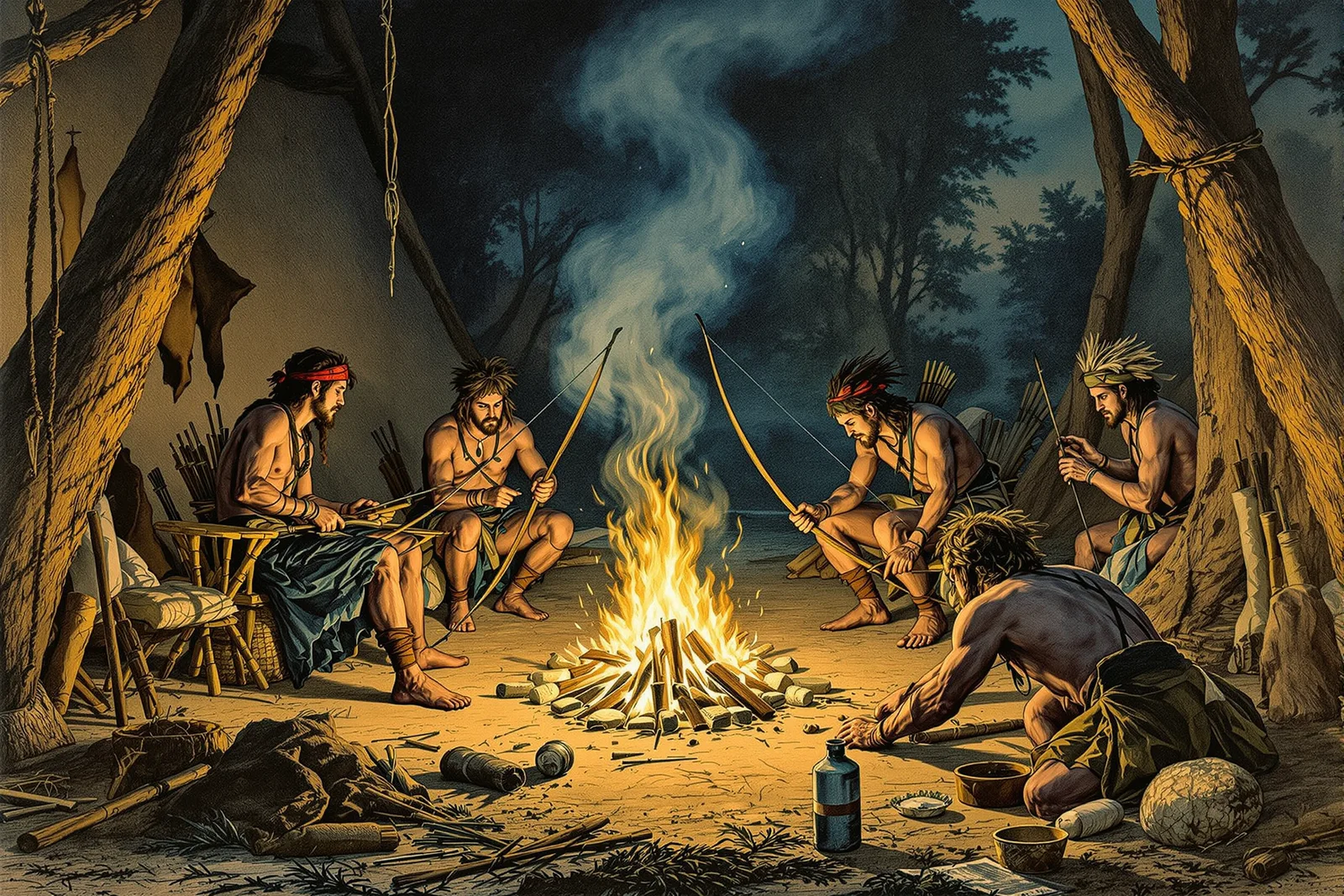
The Complete Bow Making, Tillering, and Primitive Archery Production Guide
A Sovereignty Module of the Practitioner Community
Preamble
The bow is the most effective ranged weapon that can be built entirely from natural materials with hand tools. A properly made wooden bow launches arrows at 150+ fps, is effective to 40+ yards for hunting, and can be constructed in a single day from a suitable stave. This campaign covers wood selection, stave preparation, tillering, string making, and bow finishing.
Part I: Wood Selection
Chapter 1: Bow Wood Comparison
| Wood | Quality | Availability | Properties | Draw Weight Potential |
|---|---|---|---|---|
| Osage orange | Excellent (best) | Central/South US | Dense, elastic, rot-resistant | 60+ lbs |
| Yew | Excellent | Pacific NW, Europe | Natural sapwood/heartwood laminate | 60+ lbs |
| Black locust | Very good | Eastern US | Dense, strong, durable | 55+ lbs |
| Hickory | Very good | Eastern US | Extremely tough, flexible | 55+ lbs |
| White ash | Good | Eastern US | Light, fast, good for beginners | 50+ lbs |
| Elm | Good | Widespread | Flexible, forgiving | 45+ lbs |
| Maple | Good | Widespread | Hard, reliable | 50+ lbs |
| Mulberry | Good | Widespread | Similar to osage, lighter | 50+ lbs |
| Bamboo | Good (backed) | Warm climates | Must be backed or laminated | 50+ lbs |
Chapter 2: Stave Selection and Harvesting
| Step | Action | Details |
|---|---|---|
| 1. Select tree | Straight trunk or branch, 4-6 inch diameter, no knots | Slight curve OK — will become belly of bow |
| 2. Season | Dead standing preferred. If green, split and dry 3-12 months | Seal ends with glue/wax to prevent checking (end cracks) |
| 3. Split | Split log in half (or quarters if large enough) | Follow grain — never saw across grain |
| 4. Mark | Identify sapwood (outer, light) and heartwood (inner, dark) | Sapwood = back of bow (faces target). Heartwood = belly (faces you) |
| 5. Rough shape | Remove excess wood, leave stave 2 inches wide, 1 inch thick | Leave EXTRA material — you can always remove more |
Chapter 3: Tillering Process
| Step | Action | Details |
|---|---|---|
| 1. Layout | Mark handle (center 4 inches), fade (2 inches each side), limbs | Limbs taper from fade to tips — wider at handle, narrower at tips |
| 2. Floor tiller | Remove wood from belly until bow bends slightly with hand pressure | Work BOTH limbs equally — check frequently |
| 3. String notch | Cut small notches at tips for temporary tillering string | 1/4 inch deep, angled to hold string |
| 4. Long string | Attach string 6 inches longer than bow (low brace) | Allows you to see limb bend without full stress |
| 5. Tiller tree | Pull string to increasing draw lengths (2 inch increments) | Observe limb bend — both limbs must bend equally |
| 6. Remove wood | Scrape belly where limb is stiff (doesn't bend enough) | NEVER remove wood from back (sapwood ring) |
| 7. Check often | Every 10-20 scrapes, re-string and check bend | Patience — removing too much wood is irreversible |
| 8. Full draw | When bow reaches target draw length with even bend | Typical: 28 inches draw, 40-55 lbs for hunting |
Chapter 4: String Making
| Material | Strength | Availability | Method |
|---|---|---|---|
| B-50 Dacron (modern) | Excellent | Purchased | Pre-made or twist from serving |
| Linen (flax) | Very good | Grown/purchased | Reverse-twist 12-16 strands |
| Sinew (animal tendon) | Excellent | Harvested from game | Reverse-twist dried sinew fibers |
| Plant fiber (dogbane, nettle) | Good | Wild-harvested | Reverse-twist processed fibers |
| Rawhide | Good | From animal hides | Cut thin strip, twist |
Reverse Twist Method: Take 2 bundles of fiber. Twist each clockwise individually. Wrap them counterclockwise around each other. The opposing twists lock together and prevent unraveling. This is the universal cordage technique.
Chapter 5: The Practitioner Bow Making Reference Card
NEVER VIOLATE THE BACK: The back of the bow (facing the target) must be a single continuous growth ring of sapwood. Any cut, nick, or violation of this ring creates a failure point. The back is under tension — it must be perfect.
TILLER IS EVERYTHING: A bow that bends unevenly will break. The tillering process (removing wood from stiff spots on the belly) is 80% of bow making. Rush tillering = broken bow. Check bend every 10-20 scrapes.
GRAIN IS STRENGTH: Wood grain must run the full length of the bow without runoff (grain diving into the surface). Follow the grain, never cut across it. A bow with good grain at 35 lbs outperforms a bow with bad grain at 55 lbs.
REMEMBER: The bow is the great equalizer. A 120-lb person with a well-made bow has the same lethal range as a 250-lb person. It requires no ammunition that can't be made from natural materials. A Practitioner who can make a bow and arrows from forest materials has a renewable, silent, effective tool for hunting and defense that never runs out of ammunition.
Council Approval
All 12 voices unanimously approve. Complete bow making sovereignty.
Council Result: 12/12 APPROVED. Campaign 122 is complete.