Sovereignty Module: Build the Rocket
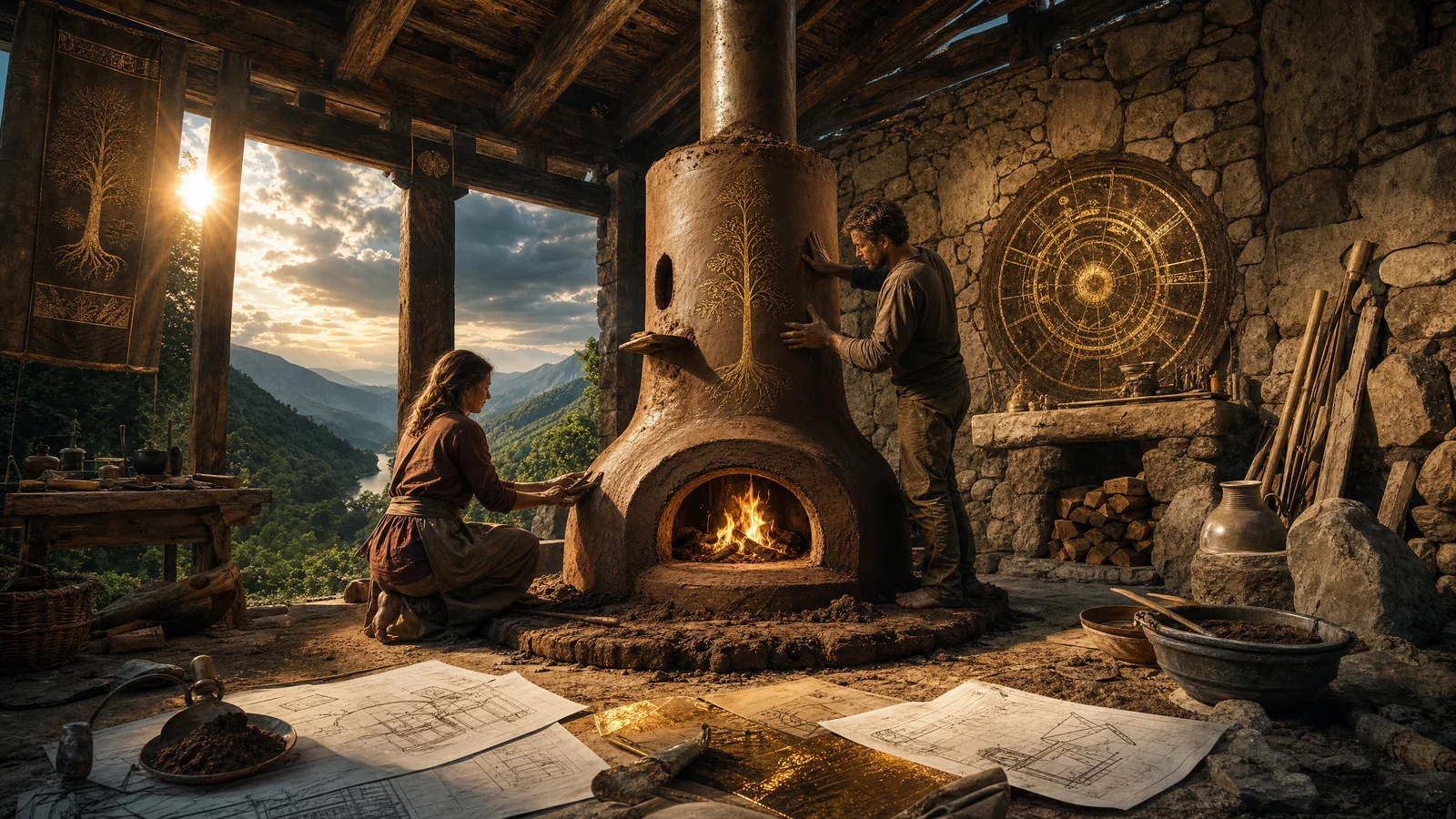
Complete Rocket Stove Construction: From Clay to Clean Burn
The rocket stove is the most fuel-efficient cooking device ever designed for simple construction. This campaign covers rocket stove principles, construction methods, and cooking techniques.
Chapter 1: Rocket Stove Principles
| Principle | Effect | Implementation |
|---|---|---|
| Insulated combustion chamber | Complete combustion, less smoke | Insulate burn tunnel with ash, perlite, or vermiculite |
| L-shaped airflow | Natural draft, no bellows needed | Horizontal feed tube meets vertical chimney |
| Small fuel, hot fire | Maximum efficiency | Use sticks 1-2 inches diameter, not logs |
| Concentrated heat | Less fuel wasted | Pot sits directly on chimney opening |
| Air gap around pot | Heat wraps around cooking vessel | Skirt or shelf creates gap |
Chapter 2: Simple Rocket Stove (16-Brick)
16-brick rocket stove: 1) Requires 16 standard bricks (no mortar needed). 2) Base layer: 4 bricks in a square (open center). 3) Second layer: 4 bricks offset to create L-shape (feed opening on one side). 4) Third layer: 4 bricks continuing the chimney upward. 5) Fourth layer: 4 bricks (top, pot rests on these). 6) Leave gap between top bricks for pot support (air gap around pot). 7) Feed sticks horizontally through feed opening. 8) Fire burns at L-junction (hottest point). 9) Hot gases rise through chimney to pot. 10) Total construction time: 5 minutes. 11) Fuel consumption: 50-70% less than open fire. 12) Can be disassembled and rebuilt anywhere.
Chapter 3: Permanent Rocket Stove (Cob/Clay)
| Component | Material | Purpose | Specification |
|---|---|---|---|
| Feed tube | Firebrick or clay pipe | Fuel input | 4x4 inch opening, 8-12 inches long |
| Burn tunnel | Firebrick | Primary combustion | 4x4 inch, 8-12 inches long |
| Insulated chimney (heat riser) | Metal pipe in insulated cob | Secondary combustion, draft | 4-6 inch diameter, 12-24 inches tall |
| Pot skirt | Sheet metal | Direct heat around pot | 1-inch gap around pot |
| Insulation | Perlite, vermiculite, or wood ash | Retain heat in combustion | 2-4 inches around burn tunnel |
| Cob body | Clay, sand, straw | Structural, thermal mass | Shaped around components |
Permanent rocket stove construction: 1) Build firebrick burn tunnel (L-shape: horizontal feed meets vertical riser). 2) Install metal chimney pipe (heat riser) vertically above burn tunnel. 3) Insulate around burn tunnel and riser with perlite or ash. 4) Build cob body around everything (structural support). 5) Form pot opening at top (sized for your largest pot). 6) Install pot skirt (sheet metal ring creating 1-inch gap). 7) Add secondary air intake (small hole at base of riser). 8) Allow to dry 1-2 weeks before heavy use. 9) First fires should be small (cures the cob slowly). 10) A well-built permanent rocket stove lasts 5-10 years.
Chapter 4: Cooking Techniques
| Technique | Fuel Amount | Time | Best For |
|---|---|---|---|
| Rapid boil | Moderate (continuous feed) | 10-15 minutes per gallon | Water, pasta, blanching |
| Simmer | Low (occasional feed) | Extended | Soups, stews, beans |
| Stir fry | High (hot, fast) | 5-10 minutes | Vegetables, meat |
| Baking (with oven attachment) | Moderate | 30-60 minutes | Bread, casseroles |
| Water heating (batch) | Moderate | 20-30 minutes per 5 gallons | Washing, bathing |
Fuel management: 1) Use dry sticks, 1-2 inches diameter. 2) Feed sticks gradually (do not overload). 3) Push sticks in as they burn (gravity feed). 4) Hot, clean burn = almost no smoke. 5) If smoking: add less fuel, ensure air supply. 6) Ideal fuel: dead, dry hardwood branches. 7) Avoid: green wood, large logs, treated wood, leaves (all cause smoke).
Chapter 5: Variations
| Variation | Purpose | Modification | Complexity |
|---|---|---|---|
| Rocket bread oven | Baking | Add insulated oven chamber above riser | Moderate |
| Rocket water heater | Hot water | Coil copper pipe around riser | Moderate |
| Rocket mass heater | Space heating | Add exhaust ducting through thermal mass bench | High |
| Institutional rocket stove | Large-scale cooking | Scale up to 6-8 inch burn tunnel | Moderate |
| Portable rocket stove | Field cooking | Build from #10 cans | Very low |
Reference Card
- The L-shape creates the draft (a horizontal feed tube meeting a vertical chimney creates natural convection; air is drawn in through the feed tube and hot gases rise through the chimney). 2. Insulation is the secret (insulating the burn tunnel and riser keeps combustion temperatures high; high temperatures mean complete combustion, which means less smoke and more heat). 3. Small sticks burn cleaner (sticks 1-2 inches in diameter burn completely; large logs smolder and produce smoke; a rocket stove is designed for small fuel). 4. The pot skirt captures heat (a metal skirt around the pot forces hot gases to flow along the pot's sides and bottom; without a skirt, heat escapes around the pot). 5. Sixteen bricks, five minutes (a functional rocket stove can be built from 16 standard bricks in 5 minutes with no mortar; it is the fastest effective cooking solution). 6. Fifty to seventy percent fuel savings (a rocket stove uses 50-70% less fuel than an open fire; in a survival situation, this means your fuel supply lasts 2-3 times longer). 7. No smoke means complete combustion (a properly operating rocket stove produces almost no visible smoke; smoke means wasted fuel and wasted heat). 8. Feed gradually, burn hot (push sticks in as they burn; maintain a hot, active fire rather than loading fuel and letting it smolder).