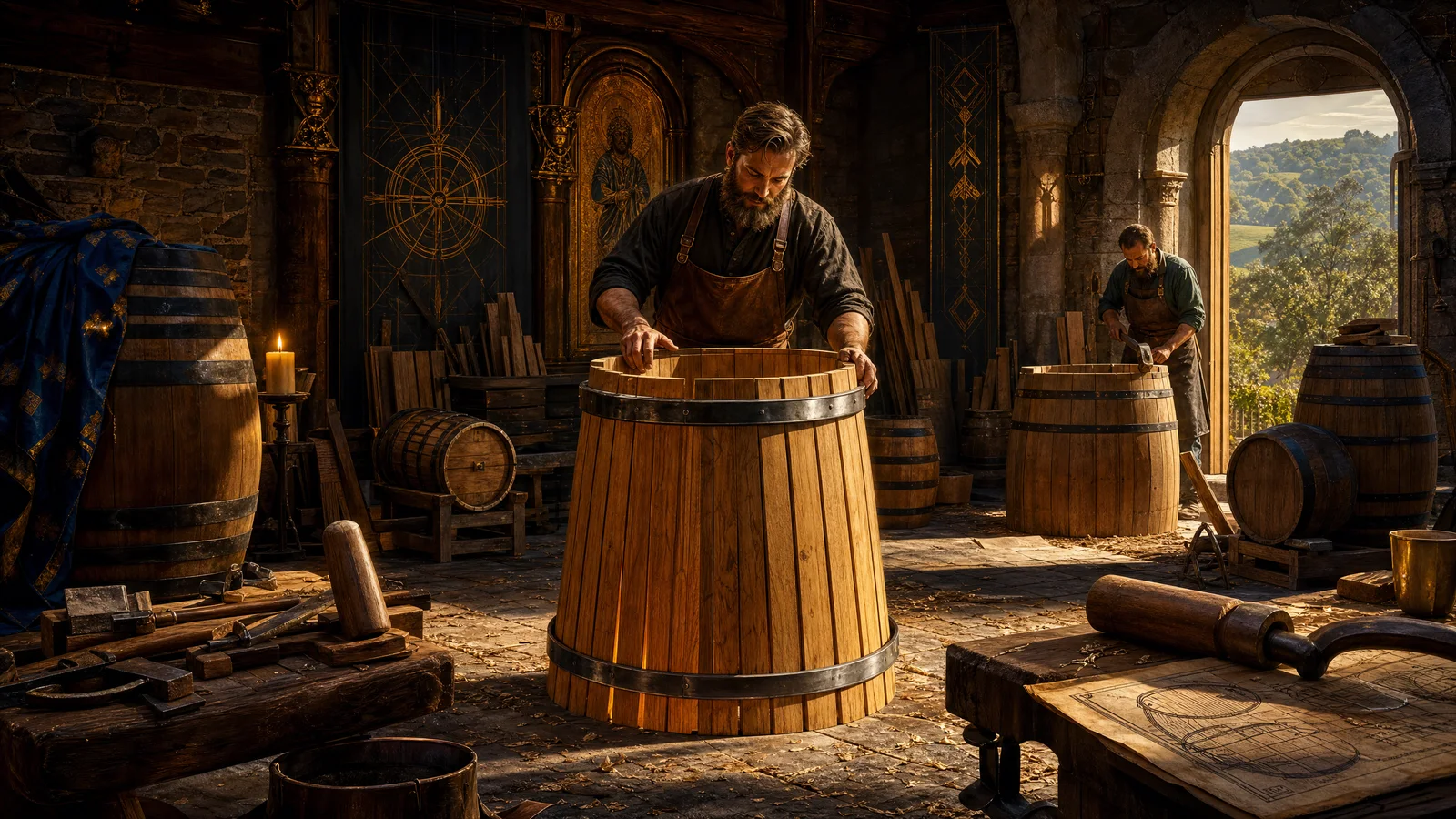
Complete Coopering and Barrel Making: From Stave to Cask
Barrels store, transport, and preserve food, water, and spirits. This campaign covers stave preparation, hoop making, barrel assembly, and charring.
Chapter 1: Barrel Types
Type
Capacity
Use
Watertight
Difficulty
Tight barrel (wet cooperage)
5-55 gallons
Liquids (water, wine, spirits)
Yes
High
Slack barrel (dry cooperage)
10-55 gallons
Dry goods (flour, nails, apples)
No
Moderate
Bucket/pail
1-5 gallons
Water, milk, general
Yes
Moderate
Tub/vat
10-100+ gallons
Washing, fermenting, soaking
Yes
Moderate-high
Keg
5-15 gallons
Beer, spirits
Yes
High
Chapter 2: Stave Preparation
Step
Method
Purpose
Tools
Log selection
Straight-grained oak, 24-36 inch diameter
Quality staves
Axe, eye
Splitting (riving)
Froe and mallet, split along grain
Stronger than sawn staves
Froe, mallet
Shaping (rough)
Draw knife on shaving horse
Taper and thickness
Draw knife, shaving horse
Jointing
Jointer plane (long plane)
Precise edge angles
Jointer plane
Hollowing
Inshave (curved draw knife)
Interior curve
Inshave
Backing
Draw knife or plane
Exterior curve
Draw knife
Seasoning
Air dry 1-2 years
Reduce moisture, improve flavor
Time, sticker stack
Stave geometry: 1) Each stave is wider at center, narrower at ends (barrel shape). 2) Edges are angled (beveled) so staves fit together in a circle. 3) The angle depends on barrel diameter and number of staves. 4) Typical barrel: 20-24 staves. 5) Each stave edge must fit perfectly against its neighbor (watertight joint). 6) Interior is slightly hollowed (concave). 7) Exterior is slightly rounded (convex). 8) Ends are thinner than center (allows bending to barrel shape).
Chapter 3: Hoop Making
Hoop Material
Strength
Difficulty
Durability
Traditional Use
Iron (flat bar)
Very high
Moderate (smithing)
Excellent
Permanent barrels
Hickory/ash (split)
Good
Moderate
Good (5-10 years)
Traditional, temporary
Steel strap
Very high
Low (if available)
Excellent
Modern
Willow/hazel
Moderate
Low
Fair (2-5 years)
Temporary, buckets
Iron hoop making: 1) Forge flat iron bar (1 inch wide, 1/8 inch thick). 2) Bend to circle matching barrel diameter. 3) Overlap ends and rivet (or forge weld). 4) Make 6 hoops per barrel (2 head hoops, 2 quarter hoops, 2 bilge hoops). 5) Hoops are driven down over staves to compress and tighten.
Chapter 4: Barrel Assembly
Assembly process: 1) Set up one head hoop (smallest diameter) on work surface. 2) Place staves inside hoop, standing upright. 3) Fit all staves into hoop (like a crown). 4) Drive head hoop down to tighten staves at one end. 5) Apply heat to open end (fire or steam). 6) Heat softens wood, allows bending. 7) Use windlass or rope to draw open end together. 8) Drive second hoop onto open end. 9) Continue heating and driving hoops until barrel takes shape. 10) Cut croze (groove) near each end for barrel head. 11) Fit barrel heads (circular discs) into croze grooves. 12) Drive final hoops into position. 13) Test for leaks (fill with water). 14) Tighten hoops if leaking.
Assembly Step
Temperature
Duration
Critical Factor
Stave raising
Ambient
30-60 minutes
All staves must fit in hoop
Bending (fire/steam)
200-300°F
30-60 minutes
Even heat, gradual bending
Hoop driving
Ambient
15-30 minutes per hoop
Even pressure, no cracking
Head fitting
Ambient
30-60 minutes
Precise fit in croze
Leak testing
Ambient
24 hours
Fill with water, check all joints
Chapter 5: Charring and Toasting
Level
Temperature
Duration
Color
Flavor Effect
Light toast
250-300°F
10-15 minutes
Light brown
Vanilla, coconut
Medium toast
300-400°F
15-25 minutes
Medium brown
Caramel, toffee
Heavy toast
400-500°F
25-35 minutes
Dark brown
Spice, smoke
Char #1 (light)
500-600°F
15 seconds
Black, thin
Light filtering
Char #2 (medium)
500-600°F
30 seconds
Black, medium
Moderate filtering
Char #3 (heavy)
500-600°F
55 seconds
Black, alligator skin
Heavy filtering, bourbon
Char #4 (deep)
500-600°F
60+ seconds
Deep black, cracked
Maximum filtering
Reference Card
Riving is stronger than sawing (splitting staves along the grain preserves the wood fibers intact; sawn staves cut across fibers and are weaker and more prone to leaking). 2. Every edge must be perfect (a watertight barrel depends on every stave edge fitting precisely against its neighbor; a gap of 1/32 inch will leak). 3. Heat allows bending (wood becomes flexible when heated with fire or steam; without heat, staves crack when bent to barrel shape). 4. Hoops compress the staves (driving hoops down the barrel forces staves together; tighter hoops mean a tighter barrel). 5. The croze holds the head (a groove cut near each end of the barrel receives the circular head; the head must fit precisely in the croze to seal). 6. Oak is the barrel wood (white oak is the traditional barrel wood because it is strong, splits cleanly, and its tyloses make it naturally watertight). 7. Charring creates flavor (the charred interior of a barrel filters spirits and adds vanilla, caramel, and smoke flavors; bourbon requires new charred oak barrels). 8. Season staves for one to two years (freshly split staves contain too much moisture and sap; air drying for 1-2 years produces staves that are stable and flavorful).