Sovereignty Module: Burn the Lime
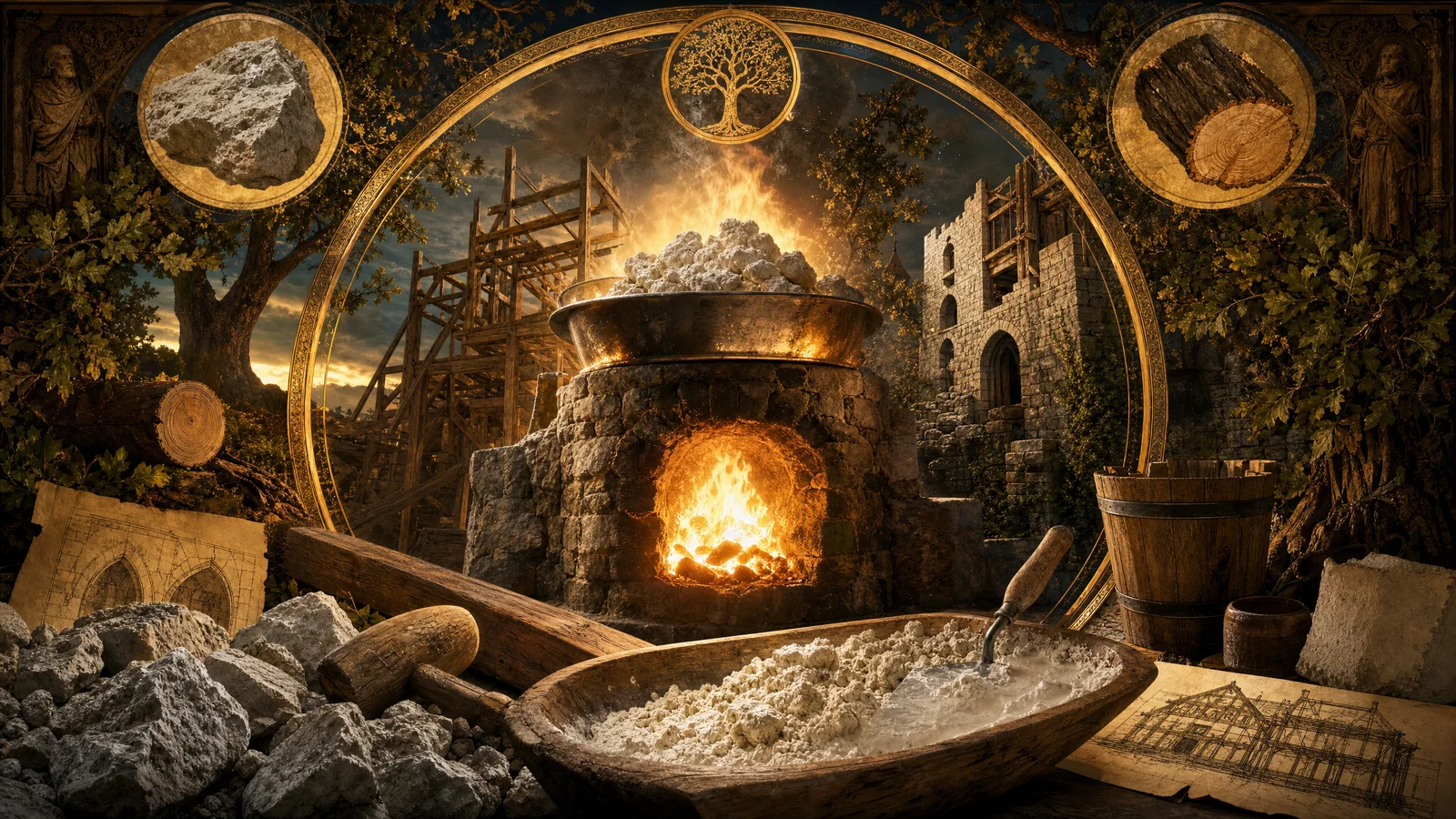
Complete Lime Mortar and Plaster Production: From Limestone to Wall
Lime mortar built the pyramids, the Colosseum, and every medieval cathedral. This campaign covers lime burning, slaking, mortar mixing, plastering, and limewash.
Chapter 1: Lime Production
| Stage | Process | Temperature | Duration | Product |
|---|---|---|---|---|
| Raw material | Quarry or collect limestone | N/A | N/A | Calcium carbonate (CaCO3) |
| Calcination (burning) | Heat limestone in kiln | 1650-1800°F | 24-72 hours | Quicklime (CaO) |
| Slaking | Add water to quicklime | Exothermic (generates heat) | Hours to days | Slaked lime (Ca(OH)2) |
| Aging (optional) | Store wet lime putty | Ambient | Months to years | Aged lime putty (superior) |
Lime kiln construction: 1) Simple updraft kiln: stone-lined pit or cylinder. 2) Size: 4-6 feet diameter, 6-8 feet tall. 3) Fire grate at bottom (supports fuel and limestone). 4) Load alternating layers of limestone and fuel (wood or coal). 5) Light fire at bottom. 6) Maintain temperature above 1650°F for 24-72 hours. 7) Limestone changes from gray/white to white powder (quicklime). 8) Test: quicklime crumbles easily and reacts vigorously with water. 9) Cool kiln before removing quicklime. 10) Store quicklime dry (reacts with moisture in air).
Chapter 2: Slaking Quicklime
| Method | Water Ratio | Result | Use |
|---|---|---|---|
| Dry slaking | Minimum water (sprinkle) | Hydrated lime powder | Mortar, plaster (immediate use) |
| Wet slaking | Excess water | Lime putty (paste) | Superior mortar, plaster |
| Hot lime mortar | Quicklime mixed directly with sand and water | Hot mortar | Traditional method, fast setting |
Wet slaking process: 1) Place quicklime in large container (metal or stone, not plastic). 2) Add water slowly (quicklime reacts violently, generates extreme heat). 3) Wear eye protection and gloves (caustic, can cause severe burns). 4) Mixture boils and steams (exothermic reaction). 5) Stir carefully with long stick. 6) Continue adding water until mixture is creamy paste. 7) Screen through mesh to remove unburned lumite. 8) Store lime putty under water (prevents carbonation). 9) Aged lime putty (months to years old) produces superior mortar. 10) The longer lime putty ages, the finer and more workable it becomes.
Chapter 3: Lime Mortar
| Mortar Type | Lime : Sand Ratio | Strength | Flexibility | Best For |
|---|---|---|---|---|
| Fat lime mortar | 1:2 to 1:3 | Moderate | Very good | Stone masonry, brick |
| Hydraulic lime mortar | 1:2 to 1:3 | High | Good | Wet conditions, foundations |
| Hot lime mortar | 1:3 (quicklime:sand) | Good | Good | Fast work, cold weather |
| Lime-pozzolan mortar | 1:1:3 (lime:pozzolan:sand) | Very high | Good | Underwater, high-strength |
Pozzolanic additives (make lime mortar set underwater): 1) Volcanic ash (original Roman pozzolan). 2) Crusite brick dust (ground fired clay). 3) Fly ash (coal combustion byproduct). 4) Calcined clay (heated to 1200°F). 5) These additives react with lime to form hydraulic cement. 6) Roman concrete used lime + volcanic ash and has lasted 2,000 years.
Chapter 4: Lime Plaster
| Coat | Thickness | Mix (Lime:Sand) | Purpose | Technique |
|---|---|---|---|---|
| Scratch coat | 3/8 inch | 1:3 (coarse sand) | Bond to wall, key for next coat | Score surface with comb |
| Brown coat | 3/8 inch | 1:3 (medium sand) | Level and flatten | Float smooth |
| Finish coat | 1/8 inch | 1:1 (fine sand) or lime putty only | Smooth, decorative surface | Trowel smooth |
Plastering technique: 1) Dampen wall surface (plaster bonds better to damp surface). 2) Apply scratch coat with trowel (press firmly into wall). 3) Score scratch coat with notched tool (creates key for next coat). 4) Allow to set but not dry completely (keep damp). 5) Apply brown coat (level and flatten with float). 6) Allow to set (keep damp by misting). 7) Apply finish coat (thin, smooth, troweled). 8) Keep plaster damp for 3-7 days (slow curing produces stronger plaster). 9) Lime plaster sets by absorbing CO2 from air (carbonation). 10) Full cure takes months to years (continues to harden over time).
Chapter 5: Limewash
Limewash recipe: 1) Mix lime putty with water to milk-like consistency. 2) Add salt (1 cup per 5 gallons) for durability. 3) Optional: add pigment for color (earth pigments work best). 4) Apply with large brush in thin coats. 5) Apply to damp surface (better absorption). 6) Each coat appears translucent when wet, dries opaque white. 7) Apply 3-5 coats for full coverage. 8) Limewash is breathable (allows moisture to pass through). 9) Limewash is naturally antimicrobial. 10) Reapply every 1-3 years (or as needed).
Reference Card
- Limestone plus heat equals quicklime (heating limestone above 1650°F drives off carbon dioxide, leaving calcium oxide; this is the fundamental chemistry of lime production). 2. Quicklime is dangerous (quicklime reacts violently with water, generating extreme heat; always wear eye protection and gloves when slaking). 3. Aged lime putty is superior (lime putty stored under water for months or years becomes finer and more workable; the best historic mortars used aged putty). 4. Lime mortar is flexible (unlike Portland cement, lime mortar flexes with building movement; rigid cement mortar cracks and damages soft stone and brick). 5. Pozzolans make lime set underwater (volcanic ash, brick dust, or calcined clay mixed with lime creates hydraulic mortar that sets even when submerged; this is how Romans built harbors). 6. Keep plaster damp while curing (lime plaster cures by absorbing CO2 from air; if it dries too fast, it becomes weak and powdery; mist regularly for 3-7 days). 7. Limewash is the original paint (lime putty thinned with water creates a breathable, antimicrobial, brilliant white coating; it has been used for thousands of years). 8. Lime mortar lasts centuries (properly made lime mortar has survived 2,000 years in Roman structures; it is the most durable traditional building material).